




Brazil: 2025-2026 orange crop forecast update for the Sao Paulo and West-Southwest Minas Gerais citrus belt – April 2026
The 2025-2026 orange crop for the São Paulo and West-Southwest Minas Gerais citrus belt, published by Fundecitrus, carried out in cooperation with full professor (retired) from FCAV/Unesp, concluded with 292.94 million boxes of 40.8 kg each …
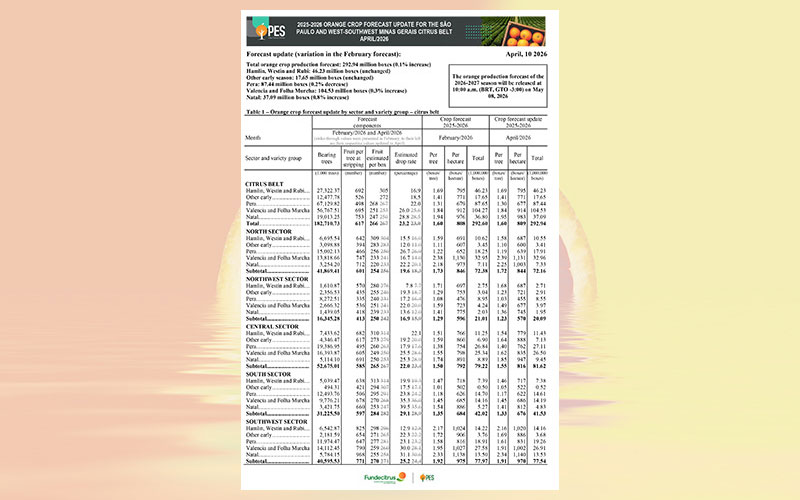
Total orange production1 for the 2025-2026 crop season ended at 292.94 million boxes
The 2025-2026 orange crop for the São Paulo and West-Southwest Minas Gerais citrus belt, published by Fundecitrus, carried out in cooperation with full professor (retired) from FCAV/Unesp2, concluded with 292.94 million boxes of 40.8 kg each (90 lbs), divided as follows:
- 46.23 million boxes of the Hamlin, Westin and Rubi early-season varieties;
- 17.65 million boxes of the Valencia Americana, Seleta, Pineapple and Alvorada early-season varieties;
- 87.44 million boxes of the Pera mid-season variety;
- 104.53 million boxes of the Valencia and Folha Murcha late-season varieties;
- 37.09 million boxes of the Natal late-season variety.
Of the total, about 25.69 million boxes were produced in the Triângulo Mineiro region.
Production this season was 26.9 % higher compared to the previous crop, which reached 230.87 million boxes, and 6.9 % lower than the initial forecast released in May 2025. Climatic and phytosanitary factors, within the context of a more delayed harvest, contributed to higher fruit drop rates and to reduced fruit weight compared to the initial forecast. The 2025-2026 crop was marked by a later harvest pace compared to previous crop seasons due to the high proportion of second-bloom fruit and to harvesting at optimal maturity. In this context, most of the Pera variety was expected to be harvested after the onset of heavier spring rains; however, nearly half of its production was harvested under dry conditions, as rainfall only intensified midway through October. Moreover, below-average rainfall throughout the period also adversely impacted the weight of the late varieties Valencia, Folha Murcha, and Natal, which were harvested through mid-January and did not reach the expected weight of the initial forecast. Furthermore, the premature fruit drop rate in this crop reached the highest level observed over the past 11 crop seasons, driven by increased greening severity, higher incidence of citrus leprosis, water deficit, and the occurrence of strong wind gusts throughout the production cycle …
Please download the complete forecast here.
1Hamlin, Westin, Rubi, Valencia Americana, Seleta, Pineapple, Alvorada, Pera Rio, Valencia, Valencia Folha Murcha, and, Natal.
2Department of math and science, FCAV/Unesp Jaboticabal Campus.