The shift from fossil-based to renewable bio-plastics requires new efficient methods. New technology developed at VTT enables the use of pectin-containing agricultural waste, such as citrus peel and sugar beet pulp, as raw material for bio-based PEF-plastics for replacing fossil-based PET. The carbon footprint of plastic bottles can be lowered by 50 % when replacing their raw material of PET with PEF polymers, which also provides a better shelf life for food.
“In the near future, you may buy orange juice in bottles that are made out of orange peel. VTT’s novel technology provides a circular approach to using food waste streams for high-performance food packaging material, and at the same time reducing greenhouse gas emissions,” shares Professor of Practice Holger Pöhler from VTT”.
PET (polyethylene terephthalate) and other polyesters are being widely used in food packaging, plastic bottles and textiles. The annual production of PET products is estimated at 30 million tonnes. Replacing fossil-based PET with plant-based PEF (polyethylene furanoate) polymers can lower the carbon footprint of the products by 50 %.
Moreover, the barrier properties of PEF plastics are better than PETs, meaning that the food products have a longer shelf life. PEF is a fully recyclable and renewable high-performance plastic. Therefore, it opens up possibilities for the industries to reduce waste and to have positive impact on the environment.
VTT’s technology has significant advantages for making bio-based PEF plastics. The technology uses a stable intermediate for the production of FDCA (2,5-furandicarboxylic acid), one of the monomers of PEF, which enables a highly efficient process. In addition, utilising pectin-containing waste streams opens up new possibilities for the circular economy of plastics.
VTT’s unique scale-up infrastructure from laboratory to pilot scale ensures that this new technology will be brought to a technology readiness level that will allow polymer manufacturers’ easy transition to full scale.
Reaching 14.6 % reduction of added sugars in soft drinks between 2015-2019
Europe’s soft drinks industry has reduced added sugars in its drinks across Europe by an average of 14.6 % between 2015 and 2019.[1]
UNESDA Soft Drinks Europe, representing soft drinks producers across the EU, is committed to creating healthier and more sustainable food environments. It is determined to support consumers in managing their intake of added sugars from soft drinks by ensuring that the healthier choice becomes the easy choice. The industry responded to the European Commission’s call for a 10 % reduction in added sugars by 2020 and recent research, by independent analysts GlobalData, confirms that it has met, and surpassed, the target ahead of time.
“This reduction is proof that the soft drinks industry’s voluntary efforts to reduce sugar across the EU are delivering tangible results,” said UNESDA president and president Western Europe at The Coca-Cola Company, Tim Brett. It demonstrates our sector’s accelerated action in response to changing consumer preferences and the expectations of public health stakeholders.”
The 14.6 % reduction in added sugars has been achieved through a comprehensive range of actions including changing recipes to reduce sugars while maintaining a taste with which consumers are happy; innovating to develop new products with different sweetness levels; increasing availability of small packs to support portion control and moderation; and nudging people toward more no- and low-sugar/calorie options through marketing investments. This latest sugar reduction comes on top of previous achievements and means that Europe’s soft drinks industry has now reduced added sugars by an average of 26 % since 2000.
UNESDA is a founding member of the EU Platform for Action on Diet, Physical Activity and Health and has undertaken a series of voluntary commitments over the past 15 years to help address unhealthy diets as a risk factor for non-communicable diseases. These have been complemented by numerous national pledges to support EU member states in their action plans to create healthier food environments. These pledges are the result of stakeholder engagement at a national level and set targets based on local baselines and expectations. They reflect the conclusions of the 2016 Dutch EU Presidency which highlighted that sugar reduction is a gradual process and needs to take account of different dietary habits and preferences across the EU.
“Our sector’s progress in reducing sugar and calorie reduction has been enabled by the openness of stakeholders to engage through the EU Platform,” concluded Tim Brett. “We believe that the EU Code of Conduct for responsible business and marketing practices announced in the EU Farm to Fork strategy offers an opportunity to continue this dialogue with all actors, including Member States. As an industry we are committed to maintaining our efforts through a range of voluntary actions to ensure that the healthier choice becomes the easy choice.”
The path towards sugar reduction through reformulation comes with multiple challenges from a technological and consumer acceptance perspective and these become greater the more the reductions continue.
While the soft drinks sector has reduced the average sugar content in its products, and the WHO’s research[2] shows that frequency of consumption among school-aged children has declined across all age groups over the past 16 years, recent data shows that rates of overweight and obesity have not reduced. This demonstrates the complexity of the issue and the need for a holistic approach with all food and drink sectors committing to actions that support healthier food environments.
In addition to ongoing sugar and calorie reduction, Europe’s soft drinks sector has also made far-reaching commitments to behave responsibly in the marketplace including no advertising to children under 12; no sales of any soft drinks in EU primary schools and only no- and low- calorie drinks offered for sale in EU secondary schools.
About UNESDA Established in 1958 UNESDA Soft Drinks Europe is a Brussels-based association representing the European soft drinks industry. Its membership includes both companies and national associations from across Europe producing drinks including still drinks, squashes, carbonates, powders, iced teas, iced coffees, syrups, energy drinks and sports drinks. It is signatory to the EU Transparency Register (No: 25498952296-56).
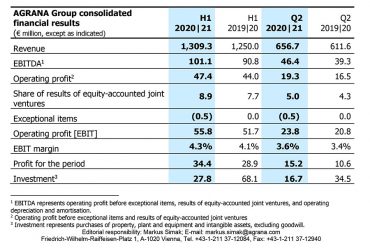
AGRANA, the fruit, starch and sugar company, generated operating profit (EBIT) of € 55.8 million in the first half of the 2020|21 financial year, a moderate increase of 7.9 % year-on-year (H1 prior year: € 51.7 million). The Group’s revenue rose slightly to € 1,309.3 million (H1 prior year: € 1,250.0 million).
AGRANA Chief Executive Officer Johann Marihart says: “Much of our positive business performance can be credited to the diversification of our business activities, which enables us to balance out fluctuating economic conditions in the various segments. Thus, in the first half of the year, the Starch segment was able to maintain the prior year’s EBIT earnings despite significantly weaker starch sales in the paper sector, thanks to the very strong performance in bioethanol especially in the second quarter.”
Helping make the year-on-year growth in Group EBIT possible was the Sugar segment, which, as in the first quarter, saw a year-on-year improvement in earnings in the second quarter as a result of higher sugar prices. The Sugar segment’s EBIT nonetheless remained negative. In the Fruit segment, AGRANA was able to hold earnings in the fruit preparations business in line with the first half of the prior year. The performance of the fruit juice concentrate business was down significantly due to lower available volumes from the 2019 apple crop.
(All Photos: Agrana)
Net financial items amounted to an expense of € 9.1 million (H1 prior year: expense of € 7.9 million). After an income tax expense of € 12.3 million, corresponding to a tax rate of about 26.3 % (H1 prior year: 34.0 %), profit for the period was € 34.4 million (H1 prior year: € 28.9 million). Earnings per share attributable to AGRANA shareholders increased to € 0.54 (H1 prior year: € 0.43).
Net debt at 31 August 2020 amounted to € 479.6 million, up € 15.6 million from the year-end level of 29 February 2020 (year-ago level of 31 August 2019: € 423.6 million). The gearing ratio rose accordingly to 36.1 % as of the quarterly balance sheet date (29 February 2020: 33.5 %; 31 August 2019: 31.2 %).
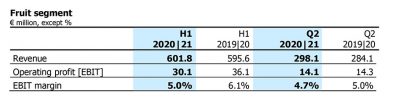
The Fruit segment’s revenue in the first half of 2020|21 rose slightly year-on-year, by 1.0 %. In the fruit preparations business, revenue remained stable despite somewhat lower sales volumes. Revenue in the fruit juice concentrate activities saw an increase from a year ago, thanks largely to higher prices for apple juice concentrate produced from the 2019 crop. EBIT of the Fruit segment was off 16.6 % from the first half of 2019|20. The reason for the deterioration lay in lower delivery volumes in the fruit juice concentrate business combined with reduced contribution margins for apple juice concentrate from the 2019 harvest.
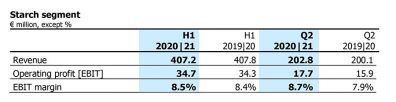
Starch segment revenue in the first half of 2020|21 was steady at the prior-year level. With the full operation of the new, second wheat starch plant, sales volumes and revenues of the products manufactured in-house increased. At the same time, revenue from resold merchandise declined sharply, as the sale of sugar by-products is now charged on a commission basis and the corresponding sales are no longer included in the Starch segment’s revenue. Ethanol quotations, after collapsing in March 2020 amid the COVID-19 lockdown and the steep fall in demand for petrol, recovered again progressively especially in the second financial quarter and even reached a new all-time high in August. Sales volumes of saccharification products, on the other hand, were negatively affected by the COVID-19 crisis, particularly with the beverage industry.
EBIT in the Starch segment slightly exceeded the year-earlier result, by 1.2 %. The earnings were driven by the high selling prices for ethanol, which made up for the lower market demand for starch and starch products.
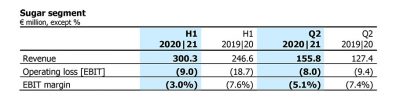
The Sugar segment’s revenue in the first half of 2020|21 was up 21.8 % from one year earlier. This growth was attributable both to higher sugar selling prices and increased sugar sales volumes, especially with food retailers. Although EBIT was still negative, it marked a substantial improvement from the same period of the prior year due to a more benign sales price environment.
Outlook
Taking into account potential impacts of the coronavirus crisis, AGRANA expects Group EBIT for the full 2020|21 financial year to at least match the prior-year level. Group revenue is projected to show slight to moderate growth of up to 10%. Due to the ongoing COVID-19 pandemic and the associated high volatility in all business segments, this forecast remains characterised by a very high degree of uncertainty. It also does not yet include any financial effects of a possible closure of the sugar plant in Leopoldsdorf, Austria, after the 2020 campaign.
The drive to secure grower contracts with beet farmers is underway, with the aim of increasing next year’s beet cultivation area in Austria to at least 38,000 hectares by the middle of November 2020. With a three-year contract and guaranteed minimum prices, AGRANA is offering farmers long-term predictability for beet cultivation. Depending on the contracting status in mid-November, a decision will be made on whether to continue operations at the Leopoldsdorf factory or close it down after the end of the campaign.
In the 2020|21 financial year, the AGRANA Group’s investment is expected to amount to € 73 million, which is significantly below the year’s depreciation of about € 120 million following the very high capital expenditure of prior years.
In the first quarter of the 2020/21 financial year (ended 31 May 2020), AGRANA, the fruit, starch and sugar company, achieved a slight increase in both revenue and operating profit (EBIT) despite the COVID-19 crisis. AGRANA Chief Executive Officer Johann Marihart comments: “The key factor in the solid Group EBIT was a very significant profitability improvement in the Sugar segment compared to the same quarter last year. EBIT in the Starch segment was moderately below the year-earlier level, with the decline due mainly to a short-term slump in bioethanol prices at the beginning of the COVID-19 pandemic, which have since recovered again. Ethanol sales remained stable in volume terms despite the lockdown, thanks to the firm export market for bioethanol with high CO2 reductions and to the sale of 10 million litres into the disinfectant sector. In the Fruit segment, earnings were significantly below those of one year ago. Thus, the performance of the fruit juice concentrate activities was down as a result of the prior-year harvest and there were COVID-19-related decreases in the fruit preparations business.”
Results in each business segment in Q1 2020|21
FRUIT segment
Revenue in the Fruit segment, at € 303.7 million, was off slightly from one year earlier. Revenue from fruit preparations fell somewhat, as a result of lower sales volumes. In the fruit juice concentrate business as well, volumes were the reason for a moderate revenue decline relative to a year ago. EBIT in the Fruit segment was € 16.0 million in the first three months, a reduction of 26.6 % year-on-year. The causes of the deterioration lay primarily in the fruit juice concentrate business, which notably saw reduced delivery volumes in combination with lower contribution margins of apple juice concentrates produced from the 2019 crop.
STARCH segment
The Starch segment’s revenue of CHF 204.4 million was slightly below the year-earlier level. The COVID-19 crisis had a negative impact on sales volumes of saccharification products, and initially also led to a drastic fall in bioethanol prices amid the lockdown and the sharp drop in demand for petrol. However, over the rest of the financial first quarter, bioethanol quotations rebounded again due to the resurgence in private transport. At € 17.0 million, EBIT of the Starch segment was moderately below the year-earlier amount. In the period under review, weaker market demand dampened prices and put pressure on margins.
SUGAR segment
The Sugar segment’s revenue of € 144.5 million in the first quarter was up significantly from one year before. Both higher sugar selling prices and increased sugar sales volumes led to this growth. Although EBIT was still negative at a deficit of € 1.0 million, it marked a substantial improvement compared to the same quarter of the previous year due to a more benign sales price environment.
The detailed financial results are provided in the interim statement for the first quarter of 2020|21 at www.agrana.com/en/investor.
What others consider waste, Fooditive considers a primary resource. Its new 100 % natural sweetener is produced from apple and pear leftovers, making it a chemical- and allergen-free sugar substitute. The sweetener came into fruition after founder and food scientist the Jordanian, Moayad Abushokhedim noticed that the multi-billion-dollar industry had been dominated by unhealthy sweeteners and had seldom seen change. Cue Fooditive.
Fooditive’s “mission is to develop food additives that contribute to a healthier body and a healthier environment” (Abushokhedim) with sustainability at its core. In 2019, Fooditive caught Rabobank’s attention and was awarded the Innovation Loan.
“Fooditive contributes to the European food industry by offering healthy alternatives to chemical sweeteners. Additionally, this product helps battle food waste. This fits in with our vision of Banking for Food: Rabobank wants to facilitate and support entrepreneurs in the agricultural and food industries, now and in the future to contribute to a more sustainable way of feeding the world” (Wiel Hopmans, SME account manager at Rabobank Rotterdam).
Fooditive is currently developing a range of other products in food ingredients, the specifics of which will be revealed later this year. The sweetener complies with EU organic standards, which has led to Fooditive being awarded the Skal certification meaning it can also produce an organic sweetener next to its regular one. In 2019, Fooditive have partnered with sustainable third-party production company Bodec. Allowing the zero-calorie sweetener to reach consumers through products in Dutch supermarkets. This year, it will be further distributed to various food and beverage companies across the Netherlands.
Last year, Fooditive began collaborating with Rotterdam Circulair, an organisation that is dedicated to reducing, re-using and recycling waste and whose ultimate goal is to transition from a linear to a circular economy by 2030. Fooditive plays a major role in achieving this target because its sweetener is transforming and challenging the long-standing sugar-substitute industry from a greener, healthier and more sustainable perspective.
It is not just the Netherlands that is interested in Fooditive, Sweden also wants to pear up. In October 2019, €100,065.63 was raised to set up the now registered branch in Stockholm. Future plans include expanding to the UK and Jordan. By starting production in these countries, Fooditive aims to reduce its carbon footprint and contribute to an all-round better future.
As this year saw the rise of the sober-curiousness trend, non-alcoholic drinks such as wine waters have a great market potential, due to their natural antioxidants content and their functionality. Wine water, either still or sparkling, is promoted as healthy and naturally functional, with a distinctive wine taste. According to GlobalData’s Q3 2019 global consumer survey, 92 % of surveyed consumers consider that eating healthily creates a feeling of wellness and 60 % say they believe antioxidants have a positive impact on their health.
Ana-Maria Iscru, Consumer Analyst at GlobalData, explains: “A new water concept, wine water is different from alcoholic seltzers, non-alcoholic wine and fruit flavored waters, in that it does not contain alcohol but does have a wine-infused flavor, for a more sophisticated taste. The wine essence water from Wine Water Ltd., for instance, was released last year and has already sparked interest. The brand taps into a few consumer trends, namely the absence of alcohol, low sugar content, low calories and an elegant glass bottle packaging instead of plastic.”
Another slightly similar brand is Napa Hills, flavored water ‘with red wine’s natural antioxidants’, but without a wine flavour. PepsiCo also gave the trend a try, releasing a limited-edition rosé-flavored sparkling cola, which was served at the first edition of the BravoCon in November. Moreover, Walmart recently introduced a rosé wine drink enhancer, but it is not expected to come too close to the wine taste.
Iscru adds: “Wine waters are seen as much lower in calories and sugar than actual wine, enough to respond to the growing health & wellness demands. All of this while not ditching the classic wine taste that a lot of people love.
“The category is yet to grow, as there is not a large variety of wine waters, but it has potential in the way it is presenting itself: natural, sustainable and tasty. However, until wine water as a category grows globally, for now consumers are just left wanting more.”
Sugar reduction remains a central topic in the media and among consumers and opportunities for reducing sugar intake are taking a number of directions as companies address evolving concerns and demands.
Strategies for reducing sugar intake feature a combination of sugar reduction, sugar substitution and moving beyond sweetness to alternative tastes. These methods are often supported by a combination of functional formulations and blends, next generation sweeteners and other technological developments.
In an Innova Market Insights survey, sugar reduction is a popular option for the three in five US consumers in an Innova Market Insights survey who would rather cut back on sugar than consume artificial sweeteners. Sugar-related claims continue to grow and increasingly take on more prominent on-pack positionings.
In the US, for example, 8 % of all new food and beverage launches tracked by Innova Market Insights in 2018 featured a sugar reduction claim. Claims of no added sugar were most prominent, accounting for 42 % of all sugar-related claims, ahead of sugar-free (36 %) and low sugar (27 %). Although the low sugar claim is smallest in terms of its share of launches, it is also the fastest growing with an NPD CAGR of 17 % over the 2014 to 2018 period.
Sugar reduction can be achieved in a number of ways, including removing or reducing the amount of added sugar, replacing part of the sugar formulation with non-nutritive sweeteners and/or using innovative processing technologies, such as “aeration” to increase perceived sweetness, slow straining milk to remove sugar prior to yogurt making, or using enzymes to convert simple sugars to fibers in juices.
Interest in sugar substitution has also driven the rising use of sweeteners, particularly non-nutritive ones derived from nature, such as stevia, monk fruit and thaumatin. Allulose, which also occurs naturally in small quantities in a variety of sweet foods such as figs, can also be manufactured synthetically.
The April 2019 announcement by the FDA that allulose did not have to be included in total and added sugar counts in US nutritional labeling has also cleared the way for much higher levels of use and a potential move mainstream. Levels of patent activity indicate current interest in the use of allulose, rising 42 % in 2018 over 2017, while global NPD in food and beverages featuring the ingredient had an average annual growth of 45 % over the 2014 to 2018 period, although from a low base.
Companies are also looking at alternative ingredients such as coffee cherries as a potential stealth reducer of sugar in foods containing chocolate. Upcycled coffee cherries can be used to reduce the amount of sugar in finished products by emulating flavor in highlighting the cocoa notes, so that less cocoa powder is needed.
Another approach to sugar reduction is to use alternative flavor notes, such as bitter, sour or spicy, exploiting interest in novel and unconventional flavors to reduce the demand for sweetness overall. Interest in botanicals and their health benefits is also rising and may likewise encourage consumers to move away from more sugar laden foods; the use of botanical flavors for food and drinks NPD is expanding and can be seen across a whole range of different categories.
At this year’s Gulfood Manufacturing in Dubai, Hydrosol is focusing on sugar-reduced milk beverages.
Less sugar, same enjoyment
Given the worrying increase in obesity around the globe, reducing the amount of sugar in foods and beverages is a major issue worldwide. More and more governments are demanding low sugar products or introducing sugar taxes. But sugar isn’t just a matter of taste. It also gives products body, texture and a pleasant mouth feel. These are the effects that Hydrosol’s individual stabilising and texturing systems address. They are suitable for many different applications – yogurt, drinking yogurt, pudding, refreshing fruity drinks, energy drinks, ketchup, whippable plant cream with reduced sugar content, and more. Natural flavourings round out the flavour profile. Hydrosol’s sister company OlbrichtArom, also exhibiting at Gulfood, offers its SugarBooster for reduced-sugar products. This natural flavouring amplifies the delicate taste profile of the final product without influencing its characteristic flavour.
New to the product range are stabilising systems for very diverse milk mixed beverages, from conventional varieties like cocoa, vanilla and strawberry to trendy flavours like cappuccino, walnut and pistacio. These proven systems are offered in a carrageenan version, which enables stable products without high-pressure homogenisation, as well as in an alternative version with gellan. This lets milk beverages be filled at high temperatures, up to 40°C. The stabilising systems in the Stabiprime MFD Range are soluble in water as well as in sweet whey. They can be used for the manufacture of sugar-reduced as well as low-fat or lactose-free milk beverages. High-protein milk drinks are also possible.
Euromed’s natural ingredient ABAlife™ shows beneficial effects on glucose metabolism
A recently published human study from the University of Sydney, Australia, evaluated the efficacy of ABAlife™ on glucose metabolism blood parameters1. The abscisic acid (ABA) standardized fig extract has been shown to improve glucose tolerance, assist insulin release and may help to lower post-prandial blood glucose levels, besides having anti-inflammatory and adaptogen properties too2. ABAlife™ is a patented extract from Euromed, a leading manufacturer of therapeutic botanical extracts, and available for dietary supplements.
In the randomized, double-blind crossover study, the researchers investigated the effects of two different ABA doses in fig extracts (100 mg and 200 mg) on post-prandial glucose and insulin responses in healthy subjects. Figs have one of the highest ABA concentrations found in nature. A 200 mg dose of ABAlife™ added to a glucose drink lowered overall blood glucose and insulin levels and peaks between 30 and 120 minutes post-dose, and significantly improved glycemic index (GI) levels compared with a reference glucose solution alone. The GI indicates how fast and efficiently the body can metabolize a carbohydrate meal.
The lower dosage was also effective on GI but did not reach statistical significance. Both dosages, however, were able to significantly lower the post-prandial insulinemic index (II), which shows how much insulin the body releases in response to a meal. The data displays a clear dose-response reduction of GI and II.
This initial study suggests that ABAlife™ may be a beneficial dietary supplement in terms of helping to maintain healthy blood sugar levels and an adjunctive treatment for chronic metabolic disorders such as prediabetes and type 2 diabetes. According to the International Diabetes Federation, 66 million people in Europe have diabetes. Prevalence is rising among all age groups, mostly owing to increases in lifestyle-related risk factors such as unhealthy diets and physical inactivity. Sugar boosts the level of glucose in the blood and causes the pancreas to release insulin. Higher insulin levels lead to the storage of dietary calories as fat, which can result in overweight and obesity – both risk factors for diabetes. A second, larger acute clinical trial is currently ongoing, and a chronic administration study will start next year.
1ABAlife™ is a whole fruit extract that’s produced from figs according to the highest quality standards of Euromed and purified using a carefully controlled process to achieve a high, standardized ABA content. The ingredient delivers the scientifically proven health benefits of ABA while avoiding the additional calories associated with eating figs. 2Atkinson FS et al.: Nutrients. Abscisic Acid Standardized Fig (Ficus carica) Extracts Ameliorate Postprandial Glycemic and Insulinemic Responses in Healthy Adults. 2019 Jul 31;11(8). pii: E1757. Zocchi E, Hontecillas R, Leber A, et al. (2017) Abscisic Acid: A Novel Nutraceutical for Glycemic Control. Front. Nutr. 4:24. doi: 10.3389/fnut.2017.00024
Celebrating 30 years of growth in Turkey, Firmenich is proud to announce its new and expanded facility in Istanbul, strategically located to serve the dynamic Turkish market, as well as Europe and the Middle-East. With state-of-the-art laboratories for enhanced creativity and fast speed-to-market, this facility is designed according to the WELL Building Standard™, the global benchmark for employee wellbeing in the workplace.
“Following three decades of solid growth in Turkey, this strategic investment reinforces Firmenich’s commitment to this dynamic market,” said Gilbert Ghostine, CEO, Firmenich. “With this new creative center in Istanbul, we are set up to deliver winning scent and taste innovation to our customers with greater speed-to-market.”
“Today’s opening is in line with our ambitious growth plans in Turkey and beyond”, said Dilek Arvas, Director & General Manager, Firmenich Turkey. “With our people at the heart of everything we do, we designed this new facility with our colleagues’ wellbeing top of mind, to offer an optimal working and creative environment where everyone can thrive.”
Building on its unique legacy of responsible business, Firmenich operates an inclusive capitalism business model based on delivering positive value for all its stakeholders, including people, planet and society. Putting people first, Firmenich is one of only seven companies worldwide, and the first ever in Turkey, to be globally certified as a gender equal employer by EDGE, the gold standard for workplace equality.
Another key pillar of its inclusive capitalism business model is the Group’s commitment to preserving the planet, by leading the most traceable, ethical and sustainable value chain for its natural ingredients. For instance in Turkey, Firmenich works hand-in-hand with producers in the Isparta region, in mid-Anatolia, to harvest Turkish Roses, known for their beauty and delicacy, in the most sustainable way possible.
When it comes to society, as leaders in the Science of Taste, Firmenich plays a key role in addressing today’s malnutrition crisis, by making healthier food and drink options taste delicious for all. For example, its latest technology TastePRINT™ can reduce up to 100% of added sugar naturally without compromising on taste. Last year alone it removed 150 metric tons of sugar from products that people love, removing 600 billion calories from their diets.
JuiceInnov8, a Bangkok based deeptech startup in food biotechnology space, has closed a pre-Series A funding led by 500 Startups (500 Durians and 500 Tuktuks), making the total amount raised (including Seed Round and grants) at USD 1.2 M to date.
As the first venture-backed food-biotech startup in Asia, the company is now on the verge to reinvent global beverage industry with a better & healthier juice that has less sugar & lower calories. By working with leading food & beverage manufacturers worldwide, JuiceInnov8 develops sugar reduction technology platform with natural & non-GM (non-genetically modified) microbes and proprietary sugar conversion process through biotechnology. The technology allows sugar & calories reduction in juice to near zero while preserving its original 100 % juice content and key nutrients.
Proceed from this round will help JuiceInnov8 expand its core scientist & engineering team and help accelerate the development from pilot to commercial scale. The company is now working closely with leading brands & suppliers in the food & beverage supply chain in multiple regions around the globe.
Variety-seeking Coca-Cola fans will soon have a new fun-yet-familiar flavor to reach for.
Orange Vanilla Coke and Orange Vanilla Coke Zero Sugar – the first Coca-Cola trademark flavor innovations in over a decade – hit stores in the USA on Feb. 25 in a range of packaging options.
Kate Carpenter, brand director, Coca-Cola, said the 2016 launch of the One Brand strategy – which combined all Coca-Cola variants under a common visual identity and creative campaign – showcases the breadth of the brand. Following the successful relaunch of Coca-Cola Zero Sugar in 2017, the trademark team began to explore additional growth opportunities.
“What we realized is that we had a diamond in the rough when we looked at our flavors portfolio,” Carpenter said. “The growth of Cherry Coke and Vanilla Coke – and their zero-calorie variants – has been really strong in recent years even with very limited marketing support.”
Despite this growth, only 12 percent of Coca-Cola drinkers were reaching for flavors. “This showed us our fans want choice but are getting it outside the Coke Trademark,” Carpenter said. …
The Hamburg-based ingredients specialist Bösch Boden Spies presents a new product in its range: Ocean Spray’s 50° Brix cranberry concentrate. It offers beverage manufacturers numerous advantages.
The beverage market is changing: More and more consumers are looking for healthy thirst quenchers that are low on sugar and high on added functional value. Meanwhile, traditional juices and spritzers are increasingly having a hard time in the market. New product concepts are in demand: Ocean Spray’s 50° Brix cranberry concentrate offers beverage manufacturers the ideal basis for this.
The product is characterized by a special production process whereby fewer turbidity-forming ingredients are transferred into the concentrate. As a result, it is particularly color-stable and can easily be mixed with other beverages without flocculating.
Adding this cranberry concentrate to juices, for example, can significantly reduce the sugar content of the beverages. The products taste tart and exotic with a natural, light sweetness. At the same time, the subtle cranberry taste enhances the flavors of the other fruits.
The cranberry concentrate increases the antioxidant content of a drink. And their attractive red color gives beverages containing cranberry a special visual appeal as well.
The cranberry concentrate is also good for using in alcoholic beverages, and is suitable for other product segments as well, such as the dairy sector.
Less sugar, more minerals and still: 100 percent juice!
From 16 to 18 October 2018, the largest and most important European summit of the fruit juice industry – the Juice Summit in Antwerp – took place. Stefan Reiß, CEO of Green Coco Europe GmbH and co-founder of premium brand Dr. Antonio Martins was invited as a speaker emphasizing the potential and relevance of coconut water / coconut juice to the juice industry in front of about 600 decision-makers. The CEO of the Nuremberg company presents an interesting approach to reducing sugar in fruit juices. Coconut juice is very popular among athletes, vegans and nutritionally-conscious consumers due to its high potassium and low calorie content – making it an ideal blend for juices whose high sugar content no longer seems to hit the nerve of the times.
For some time now, the juice industry has faced immense challenges in terms of sugar discussions. The high sugar content of orange juice & co is increasingly being pilloried. For example, orange juice with about 8 grams of sugar per 100 ml of juice contains as much sugar as cola. For this reason, the 100 % fruit juice loses its healthy reputation not only with relevant nutritionists, but more and more with nutritionally conscious consumers.
“Coconut juice can be a solution here and take out the wind of the issue´s sails. Why not add coconut juice to orange juice and drastically reduce sugar content and calories? The fruit juice content remains in this way at 100 percent. The light and neutral properties of the coconut juice do not mask the taste of the orange juice. According to the latest figures from the market research study by Arizton, I see a potential of 297 million liters for juice with coconut juice by 2023, “says Green-Coco CEO Stefan Reiß, summing up his solution. Coconut juice adds valuable minerals such as potassium, calcium and magnesium to the juice and these can also be declared as such. The juice of the coconut is 11-19 kcal per 100 ml – the lowest calorie fruit juice ever.
A mixing ratio of 40 % coconut juice and 60 % orange juice gives 29 calories per 100 ml, instead of 42 kcal as before. In this way you achieve a reduction of more than 10 calories per 100ml to less than 30 kcal compared to the pure variant – in times of steadily rising numbers of diabetes diseases a step in the right direction. Even in multivitamin juices, adding coconut juice would mean a significant calorie and sugar reduction.
Other facts should encourage the industry to take this path: According to a market study by Arizton, the coconut water market is expected to grow by 25 % per year across Europe by 2023. Coconut juice is no longer a niche product, has established itself as an independent category and can be found in almost every discount. Supermarkets, such as REWE, already have a firm place on the shelves for their own coconut juice brands.
Patented natural process converts sugar to fibers in just one-step
Better Juice Ltd. has developed innovative technology to reduce the load of simple sugars in orange juice. The patent-pending enzymatic technology uses all-natural ingredients to convert monosaccharides and disaccharides (fructose, glucose, and sucrose) into prebiotic and other non-digestible fibers and sugars, while keeping the juicy flavor of the beverage.
Popular juices, such as orange juice and apple juice, have nearly 1 oz. (25 g) of sugar per 1-cup serving (250 ml). Although juice contains the vitamins and minerals you’d find in fresh produce, it’s devoid of most of the natural dietary fiber as an outcome of traditional methods of juicing. In addition to its intrinsic health benefits, fiber also adds to the feeling of fullness.
Better Juice’s process harnesses a natural enzymatic activity in non-GMO microorganisms to convert a portion of the simple fructose, glucose, and sucrose sugars into fibers and other non-digestible natural sugars. The process works on all types of sugars. Yet the process preserves the great flavor and the full complement of vitamins and other nutrients inherent in the fruits. The technology was developed in collaboration with Hebrew University in Rehovot, Israel.
“This natural a non fermentative process occurs without adding or removing ingredients,” says Eran Blachinsky, PhD, Founder and CEO of Better Juice. “It also will not alter the flavor or aroma of the juice.” Better Juice uses an advanced solution that involves just one short and simple pass-through step in the juice-making process, allowing the product to be marketed at a price point comparable to other premium juice products.
”While the process does slightly reduce the sweetness of the juice,” explains Blachinsky, “It actually brings out more of the fruit flavor, making for a better-tasting juice product overall.”
Better Juice conducted several trials with different beverage companies and succeeded in reducing sugars in orange juice from 30 %, up to 80 %. The start-up can now provide proof of concept for orange juice.
Mono-and disaccharides – often called “simple sugars” – are easy for the body to digest and thus quickly metabolized. If the energy they provide can’t be used, it is converted to fat and stored. But when these individual sugar molecules link up, they become prebiotic fibers that are non-digestible. The shorter of these fibers, called oliggosaccharides, are still sweet yet have been shown to bestow a number of health benefits, from protecting against disease to helping manage weight. There are other natural monosaccharides that are not easily digested. These sugars have no glycemic index and low caloric values.
“Consumers, especially children, enjoy drinking natural juices but are not always aware of the less nutritious aspects of juice,” notes Blachinsky. “They want the whole package — great flavor, health, and natural ingredients, including the fibers that are essential part of fruits.”
The company will market an advanced device with the unique technology to fruit juice producers and, eventually, to cafés and restaurants.
As the government contemplates a ban on the sale of energy drinks to children in England, Jonathan Davison, Beverage Analyst at GlobalData, a leading data and analytics company, gives his view on the news: “Considering a ban on energy drinks sales in the UK defined by age might seem premature given the already pervasive impact of the recently introduced sugar tax. A handful of energy drinks brands have reformulated their products and the *22 % volume sales increase of low calorie energy drinks in the UK in 2017 v 2016 would suggest the industry is making progress.
“Such action from the government would of course have an effect, but if reducing caffeine and sugar intake is the goal another approach could simply be to look at capping energy drink pack sizes instead. Larger energy drink pack formats have fast become the norm in the UK, particularly 50cl which has more than doubled in volume over the last 10 years to dominate the category. Limiting energy drink pack sizes to 25cl and below, and potentially the quantity that can be purchased, could go some way to addressing the current concerns without the need for an outright ban.”
* GlobalData Consumer Intelligence Centre
Made from sugar cane, bio-sourced plastics offer a new level of sustainability
United Caps, an international manufacturer of caps and closures, and Braskem, a leading Brazilian petrochemical company, reported they have collaborated to deliver to the market greener bio-sourced plastic caps and closures made from sugar cane as an addition to the United Caps product portfolio.
Bio ethanol, the feedstock for I’m green™ Polyethylene, the basis for United Caps greener bioplastic caps, is derived from sugarcane, a renewable alternative to traditional fossil feedstocks. Being a renewable feedstock, sugarcane captures and fixes CO2 from the atmosphere with every growth cycle, which occurs annually. This means that the production of I’m green™ Polyethylene contributes to the reduction of greenhouse gas emissions when compared to conventional polyethylene, made from fossil materials.
“As a result, the carbon footprint of I’m green™ Polyethylene is negative, when considering our life cycle analysis. This means that every kilogram of I’m green™ Polyethylene used in United Caps products results in 3.09 kilograms of CO2 being sequestered from the atmosphere,” Brendan Hill, Sales Manager at Braskem Netherlands B.V., explained “Apart from the feedstock, I’m green™ Polyethylene follows the same production process as traditional fossil Polyethylene, ensuring that our Polyethylene has the same characteristics, quality and properties as the fossil equivalent,” he added “It goes without saying that I’m green™ Polyethylene fits all existing end-of-life scenarios and that our ethanol is sustainably sourced with clear chain of custody certification possible.”
United Caps is initially bringing to market two standard closures manufactured using bioplastic resin from Braskem, including:
The VICTORIA closure, a 30/25 screw closure designed for still drinks.
PROFLATSEAL, ideal for dairy products and still drinks, both pressurized and non-pressurized.
Innovative caps and closures for the food and drink industry are the core business of the Luxembourg-based family company United Caps. Its custom-designed caps and closures solutions have been one of the most sought-after solutions in the packaging industry for years. The company has experience growth in the high single digits since its 2015 rebranding, with a significant percentage of production being bespoke products that are uniquely designed to meet customer needs for exceptional appearance and ease of use, both in the filling line and for the consumer.
Following the latest news that PepsiCo has purchased SodaStream for $3.2bn, Melanie Felgate, Senior Consumer Insights Analyst at GlobalData, a leading data and analytics company, offers her view on the breaking news:
“As the carbonates industry faces ongoing challenges both in terms of health and the environment, the decision by PepsiCo to purchase Soda Stream is a bold and potentially smart move. Although long established, SodaStream has remained a relatively niche brand, but with the backing of a global soft drinks giant there is an opportunity to propel the concept mainstream.
‘‘SodaStream allows consumers to customize their own beverages to create not only flavors – but potentially sugar levels – to suit their needs, helping PepsiCo better meet consumer’s needs for products which are not only healthier but do not compromise on taste.
‘‘Furthermore as the environmental burden of plastic waste comes to the fore, the concept can also tackle this by reducing reliance on plastic bottles. This is likely to attract the 35% of consumers globally surveyed by GlobalData in Q3 2018 who claim they would buy more of specific types of products if they were “packaged without any plastic at all”.
‘‘Aside from environmental and health advantages, the move will undoubtedly enable consumers to recreate the famous Pepsi brands they are already familiar with and enjoy. This may help entice the 59% of consumers globally that are influenced by how familiar or trust-worthy a product feels when choosing non-alcoholic beverages, according to GlobalData’s Q3 2018 survey, and may help move SodaStream from a niche appliance to a mainstream fixture in homes.”
Many people love real sugar just as it is – with the calories it contains naturally. In light of the ongoing nutritional debate, others would prefer it without calories. That already exists: The start-up “Savanna Ingredients” from Elsdorf near Cologne (Germany) is producing initial quantities of real sugar without calories named allulose. Managing Director Dr. Timo Koch: “Natural sugar without calories occurs in nature – but only in very small quantities to date. We have gained access to this way of nature and developed a method for producing real sugar without calories from sugar beets on a large scale – in other words, the ability to produce it for many people.”
Savanna Ingredients will soon apply for its approval as a foodstuff in Europe. Production capacities for the functional carbohydrates are currently being expanded at the site in Elsdorf. Its taste and functional characteristics make allulose suitable for many different applications like beverage, bakery, etc.
Savanna Ingredients GmbH is a start-up that was founded from the Innovation Centre of the sugar producer Pfeifer & Langen. Savanna develops so-called functional carbohydrates, i.e.: new types of sugar with specific characteristics. Another Savanna product is cellobiose. It can be used to replace lactose by people who are lactose intolerant. At the same time, cellobiose – also a natural sugar – has half the calories of sugar.
The Federal Ministry for Food and Agriculture is funding the Savanna Ingredients research project in the framework of the national reduction strategy for fat, salt and sugar. As well as Savanna and the associated company Pfeifer & Langen GmbH & Co. KG, other companies and universities (RWTH Aachen, Hochschule Ostwestfalen-Lippe) are involved.
Whilst we recognise health issues associated with obesity are a serious matter, it’s important to note that obesity is a complex issue with a number of factors and there is no evidence to suggest a tax will reduce obesity.
As an industry we recognise we have a role to play in tackling obesity. Soft drink companies have been engaged in a range of calorie reduction initiatives for many years – resulting in a 19 % reduction in sugar intake (from soft drinks) since 2013. [Kantar]
Current data illustrates that a tax of this sort on a single category will not have a meaningful impact on obesity levels.
Sugar intake from soft drinks has been declining year-on-year since 2013 yet figures from the NHS state that obesity prevalence increased from 15 % in 1993 to 27 % in 2015.
Also, latest figures from NHS Digital show that hospital admissions where obesity is a factor has more than doubled in England during the last four years.
Recent reports from Food Standards Scotland outline that levels of obesity are not reducing and that the decline in sugar from soft drinks has been offset by increases in sugar from other foods. This is underpinned by data from Kantar, which states whilst sugar intake from soft drinks has decreased by 18.7 %, it has increased in frozen confectionery (+ 8.7 %), take home confectionary (+ 2.3 %), and biscuits (+ 1.4 %) since 2013.
We all have a role to play in helping to tackle obesity and we hope our actions on sugar reduction, portion size and promotion of low and no calorie products set an example for the wider food sector.
Source: British Soft Drinks Association
The carbonated soft drink (CSD) sector in Australia is facing continued pressure amid consumer concerns about sugar. New research from global market intelligence agency Mintel reveals that total volume sales of Australia’s CSD category are expected to see a 2.3 % decline in 2017. In fact, CSD sales dipped 4.7 % in 2016 since 2014.
Mintel research indicates that negative sentiments towards sugar have driven many Australians to reconsider their sugar intake. One in three (34 %) metro Australian consumers* say that they are limiting the amount of sugar/sugar substitutes in their diets, while three in 10 (29 %) are avoiding items with sweeteners. Furthermore, as many as three in five (58 %) Australians say they are limiting their consumption of sugar and sugar substitutes in an effort to to watch their weight, while over half (53 %) do so because of future health concerns (eg. developing diabetes).
Jenny Zegler, Global Food & Drink Analyst at Mintel, said:
“With concerns about obesity rates and overall health in Australia, many consumers are now focusing on sugar and sweetener content when choosing food and drink, with some limiting the amount of sugar or sweeteners in their diets. These concerns have especially taken a toll on Australia’s carbonated soft drinks category, which is forecast to see further sales declines by the end of 2017. Carbonated soft drink companies that seek to reconnect with consumers must take into account that concerns about sugar and sweeteners will continue to be a focal point for consumers moving forward.”
Indeed, it seems there is close scrutiny on the sugar content found in CSDs among Australian consumers; over a third of (35 %) metro Australians say that they check for the level of sugar/sweetener content in CSDs and 30% check for the types of sugar/sweeteners.
While personal preferences for or against sugar or specific sweeteners may vary by the individual, it appears that many Australians have a desire for more clarity around sugar content. More than three in five (64 %) metro Australians say they feel cheated when a company is not clear about the high sugar content of its products. What’s more, as many as three in four (76 %) agree that food and drink companies should make it easier to understand how much sugar is in their products.
Shelley McMillan, Trend & Innovation Consultant, ANZ, at Mintel said:
“Our research points to the necessity for simple and direct communication to reassure Australian consumers who are wary of their sugar consumption. To avoid consumer confusion or concern, products could define the amount and type of sugar or sweeteners on product labelling to ensure that consumers can easily understand the sugar content of food and drink. Currently, the provision of front-of-pack sugar descriptions by carbonated soft drink companies are few and far between. This challenges more companies to be transparent in their claims.”
Meanwhile, even though consumers are looking for reduced sugar products, innovation activity does not necessarily align with interest. According to Mintel Global New Products Database (GNPD), ‘low/no/reduced sugar’ is a claim carried by just 12 % of CSD product launches in Australia in the two years to October 2017**. This is just below the already low global average of 15 % of CSD introductions launched globally in the same time period.
Finally, Mintel research shows that consumers think that manufacturers could be more aggressive in creating reduced-sugar formulations, with three in four (74%) metro Australians agreeing that food and drink companies should be doing more to reduce the amount of sugar in their products.
“Though there is a demand for reduced sugar food and drink products, companies are not doing enough when it comes to new product development. In fact, our research indicates that there is a definite opportunity for players in the carbonated soft drink industry to introduce more low, no or reduced sugar offerings into the Australian market. Another key way of enticing consumers to stay engaged with the category is for CSD brands to consider developing low, no or reduced sugar limited edition flavour offerings,” Jenny concludes.
*1,406 internet users aged 18+ from major metropolitan cities in Australia, polled in 2017 **November 2015 to October 2017
You need to load content from reCAPTCHA to submit the form. Please note that doing so will share data with third-party providers.
You are currently viewing a placeholder content from Turnstile. To access the actual content, click the button below. Please note that doing so will share data with third-party providers.