New research highlights consumers’ desire for brands to lead with transparency – strengthening credibility and deepening audience trust
Meltwater, a global leader in media, social, and consumer intelligence, and YouGov, the international research and data analytics group, released Trust in the Age of Generative AI, a new report exploring how the rapid rise of AI-generated video, audio, images and text is shaping consumer trust in brands and content. The study analysed consumer attitudes toward generative AI (GenAI) and the media environments influencing those perceptions, offering insights for brands navigating this emerging landscape.
As GenAI becomes more integrated into marketing and communications, the report’s findings reveal a pivotal moment for brands, not only in how they adopt AI, but in how it redefines their approach to building trust with audiences. Drawing on insights from nearly 10,000 consumers across seven global markets, the research explores what the expectations are around transparency, authenticity, and credibility as AI adoption increases.
Rather than signaling risk alone, the findings also point to a meaningful opportunity: consumers want brands to be transparent, intentional, and audience-first in their use of AI – and those that are could differentiate themselves and build stronger, more trusted relationships with their audiences.
Key findings from the report include:
A clear path to trust: 86 % of consumers say AI-generated content should be disclosed, signaling a strong opportunity for brands to lead with transparency.
Closing the trust gap through intention: While 32 % say they would trust brands less if content is AI-generated, 15 % would trust them more, highlighting the importance of how AI is used and communicated.
Skepticism outweighs excitement: While 39 % of consumers are excited about AI, 51 % disagree.
AI awareness is rising: 58 % believe they can identify AI-generated content, while online mentions have risen 53 %, with media driving 34 % of coverage.
Misinformation is a key concern: While 73 % are concerned about misinformation, this creates space for brands to stand out as trusted, reliable sources.
Context matters: Acceptance of AI is higher in entertainment (53%) and advertising (47%), but very low in news (21%) and influencer content (28%).
Driving the conversation: Most high-impact conversations around AI are driven by individual creators on social media (92 % of top posts), rather than traditional news media (8 %).
AI video leads engagement and growth: Posts referencing AI video tripled and engagement surged (557 %) from March ’25 to Feb ’26, outperforming other formats in positive sentiment and engagement.
“These insights show that trust is not being lost, it’s being redefined,” said Chris Hackney, Chief Product Officer at Meltwater. “Generative AI gives brands a powerful new way to connect with audiences, but success will depend on how transparently and thoughtfully it’s used. The brands that lead with clarity and accountability have a real opportunity to build deeper trust than ever before.”
“Generative AI has moved from novelty to normality at remarkable speed,” said Andrew Farmer, Global Head of PR and Editorial at YouGov. “PR and brand professionals now operate in a landscape where the line between human and machine-generated content is increasingly blurred. It is important for comms teams and brand insight analysts to understand how Generative AI is shaping how audiences interpret authenticity, credibility and trust. YouGov’s data suggests that ultimately, the brands that succeed in the generative era may not simply be those that adopt AI fastest, but those that earn and maintain the trust of the audiences they serve.”
The World Citrus Organisation (WCO) has released its annual Northern Hemisphere Citrus Forecast for the upcoming citrus season (2025-2026), which was presented on the occasion of the 2025-2026 Northern Hemisphere Citrus Forecast Outlook, organised on 20 November by WCO. The Forecast, based on data from Egypt, Greece, Israel, Italy, Morocco, Spain, Tunisia, Turkey, the United States, and Portugal, shows that citrus production is expected to decrease by 1.51 % compared to the 2024-2025 season, with a total of 27,397,239 t, which is also a 5.13 % decrease from the average of the previous four seasons.
WCO, the World Citrus Organisation, released on 20 November its annual Northern Hemisphere Citrus Forecast for the upcoming season (2025-26). The preliminary Forecast is based on data from industry associations from the Mediterranean region and the United States. Citrus production for 2025/2026 is expected to decrease by 1.51 % compared to the 2024-2025 season, with a total of 27,397,239 t, which is also a 5.13 % decrease compared to the average of the previous four seasons. Exports are also foreseen to decline (-0.81 % compared to last season and -8.25 % compared to the 4-year average, respectively).
Looking at the country-specific figures for the largest producers in the EU, Spain’s citrus production is projected to decrease by 9.72 % compared to the previous season, to a total of 5.59 million t (-11.20% lower than the previous four seasons). The second-largest EU producer, Italy, also foresees a decrease in its volumes (-6.12 %, 3 million t in total), with Greece (1.23 million t) also reducing its production by 1.58 %. Portugal, contributing to the forecast for the second year, expects a 14.20 % increase (0.38 million t). Looking at the main non-EU countries in the Mediterranean, Egypt expects a 13.85 % growth to become the largest producer with 4.95 million t. Turkey, on the other hand, foresees a stark decline in 2025-2026 compared to both last year (-10.83 %) and the average of the last four seasons (-15.31 %), with 4.42 million t. The situation in Morocco should remain stable at 2.09 million t. Regarding the smaller non-EU Mediterranean producers, Israel reports the largest increase (+24.12 %, 0.53 million t in total), while the estimates for Tunisia are 3 % lower than last season (0.37 million t). Although the release of the yearly forecast by the USDA has been delayed due to the government shutdown, early estimates from California and Florida indicate a 4.53 % increase, bringing the American production to 4.85 million t, pending further revisions.
Looking at the production by category, oranges (representing 51 % of the total volumes) are set to decrease by 2.16 % to a total of 13.86 million t. Soft citrus production should increase by 5.91 % (8.51 million t in total), while lemons are expected to experience a 12.38 % reduction (4.23 million t). Finally, grapefruit production is predicted to increase slightly to 0.79 million t (+1.17% compared to 2024-2025).
Next April, the WCO will release the 2026 production and export forecast for the Southern Hemisphere.
Prognosfruit’s 2022 European apple and pear crop forecast reveals that apple production is set to increase by 1 % compared to 2021, while the upcoming pear crop is estimated to increase by 20 % compared to last year’s record low crop of the decade and by 5 % compared to the 3-year average. On 4 August 2022, more than 200 international representatives from the apple and pear sector joined Prognosfruit 2022 in Belgrade, Serbia, the first in-person Prognosfruit event after two online editions, to discuss the 2022 production forecast for apples and pears.
The World Apple and Pear Association (WAPA) released the 2022/2023 European apple and pear crop estimate on the occasion of the 47th edition of the Prognosfruit, which took place on August 3-5 in Belgrade, Serbia, returning as an in-person event after two years of online editions. Philippe Binard stated: “The apple production in the EU27 and UK is estimated to increase by 1 % to reach 12.167.887 T compared to last year. This year’s crop is also forecasted to be 9 % above the average of 2019-2020- 2021”. The European crop continues its adaptation to the varieties and quality specifications demanded by consumers. Dominik Wozniak, President of WAPA, indicated: “The prospects for the upcoming season are positive, although the sector will have to be prepared to face a variety of challenges including significant rising costs impacting the competitiveness of the sector, intense weather conditions, logistical issues, inflation, and difficulty to secure seasonal workers, with the ultimate goal of increasing consumption thanks to the quality of the products of the season and reverse the recent negative trend”.
Philippe Binard added: ”The EU pear crop for 2022 is estimated to increase by 20 % compared to last year’s record low crop of the decade and by 5 % compared to the 3-year average, rising to 2.077.000 T, mainly due to Italy and France more than doubling their production compared to 2021 (reaching 473.690 T and 137.000 T respectively), although, in the case of the former, the crop remains below its full potential.”. WAPA will continue to monitor the developments of the Northern Hemisphere crop and will issue updates when available.
The 2022 Prognosfruit Conference gathered more than 200 apple and pear sector experts from 23 countries. The event, organised by WAPA and Serbia Does Apples, featured the forecast and market analysis for the European apple and pear market as well as an overview of the latest trends in processing, organic, and the cider market. Luc Vanoideek (COPA COGECA-VBT) commented: “ The Belgrade meeting was the ideal opportunity to learn more about the development in the EU neighbourhood, including Serbia, Moldova, Ukraine, Turkey, as well as the Central Asia and Caucasus region” He further explained: “The additional contributions from representatives of China, India, and the USA provided to the conference a global outreach with the full picture of the whole Northern Hemisphere crop forecast.”
Prognosfruit is the compass for the apple and pear sector. Philippe Binard concluded: “The strong attendance at this first in-person Prognosfruit Conference after two years of online meetings is a clear sign that the sector representatives also very much appreciate the sense of community and networking opportunities that Prognosfruit provides. We look forward to continuing this tradition next year in Trento, Italy from 2 to 4 August 2023”.
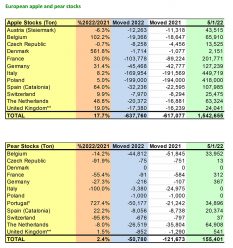
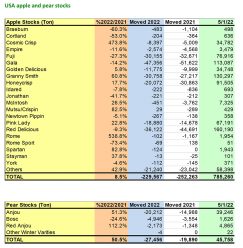
WAPA, the World Apple and Pear Association, released the apple and pear stock figures from 1 May 2022. The figures show that in Europe apple stocks increased by 17.7 % compared to 2021 to reach 1,542,655 T, while pear stocks increased by 2.4 % to 155,401 T. In the USA, apple stocks as of 1 May 2022 stood at 785,260 T (+8.5 % compared to 2021), while pear stocks reached 45,758 T (50.5 % above 2021).
WAPA, the World Apple and Pear Association, collects every month the stock figures for apples and pears from Europe and the United States. WAPA can reveal that European apple stocks stood at 1,542,655 T as of 1 May 2022, which is 17.7 % above the figure of 2021. This trend can be explained by the increases concerning Red Jonaprince (65.6 % up from 2021), Gala (+ 56.1 %), Jonagold (+ 40.8 %), and Golden Delicious (+ 27.7 %), although several varieties reported a decrease compared to 2021, most notably Gloster (- 71.3 %) and Granny Smith (- 19.8 %). On the other hand, pear stocks stood at 155,401 T on 1 May 2022, 2.4 % above the volume of 2021. While the Italian varieties were down to zero, Portugal’s Rocha pears increased substantially (+ 30,678 T above 2021’s levels).
European apple and pear stocks (Photo: WAPA)
In the USA, apple stocks in May stood at 785,260 T (+ 8.5 % compared to 2021). Cosmic Crisp (+ 473.8 % compared to 2021), Granny Smith (+ 60.8 %), and Pink Lady (+ 22.8 %) compensated for the decrease in several major varieties, such as Fuji (- 27.3 %) and Red Delicious (- 9.3 %). Pears stocks in the USA stood at 45,758 T, which is 50.5 % above last year, with Anjou pears increasing by 51.3 %.
USA apple and pear stocks (Photo: WAPA)
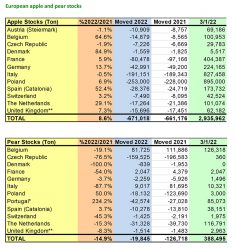
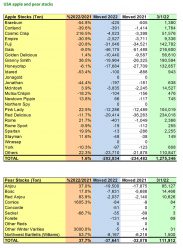
WAPA, the World Apple and Pear Association, released the apple and pear stock figures from 1 March 2022. The figures show that in Europe apple stocks increased by 8.6 % compared to 2021 to reach 2,935,962 T, while pear stocks decreased by 14.9 % to 388,495 T. In the USA, apple stocks as of 1 March 2022 stood at 1,275,346 T (+ 1.6 % compared to 2021), while pear stocks reached 111,912 T (37.7 % above 2021).
WAPA, the World Apple and Pear Association, collects every month the stock figures for apples and pears from Europe and the United States. WAPA can reveal that European apple stocks stood at 2,935,962 T as of 1 March 2022, which is 8.6 % above the figure of 2021. This was mainly driven by the increases concerning Red Jonaprince (54 % up from 2021), Jonagold (+ 27.9 %), Golden Delicious (+ 23.3 %), and Gala (+ 18.4 %), and despite the decrease in some major varieties, including Granny Smith (- 20 %) and Cripps Pink (- 14.9 %). On the other hand, pear stocks stood at 388,495 T on 1 March 2022, 14.9 % below the volume of 2021. The decrease in the Italian varieties (Abate Fetel – 97.8 % and Kaiser – 95.2 %) was partially mitigated by the stark increase in Portugal’s Rocha pears (+ 59,614 T compared to March 2021).
In the USA, apple stocks in March stood at 1,275,346 T (+ 1.6 % compared to 2021). The decrease among several large varieties, such as Fuji (- 20.8 %), Red Delicious (- 11.7 %), and Gala (- 9 %) was compensated by the 216.5 % increase in Cosmic Crisp apples, which reached 51.576 T, and the 36.5 % increase in the Granny Smith variety. Pears stocks in the USA stood at 111,912 T, which is 37.7 % above last year.
European apple and pear stocks (Photo: WAPA)
USA apple and pear stocks (Photo: WAPA)
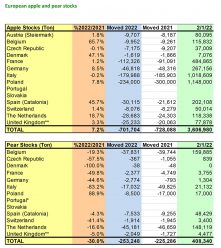
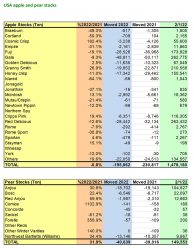
WAPA, the World Apple and Pear Association, released the apple and pear stock figures from 1 February 2022. The figures show that in Europe apple stocks increased by 7.2 % compared to 2021 to reach 3,606,980 T, while pear stocks decreased by 30 % to 408,340 T. In the USA, apple stocks as of 1 February 2022 stood at 1,478,180 T (- 0.8 % compared to 2021), while pear stocks reached 149,553 T (31.9 % above 2021).
WAPA, the World Apple and Pear Association, collects every month the stock figures for apples and pears from Europe and the United States. WAPA can reveal that European apple stocks stood at 3,606,980 T as of 1 February 2022, which is 7.2 % above the figure of 2021. This was mainly driven by the increases concerning Red Jonaprince (35.9 % up from 2021), Golden Delicious (+ 22.5 %), Gala (+ 19.9 %), and Jonagold (+ 17.2 %), while several varieties decreased, including Cripps Pink (- 17.3 %) and Granny Smith (- 13.2 %). On the other hand, pear stocks stood at 408,340 on 1 January 2022, 30 % below the volume of 2021, mostly because of the large decrease in Italy (- 83.2 %).
In the USA, apple stocks in January stood at 1,478,180 T (down 0.8 % compared to 2021). The overall stability is due to the fact that Granny Smith’s 26.9 % increase over 2021 compensated for the decrease among several large varieties, such as Fuji (- 19.1 %), Red Delicious (- 12.6 %), and Gala (- 9.3 %). Pears stocks in the USA stood at 149,553 T, which is 31.9 % above last year.
(Photo: WAPA)
(Photo: WAPA)
You need to load content from reCAPTCHA to submit the form. Please note that doing so will share data with third-party providers.
You are currently viewing a placeholder content from Turnstile. To access the actual content, click the button below. Please note that doing so will share data with third-party providers.