All Oranges 43.5 Million Boxes
The 2021-2022 Florida all orange forecast released by the USDA Agricultural Statistics Board is 43.5 million boxes, down 2 percent from the January forecast. If realized, this will be 18 percent less than last season’s final production. The forecast consists of 17.5 million boxes of non-Valencia oranges (early, mid-season, and Navel varieties) and 26.0 million boxes of Valencia oranges. A 9-year regression has been used for comparison purposes. All references to “average”, “minimum”, and “maximum” refer to the previous 10 seasons, excluding the 2017-2018 season, which was affected by Hurricane Irma. Average fruit per tree includes both regular and first late bloom …
Please download the full citrus crop production forecast: www.nass.usda.gov
Orange prices increased in the Brazilian in natura market in the first fortnight of February. According to Cepea collaborators, frequent rains in the citrus belt (São Paulo State) favoured the quality (majorly the size) of oranges, making them suitable for sale in the in natura segment and allowing farmers to raise asking prices. Besides, rainfall also hampered the harvesting, limiting supply. In that scenario, values remained firm.
Usually, orange availability is not high in February – a month that may even be considered offseason –, however, as the 2021/22 season is late, supply is currently higher. Still, there is not an orange surplus in the domestic market, since processing at industries has been faster than usual this month.
So far, the number of early varieties to be harvested is not high – activities are expected to step up only from March onwards. However, supply may be constrained by the low flower set in the first blooming. Thus, the oranges currently available in the in natura market are mostly late varieties and pear oranges out of the ideal period.
TAHITI LIME – The production of tahiti lime is also being favoured by rains, however, farmers reported difficulties to harvest the fruits, which underpinned prices in the first fortnight of February, although it is currently the peak of harvest for tahiti lime in Brazil.
Despite the recent valuations for oranges and tahiti lime, Cepea collaborators have reported that the current economic scenario in Brazil is still constraining higher price rises. With high unemployment and inflation rates and lower income, the purchase power of many consumers is weak.
ESTIMATES – Although rains have favoured the quality of part of the fruits in orchards, they have not been enough to reverse all the damages caused by the drought to the oranges from the 2021/22 season.
According to data from Fundecitrus released on Feb. 10, the orange output (São Paulo + Triângulo Mineiro) in the 2021/22 season is still estimated at 264.14 million boxes of 40.8 kilograms, the same as that estimated in December, but 10 % below that forecast at the beginning of the season.
According to Somar/Climatempo (weather forecast agency), rainfall in SP between May/21 and Jan/22 was 25 % below the average for the period. In the Triângulo Mineiro, rains were 5 % higher than the average. Thus, orange growth was hampered, and the average fruit weight decreased. However, it is important to consider that the oranges harvested in February and in March 2022 are expected to be slightly larger, since they have been favoured by recent rains.
The volume harvested is still enough to replenish ending stocks at the processing plants in SP. According to CitrusBR, by the end of the 2021/22 season (in June 2022), the volume of Frozen Concentrate Orange Juice (Equivalent) stocked is expected to total 170 – 190 thousand tons, lower than the strategic level (250 thousand tons). It is important to consider that new estimates are supposed to be released until the end of February.
In this scenario, the harvest in 2022/23 needs to be large enough to raise stocks at least to the strategic level and thus prevent a world shortage of orange juice. Cepea calculations show that the orange output next season needs to total, at least, 330 million boxes in order to raise juice stocks to 250 thousand tons.
PROGRESS OF THE 2021/22 HARVESTING – According to Fundecitrus’ report, 82 % of the orange orchards had been harvested by mid-January/22, similar to that in the same period last season (81 %).
All Oranges 44.5 million boxes
The 2021-2022 Florida all orange forecast released by the USDA Agricultural Statistics Board is 44.5 million boxes, down 1.50 million boxes from the December forecast. If realized, this will be 16 percent less than last season’s final production. The forecast consists of 17.5 million boxes of non-Valencia oranges (early, mid-season, and Navel varieties) and 27.0 million boxes of Valencia oranges. A 9-year regression has been used for comparison purposes. All references to “average”, “minimum”, and “maximum” refer to the previous 10 seasons, excluding the 2017-2018 season, which was affected by Hurricane Irma. Average fruit per tree includes both regular and first late bloom. …
Please download the full citrus crop production forecast: www.nass.usda.gov
In 2021, orange prices were high in São Paulo State (SP) and in the Triângulo Mineiro. In general, the industry in SP kept the demand high for fruits, and the low production limited the supply throughout the year. Although the remuneration (in BRL per box) had been higher, the profitability for many citrus growers was restricted, given that the limited productivity increased the cost of production per unit even more.
Fundecitrus (Citrus Defense Fund) indicated, in its estimate released in December/21, that the production in the citrus belt may reduce 1.7 % compared to 2020/21, totaling 264.14 million 40.8-boxes. Even with the positive biennial cycle in the 2021/22 season and the higher fruit load, oranges have presented a smaller size, which explains the lower production.
From May to August 2021, rainfall accounted for only 30 % of the regular volume for the period, according to data from Somar Meteorologia/Climatempo. Fundecitrus says that this scenario affected even irrigated orange groves (which correspond to 30 % of the citrus belt), due to the limited water supply in tanks. In some areas, frosts in July worsened the situation. Besides the small-sized oranges, the premature fruit drop was one of the worst in history.
Due to the low supply of fruits, orange juice processors boosted prices compared to the 2020/21 season. In the partial of the crop (from July to December/21), the average price in the spot market was 27.50 BRL/40.8-kilo box, harvested and delivered at the industry, for a nominal increase of 22.5 % in relation to the same period last year.
EXPORTS – As expected, orange juice (volume equivalent to concentrate juice) shipments finished the 2020/21 season with a 7 % decrease in relation to the previous (2019/20). From July/20 to June/21, shipments to all destinations totaled 1.03 million tons, according to data from Secex. The revenue, in turn, amounted 1.54 billion USD, 15 % down compared to the season before.
IN NATURA MARKET – Orange prices hit nominal records in most part of 2021. Increases are attributed to the limited supply in the 2021/22 crop, because of the low volume of rainfall and high temperatures in the second semester of 2020 and the low humidity in 2021. From the second semester of 2021 onwards, the low quality of fruits (due to a long period of dry weather and frosts in July) reinforced the upward trend. In the partial of the crop (from July to December/21), the average price for pear oranges (in natura) is at BRL 39.52/40.8-kilo box, on tree, 20 % up from the average in the same period in 2020, in nominal terms.
TAHITI – The price trend was atypical in 2021. Values were low in the first semester and in some periods of the second part of the year, and peak prices were less intense. From January to December, the average price for tahiti lime was at BRL 25.19/27-kilo box, harvested, 31.3 % lower compared to that in 2020.
All oranges 46.0 million boxes
The 2021-2022 Florida all orange forecast released by the USDA Agricultural Statistics Board is 46.0 million boxes, down 1.0 million boxes from the October forecast. If realized, this will be 13 percent less than last season’s final production. The forecast consists of 18.0 million boxes of the non-Valencia oranges (early, mid-season, and Navel varieties) and 28.0 million boxes of the Valencia oranges. A 9-year regression was used for comparison purposes. All references to “average”, “minimum”, and “maximum” refer to the previous 10 seasons, excluding the 2017-2018 season, which was affected by Hurricane Irma. Average fruit per tree includes both regular bloom and the first late bloom …
Please download the full citrus crop production forecast: www.nass.usda.gov
The current number of flowers in the orange orchards in São Paulo – which will give origin to the fruits from the 2022/23 season – is considered satisfactory in most citrus-producing regions within the state. In general, while in irrigated orchards blooming was observed from September onwards, in non-irrigated orchards, flowers were only observed in October, after the late arrival of rainfall.
Agents have been concerned about the possible effects of the lack of rains this year on the vigor of orange trees, since low moisture may hamper fruit set, increasing the rate of fruitlet fall in irrigated orchards and, largely, in the orchards in dryland.
According to forecasts from the National Oceanic and Atmospheric Administration (NOAA), there is a 90 % chance of La Niña forming in Brazil until the end of 2021. If this is confirmed, rainfall in the coming months may be lower than usual in the southeastern region of the country. However, La Niña is forecast to be weak in Brazil.
This scenario may have a negative influence on the output from the 2022/23 season, since the development stage of plants in the coming months demands good amounts of water. With estimates for low ending stocks of orange juice in the 2021/22 season, the output from 2022/23 needs to be high in order to ensure comfortable inventories for world supply.
Cepea calculations show that, for ending stocks in the 2022/23 season (June 2023) to return to the strategic level of 250 thousand tons, the output next season needs to surpass 330 million boxes of 40.8 kilograms each. In this context, the average productivity would have to be around a thousand boxes per hectare, which has only been observed in seasons favored by the weather.
The price for pear oranges has been on the rise in Brazil since the beginning of the season, in June, influenced by the low supply of oranges in the market. In the second fortnight of October, pear orange prices surpassed BRL 50.00/40.8-kilo box, on tree, setting a new nominal record in the series of Cepea. The monthly average in October (in São Paulo State) closed at BRL 49.88/box, on tree, 10.1 % up from that in September/21 and 28.3 % above that in October/20, in nominal terms.
Agents in the Brazilian citrus sector did not expect supply in the 2021/22 season to be high, based on the effects of the weather on blooming and flower set. However, along the season, weather issues increased, with rainfall below the ideal and frosts in some locations at the end of July.
Although rains were more frequent in October, agents reported that the oranges were mostly small-sized, which kept the prices for larger-sized fruits on the rise – since this standard is required in the in natura segment. From November onwards, quality may increase, and a higher number of late oranges is expected to be available in the market. On the other hand, high purchases from the industry are also expected to control supply in the in natura market.
TAHITI LIME – In the Brazilian market of tahiti lime, the return of rains favored production and raised supply. Besides, the quality of the fruits continued low, and the exports pace was slow in October. Thus, prices for this variety dropped in the orchards in SP, averaging BRL 23.15/27-kilo box, harvested, 21.8 % down from that in September.
ORCHARDS – The rains that hit São Paulo State in October favored blooming in orange orchards, largely in dryland or those that had not bloomed yet. According to citrus farmers, the scenario varied among regions, according to the volume of rain and the production system (irrigated or dryland), but, in general, all agents agree that blooming was satisfactory.
As in previous seasons, this year’s flowering has been irregular and heterogeneous. While in some regions, orchards bloomed earlier (in September), in others, flowering was observed in October. However, the early flowers were compromised by the hot and dry weather in many areas, which led some of the fruitlets to fall, even in irrigated orchards.
Citrus farmers believe this will be another season of multiple blooming, which would hamper both the harvesting and management of trees because of the different development stages of flowers – as it happened in most Brazilian regions in the last years.
Although flowering brought some relief to citrus farmers in all regions, it is important to consider that plants are still debilitated, due to the long drought, which may hamper fruit fixing. Thus, the success of the recent blooming will depend on the weather from now onwards (high moisture interleaved with sunny periods) and preventive care for blossom-end rot. According to Cptec/Inpe (weather forecast agency), rains may be lower than the average in November and in December, which may be a reflex of the La Niña phenomenon, and hamper flower set.
The return of rains to important citrus-producing regions in São Paulo State (SP) cheered up farmers about flower development. However, it is still early to estimate results for the 2022/23 season, since the set of fruitlets will depend on the weather along October and more flowers may open until the end of the month.
According to data from Inmet (National Institute of Meteorology), rainfall is expected to average 50 mm in most citrus-producing regions in October.
ORANGE MARKET – The trading pace for oranges was slow in the Brazilian market in the first fortnight of October because of the holiday on the 12th. Higher rainfall is expected to improve the quality of the fruits on tree, although they have not reached the ideal standard to be sold yet. This scenario added to low supply pushed up orange prices in that period.
TAHITI LIME – In the market of tahiti lime, prices faded in the first half of October, reflecting the small size of the fruits available, which is not appreciated in the in natura market. In the second week of the month, values increased slightly, influenced by higher demand during the holiday (on the 12th), which surprised farmers.
ORANGE JUICE EXPORTS – The Brazilian exports of orange juice are on the rise in the current season (2021/22). According to data from Secex (Foreign Trade Secretariat), between July and September, Brazil exported 278.9 thousand tons of Frozen Concentrate Orange Juice (FCOJ) Equivalent to all destinations, 19 % up from that in the same period last season. Revenue increased more sharply, by 32 %, reflecting the higher prices paid for the product, totaling USD 440.8 million. Of the total volume shipped this season, 20 % were sent to the United States – the volume exported to the USA has increased by 33 %, and the revenue received from the country, by 51 %.
Estimates about the 2021/22 orange season in the Brazilian citrus belt (São Paulo and the Triângulo Mineiro) have been revised down, due to weather issues in Brazil. Data released by Fundecitrus (Citrus Defense Fund) in September estimated the harvest to be 8.9 % lower than that forecast in the first report, released in May, at 267.87 million boxes. In light of that, the output may be similar to that in the previous season (268.63 million boxes). Although the 2021/22 season is a positive biennial cycle, oranges have been smaller, which explains lower production.
Although the estimates from May considered rainfall below the average, weather issues have increased since then, with frosts and severe drought. Between May and August, rainfall accounted for 30 % of the usual for the period, according to data from Somar/Climatempo Meteorologia (weather forecast agency).
The lack of rains has been damaging majorly the plants in dryland, however, agents from Fundecitrus highlight that even irrigated orchards (which account for 30 % of the trees in the citrus belt) have been debilitated by the drought, due to the limited availability of water at reservoirs. It is important to mention that the scenario has worsened since the frosts in late July.
Besides the smaller size of the oranges, the rate of premature fall of fruits is one of the highest. As the weather is forecast to continue unfavourable until the end of the season, the scenario is not expected to change, raising expectations for low production in 2021/22. Also, the chance of La Niña phenomena to occur until late 2021 is high, which may result in lower rainfall in southeastern Brazil in the second semester. This scenario would limit the growth of late varieties.
INDUSTRY – With the probable lower harvest of oranges in the 2021/22 season, the number of fruits allocated to processors is supposed to be lower too. CitrusBR (Brazilian Association of Citrus Exporters) has not revised processing estimates yet, but Cepea forecasts the industry to purchase around 225 million boxes of oranges (40-8 kilograms each) this season. If this is confirmed and sales of orange juice are near the usual, juice inventories are expected to decrease steeply, to less than 200 thousand tons (Frozen Concentrate Orange Juice Equivalent), even with higher yield at processing plants, which usually happens in years of low rainfall.
This context will demand high orange production in the 2022/23 season (higher than 330 million boxes) so that ending stocks are replenished with no risk of world shortages. This situation may favor the prices paid to farmers in Brazil.
In early September, orange trees bloomed in some orchards in São Paulo State (SP). These flowers will become the fruits from the 2022/23 season. Cepea collaborators reported higher blooming in irrigated orchards, majorly in northern and northwestern SP.
However, citrus farmers have been concerned about the effects of the weather on flower settlement. In dryland orchards, which count exclusively on rainfall for moisture, precipitation has been insufficient to trigger blooming.
According to Somar Meteorologia (weather forecast agency), rainfall was low in the major citrus-producing regions in SP in the first half of September. Thus, while it does not rain significantly, farmers are investing in plant nutrition in order to help on fruit set.
During fruit set (after blooming), temperatures and soil and air moisture deeply influence production. However, in the last years, high temperatures and rainfall below the average were common, limiting the output, largely in non-irrigated orchards.
Climatempo (weather forecast agency) forecasts rains for the second fortnight of September, and rainfall is expected to be within the average in the month in most citrus-producing regions in Brazil, except in southern SP. On the other hand, according to NOAA (National Oceanic and Atmospheric Administration), there is a 70 % chance that La Niña phenomena may return to Brazil until the end of 2021.
In Brazil, La Niña increases rainfall in the northeastern region and delays precipitation in the south. In southeastern BR, the scenario becomes similar to that in the southern area of the country, which concerns agents, in light of the current drought. For citrus farming, this delay may cause more damages to the 2022/23 harvest, since the coming months are critical for the development of trees, when higher moisture is needed.
BRAZILIAN MARKET IN SEPTEMBER – The demand for oranges increased in the in natura market in the first fortnight of September, favored by high temperatures and the payment of workers’ wages early in the month. As regards supply, the hot and dry weather in SP continued to limit the availability of high-quality fruits in the market (most of them are wilted and small-sized). In this scenario, prices increased.
By the end of the 2020/21 season, in June 2021, the inventories of Frozen Concentrate Orange Juice (FCOJ) equivalent at Brazilian processors totaled 316.93 thousand tons, according to data from CitrusBR (Brazilian Association of Citrus Exporters) released in mid-August. Compared to that at the end of the 2019/20 season, inventories decreased by 33 %. This reduction was already expected by agents, due to the slower crushing pace of oranges in 2020/21, when orange production was low.
CitrusBR avoided releasing estimates for the current season because of the weather issues (extended drought in the citrus belt and frosts in late July) in the major citrus-producing regions in Brazil, which are still concerning agents. However, ending stocks in the 2021/22 season (by June 2022) may be lower than the strategic level.
So far, considering Fundecitrus’ (Citrus Defense Fund) production estimates from May, of 294 million boxes (40.8 kilograms each), the volume processed may be around 250 million boxes. In that scenario, Cepea data indicate that ending stocks in the 2021/22 season (which ends in June/22) may not be enough to generate a world surplus of orange juice.
Also, agents in the Brazilian citrus sector believe that the estimates from Fundecitrus will be revised down, due to the drought and frosts in Brazil. In this context, the volume processed may be revised too, and juice inventories may be even lower. Thus, processors will depend on higher orange production in 2022/23 to, at least, replenish inventories – which is a concern too, considering that the effects of the weather may be extended to the coming season, since many trees are currently debilitated.
As regards orange processing, the crushing pace for the fruits from 2021/22 was fast in August at the large-sized plants in São Paulo State (SP), with mostly pear oranges being crushed.
Orange processing is expected to last until mid-February/March 2022, with less plants in activity compared to that in the second semester of 2021, however, with higher volumes being produced than that in the same period of previous years, because of the delay in the development of trees (due to weather issues) and irregular flowering. It is worth to consider that the 2021/22 season is expected to have higher volumes of fruits from the third and fourth flowering events (altogether) since Fundecitrus began estimating crops, in 2015/16 – making it a late crop.
BRAZILIAN MARKET IN AUGUST – The demand for oranges was low in the Brazilian market in August, constrained by the current high price levels and lower quality of the oranges available (small-sized and wilted). Still, prices increased, boosted by low supply.
For a sustainable citrus supply chain
They serve as fragrant fertilizer, basis for vegan meat substitutes and even raw material for sustainable fashion: the peels and fruit fibers left over from pressing orange juice. They are already being recycled – but not by default. The “ImPUlSe” project, led by the University Duisburg-Essen (UDE, Germany), wants to change that and also aims to render the entire suppy chain for citrus fruits in the Mediterranean region more sustainable. A total of € 1.3 million in funding will be provided*, € 530,000 from the Federal Ministry of Education and Research will go to the UDE. Kick-off is on September 9.
“Innovation in the by-product supply chain of citrus in the Mediterranean area”, or ImPUlSe for short, is coordinated by the Centre for Logistics and Traffic (ZLV) at the UDE. From planting the seeds on the plantations to transporting them to the local supermarkets and recycling the peels and fibers – the international team wants to analyze and improve the processes by following the “triple bottom line” approach: All changes should be sustainable on an ecological, economic and social level.
The four pilot projects are located in Algeria, Egypt, Tunisia and Turkey. Besides the UDE as coordinator, research institutions and companies from all countries are involved, as well as a research partner from France: “Different disciplines are working hand in hand here. Thus, we will not only improve existing products, but also develop new supply chains for citrus by-products and open up new markets for producers from the Mediterranean region. Eventually, we will publish our results on an online platform and make them available to everyone, especially consumers”, explains spokesperson Dr. Ani Melkonyan-Gottschalk, executive director of the ZLV.
This innovation platform is expected to encourage exchange between all participants – even beyond the duration of ImPUlSe. It is also a basis for researchers to assess the sustainability of the changes they have initiated. “We are developing an evaluation system that simulates different scenarios to facilitate work for decision-makers in agriculture, food processing, trade and politics”, says Melkonyan-Gottschalk.
In the long term, the interdisciplinary project aims to use and reuse resources more efficiently, develop digital solutions and establish more effective market mechanisms. As a result, the employment rate and quality of life in the Mediterranean region are expected to increase.
*EU funding within “Partnership for Research and Innovation in the Mediterranean Area” (PRIMA).
New study finds that vitamins and bioactives in 100 % orange juice help shore up natural immunity and fight immune-sapping inflammation in the body
A new research review, published in Frontiers in Immunology1, has found that a simple glass of citrus juice – for example orange or grapefruit – contains key nutrients and bioactive substances that help our immune system to work efficiently.
Scientists examined evidence from nearly 200 different studies and reports, and concluded that vitamin C, folate and polyphenol compounds in citrus juices have the capacity to impact on immune health, fight inflammation and improve our defence against bacteria and viruses.
Co-author, Philip Calder, Professor of Nutritional Immunology at Southampton University, said: “A weak immune system increases susceptibility to infections and allows these to become more severe. One component of the immune response is inflammation. Where inflammation is excessive or uncontrolled it can damage body tissues, sometimes irreparably, and affect our ability to fight infections. Having a diet rich in antioxidant foods and drinks is one way to control inflammation and ensure the body can mount an effective immune response. Trials in humans confirm that orange juice consumption reduces inflammation.
“Citrus fruit juices are particularly good sources of vitamin C and folate, which have roles in strengthening the gut and skin barriers which are our first line of defence against viruses and bacteria. In addition, these nutrients – which are absorbed well from fruit juices –support the function of many types of immune cells including phagocytes, natural killer cells, T-cells and B-cells.
“Another area of research is the bioactive polyphenols found in citrus fruit juices which include hesperidin, narirutin and naringin. These not only have anti-inflammatory effects but could also have direct anti-viral effects according to emerging data from modelling studies”.
Dr Carrie Ruxton, from the Fruit Juice Science Centre, comments: “The evidence about the positive role that fruit juices play in the diet continues to build. We know from several large studies that a daily glass of pure fruit juice provides vitamin C, folate and potassium, can help to lower blood pressure, and reduces the risk of stroke. Now it’s clear that citrus juices can also contribute to immune health which is crucial as we all get back to our normal lives”.
1Miles EA & Calder PC (2021) Effects of Citrus Fruit Juices and Their Bioactive Components on Inflammation and Immunity: A Narrative Review. Front. Immunol. 12:712608. https://www.frontiersin.org/articles/10.3389/fimmu.2021.712608/full
The intense cold observed in São Paulo State (SP) in late July hit the orchards located in the citrus belt, with frosts registered in some areas. This scenario increased agents’ concerns about both orange production in the current season and the vitality of trees in the coming season – it is worth to mention that agents were already worried about these factors because of the lack of rains this year.
These agents are concerned about the vitality of the trees in all the groves hit by the recent frosts, since they are nearing the period of flower induction already debilitated by the lower rainfall in the last two years. However, it is worth to mention that it is still early to assess the damages caused by the bad weather, majorly the effects on the volume to be harvested next season.
Considering the current season (2021/22), the quality of the oranges on tree is expected to decrease, since some of the fruits affected by the frosts in late June/early July are dry and crystalised in the inside – these are undesired traits for both the in natura and the industrial segments, since the oranges have almost no juice in that condition. Besides, fruits dropped down in the areas that were already debilitated by the drought.
As regards next season (2022/23), the younger trees (which are currently sprouting) are expected to be the most damaged by the frosts. In the irrigated groves where flowering was anticipated, the effects of the bad weather are a concern too, since flowers may have been burned, as well as small fruits. It is worth to highlight that the recent frosts were not homogeneous, and it is still impossible to affirm that the volume to be produced in 2022/23 will be affected.
PONKAN TANGERINE – Although ponkan tangerine is more sensitive to temperature swings, the volume to be harvested in SP is not forecast to be affected, since the harvesting is practically over. On the other hand, in Minas Gerais, the volume to be harvested is higher, and there may be negative effects on the quality of the fruits.
TAHITI LIME – For this variety, although damages have not been assessed yet, concerns are higher, since tahiti lime is very sensitive to weather changes. Besides, differently from oranges, whose groves are mostly in the ripening stage or being harvested, development is at different stages among the regions with tahiti lime, with some of them in the flowering stage. According to Cepea collaborators, the intense cold caused the drop of some small fruitlets, flower buds and flowers.
The 2020-2021 Florida all orange forecast released by the USDA Agricultural Statistics Board is 52.8 million boxes. The total is comprised of 22.7 million boxes of non-Valencia oranges (early, midseason, and Navel varieties), unchanged from the June forecast, and 30.1 million boxes of Valencia oranges, up slightly from the June forecast. The forecast of all Florida grapefruit production is unchanged at 4.10 million boxes. Of the total grapefruit forecast, 620,000 boxes are white, and 3.48 million boxes are the red varieties. The Florida all tangerine and tangelo forecast remains at 890,000 boxes …
Please download the full citrus crop production forecast: www.nass.usda.gov
The volume of orange juice stocked at Brazilian processors in the 2020/21 season (June 2021) is expected to be higher than the strategic limit (250 thousand tons). On the other hand, in the 2021/22 season (June 2022), the volume stocked may be lower than that.
As regards the 2020/21 crop, a report released by CitrusBR (Brazilian Association of Citrus Exporters) on June 9 indicates that the inventories of Frozen Concentrate Orange Juice (FCOJ) Equivalent may total 310.759 thousand tons in June 2021, 34 % down from that in the same period of the 2019/20 season, but 14 % up from that previously estimated (in February 2021).
In the 2021/22 season, although oranges still need to ripen, juice inventories are likely to decrease, despite the possible recovery of production forecast by Fundecitrus (Citrus Defense Fund).
Although this scenario is not a threat to world supply in the 2021/22 season, it has been concerning agents about availability in the following season (2022/23), since production would have to be higher in order to avoid a lack of juice. However, with the recent area reduction in the Brazilian citrus belt, production should hardly surpass 350 million boxes. Thus, the prices paid to orange farmers in Brazil are likely to continue at high levels, at least until next season.
ORANGE AREA IN BRAZIL – The crop forecast survey released by Fundecitrus in late May surprised agents from the Brazilian citrus sector. The area allocated to orange groves in the 2021/22 season had its second largest decrease – in terms of both hectares and percentage – since the beginning of the PES project, in 2015/16.
In the 2021/22 season, the area allocated to orange groves might total 379.4 thousand hectares, 16.262 hectares smaller (- 4 %) than that in the previous season.
According to Fundecitrus, one of the reasons for this decrease is the drought, which is becoming more and more severe in Brazil, majorly in the current season. Thus, area reductions were more significant in the citrus-producing regions of São Paulo that had low rainfall in the last couple of years, with the worst effects observed in non-irrigated, condensed and rootstock groves, which are not that drought-resistant. In these groves, productivity decreased sharply last season, and many plants died. Besides, the current high prices of some commodities, such as corn, soybean and sugar, have attracted farmers.
This area reduction should considerably lower the productive potential of the citrus belt to around 340 million boxes of 40.8 kilograms in years of good productivity (1,000 boxes per hectare, on average).
BRAZILIAN MARKET IN JUNE – The weak demand for oranges in the in natura market of SP along with the current low temperatures pressed down orange prices in the first fortnight of June. However, expectations are for limited price drops or even price rises as processing steps up, reducing supply in the in natura market, largely of early varieties.
All Oranges 52.7 Million Boxes
The 2020-2021 Florida all orange forecast released by the USDA Agricultural Statistics Board is raised 1.0 million boxes to 52.7 million boxes. The total includes 22.7 million boxes of the non-Valencia oranges (early, mid-season, and Navel varieties) and 30.0 million boxes of Valencia oranges. …
Please download the full citrus crop production forecast: www.nass.usda.gov
The 2021-2022 orange crop forecast for the São Paulo and West-Southwest Minas Gerais citrus belt, published on May 27, 2021 by Fundecitrus, in cooperation with Markestrat, FEA-RP/USP and FCAV/Unesp, is 294.17 million boxes (40.8 kg or 90 lb). Total orange production includes:
- 51.37 million boxes of the Hamlin, Westin and Rubi varieties;
- 16.87 million boxes of the Valencia Americana, Seleta and Pineapple varieties;
- 84.66 million boxes of the Pera Rio variety;
- 107.07 million boxes of the Valencia and Valencia Folha Murcha varieties;
- 34.20 million boxes of the Natal variety.
Approximately 26.09 million boxes are expected to be produced in the Triângulo Mineiro.
As compared to the final forecast of 268.63 million boxes in the previous crop, the current projection represents an increase of 9.51 % although it is still below the average of 35 million boxes for the last ten crop seasons, which corresponds to a drop of 10.53 % …
Please download the complete forecast under: www.fundecitrus.com.br/pdf
All Oranges 51.7 Million Boxes
The 2020-2021 Florida all orange forecast released by the USDA Agricultural Statistics Board is unchanged at 51.7 million boxes. If realized, this will be 23 percent less than last season’s revised final production. The forecast consists of 22.7 million boxes of non-Valencia oranges (early, mid-season, and Navel varieties) and 29.0 million boxes of Valencia oranges. …
Please download the full citrus crop production forecast: www.nass.usda.gov
With the anticipation of the drought and rainfall below the average in the first quarter of 2021 in São Paulo (SP), the development of the oranges from the 2021/22 season is below the expected, majorly in non-irrigated groves. At the current stage of groves development (fruit enlargement), moisture is crucial, which is warning farmers about the volume to be harvested this season.
So far, it is believed that production will be small, but larger than that in the 2020/21 season (due to the weather in the second semester of 2020 and its effects on flowering and settlement).
Besides the number of fruits, which is not forecast to be high, citrus farmers have been concerned about quality issues that may occur because of low moisture. The top complaints are related to size (since fruits may take longer to reach the ideal size) and wilted oranges (riper fruits), largely pear and early oranges. On the other hand, until the end of April, fruit drop, which may also be worsened by the lack of rain, was not significant, according to farmers.
In order to avoid higher quality loss, some farmers may accelerate the harvesting, even if the oranges have not reached the ideal size and ripening, which may hamper sales and constrain price rises.
INDUSTRIAL YIELD – On the other hand, industrial yield may be favored by the lack of rainfall in citrus-producing regions, since less boxes of oranges may be necessary to produce a ton of concentrated juice.
Orange production for the 2020-2021 crop season totaled 268.63 million boxes1
The final 2020-2021 orange crop for the São Paulo and West-Southwest Minas Gerais citrus belt, published on April 12, 2021 by Fundecitrus – performed in cooperation with Markestrat, FEA-RP/USP and FCAV/Unesp2 – was 268.63 million boxes of 40.8 kg each (90 lb), which represents a decrease of 6.65 % in relation to the first crop forecast published in May 2020, accounting for a reduction of 19.13 million boxes. This crop had a decrease of 118.16 million boxes in comparison to the previous season, which is equivalent to a volume 30.55 % smaller than that of the 2019-2020 cycle, confirming a record crop loss for all the years in which the crop suffered the physiological effects of the negative biennial production cycle of orange trees since the beginning of the historical series in 1988. Total orange production included:
- 47.00 million boxes of the Hamlin, Westin and Rubi early-season varieties;
- 13.85 million boxes of the Valencia Americana, Seleta and Pineapple early-season varieties;
- 81.45 million boxes of the Pera Rio mid-season variety;
- 91.95 million boxes of the Valencia and Valencia Folha Murcha late-season varieties;
- 34.38 million boxes of the Natal late-season variety.
- Approximately 19.33 million boxes were produced in West Minas Gerais.
One of the reasons that explains this substantial crop loss is the fact that orange trees started flowering in the spring of 2019, when reserves were lower because they had been used in the previous crop season when there was a significant yield increase. Decreased reserves led to a significant reduction in the number of fruits per tree in this season, a phenomenon known as alternate bearing. The other reason is the strong negative influence of the climate throughout the season. …
Please download the complete forecast under: www.fundecitrus.com.br/pdf
1Hamlin, Westin, Rubi, Valencia Americana, Seleta, Pineapple, Pera Rio, Valencia, Valencia Folha Murcha and Natal.
2Department of math and science, FCAV/Unesp Jaboticabal Campus.
All Oranges 51.7 Million Boxes
The 2020-2021 Florida all orange forecast released by the USDA Agricultural Statistics Board is down 3.80 million boxes to 51.7 million boxes. If realized, this will be 23 percent less than last season’s revised final production. The forecast consists of 22.7 million boxes of non-Valencia oranges (early, mid-season, and Navel varieties) and 29.0 million boxes of Valencia oranges. A 9-year regression has been used for comparison purposes. All references to “average”, “minimum”, and “maximum” refer to the previous 10 seasons, excluding the 2017-2018 season, which was affected by Hurricane Irma. Average fruit per tree includes both regular and first late bloom. …
Please download the full citrus crop production forecast: www.nass.usda.gov
The supply of early citrus fruits was increasing in São Paulo State (SP) in late March, while the demand from juice processors was lower, and businesses were facing a new period of restrictive measures to fight covid-19 in Brazil.
Although estimates do not point to an extremely high availability in April, supply should still be higher than that in March, since more early oranges should reach the ideal maturation stage to be harvested this month. As for demand, besides the new restrictive measures, logistic issues were constraining purchases from wholesalers and retailers in Brazil.
Among the major changes in food services during the covid-19 pandemic are the halt in school meals, which highly demands in natura oranges, and the closure of bars and restaurants, where the demand for juice is high. Thus, in March, fruits were mostly sold to supermarkets.
PRICES – Although orange prices were still high in March, underpinned by lower supply, they decreased late in the month. The average price for pear oranges in March was 38.71 BRL per 40.8-kilo box, on tree, 2.7 % down compared to that in February. For hamlin oranges (early variety), the average closed at 29.48 BRL/box, on tree, practically stable in the same comparison.
According to Cepea collaborators, some farmers anticipated the harvesting of pear oranges, aiming to take advantage of the current price levels – these agents are aware of the forecasts for higher supply of early oranges in the market from April onwards and, thus, fear quotes may drop in the coming weeks.
In the Brazilian market of tahiti lime, which is also largely sold to bars and restaurants, the decrease in the demand and the slightly higher supply pressed down quotes in March. Besides, the pace for exports and crushing slowed down.
The average price for tahiti lime closed at 20.60 BRL per 27-kilo box, harvested, 32.8 % down from that in February. However, despite this devaluation, prices are currently higher than that last year, due to lower production this season.
The global pectin market is estimated to reach USD 1.87 billion by 2026 and is anticipated to grow at a CAGR of 6.4 % from 2018 to 2026. Pectin market is projected to witness significant growth over the forecast period. Increasing health consciousness among consumers and various health benefits of pectin products is expected to drive the global market over the forecast period.
Pectin are plant-derived compounds, a structural heteropoly saccharide that is contained in primary cell walls of the terrestrial plants. It is mainly extracted from citrus fruits, apples, apricots, cherries, oranges, and carrots. Commercially, it is available in the form of white to light brown powder. The industry is characterized by companies characterized by medium level of integration in the value chain. Packaging and shipping play an important role in integrating the value chain. This helps the companies to incorporate their businesses in a cost-effective way.
Suppliers include companies which are involved in the production & distribution of processes raw materials such as apple, citrus, and others. The rising shortage of raw materials and increased import for Brazil and European countries is resulting in high bargaining power to the suppliers. In addition, low threat of backward integration from manufacturers, except some of the major and giant market players is also resulting in high bargaining power of suppliers.
The pectin market witnesses an external threat of substitution from natural gum and Citri-fi. Citri-fi is natural functional fibers, which are derived from citrus fruits. They offer hydrocolloidal properties, which is significant for high water holding capabilities. There are also some synthetic alternatives such as polyurethane, but these are usually not considered suitable for skin contact applications. However, the various advantages of pectin over these products are expected to lower the threat.
Pectin extracted from this raw material are used for high cholesterol high blood pressure, & blood sugar, joint pain, weight loss, prevent colon & prostate cancer, high triglycerides, gastroesophageal reflux disease (GERD) and diabetes. In addition, some people also use pectin to prevent poisoning caused by strontium, and other heavy metals.
Despite the shortage in the supply of raw material, some of the major players are also trying to increase their production capacity to meet the demand. For instance, Cargill acquired FMC’s plant to boost their pectin production capacity. The market is highly fragmented and competitive. In addition, it also experiences the presence of small-scale as well as giant players. The key and major companies are investing in R&D activities and frequently involved in merger and acquisition to increase their market share and product portfolio. Some of the companies that have a significant influence in the industry include DuPont Nutrition & Health, FMC Corporation, CPKelco, Herbstreith & Fox, Devson Impex Private Limited, Cargill Incorporated, B&V srl. and Yantai Andre Pectin Co. Ltd.
Growth in food & beverage industries, in emerging economies, is expected to drive the Asia Pacific market. The market is projected to grow rapidly in the Asia Pacific region, owing to the changing lifestyle of consumers in emerging economies including, China and India. The rising health consciousness among consumers and the presence of major players in North America is projected to positively drive the growth of the market over the forecast period.
The third production estimates for the Brazilian citrus belt (São Paulo and the Triângulo Mineiro) in the 2020/21 season, released by Fundecitrus on Wednesday, February 10, indicates that orange supply should total 269.01 million boxes of 40.8-kilograms each. This volume is 6.52 % lower than that initially estimated and 30.45 % below that in the previous season. This is also the worst annual decrease in all times.
As low supply has been confirmed, orange prices continue firm in the Brazilian market. According to Fundecitrus estimates, 81 % of the fruits had been harvested up to mid-January. The harvesting of pear oranges has reached 82 % of the volume forecast, and for the late varieties (valencia, folha murcha and natal), 75 %.
According to Fundecitrus, the biennial production cycle and the unfavorable weather (drought and high temperatures) in the second semester of 2019 (flowering) and 2020 (fruit-filling stage) led to the current crop failure. The report from Fundecitrus also points that, although rainfall was higher in the citrus belt in December 2020 (8 % up from the average), it was lower, irregular and short in January, due to the La Niña phenomenon.
Thus, the average weight of the oranges harvested was lower – usually, 261 fruits fill up a box, meaning that each orange should weight 156 grams, 8 % down from the average of the last five crops.
PRODUCTIVITY – Low productivity this season has been majorly linked to late varieties and pear oranges. Thus, with lower volumes, the demand from processors continues high, which is controlling both supply and prices in the first months of 2021.
PRICES – In the market of tahiti lime, supply was high in the first fortnight of February, due to the peak of harvest, however, sales were firm. According to Cepea collaborators, the increase of crushing was leading agents from processors to search for fruits in the in natura market, pushing up quotes in São Paulo. It is important to highlight that the supply of lower quality fruits is high, which is discouraging exports.
On the other hand, orange prices were fading in the first half of the February. Despite the beginning of the month (when workers’ wages are paid) and the low supply of high-quality fruits, low demand was limiting sales. Farmers expect demand to increase when the first oranges harvested are available, since their quality should be higher – however, this is forecast for mid-March only.
Price averages of all orange varieties were firm in January in São Paulo state and may continue high in February. The lower production in the citrus belt (São Paulo and Triângulo Mineiro) in the 2020/21 season and difficulties to harvest in some areas, due to rains, underpinned values. Moreover, the supply of high-quality orange was low – most fruits available in January had characteristics unwanted by consumers, such as large size and thick peel.
In January/21, pera rio orange quotes averaged 39.06 BRL per 40.8-kilo box, on tree, 27.9 % up compared to January/20, but a decrease of 3.6 % in relation to December/20, in nominal terms. As for lima orange, the average was 73.85 BRL/box, 101 % up in the annual comparison, but 8.6 % lower in relation to December/20. Natal orange values averaged 35.07 BRL per box (+29.9 % in one year, but -3.4 % compared to the month before).
Values may continue at high levels to citrus growers in February, mainly for high-quality fruits in the in natura market. The loss of fruitlets and the low rate of established flowers last year that now result in a limited volume of out-of-season oranges favor this scenario. As for the demand, it can increase in February because of high temperatures.
As for the first oranges harvested in the 2021/22 season in Jales, where major flowerings are advanced, they can be available from March onwards. However, due to the dry weather in the second semester of 2020 and the consequent low rate of flowers established, the volume may not be very high.
TAHITI LIME – The peak season in São Paulo continued to press down tahiti lime prices in late January. However, producers reported problems brought by hot weather and rains, which can increase the allocation of fruits to crushing activities and limit the supply in the in natura market.
Oranges
Global orange production for 2020/21 is forecast to rise 3.6 million metric tons (tons) from the previous year to 49.4 million as favorable weather leads to larger crops in Brazil and Mexico, offsetting declines in Turkey and the United States. Consequently, consumption, fruit for processing, and fresh exports are also forecast higher. …
Please download the full citrus crop production forecast: https://apps.fas.usda.gov/psdonline/circulars/citrus.pdf
After the low production in the 2020/21 season, agents expect a limited orange crop in 2021/22 in São Paulo State and the Triângulo Mineiro, due to unfavorable weather conditions. This scenario tends to underpin orange prices in 2021.
The first estimates for the 2021/22 crop, released by the USDA in December/2020, indicate that the harvest in SP and the Triângulo Mineiro should total 315 million boxes of 40.8-kilos each, 17 % up from that in the previous season. Despite this recovery, this volume does not mean the productive potential of crops will be recovered because of the bad weather conditions in these regions.
Thus, a harvest of 315 million boxes is not high, and therefore may not be enough to totally offset orange juice inventories. On the other hand, it should favor farmers’ revenue for one more year, due to the firm industrial demand. It is worth to mention that these estimates may change, since it is still early to assess production, majorly this year. Fundecitrus should release estimates only in May 2021.
INVENTORIES – Data from CitrusBR indicate that initial inventories in the 2021/22 season may be from 240 to 280 thousand tons in July/21. Although this volume is not lower than the strategic level established, the small harvest in the 2021/22 season may limit the volume by the end of the season, in June 2022.
CONTRACTS WITH THE INDUSTRY – Deals for the new season have not been closed. As the volume produced is still uncertain, reasonable prices cannot be fixed either. Besides, in the 2020/21 season, many processors closed deals for the following crop. Thus, a higher volume of fruits from the coming season has already been sold. Still, prices are expected to be positive in this segment, since the demand from the industry should be high.
IN NATURA MARKET – Higher industrial demand should keep orange prices on the rise in the in natura market in 2021/22. As the 2021/22 crop is expected to be late again, the prices of early oranges should be favored, and quotes should be underpinned, since the pear orange crop may be late.
The Brazilian orange crop for Marketing Year (MY) 2020/21 is forecast at 415 million 40.8-kg boxes (MBx), equal to 16.93 million metric tons (mmt), an increase of 14 percent relative to the current season. The forecast assumes normal weather conditions will prevail as of mid-December 2020 to support fruit setting and development of the second blossoming in the Sao Paulo and Minas Gerais commercial citrus belt. The current orange crop estimate in the Sao Paulo and Minas Gerais citrus belt was revised downward from 287.8 to 269.4 MBx (11.74 mmt to 10.99 mmt) as a consequence of the lack of rain fall and high temperatures between September and October. Total Brazilian FCOJ 65 Brix equivalent exports for MY 2020/21 are forecast at 1.08 mmt, similar to revised figure for MY 2019/20 …
Please download the full citrus crop production forecast: www.nass.usda.gov
In general, citrus prices were high in São Paulo State in 2020. With the lower orange production in the Brazilian citrus belt (São Paulo and the Triângulo Mineiro) in the 2020/21 season due to bad weather conditions, the demand from processors for fruits continued high along the year, which underpinned prices.
According to a report released by Fundecitrus on December 10, crop failure in the citrus belt (SP and the Triângulo Mineiro) should be the worst since 1988/1989, when the series began. In total, orange production should be 30 % lower in the 2020/21 season, totaling 269.36 million boxes of 40.8 kilos each.
INDUSTRIAL PRICES – Although processors began the 2020/21 season with high volumes of juice stocked – 471 thousand tons of Frozen Concentrate Orange Juice (FCOJ) Equivalent, according to CitrusBR –, low orange supply kept the demand for fruits high, which reflects on bidding prices.
On the average of the 2020/21 season, prices in the spot market between July and November closed at 23.51 BRL/box, 17.8 % up from that in the same period of 2019 and 7 % above that in the same period of 2018, in nominal terms.
IN NATURA MARKET – Higher demand from the industry lowered the availability of fruits in the in natura market, since some farmers who usually sell to the in natura market preferred to allocate their fruits to processors, due to the uncertainties caused by the covid-19 pandemic and the attractive prices bid by processors. This scenario added to the weather issues and high demand pushed up orange prices (in natura) all the year. For the variety pera rio, prices hit the highest level of the year in November, when the average was 43.35 BRL/box, on tree, 54.6 % up from that in Nov/19, in nominal terms.
Updated orange1 crop forecast totals 269.36 million boxes
The 2020-2021 orange crop forecast update for the São Paulo and West-Southwest Minas Gerais citrus belt, published on December 10, 2020 by Fundecitrus – performed in cooperation with Markestrat, FEA-RP/USP and FCAV/Unesp2 –, is 269.36 million boxes of 40.8 kg each. The first forecast update, published in September, already showed a drop as compared to the initial projection, but the expected production was significantly hindered by late rainfall in the spring and intense heat. In this second forecast update, a decrease of 18.40 million boxes represents a drop of 6.39 % in relation to the initial forecast. Should this new projection hold true until harvest ends, it will result in the largest crop loss for the citrus belt since the beginning of the historical series in 1988-1989 and a downturn of 30.36 % in comparison to the previous crop season. Approximately 19.35 million boxes of the total crop should be produced in West Minas Gerais.
A poor outlook for rainfall was expected in 2020 due to the possibility of the climate event La Niña forming, which was officially confirmed in September. However, other phenomena, such as the so-called Atlantic Multidecadal Oscillation, simultaneously contributed to less rainfall and increased temperatures that reached unprecedented levels in several regions of the citrus belt. Consequently, the effects on groves resulting from adverse weather conditions this year were much worse as compared to those observed during the last La Niña, between November 2017 and April 2018. …
Please download the complete forecast under: www.fundecitrus.com.br/pdf
1Hamlin, Westin, Rubi, Valencia Americana, Seleta, Pineapple, Pera Rio, Valencia, Valencia Folha Murcha and Natal.
2Department of math and science, FCAV/Unesp Jaboticabal Campus.
There is a saying among those who have been in the industry for a long time: “there is no harvest like the other”. The current one is overcoming itself; such are the difficulties faced.
The first signs that the season would be different were given by last year’s bloom. Blooming in August and September 2019 was very good. However, a period with no rain in the following months accompanied by intense heat has caused an expressive fruitlet fall. The fruits developed until a 2-3 cm diameter size but were overturned by excessive heat. Rains came up in the end of October and a new flowering is expected.
The harvest season was preceded by the arrival of the COVID-19 pandemic. The great demand for labor, much of it coming from northeastern states in the country, concerned everyone and made us take extraordinary care to preserve the health of workers involved in the harvest and of other collaborators from other sectors of the properties.
Thus, the current harvest has been one of great surprises and has presented unusual challenges to citrus growers of the Brazilian citrus belt. The main consequences are presented below.
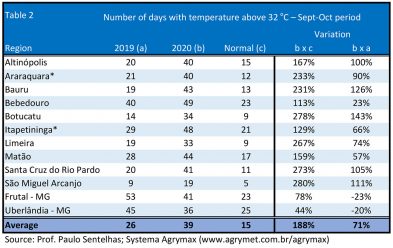
The period without rain, from May of this year until this last month of October, was one of the most extensive ever recorded in the state of São Paulo, according to the graphs and tables below. In addition to drought, very high maximum temperatures were recorded, even at night, causing considerable weight loss and lower fruit quality. The water deficit was very significant in all regions. This is the main reason for the significant decrease in the volume of fruit produced in the “citrus belt”. The losses are more accentuated in the north of the state of São Paulo and in the Triângulo Mineiro, warmer and drier regions.
- However, even further south in the state, losses were above normal. The first harvest estimate released by Fundecitrus, last May, brought an amount of 287.8 million boxes, 25% less than the previous harvest (2019/2020). What you see in the field is a volume of oranges quite below that number. The common perception among consulted technicians and citrus growers is that the final figure is expected to be below 250 million, perhaps below that.
- The period without rain and with temperatures well above the average resulted in extremely withered orchards – plants even died in orchards without irrigation. Another aggravating factor this year was the scarcity of water for irrigation. There are properties that have an installed irrigation structure; however, they do not have enough water available to meet the needs of the plants.
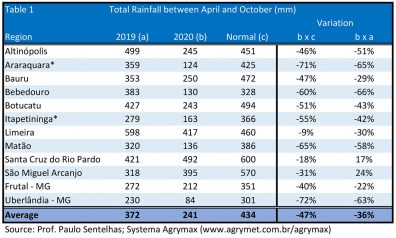 Due to the flowering in non-traditional months (December and January) there are a large number of “green”, not yet ripe fruits mixed with ripe fruits from the normal flowering (August-September 2019). This brings an additional difficulty to the harvesting operation that has to be carried out in at least two different times, resulting in an increase of the production cost for the citrus growers.
- This mix of fruits with different level of ripeness, impair the quality of the juices, especially due to the greater amount of limonin present in the green peels of oranges. On the other hand, in the northern regions of the citrus belt, the fruits are getting ripe much faster than normal, producing juices with a ratio (ratio between the amount of sugars divided to acidity) much higher than the average for the period of the year. Industrial income has been better this year than in the previous two years, at least until this time of the harvest (November 2020).
- As a further consequence of this year’s climate events, we will see an increase in the effects of HLB or greening. The symptoms of the disease, such as early fruit fall and low production, usually express themselves more strongly when there is a water deficit. In addition, the psilideo, vector of the disease, presented very high rates even in winter, indicating that we will have a greater number of infected plants in the next years. This has probably occurred because of the warmer climate which resulted in a very irregular or uneven plant vegetation.
What can we expect from the next crop?
The northernmost regions only flourished after the rains that fell in the last days of October. This late blooming should not have a good fruit set because they will be still small in the higher summer temperatures. Moreover, the loss of leaves was very great in the recent drought period, and this will not allow for a large amount of fruit for the next season, since the plant will not be able to provide the metabolites necessary for an expressive fruit set. A good 21/22 harvest is not to be expected for these regions.
In the most southern regions, which suffered less from water deficit, the flowering came in the normal period, between August and September. However, irregular rainfall and high winter temperatures (table 2), after flowering, have worried producers. What they see in their orchards does not indicate a good harvest for the second year in a row. My experience shows that the harvest after a year as irregular as this one is also not usually good.
Price of juice should go up
Although it is common for citrus to have alternate crops, i.e., smaller crops followed by larger crops, the climatic factors presented in this article should result in two “small” crops in a row, the current and the next seasons.
Thus, Brazilian orange juice industries should process fewer oranges for two consecutive years. This reduction in supply, combined with the growing demand for juices in times of pandemic, should cause increases in the price of juices on the international market.
Author:
Mauricio Mendes
Citrus Consultant
Agriplanning Brazilian Agribusiness Company
GCONCI (Citrus Consultant Group)
Mauricio Mendes is a citrus consultant sine 1980 and Citrus grower since 1988. Has worked to major Citrus Farms in Brazil. Is COO of a 6.000 ha Citrus Farms operation in the SW od Sao Paulo State. Mauricio is also Beachead Advisor for New Zealand Trade and Enterprise (NZTE) . Also has been partner and CEO, for 14 years, of Informa FNP which is one of the most important Agribusiness consultant company in Brazil. FNP was recently acquired by IHS Markit.
Mauricio is also member of GCONCI (Citrus Farming Consultants Group) which gathers 17 Consultants. GCONCI provide direct technical assistance to over 40 million citrus plants (25 % of the Brazilian Citrus Belt)
*Araraquara and Itapetininga are major production citrus regions in São Paulo State.
Although the harvesting of the 2020/21 orange crop is advancing in Brazil, delivery to processors in São Paulo State (SP) was slow in November. According to Cepea collaborators, this scenario is linked to the lack of rains in the citrus-producing regions in SP in the last months, which limited both quality and supply, hampering activities at processing plants. On the other hand, rainfall in late November increased ratio and brix, favoring the juice produced in that period.
As regards the deals for the coming season (2021/22), the large-sized processors of orange juice in SP have been more interested in closing deals. However, bids have not been fixed and there may be an additional for participation in juice sales to the international market. Most citrus farmers are waiting for a better definition of the crop, since it seems the bad weather conditions this year may affect results.
SPOT – In the current season, large-sized processors are bidding prices up to 24.00 BRL per 40.8-kilo box, while bids from smaller-sized processors have been up to 28.00 BRL/box – late and pear oranges account for the most varieties processed. In November (until Nov. 26), prices averaged 24.46 BRL/box, 20.7 % up from the average in Nov/19, in nominal terms.
However, it is worth to mention that one of the large-sized processors was not closing deals in the spot market in November because of both the low supply of higher quality and larger-sized fruits and the competition with the domestic market, since prices have been attractive in this segment, and farmers are opting for selling fruits in natura.
Orange prices have been on the rise in the Brazilian in natura market this month – the upward trend of quotes has been observed since July. Although the share of late varieties is increasing in the in natura market, in general, supply is low, while consumption is increasing sharply, due to the current high temperatures in Brazil.
Between October 1st and 15th, the average price for pear oranges was 36.52 BRL per 40.8-kilo box, on tree, 14.7 % higher than that in the first fortnight of September.
Low supply, mainly of high-quality oranges, is expected to keep prices on the rise in Brazil in the coming weeks. Besides, estimates for a 26 % decrease in the output of the 2020/21 crop should be revised, due to the drought and high temperatures in São Paulo State, which should reduce even more the volume harvested compared to the official estimates.
Data released in early October by the ABCM (Brazilian Association of In Natura Citrus) indicate that the 2020/21 citrus crops in São Paulo and in Minas Gerais States are, indeed, going to be lower. The drought faced by the sector in the major producing months hampered the development of fruits, which are small-sized. ABCM reported that, soon, the retail market and distributors may have lower supply of in natura citrus – or even a lack of products.
ABCM entrenches that the high temperatures and low rains between July and August damaged the fruits from the second flowering in the 2020/21 crop, which accounted for most of the output. In this scenario, agents believe that Fudencitrus’ next estimates, forecast to be released in December, may be revised down.
ORANGE JUICE – The 2020/21 orange crop in Florida was damaged by the hot and dry weather, which constrained groves’ productivity. Thus, the American orange output should be lower, which may lead the country to import higher amounts of orange juice. This scenario may favor the Brazilian sector, since Brazil is the top supplier of orange juice to the United States.
Between Oct/19 and Jul/20 (2019/20 season), the USA imported lower volumes of orange juice: 38 % of concentrated juice and 39.5 % of fresh juice, compared to that in the previous season, according to the Florida Department of Citrus (FDOC).
Although the Brazilian juice is losing market share to that from Mexico, the orange harvest from Mexico in the 2019/20 season (Nov/19 to Oct/20) decreased sharply, which may constrain juice production. According to the USDA, the Mexican supply should be 45 % lower than that in the previous season, and orange juice production, 60 % lower. Although initial inventories are high, juice supply should be 50 % lower.
However, it is worth to mention that the crops from São Paulo and the Triângulo Mineiro should also be lower in 2020/21. According to a report from Fundecitrus released last month, the harvest in the Brazilian citrus belt should total 286.72 million boxes, 26 % down compared to that in the previous season. This volume may decrease even more because of the drought in this region in the past months, which may even reduce supply in the 2021/22 season.
Consortium invests €10 million to realize sustainable ambitions of PeelPioneers
Dutch scale-up PeelPioneers is building Europe’s largest peel processing factory in Den Bosch, the Netherlands. Supermarkets, restaurants and hotels that offer freshly-squeezed orange juice to their customers now have an effective, sustainable way to dispose of their growing pile of peels. Supported by a strong consortium of investors, the new plant triples the company’s processing capacity to 120,000 thousand kilos of peels per day. PeelPioneers plans to expand into Europe with five new peel processing plants in the next five years.
The new factory builds on the strong trend in many European countries of consumers that increasingly appreciate freshly squeezed orange juice. In addition to scaling up production, the plant in Den Bosch will enable PeelPioneers to extract even more value from peels. In the factory’s laboratory, PeelPioneers’ scientists are developing new citrus peel products, such as dietary fibers that offer strength and structure to meat substitutes bakery products, and sauces and ensure the right mouth sensation. With this, PeelPioneers wants to contribute to the protein transition.
Proprietary pioneering technology
PeelPioneers’ proprietary pioneering technology provides a one hundred percent circular solution for these peels that in most countries end up getting destroyed in an incinerator. The company extracts orange oil and other much-wanted raw materials that food manufacturers use in products such as beer, lemonade, muffins and chocolate. The raw materials that PeelPioneers derives from orange peels are also sold to manufacturers of non-food products such as detergents and cosmetics.
Sytze van Stempvoort, co-founder of PeelPioneers: “With the growing demand for freshly squeezed juice, the number of peels is also growing. We make food from food. In this process, the entire incoming stream is retained in the food chain. With the new factory in Den Bosch, we will soon be able to save even more peels from the incinerator. We are scaling up to one hundred and twenty thousand kilos of peels a day: an Olympic swimming pool full”.
Strong investment consortium
PeelPioneers is actively supported by a strong investment consortium consisting of Rabobank, the Netherlands Ministry of Economic Affairs (Top Sector Energy Grant), het Nationale Groenfonds, Brabantse Ontwikkelings Maatschappij, European Circular Bioeconomy Fund, and initial investor DOEN Participaties.
European rollout
PeelPioneers is also exploring an European rollout, to take away the ever-growing pile of peels from supermarkets, hotels, and restaurants in target countries where the stream of orange peels is growing, while offering them a one hundred percent circular solution.
Bas van Wieringen, co-founder of PeelPioneers: “PeelPioneers is the largest producer of raw materials from citrus peels in Northwest Europe. In this way, we are responding to the growing need of our North-West European customers for a local supply chain. Thanks to the local
production of high-quality food ingredients, they are no longer dependent on seasonal oranges or transport from outside Europe. In this way, we contribute to the reduction of CO2 emissions”.
The dry weather and high temperatures in São Paulo State are concerning Brazilian citrus farmers. Besides limiting the supply of higher quality fruits in the current crop (2020/21), this scenario may affect the output next season (2021/22), since trees are very weak, and the current stage (fruit settlement) is very critical – some farmers have already reported fruitlet drops.
Data from Somar Meteorologia (weather forecast agency) show that it rained in southwestern SP (Avaré and surroundings) between May and June, while in central and northern state, precipitation was extremely low. In July, the scenario became worse, with mostly dry weather in all the areas – the monthly average of rains was below 10 mm.
In August, rains returned to SP, but were concentrated in the southwestern region – in some areas, the monthly rain volume hit 140 mm. Thus, this area is the least affected by the weather, with larger-sized fruits and, so far, higher flower settlement (for the fruits from the 2021/22 season). On the other hand, northern SP (Bebedouro and surroundings) has been the most affected region, mainly non-irrigated groves, with many trees almost totally dry and weak. In central SP, the scenario is concerning too, while in eastern SP, the situation is intermediate.
It is worth to mention that, concerning the output in the 2021/22 crop, the current development period is critical and largely influenced by the water availability in the soil, temperatures and air moisture.
Although it is still early to confirm, farmers have reported that settlement of the first flowering (which occurred mostly in mid-July) has been compromised in most regions. New flowering may occur if rains are enough to interrupt the water stress (more than 40 mm). In this context, flowering may be heterogeneous, depending on the region and plants conditions, which would result in trees with fruits in different development stages.
GREENING – High temperatures and low air moisture are also favoring an increase in the psyllids’ population. According to Fundecitrus (Citrus Defense Fund), the incidence of this bug in SP was high in the second fortnight of August, increasing the risk of spread in groves.
BRAZILIAN MARKET IN SEPTEMBER – With the high temperatures in Brazil, the sales pace has been fast in the market of in natura oranges. This scenario and the lower supply of quality fruits (due to low rains) underpinned pear orange prices in September. Between September 1 and 30, the average price for pear oranges closed at 32.78 BRL per 40.8-kilo box, on tree, 9.2 % up compared to that in August.
In the market of tahiti lime, prices oscillated in September, but drops were more frequent. The number of fruits within the standard required in the in natura market was low, since most of them are wilted and small-sized, due to low rains.
The average price for tahiti lime last month closed at 59.38 BRL per 27-kilo box, harvested, 16% down compared to that in August. With the new devaluations, prices are now lower than that in the same period last year, in nominal terms.
Citrus farms have 182 thousand hectares of native woods equivalent to one hectare of forest to every two and a half hectares of citrus
This year, the Crop Forecast Survey (PES) by Fundecitrus included a study in citriculture on the quantification of areas dedicated to the preservation of native vegetation and biodiversity on citrus farms in São Paulo and West-Southwest Minas Gerais, which showed that green areas total 181,750 hectares. The area allocated to citriculture on those same farms amounts to 459,058 hectares, i.e., there is one hectare dedicated to environmental preservation to every 2.52 hectares of citrus groves.
“For the first time it was possible to assess the environmental contribution of citriculture, which is quite considerable. This preserved fixed asset shows the commitment of the Brazilian citriculture to environmental sustainability”, says Fundecitrus general manager Juliano Ayres.
PES coordinator Vinícius Trombin explains that the perenniality of citriculture favors the preservation of flora and fauna, creating favorable conditions for animal life to thrive. “The bearing life of citrus trees is approximately 20 years, therefore intense earth moving is not frequent and the growing system involves low traffic of invasive equipment, keeping woods stable and safe to animals”, he clarifies. “Fruticulture also provides food to birds and small animals”, he adds.
Methodology by Embrapa Territorial
The quantification of the preserved area was based on a methodology developed by Empresa Brasileira de Pesquisa Agropecuária – Embrapa Territorial, with information of the complete mapping of the citrus belt performed by Fundecitrus in 2017 and data from the Rural Environmental Registry (RER).
According to head of Embrapa Territorial Evaristo de Miranda, information is relevant to protect the sustainability of the Brazilian production. “This work complements and enriches the analyses on the territorial dimension of areas designated to preservation of native vegetation by farmers who use the methods developed by Embrapa Territorial on their farms in the citrus belt with significant results, he comments.
Sustainable production
According to the Brazilian forest code, preservation of vegetation aims at conserving water resources, landscape, soil, biodiversity of flora and fauna and the well-being of the population.
In the assessment by researcher at the Instituto Internacional de Ecologia (IIE) José Galizia Tundisi, who specializes in the management of water resources, the rate between areas of native forests and citrus growing areas represents an important investment and a crucial example for sustainable production. “This initiative benefits not only the citrus production sector, but rather all society”, he states. “It has already been scientifically evidenced that areas of preserved native vegetation have quantitative and qualitative influence on the hydrological cycle and the spring water quality, as well as on the preservation of the land biodiversity”, he points out.
Biologist and researcher at the Centro de Estudos de Insetos Sociais of the Universidade Estadual Paulista (Unesp-Rio Claro) Osmar Malaspina also highlights the impact on the fauna. “These protected areas contribute to sustained biodiversity and help preserve pollinating species such as bees. The presence of pollinators generates a significant financial return to growers due to an increase of up to 50% in the quantity and quality of fruits produced”, he emphasizes.
In addition, data from the Instituto Brasileiro de Geografia e Estatística (IBGE) points to a large production of honey in the citrus belt. “Approximately 80% of the honey in the state of São Paulo is produced in cities where citrus is grown. In the region, the increase in honey production in the last decade was much greater than in cities that are not part of the citrus belt “, highlights Trombin.
In Aguaí (SP), the farm of citrus grower Richard Van Den Broek surpasses the 20% of preserved woods required by law. His family has been dedicated to citriculture for three generations, passing on the concern about the environment. In order to conserve the soil and the eight kilometers of the Itupeva river that cross the farm, the citrus grower employs no-till and contour farming. Animals such as puma, pampas deer, black capuchin and paca are often seen
– hunting and fishing are prohibited. Bees are kept in the woods as well.
“The farm was purchased in 2002 and already had a preservation area that demanded care, so all recommended good practices were adopted to maintain it”, he comments. “As long as growers respect the environment, they benefit the most, with preserved tributaries, water supply and a balanced ecosystem. We perceive that as wealth and are greatly pleased to know that flora and fauna are in harmony with citrus growing”, he says.
Orange Juice
Global orange juice production for 2019/20 is estimated to slip 23 percent to 1.6 million tons (65 degrees brix) as production in Brazil and Mexico tumbles as a result of fewer oranges expected to be available for processing. Consumption is projected to be flat (though not down) and global trade is estimated lower with the expected drop in exports from Brazil and Mexico. …
Please download the full report: https://apps.fas.usda.gov
The 2019-20 exporting season of orange juice and citrus by-products had a good performance. This result was already expected by the agents from the sector, who were based on the higher orange supply in the citrus belt from São Paulo State, which favored inventories building up at processors. With the covid-19 pandemic, agents also reported occasional higher demand for orange juice, due to the nutritional values of the product as well as higher breakfast consumption at home.
As regards orange juice, the volume of Frozen Concentrate Orange Juice Equivalent (FCOJ Equivalent) was higher, but revenue remained stable. According to data from Secex, between July/19 and June/2020, Brazil shipped 1.11 million tons of the product to all destination countries. Revenue from these shipments totaled 1.8 billion USD, stable compared to that in the previous season. In Real, revenue totaled 8.09 billion (boosted by the strong dollar), 16 % higher than that received in the 2018-19 season.
Despite the good exports performance to the European Union, the major purchaser of the Brazilian orange juice, shipments to the United States decreased, ending the season with an 11 % lower volume (174.76 thousand tons) and a 19 % lower revenue (276.93 million USD). Brazilian exports to the EU totaled 768.15 thousand tons, 20 % up compared to that in the previous season. Revenue totaled 1.26 billion USD, 7 % up in the same comparison.
As for the Brazilian exports of citrus by-products, revenue in dollar dropped during the season, totaling 369.43 million USD, 25 % lower than that received in 2018-19, according to Secex,. Among the products exported are citrus pulp pellets, citrus terpenes, d-limonene and lemon, lime and orange essential oils. Except for the citrus pulp pellets, prices for all the other by-products dropped sharply during the season.
For citrus pulp pellets, the average exports price increased during the season, but the volume shipped decreased. According to Cepea collaborators, this may be linked to the recent price rises for corn and soybean in the Brazilian market, which boosted the demand, primarily from livestock farmers, for citrus pulp pellets.
BRAZILIAN MARKET – Tahiti lime supply has been low in the major citrus-producing regions in São Paulo State. In this scenario, prices skyrocketed in June, hitting the highest average for the month, in nominal terms, in all Cepea series.
In general, tahiti lime quotes have been on the rise in the in natura market since April, due to the sales increase – related to the covid-19 pandemic – and the slower harvesting pace in May and in June – growers decided to control the harvesting in order to keep prices at higher levels. Thus, in late June, prices rose up to 60.00 BRL per 27-kilo box, harvested, averaging 32.42 BRL/box in the month, more than two-fold that registered in June 2019 (+124 %).
JULY – In the first fortnight of July, lower supply continued to push up prices in the Brazilian market. In general, quality was considered satisfactory, as well as fruits size and color, which favored exports. It is worth to mention that, in the first semester of 2020, the Brazilian shipments of lemon and lime hit a record for the period – compared to that in the same period last year, the volume exported was 12 % higher, and revenue, 7 % higher.
Between July 1st and 15, the average price for tathiti lime was 52.19 BRL per 27-kilo box, harvested, 59.6 % up compared to that in the first half of June. On the other hand, the demand from the industry continued low, with only two small-sized processors receiving tahiti lime (in Artur Nogueira and Itajobi, both in SP State). Remuneration varied according to quality, ranging from 12 to 15.00 BRL per 27-kilo box, harvested and delivered to processors.
ORANGE – The trading pace for in natura oranges was faster in the Brazilian market in the first fortnight of July. Although the demand for pear oranges did not increase much – because of the social distancing advice in many cities in São Paulo State –, the volume of early oranges available in the market decreased slightly (because of purchasers’ firm stance), underpinning prices.
Between July 1st and 15, the average price for pear orange was 26.01 BRL per 40.8-kilo box, on tree, 3 % up compared to that in the first half of June.
Citrus forecast
The 2019-2020 Florida all orange forecast released today by the USDA Agricultural Statistics Board is 67.7 million boxes. The total is comprised of 29.7 million boxes of non-Valencia oranges (early, midseason, and Navel varieties), unchanged from the June forecast, and 38.0 million boxes of Valencia oranges, unchanged from the June forecast. The forecast of all Florida grapefruit production is down 1 percent at 4.85 million boxes. Of the total grapefruit forecast, 790,000 boxes are white and 4.06 million boxes are the red varieties. The Florida all tangerine and tangelo forecast remains at 1.02 million boxes. …
Please download the full citrus crop production forecast: www.nass.usda.gov
Until May, only one of the large-sized processors was crushing oranges from the 2020/21 crop in São Paulo State (in Araraquara) and in June, three more plants started activities, one in Colina and the other two in Matão.
Although there were more plants crushing oranges in June and processors had started crushing the fruits purchased through contracts, the crushing pace was still slow compared to that in previous crops, due to the crop delay in most citrus-producing regions in Brazil, except for northern São Paulo, where fruits development was more advanced.
Most processors were crushing their own fruits or those previous purchased, however, one large-sized processors was purchasing oranges in the spot market. Bidding prices for pear or early oranges were ranging from 21.60 BRL and 24.00 BRL per 40.8-kilo box, harvested and delivered to processors, depending on fruits yield – when less than 290 boxes are needed to produce a ton of concentrate orange juice, remuneration is higher.
The volume of fruits available in the spot market this season is expected to be low, since the attractive prices paid to growers (up to 26.00 BRL/box) tend to increase the preference for purchases through contracts. It is worth to mention that, according to agents from processors, only a few growers have not traded their fruits from the 2020/21season yet.
BRAZILIAN MARKET IN JUNE – Sales were low in the in natura market in June, due to the colder weather in São Paulo. As restaurants are not working and schools are closed, the demand for larger-sized fruits was higher, resulting in a surplus of smaller-sized oranges. Although these fruits may be allocated to processors, pear oranges quotes did not rise last month. Between June 1 and 30, pear orange prices averaged 25.26 BRL per 40.8-kilo box, on tree, stable (-0.1%) compared to that in May.
As regards tahiti lime, agents reported a slight reaction in the demand in late June – both domestic and international. Besides, the harvesting pace was controlled, in order to avoid price drops. Thus, amid lower supply, prices increased in June. The average price for tahiti lime last month closed at 29.49 BRL per 27-kilo box, harvested, 9.9% higher than that in May.
The Brazilian exports of Frozen Concentrate Orange Juice (FCOJ) Equivalent (2019/20 crop) are ending, and the volume sold to all destinations continues higher than that last season.
From July/19 to May/20, Brazil shipped 1.03 million tons of juice, 13 % more than that exported in the first 11 months of the 2018/19 season (913.4 thousand tons), according to data from Secex. Revenue, in turn, rose by 1 % (in the same comparison), totaling 1.7 billion USD.
To the European Union, specifically, Brazilian juice shipments totaled 723.7 thousand tons, 23 % up compared to that in the same period last season (587.7 thousand tons). Revenue amounted 1.2 billion USD, for an increase of 10 %. To the United States, Brazilian exports have decreased by 19 % this season, to 154.5 thousand tons, and the revenue downed 25 %, to 248.96 million USD.
Low demand explains the decrease in the volume sent to the US, due to the forecast for a recovery in the 2019/20 season in Florida for the second consecutive year. The state has faced several problems involving weather and plant health this season and in previous crops.
However, due to the covid-19 pandemic, juice sales in the American retail market have increased significantly – data from Nielsen indicate that, this season (from October/19 to April 11, 2020), the volume sold was 6.1 % higher than that in the same period of the crop before.
In this scenario, local juice stocks are being consumed. Although inventories are higher than that in the season before, projections indicating an increase in stocks are lower than those at the beginning of the year.
BRAZILIAN MARKET IN JUNE – The trading pace for citrus was weak in the first half of June, but the volume of oranges available in the in natura market was lower, since processing plants were receiving fruits in that period. Therefore, the average price for pear oranges in the first fortnight of the month was 25.25 BRL per 40.8-kilo box, 4.7 % down compared to that in the first half of May.
Players surveyed by Cepea reported higher sales of ponkan tangerine in São Paulo between June 1 and 15. Thus, the harvesting of this variety stepped up in that period, so that growers could take advantage of the high price levels, although fruits have not reached the ideal maturation stage yet.
All Oranges 67.7 Million Boxes
The 2019-2020 Florida all orange forecast released today by the USDA Agricultural Statistics Board is 67.7 million boxes, down 3 percent from the May forecast. The total includes 29.7 million boxes of the non-Valencia oranges (early, midseason, and Navel varieties) and 38.0 million boxes of Valencia oranges.
Please download the full citrus crop production forecast: www.nass.usda.gov
All Oranges 69.7 Million Boxes
The 2019-2020 Florida all orange forecast released by the USDA Agricultural Statistics Board is 69.7 million boxes, down 1 percent from the April forecast. If realized, this will be 3 percent less than last season’s revised final production. The total includes 29.7 million boxes of the non-Valencia oranges (early, midseason, and Navel varieties) and 40.0 million boxes of Valencia oranges.
Please download the full citrus crop production forecast: www.nass.usda.gov
In April, the citrus growers from São Paulo State fastened the harvesting pace of the 2020/21 orange crop. Although supply was not high, the volume harvested was enough to press down citrus quotes in the in natura market during the month. Besides, the demand for oranges decreased in April, due to the social distancing advice – because of the coronavirus pandemic –, constraining fruits sales to restaurants and other food services. Supply should continue higher than demand in May, which has been concerning citrus growers about prices.
As regards early varieties (rubi, hamlin and western, for instance), deals have been closed since March. However, only in late April these fruits were near the ideal maturation stage, when baía oranges started to be supplied. Sales and the harvesting of these varieties should step up from May, but the crop peak should occur only in June, when crushing is supposed to start. In April, the average price for hamlin oranges was 25.02 BRL per 40.8-kilo box, on tree, 18.7% down compared to that from March.
For pear oranges, the gradual decrease in the demand pressed down quotes in April. Thus, the average price for this variety was 8.15% lower than that from March, closing at 32.47 BRL per 40.8-kilo box, on tree. According to Cepea collaborators, the harvesting of the first pear oranges in the 2020/21 crop should step up from the second fortnight of May, once crops development is late and phased. However, some growers preferred to anticipate the pear orange harvesting, aiming to take advantage of the price levels – these citrus growers fear that prices may drop sharply in May, due to forecasts for higher volumes of early oranges in the market.
As regards processors, although supply is forecast to increase in May, crushing should be lower early in the month. This scenario has led the early fruits to be exclusively allocated to the in natura market. On the other hand, late oranges harvesting (valencia, natal and folha murcha) should end in the coming weeks.
Crop loss of 25.6 % in relation to previous crop is due to lower nutrient reserves in plants and adverse climatic conditions
The 2020-2021 orange crop for the São Paulo and West-Southwest Minas Gerais citrus belt is estimated at 287.76 million boxes of 40,8 kg, according to the online announcement made May 11 by Fundecitrus. This number is 25.6 % smaller than the previous crop of 386.79 million boxes, and 12.5 % below the average crop size for the last 10 years. Approximately 20.56 million boxes are expected to be produced in the Triângulo Mineiro.
Expected yield is estimated at 790 boxes per hectare, as compared to the 1,045 boxes per hectare in the previous crop.
“It is a small crop, considering the productive potential of groves, but that is due to the biennial production cycle of orange trees”, explains Fundecitrus general manager Juliano Ayres. “Since the previous crop was large, nutrient reserves this year are smaller. In addition, climatic conditions were adverse during fruit setting and the first phase of fruit growth”, he states.
Influence of the climate and late blooms
Crop loss was caused by a reduced number of fruits per tree in comparison to the previous crop. The large production in the previous season increased the consumption of nutrient reserves in plants, which became scarce and triggered the phenomenon known as alternate bearing. Furthermore, the climate was also a negative influence: high temperatures in September and October 2019 affected the setting of newly formed fruit.
Adverse climatic conditions were also seen in March and April 2020, affecting fruit at a more advanced stage of development. According to data from Somar Meteorologia, the accumulated rainfall volume in that period was not even half the historical average (1981-2010), which restricted fruit growth.
245.15 million boxes of the estimated production are of fruit from the first and second blooms (85.2 % of the total), 34.64 million boxes are of fruit from the third bloom (12 %) and 7.97 million boxes are of fruit from the fourth bloom (2.8 %).
Dry weather in March and April 2020 restricted the growth of fruits that should still be small at harvest. Oranges are expected to weigh 159 grams at harvest.
Alternate bearing in regions
Yield per sector this crop season, as compared to last year’s, shows significant variations among locations. The Northwest sector, encompassing the regions of Votuporanga and São José do Rio Preto, ranks first in yield drop. 492 boxes per hectare expected to be produced in that sector represent a drop of 46.7 % in relation to the 2019-2020 crop. Next comes the North sector (regions of Triângulo Mineiro, Bebedouro and Altinópolis), with an expected yield of 686 boxes per hectare (-35.9 %); then the Central sector (regions of Matão, Duartina and Brotas), with 721 boxes expected per hectare (-30.1 %); the South sector (regions of Porto Ferreira and Limeira), with 781 boxes expected per hectare (-16.5 %); and the Southwest (regions of Avaré and Itapetininga), where 1.185 boxes should be harvested per hectare (-2.7 %) (see the graph below).
“The greater drop in yield expected for this current crop, the larger the increment observed in the previous crop. This is one evidence of the biennial production cycle of orange trees, showing that usually the fruit load one year is inversely proportional to the fruit load in the previous year, causing variations in yield per hectare that alternate with the crop seasons”, analyzes PES coordinator Vinícius Trombin. “But the main reason for crop fluctuations is the climatic change that often occurs from one year to the next. In regions with more stable climate, such as Avaré and Itapetininga, yield variations are smaller”, adds the survey coordinator.
Recovery of orange juice consumption
The São Paulo and West-Southwest Minas Gerais citrus belt is the largest worldwide producer of orange for processing. According to PES methodological coordinator and Professor at USP and FGV Marcos Fava Neves, the 2020-2021 crop and the inventory volume are now balanced due to the recovery of the demand for juice, heated up in major markets as a result of the COVID-10 pandemic.
“In view of an attempt to boost immunity, the citrus sector sees an increasing consumption of orange juice. It is an extremely nutritious liquid food”, he states.
Citriculture and sustainability
This year, based on methodology developed by Embrapa Territorial, PES has estimated the area of conserved woods on citrus farms: 182 thousand hectares throughout the citrus belt. On average, there is one hectare dedicated to conservation on farms for every 2.52 hectares of citrus groves. Data was obtained from cross-checking the information collected in the field by Fundecitrus with data from the Rural Environmental Registry (CAR).
“This work shows the important role of citriculture in environmental conservation and biodiversity, with large conserved areas integrated within farms”, says Trombin.
Methodology
For the estimate, orange trees were counted one by one in 2,557 plots and fruits from 1,590 trees were harvested throughout the citrus belt. “The reduced number of samples due to COVID-19 caused minor impact in the general survey result, which can be verified by the error of ±2.65% in the average number of fruits per tree”, PES methodology analyst and Professor at the department of engineering, math and science at FCAV/Unesp José Carlos Barbosa states.
The Crop Forecast Survey is carried out by Fundecitrus in cooperation with Markestrat, school of economics, business administration and accounting (FEA) of the university of São Paulo (USP) and the “Júlio de Mesquita” school of agricultural science and veterinary medicine (FCAV) of the São Paulo state university (Unesp).
Please download the complete forecast under: www.fundecitrus.com.br/pdf
Orange supply should continue to increase in São Paulo State in April. Although some oranges among the early varieties were traded in March, this month, availability should grow, offsetting the low supply of pear oranges in the market. Still, supply should not be considered high, since flower settlement in the first flowerings was reduced.
Thus, the upward trend of orange prices, observed until March, has been interrupted. Demand, in turn, should be affected (positively and negatively) by the covid-19 pandemic – on the one hand, citrus fruits are supposed to strengthen immunity, on the other hand, the demand for school meals, company meals and from food services should continue low.
It is also important to mention that the oranges from SP should reach the ideal maturation stage this month, which may allow these fruits to stay longer on trees while demand is low. However, growers tend to opt for closing deals at this time of the year, before availability grows too much (possibly pressing down quotes), from May.
Besides, crushing is currently at a slow pace at the processing plants from SP, and should step up again only in May, when early varieties start to be crushed. Thus, this month, oranges should be allocated exclusively to the in natura market and small-sized processors. However, as the market has been oscillating and uncertain, due to the changes caused by the pandemic, orange prices may rise again, changing the scenario forecast by growers.
TAHITI LIME – As the fruits from the second flowering have ripened, supply should continue high between April and early May. Quality should be high, reflecting the regular rains in March. Still, it should be lower than that available in the first quarter of the year (crop peak period). In this scenario, a considerable supply with fruits within the required standard may continue to favor exports if international demand keeps firm.
In the first quarter of 2020, the Brazilian exports of lemon and lime were records for the period. According to data from Secex, Brazil shipped 34.7 thousand tons of these fruits, a staggering 46 % up compared to that in the same period last year. Revenue, in turn, totaled 25.9 million USD in January, February and March, 42 % higher in the same comparison.
Orange production for the 2019-2020 crop season totals 386.79 million boxes1
The final 2019-2020 orange crop forecast for São Paulo, Triângulo Mineiro and West-Southwest Minas Gerais citrus belt, published on April 09, 2020 by Fundecitrus – performed in cooperation with Markestrat, FEA-RP/USP and FCAV/Unesp2 – is 386.79 million boxes of 40.8 kg each, which represents a decrease of 0.54 % in relation to the first crop forecast carried out in May 2019 of 388.89 million boxes. This crop is 35.3 % larger in comparison to the previous season (2018-2019), when 285.98 million boxes were produced, evidencing the biennial production cycle of orange trees, that is, larger crops alternated with smaller ones. …
1Hamlin, Westin, Rubi, Valencia Americana, Seleta, Pineapple, Pera Rio, Valencia, Valencia Folha Murcha and Natal.
2Departament of Math and Science at FCAV/Unesp Campus Jaboticabal.
Please download the complete forecast under: www.fundecitrus.com.br/pdf
Researchers at Western University are studying a molecule found in sweet oranges and tangerines called nobiletin, which they have shown to drastically reduce obesity in mice and reverse its negative side-effects.
But why it works remains a mystery.
New research published in the Journal of Lipid Research demonstrates that mice fed a high-fat, high-cholesterol diet that were also given nobiletin were noticeably leaner and had reduced levels of insulin resistance and blood fats compared to mice that were fed a high-fat, high-cholesterol diet alone.
“We went on to show that we can also intervene with nobiletin,” said Murray Huff, PhD, a Professor at Western’s Schulich School of Medicine & Dentistry who has been studying nobiletin’s effects for over a decade. “We‘ve shown that in mice that already have all the negative symptoms of obesity, we can use nobelitin to reverse those symptoms, and even start to regress plaque build-up in the arteries, known as atherosclerosis.”
But Huff says he and his team at Robarts Research Institute at Western still haven’t been able to pinpoint exactly how nobiletin works. The researchers hypothesized that the molecule was likely acting on the pathway that regulates how fat is handled in the body. Called AMP Kinase, this regulator turns on the machinery in the body that burns fats to create energy, and it also blocks the manufacture of fats.
However, when the researchers studied nobiletin’s effects on mice that had been genetically modified to remove AMP Kinase, the effects were the same.
“This result told us that nobiletin is not acting on AMP Kinase, and is bypassing this major regulator of how fat is used in the body,” said Huff. “What it still leaves us with is the question – how is nobiletin doing this?”
Huff says while the mystery remains, this result is still clinically important because it shows that nobiletin won’t interfere with other drugs that act on the AMP Kinase system. He says current therapeutics for diabetes like metformin for example, work through this pathway.
The next step is to move these studies into humans to determine if nobiletin has the same positive metabolic effects in human trials.
“Obesity and its resulting metabolic syndromes are a huge burden to our health care system, and we have very few interventions that have been shown to work effectively,” said Huff. “We need to continue this emphasis on the discovery of new therapeutics.”
Opposite to the expected by the agents from the Brazilian citrus sector, tahiti lime prices increased in São Paulo State in March, despite the crop peak. The boost came from higher demand, since, in the second fortnight of the month, people were trying to eat healthier, increasing the consumption of vitamin C, because of the coronavirus outbreak worldwide.
However, most of the demand was linked to the increase in the purchases from distributors, retailers and consumers for stocking. Besides, the closure of schools, street markets and grocery stores, and lower sales in restaurants may also reduce the demand for the fruit.
In March, the average price for tahiti lime was 22.2 % higher than that in February, at 12.52 BRL per 27-kilo box.
As regards exports, agents reported a decrease in the volumes shipped, since the coronavirus outbreak affected Europe more severely, so far. Besides, the lower availability of containers for exports and the cancelation of air deliveries also reduced sales to the international market. Thus, tahiti lime prices for exports were lower than quotes in the Brazilian market in March, averaging 12.29 BRL per 27-kilo box.
ORANGE – The demand for oranges was firm in March, and prices remained stable in the Brazilian market. According to growers, the quarantine decree in São Paulo State and the consequent halt in some activities reduced labor, limiting supply and logistic operations. Thus, orange availability was low and, now, many agents are waiting for some early varieties, such as westin and rubi, to ripen in order to start trading.
In March, the average price for pear oranges was 35.35 BRL per 40.8-kilo box, on tree, 6.9 % up compared to that in February. The maturation stage requested by the in natura market is forecast to be reached in most groves between April and May.