The WCO Secretariat has released its first crop production forecast for the forthcoming Northern Hemisphere citrus season 2020-21. The preliminary forecast is collected from industry associations in Egypt, Greece, Israel, Italy, Morocco, Spain, Tunisia, Turkey and the United States (California and Florida).
The preliminary forecast shows that the 2020-21 citrus Northern Hemisphere crop is expected to reach 28.737.570 T, which represents a decrease of slight decrease of 1 % compared to the 2019 crop. This decreased volume is the result of alternance in some countries compared to last year, as well as the impact of the droughts recorded in several production regions in the Northern Hemisphere.
By citrus categories, most categories showed decreases in production. Orange is expected to decrease by 2 %, lemon by 7 % and grapefruit by 9 %. The only category increasing production volumes compared to the previous year is soft citrus (+5 %). Looking at production by region, European production is expected to experience an increase in volume, with 12 % increases recorded for both Italy and Spain, respectively, and a 1 % decrease for Greece. In the Southern rim of the Mediterranean, crop forecasts for Egypt (-8 %), Israel (- 4 %) and Turkey (-15 %) have been lowered compared to 2019 volumes. On the other hand, Morocco and Tunisia forecast increases in their citrus crops this year, by 13 % and 20 % respectively compared to 2019 figures. On its side, the United States production is expected to decrease by 9 % compared to the precedent year, with California lowering its forecast by 5 % and Florida by 14 %.
WCO will present this forecast during the first edition of the Global Citrus Congress, which the World Citrus Organisation is co-organising with Fruitnet. The Congress with an expected attendance of more than 1.000 delegates will be the perfect opportunity to presents these latest global production figures and trade trends, as well as the importance of sustainability in citrus production and of nutrition and promotion to increase global citrus consumption.
WCO Members are ABCM- Associação Brasileira de Citrus de Mesa (Brazil), Ailimpo – Asociación Interprofesional de Limón y Pomelo (Spain), AKIB – Mediterranean Fresh Fruit and Vegetables Exporters Association (Turkey), Citrus Australia (Australia), Citrus Growers’ Association (South Africa), Chilean Citrus Committee (Chile), Fruitimpresse (Italy), Moroccan Interprofessional Citrus Federation – Maroc Citrus (Morocco), Plant Production Marketing Board (Israel), Procitrus – Asociacion de Productores de Citricos del Peru (Peru), Upefruy – Unión de Productores y Exportadores de Fruta del Uruguay (Uruguay). WCO Associated Members are AgroFresh (Spain), AM FRESH Group (Spain), Citrusvil (Argentina), Easyfresh Logistics (Spain), FruitOne (South Africa), G.F. Marketing (South Africa), Janssen Preservation and Material Protection (Belgium), MAFA-Magrabi Agriculture (Egypt), Morocco Foodex (Morocco), Oranfrizer (Italy), PCN (USA), River Front Packing (USA), San Miguel Global (South Africa) and Zalar Agri-Agricole Centre (Morocco).
Prognosfruit’s 2020 European apple and pear crop forecast revealed that most European countries are expecting an overall stable apple and pear crop for the coming season. On 6 August 2020, more than 150 international representatives from the apple and pear sector joined the Prognosfruit 2020 Online Conference, the first ever virtual version of the event in its 45 years to discuss the 2020 forecast.
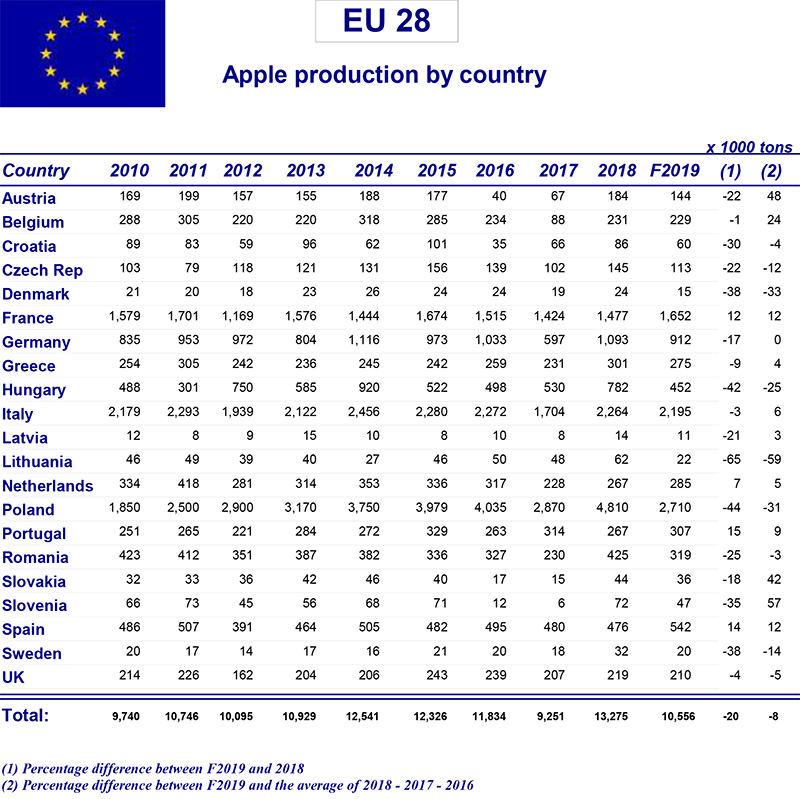
During the conference, the World Apple and Pear Association (WAPA) released the 2020 European apple and pear crop estimate. In 2020, the apple production in the EU for the 21 top producing countries contributing to this report is estimated to be just slightly below last year’s result, with a 1 % decrease and a crop of 10.711,000 T. Overall, this year’s crop is estimated to be 4 % lower than the 3- year average. On the other hand, the EU pear crop for 2020 is estimated to increase by 12 % compared to last year to 2.199.000 T. However, a revision of some of the figures presented at Prognosfruit is to be expected in the upcoming weeks. WAPA will continue to monitor the developments of the Northern Hemisphere crop and will issue updates when appropriate.
The virtual conference featured a presentation of the forecast for apples and pears by WAPA Secretary General Philippe Binard, a market analysis by AMI Market Analyst Helwig Schwartau, an overview of the latest trends in processing by Austria Juice CEO Franz Ennser and for organic by Europäisches Bioobst-Forum President Fritz Prem, as well as two panel discussions for apples and pears respectively.
Earlier this year, the Prognosfruit 2020 organisers announced the cancellation of the event, scheduled to take place in Belgrade (Serbia), due to the uncertainties of the COVID-19 pandemic. However, due to popular demand the event was rescheduled as a a virtual conference. Belgrade will now host Prognosfruit in 2021 instead.
(Photo: WAPA)
Citrus forecast
The 2019-2020 Florida all orange forecast released today by the USDA Agricultural Statistics Board is 67.7 million boxes. The total is comprised of 29.7 million boxes of non-Valencia oranges (early, midseason, and Navel varieties), unchanged from the June forecast, and 38.0 million boxes of Valencia oranges, unchanged from the June forecast. The forecast of all Florida grapefruit production is down 1 percent at 4.85 million boxes. Of the total grapefruit forecast, 790,000 boxes are white and 4.06 million boxes are the red varieties. The Florida all tangerine and tangelo forecast remains at 1.02 million boxes. …
Please download the full citrus crop production forecast: www.nass.usda.gov
In MY 2019/20, EU citrus production is projected to lower 11 percent to 10.4 MMT. This production forecast is four percent higher than previous estimates. Unfavorable weather conditions in Spain, the EU’s main citrus producer, accounts for the projected drop in overall production. The decline in EU citrus production may encourage EU imports while EU citrus exports remain flat in response to higher domestic EU demand. Strategic export markets destinations for EU citrus continue to be Canada, the Middle East, and China. In MY2019/20, U.S. tariffs related to the World Trade Organization Case against EU aircraft subsidies will likely impact Spanish exports of clementines and lemons. During the Covid-19 pandemic, domestic demand for citrus held strong as consumers looked for foods to strengthen the immune system. As of the date of this report, EU citrus exports have not been directly impacted by the pandemic. …
Despite the initial scare for the beer and cider market, expectation is that new 2022 forecasts, which falls short of the original baseline expectations, could have been much worse, says GlobalData, a leading data and analytics company.
According to the company’s recent (June 5) COVID-19 adjusted forecasts, the global beer and cider market will recover to 2019 value by 2022, reaching US$630.4bn in 2022; this represents a difference of -US$55.4bn against the previous baseline value of that same year*.
Aaron Bryson, Consumer Analyst at GlobalData, comments: “The substantial shrinkage is a reflection of the damage caused by a nonexistent foodservice channel throughout much of the year. In contrast, consumer confidence, which was initially decimated but rebounded relatively quickly, saw consumers retreating to the comfort of their own home with their favorite brands of beer and cider, as opposed to at the local pub.”
According to GlobalData’s Week 10 COVID-19 tracker consumer survey, published on June 3, 43 % of global respondents still expect the situation to get worse over the next month in their respective countries*2. Despite this, consumers purchasing habits in relation to beer and cider have largely been maintained. The same survey found that 45 %*3 of respondents have been purchasing the same amount or more beer, since the outbreak of COVID-19. In contrast, only 28 %*4 of respondents stated that they had reduced or stopped buying beer since the outbreak.
A similar story is seen with cider. The survey found that 33 %*3 of respondents had maintained or increased the volume of cider they purchase, and 28 %*4 had also reduced or stopped purchasing cider, since the outbreak.
Bryson continues: “The original concern displayed at the beginning of the outbreak had limited longer impacts upon beer and cider sales. A key reason being that, at home drinking is part of a routine for certain consumer cohorts in which they derive both pleasure and comfort. Something which most people have been looking for since the outbreak.”
Whilst the outlook for the beer industry is expected to lag behind pre-COVID-19 expectations, the immediate fallout, which posed a challenging landscape for big and small players alike, has largely leveled out. Consumers have shown a preference to fall back on familiar brands which they derive enjoyment from, with a willingness to pay a premium price, instead of switching to cheaper alternatives.
*GlobalData’s COVID-19: COVID-19 Impact Market Model – Consumer Goods – June 5 update – value US$ *2GlobalData’s Coronavirus (COVID-19) Tracker Consumer Survey – Week 10 (June 3) – global – a bit/lot worse responses combined GlobalData’s Coronavirus (COVID-19) Tracker Consumer Survey – Week 10 (June 3) – global – *3started buying/same/more/significantly more/stockpiling responses combined, *4 buying slightly lower/significantly lower/stopped altogether responses combined Data is adjusted weekly following COVID-19 developments, therefore subject to change
All Oranges 67.7 Million Boxes
The 2019-2020 Florida all orange forecast released today by the USDA Agricultural Statistics Board is 67.7 million boxes, down 3 percent from the May forecast. The total includes 29.7 million boxes of the non-Valencia oranges (early, midseason, and Navel varieties) and 38.0 million boxes of Valencia oranges.
Please download the full citrus crop production forecast: www.nass.usda.gov
Following the formal adoption of the organisation’s Statutes in March 2020, the WCO Secretariat just collected and released the first crop production and export forecasts for the forthcoming Southern Hemisphere citrus season 2020. The preliminary forecast is collected from industry associations in Argentina, Australia, Chile, Peru, South Africa, and Uruguay. The Secretariat is working closely with Brazil and Bolivia to include their data as well into the forecast very shortly.
The preliminary forecast shows that the 2020 citrus Southern Hemisphere crops is expected to reach 8.387.341 T, which represents a small decrease of 3 % compared to the 2019 crop. Export is expected to increase by 12 % to 3.486.883 T, which could be explained as a result of consumers’ higher demand for citrus fruit in COVID-19 times, thanks to the nutritional benefits associated with citrus and more home consumption. On the processing side, a total of 2.426.154 T of citrus are expected to be destined to the juice market (pending the confirmation of Brazil’s data), which constitutes a decrease of 15 % compared to 2019.
By citrus categories, the soft citrus and lemon & lime markets show stable figures, with similar production volumes compared to 2019, whereas orange showed a small decrease (-6 %), and grapefruit production increased by 3 percent compared to the previous year. Expected export volumes show increases across all categories, with lemon & lime projecting the greatest increase, by 32 % compared to 2019.
WCO is now fully operational with a complete agenda of activities for 2020. In July, a meeting of the membership will review the state of the industry and take stock of the latest consumer trends and producing countries’ experiences in the midst of the coronavirus crisis. Indeed, in the past months, citrus has been highlighted as one of the most attractive fruit categories for consumers, given their health properties. Consequently, the issue of nutrition and promotion of citrus consumption will also be discussed with members in the upcoming meeting.
All Oranges 69.7 Million Boxes
The 2019-2020 Florida all orange forecast released by the USDA Agricultural Statistics Board is 69.7 million boxes, down 1 percent from the April forecast. If realized, this will be 3 percent less than last season’s revised final production. The total includes 29.7 million boxes of the non-Valencia oranges (early, midseason, and Navel varieties) and 40.0 million boxes of Valencia oranges.
Please download the full citrus crop production forecast: www.nass.usda.gov
Crop loss of 25.6 % in relation to previous crop is due to lower nutrient reserves in plants and adverse climatic conditions
The 2020-2021 orange crop for the São Paulo and West-Southwest Minas Gerais citrus belt is estimated at 287.76 million boxes of 40,8 kg, according to the online announcement made May 11 by Fundecitrus. This number is 25.6 % smaller than the previous crop of 386.79 million boxes, and 12.5 % below the average crop size for the last 10 years. Approximately 20.56 million boxes are expected to be produced in the Triângulo Mineiro.
Expected yield is estimated at 790 boxes per hectare, as compared to the 1,045 boxes per hectare in the previous crop.
“It is a small crop, considering the productive potential of groves, but that is due to the biennial production cycle of orange trees”, explains Fundecitrus general manager Juliano Ayres. “Since the previous crop was large, nutrient reserves this year are smaller. In addition, climatic conditions were adverse during fruit setting and the first phase of fruit growth”, he states.
Influence of the climate and late blooms
Crop loss was caused by a reduced number of fruits per tree in comparison to the previous crop. The large production in the previous season increased the consumption of nutrient reserves in plants, which became scarce and triggered the phenomenon known as alternate bearing. Furthermore, the climate was also a negative influence: high temperatures in September and October 2019 affected the setting of newly formed fruit.
Adverse climatic conditions were also seen in March and April 2020, affecting fruit at a more advanced stage of development. According to data from Somar Meteorologia, the accumulated rainfall volume in that period was not even half the historical average (1981-2010), which restricted fruit growth.
245.15 million boxes of the estimated production are of fruit from the first and second blooms (85.2 % of the total), 34.64 million boxes are of fruit from the third bloom (12 %) and 7.97 million boxes are of fruit from the fourth bloom (2.8 %).
Dry weather in March and April 2020 restricted the growth of fruits that should still be small at harvest. Oranges are expected to weigh 159 grams at harvest.
Alternate bearing in regions
Yield per sector this crop season, as compared to last year’s, shows significant variations among locations. The Northwest sector, encompassing the regions of Votuporanga and São José do Rio Preto, ranks first in yield drop. 492 boxes per hectare expected to be produced in that sector represent a drop of 46.7 % in relation to the 2019-2020 crop. Next comes the North sector (regions of Triângulo Mineiro, Bebedouro and Altinópolis), with an expected yield of 686 boxes per hectare (-35.9 %); then the Central sector (regions of Matão, Duartina and Brotas), with 721 boxes expected per hectare (-30.1 %); the South sector (regions of Porto Ferreira and Limeira), with 781 boxes expected per hectare (-16.5 %); and the Southwest (regions of Avaré and Itapetininga), where 1.185 boxes should be harvested per hectare (-2.7 %) (see the graph below).
“The greater drop in yield expected for this current crop, the larger the increment observed in the previous crop. This is one evidence of the biennial production cycle of orange trees, showing that usually the fruit load one year is inversely proportional to the fruit load in the previous year, causing variations in yield per hectare that alternate with the crop seasons”, analyzes PES coordinator Vinícius Trombin. “But the main reason for crop fluctuations is the climatic change that often occurs from one year to the next. In regions with more stable climate, such as Avaré and Itapetininga, yield variations are smaller”, adds the survey coordinator.
Recovery of orange juice consumption
The São Paulo and West-Southwest Minas Gerais citrus belt is the largest worldwide producer of orange for processing. According to PES methodological coordinator and Professor at USP and FGV Marcos Fava Neves, the 2020-2021 crop and the inventory volume are now balanced due to the recovery of the demand for juice, heated up in major markets as a result of the COVID-10 pandemic.
“In view of an attempt to boost immunity, the citrus sector sees an increasing consumption of orange juice. It is an extremely nutritious liquid food”, he states.
Citriculture and sustainability
This year, based on methodology developed by Embrapa Territorial, PES has estimated the area of conserved woods on citrus farms: 182 thousand hectares throughout the citrus belt. On average, there is one hectare dedicated to conservation on farms for every 2.52 hectares of citrus groves. Data was obtained from cross-checking the information collected in the field by Fundecitrus with data from the Rural Environmental Registry (CAR).
“This work shows the important role of citriculture in environmental conservation and biodiversity, with large conserved areas integrated within farms”, says Trombin.
Methodology
For the estimate, orange trees were counted one by one in 2,557 plots and fruits from 1,590 trees were harvested throughout the citrus belt. “The reduced number of samples due to COVID-19 caused minor impact in the general survey result, which can be verified by the error of ±2.65% in the average number of fruits per tree”, PES methodology analyst and Professor at the department of engineering, math and science at FCAV/Unesp José Carlos Barbosa states.
The Crop Forecast Survey is carried out by Fundecitrus in cooperation with Markestrat, school of economics, business administration and accounting (FEA) of the university of São Paulo (USP) and the “Júlio de Mesquita” school of agricultural science and veterinary medicine (FCAV) of the São Paulo state university (Unesp).
The latest research from Mintel* reveals the online grocery market is forecast to grow by 33 % in 2020 to reach an estimated value of £16.8 billion, up from £12.7 billion in 2019. This phenomenal rise follows four consecutive years of slowing growth: in 2019 growth fell to a historic low of just 2.9 %. The market is set to be worth £17.9 billion by 2024, growing by 41 % over the five year period.
Online shopping behaviour as a whole
This comes as Mintel reveals a dramatic change in online shopping habits over the COVID-19 lockdown period, habits that Mintel believes could prove lasting. In the very early days of the spread of the coronavirus in the UK, before social distancing measures were announced, 7 % of Brits increased the total amount of online shopping (both food and non-food)**. In the space of fewer than two months, online shopping has seen a dramatic boost with the number of consumers who say they’ve increased their online shopping rising to 36 %***.
Meanwhile, 50 % of Brits have tried to limit the time they spend in-store, while a further 9% have used click-and-collect more ***.
Nick Carroll, Associate Director of Retail Research at Mintel, said: “Over the course of just a few months, COVID-19 has had a seismic impact on Britain’s grocery sector. The pandemic is giving a significant short-term boost to online grocery services, as shoppers look to avoid stores and limit their contact with the outside world. However, the impact will last beyond the crisis. Shopper numbers in the online grocery market have plateaued in recent years as retailers struggled to get new customers to try these services. The outbreak is bringing a new audience to online grocery, and this should boost the market long term with strong growth forecast through to 2024. While there is currently a significant disruption to the online grocery market, with some retailers not accepting new customers, this will ease in the short-term as more capacity is brought online.”
Over 65s still face challenges shopping online
The current guidelines, which ask those aged 70 and over to remain at home, mean that older shoppers are more heavily reliant on having groceries and other goods delivered. But while some older Brits are experienced in ordering online, they are by far the minority. Less than three in 10 (28 %) UK internet users aged 65+ were online grocery shoppers prior to the COVID outbreak****. However, Mintel’s latest research shows that 37 % of over 65s have increased the amount of online shopping they’ve done since the outbreak began***.
But while some Brits are going online for their grocery requirements, many are relying on the kindness of friends and family – as a quarter (24 %) of consumers aged under 44 say they have been helping friends/family and/or neighbours with their shopping.
Nick Carroll, Associate Director of Retail Research at Mintel, said: “Older generations that had previously shied away from online grocery have, effectively, been forced to change their habits in the face of social distancing measures. While there has been a rise in online grocery shopping among the over 65s, the reality is a significant number of consumers in the older age groups have no experience shopping online for groceries and/or are not digitally native. There is a real need to ensure access to online grocery deliveries for older consumers. We’re seeing some retailers already thinking of easier ways to order goods, including phone orders for next-day delivery.”
* Mintel’s latest estimates as of 23 April 2020; subject to change based on ongoing research and economic shifts. ** Research conducted 28 February-13 March *** Research conducted 16-23 April **** Research conducted in December 2019
Orange production for the 2019-2020 crop season totals 386.79 million boxes1
The final 2019-2020 orange crop forecast for São Paulo, Triângulo Mineiro and West-Southwest Minas Gerais citrus belt, published on April 09, 2020 by Fundecitrus – performed in cooperation with Markestrat, FEA-RP/USP and FCAV/Unesp2 – is 386.79 million boxes of 40.8 kg each, which represents a decrease of 0.54 % in relation to the first crop forecast carried out in May 2019 of 388.89 million boxes. This crop is 35.3 % larger in comparison to the previous season (2018-2019), when 285.98 million boxes were produced, evidencing the biennial production cycle of orange trees, that is, larger crops alternated with smaller ones. …
1Hamlin, Westin, Rubi, Valencia Americana, Seleta, Pineapple, Pera Rio, Valencia, Valencia Folha Murcha and Natal. 2Departament of Math and Science at FCAV/Unesp Campus Jaboticabal.
Orange crushing in the 2019/20 crop slowed down in the first fortnight of March at most of the processors in São Paulo State, due to the low supply in the Brazilian citrus belt. Currently, only one plant (in Araraquara) among the three large-sized processors is crushing oranges, primarily early pera rio and late varieties (natal and folha murcha). As usual, this plant should keep activities going until the crushing beginning for the 2020/21 crop.
Besides the lower orange supply, the quality of the fruits allocated to the industry is below the expected. Although yield is considered satisfactory this season, it has been affected by the frequent rains in the first two months of 2020.
BRAZILIAN SPOT MARKET – As both supply and quality decreased in the first fortnight of March, the prices paid for oranges dropped – the quotes paid for the fruits harvested and delivered at processing plants averaged 18.00 BRL per 40.8-kilo box in the first half of the month, against 20.00 BRL/box in February.
At smaller-sized processors, remuneration ranged from 18 BRL to 24 BRL per box, according to yield and quality (the processors that make fresh juice were paying higher prices for the fruits).
As regards the oranges from the 2020/21 crop, sales have not started yet – opposite to the scenario in the two previous seasons, when, between October and November, agents from plants started to bid in order to close deals. Uncertainties about the output in the 2020/21 season may be hampering price fixing by processors – it is worth to mention that production estimates should only be released in May.
MARCH – The firmer weather in tahiti lime producing regions favored the harvesting of the variety in the first fortnight of March, which, added to the lower demand from both the international market and domestic processing plants (since a large-sized processors has ended activities), pressed down quotes in that period. Between March 2 and 13, tahiti lime prices averaged 9.86 BRL per 27-kilo box, harvested, 7.9 % down compared to that in the first half of February.
As regards oranges, sales increased in that period, while supply decreased. The growers consulted by Cepea reported the harvesting end for late oranges, which should increase the share of early oranges in the total volume traded this month. In general, the harvesting pace is expected to be slow for these varieties, which may underpin orange quotes in the in natura market. In the first fortnight of March, pear orange prices averaged 34.86 BRL per 40.8-kilo box, on tree, 6.7 % up compared to that in the same period of the previous month.
PONKAN TANGERINE – The harvesting of ponkan tangerine started in late February in the citrus producing regions from São Paulo State – despite the slow pace. Supply (mainly of higher quality ponkan tangerine) should only increase from the second fortnight of March, when the variety starts to reach the ideal maturation to be traded in the in natura market.
Some growers harvested ponkan tangerine before the ideal maturation for trading, aiming to take advantage of the attractive price levels and the offseason period for pear and late oranges from the 2019/20 crop.
Agents expect the volume of ponkan tangerine to be lower than that in the previous season, based on the dry weather between September and October – when fruits were developing – and on the lower vegetative vigor of plants, after a large crop. In general, production was low in the last years, with well-distributed and sparse crops.
This season, fruits quality should be lower than in 2019, due to the weather. Frequent and high rains in the first two months of 2020 favored the incidence of fungal diseases and rotting after the harvesting.
All Oranges 71.0 Million Boxes
The 2019-2020 Florida all orange forecast released by the USDA Agricultural Statistics Board is lowered 1.00 million boxes to 71.0 million boxes. If realized, this will be down 1 percent from last season’s final production. The forecast consists of 30.0 million boxes of the non-Valencia oranges (early, midseason, and Navel varieties) and 41.0 million boxes of the Valencia oranges. A 9-year regression has been used for comparison purposes. All references to “average”, “minimum”, and “maximum” refer to the previous 10 seasons, excluding the 2017-2018 season, which was affected by Hurricane Irma. Average fruit per tree includes both regular and first late bloom. …
Please download the full citrus crop production forecast: www.nass.usda.gov
All oranges 72.0 million boxes
The 2019-2020 Florida all orange forecast released by the USDA Agricultural Statistics Board is lowered 2.00 million boxes to 72.0 million boxes. If realized, this will be up slightly from last season’s final production. The forecast consists of 31.0 million boxes of the non-Valencia oranges (early, midseason, and Navel varieties) and 41.0 million boxes of the Valencia oranges. A 9-year regression has been used for comparison purposes. All references to “average”, “minimum”, and “maximum” refer to the previous 10 seasons, excluding the 2017-2018 season, which was affected by Hurricane Irma. Average fruit per tree includes both regular and first late bloom. …
Please download the full citrus crop production forecast: www.nass.usda.gov
Updated orange1 crop forecast totals 384.87 million boxes
The 2019/2020 orange crop forecast update for São Paulo and Triângulo Mineiro/Southwest Minas Gerais citrus belt, published by Fundecitrus – performed in cooperation with Markestrat, FEA-RP/USP and FCAV/Unesp2 – is 384.87 million boxes of 40.8 kg each. This figure corresponds to a decrease of 0.11 % in relation to the previous forecast update published in December 2019 and is 1.03 % smaller as compared to the first crop forecast announced in May 2019. Approximately 26.85 million boxes of the total crop should be produced in the Triângulo Mineiro region.
Rainfall remained below normal for most of the citrus belt from May 2019 to January 2020, according to data from Somar Meteorologia. Accumulated rainfall in this period averaged 836 millimeters for all regions, which is 14% or 139 millimeters below the historical average of 975 millimeters (1981-2010). Rainfall shortage was more pronounced in the Central, South and Southwest sectors, including regions such as Limeira, where the accumulated amount was only 690 millimeters, that is, 33% or 341 millimeters below normal. …
1 Hamlin, Westin, Rubi, Valencia Americana, Seleta, Pineapple, Pera Rio, Valencia, Valencia Folha Murcha and Natal. 2 Departament of Math and Science at FCAV/Unesp Campus Jaboticabal.
Fresh lemon production for MY 2019/2020 is forecast at 1.6 MMT, down 11 % from 2018/19, as trees cyclically lower production in response to a heavy blossom the prior marketing year. Orange and tangerine production is projected at 720,000 MT and 390,000 MT, down 10 % and 13 % respectively, due to unfavorable weather conditions which affected fruit blossom.
MY 2019/2020 lemon exports are forecast at 300,000 MT, up 25% from 2018/19 primarily due to lower global supplies, reduced domestic demand for processing and expanded export market opportunities. Sweet citrus exports are expected to decrease slightly to 70,000 MT for oranges and 35,000 MT for tangerines. Smaller production and relatively high production costs have reduced Argentina’s ability to compete in international markets for sweet citrus against other Southern Hemisphere exporters, mainly South Africa.
Domestic consumption of lemons for MY 2019/2020 is forecast to remain stable at 150,000 MT, and fresh orange and tangerine consumption is projected to fall to 300,000 MT and 220,000 MT, respectively, due to smaller production. …
Despite the higher orange supply in the 2019/20 crop, quotes for all the varieties surveyed by Cepea in São Paulo State remained firm in January – similar to the levels observed in January last year, in nominal terms.
This scenario is linked to the lower volume of early and late oranges this season – the fruitlet losses and the lower flower settlement between December/18 and January/19 are now reflecting in a lower amount of early oranges. Prices could even be at higher levels, but the high number of lower quality fruits is constraining the average prices. This scenario helps to widen the gap between quotes.
Between January 2 and 31, the average price for pera rio oranges was 30.53 BRL per 40.8-kilo box, on tree, stable (+ 0.3 %) compared to that in Jan/19, but 8.2 % higher than that in December/19, in nominal terms. For the late varieties, natal orange quotes averaged 26.99 BRL per 40.8-kilo box, 2.4 % and 8.2 % up, respectively, compared to that in Jan/19 and Dec/19, also in nominal terms. As regards valencia oranges, the average price in January was 25.47 BRL per 40.8-kilo box, stable (- 0.5 %) compared to that in January/19, but 5.1 % higher than that in December/19.
SUPPLY – In general, the low supply of pear oranges has been reported by citrus growers since late 2019, but there still are remaining volumes of late varieties (mainly natal and folha murcha) available to be harvested in February. Therefore, the low supply of high quality fruits and the high temperatures this month, which usually favor citrus consumption in São Paulo, may underpin prices.
From March onwards, according to Cepea collaborators, the first oranges among the early varieties from the 2020/21 crop should be harvested, but only in the groves where activities have advanced. According to collaborators, most part should come from northern SP, since the weather is warmer in that area, which usually fastens fruits maturation. Still, as the harvest should not be large compared to the usual demand in that period, prices may be even higher in the in natura market.
TAHITI LIME – Growing supply and medium quality influenced tahiti lime quotes in January. From Jan. 2 to 30, quotes averaged 12.04 BRL per 27-kilo box, harvested, 28.1 % down compared to that in the same period last year and 46.9 % lower than that in December/19.
As the harvesting stepped up last month, crushing increased. In late January, four plants were operating, purchasing the fruit between 12 BRL and 14 BRL per box, harvested and delivered to the plant.
EXPORTS – The Brazilian exports of Frozen Concentrate Orange Juice (FCOJ) Equivalent increased in the first six months of the current season (2019/20). Between July and December 2019, Brazil shipped 665.85 thousand tons of the product to all dentitions, 22 % more than that from the same period of 2018, according to data from Secex. Revenue from these shipments, in turn, rose 10 % (in the same comparison), totaling 1.13 billion USD.
This result was already expected by agents from the sector, due to both the higher production in the Brazilian citrus belt (São Paulo and Triângulo Mineiro) in 19-20 and some bottling plants needs to replenish inventories. It is worth to mention that these increases also reflect the inventory flow from Brazilian terminals to terminals abroad, and not necessarily a sales increase in the same proportion.
To the European Union (the number one destination for the Brazilian juice), Brazil has exported 460.37 thousand tons of juice this season, 30 % up compared to the volume shipped between July and December 2018. To the United States, however, Brazilian shipments are decreasing, due to the crop recovery in Florida in the 18-19 season and perspectives for a positive scenario in the 19-20 season.
Higher orange supply in both Brazil and Florida in 19-20 and lower demand in the United States, in turn, are pressing down orange juice quotes this season.
Pectin market value is expected to surpass USD $1.8 billion by 2026, owing to a growing necessity for organic and herbal cosmetic products among the young population.
Global pectin market research studies the types of application (food & beverages: jams, dairy, non-dairy beverages, confectionery), their type (high methylated ester pectin, low methylated ester pectin, and amidated pectin), their function (gelling agents, thickener, stabilizer, fat replacer and others), regional outlook, price trends, growth potential, competitive market share and provides forecasts for 2019–2025. Global Market Insights, Inc., forecasts more than a 7.6 % CAGR for the worldwide pectin industry up to 2025.
Driven by the growing need for plant-based ingredients, the global pectin market is projected to observe significant gains over the forthcoming years. Plant-based ingredients are witnessing this upsurge since they offer immense health benefits.
Pectin products help to control blood sugar levels. These products also help to maintain proper bowel health. Owing to these multiple benefits, pectin products are best suited for nutritional needs, which is likely to foster their market share in the coming years.
Along with health concerns, rising applications of the product in confectionery fillings and sweets would possibly augment the market outlook. Additionally, the increasing usage of pectin in fruit juices and milk drinks as a stabilizer would add up to the industry’s expansion. Pectin helps decrease syneresis in marmalades and jams.
With respect to the raw material segment, apples have dominated the market outlook in recent years. The product is anticipated to witness similar growth in the forthcoming timeframe. This development is attributed to the use of apple pomace in production. Apple peel is one of the major wastes in preserve manufacturing. This peel contains about 1.3 percent of pectin. Apple peel yields more pectin in comparison to sugar beet and citrus peels. In addition, it has better gelling characteristics which further makes it a major raw material in the beverage and food market.
With reference to the geographical landscape, the Asia-Pacific pectin market is predicted to observe significant growth throughout the forthcoming years. Rapidly transforming customer lifestyles is the key factor augmenting the market outlook in the region.
In addition, the increasing demand for consumables that are organic in nature is likely to add up to the growth of the overall market trends. China would possibly lead the market expansion in the region. The country is among the largest producers of pectin. It is also observing mounting demand for health and wellness products due to the increasingly growing middle-class population. Furthermore, rising applications of citrus-based products in the cosmetics sector would further outline the market growth in the region.
Some of the key players in the pectin market includes Cargill, Dupont, Krishna Pectins Pvt Ltd, AEP Colloids, Silvateam S.p.a, CP Kelco U.S., Inc., TIC Gums, Inc. (Ingredion), Compania Espanola de Algas Marinas, S.A., Merck KGaA, Lucid Colloids Ltd., Herbstreith & Fox, Nikunj Chemicals, Pure Ingredients, Cifal Herbal Private Ltd, California Ingredients Inc, Calleva Ingredients Limited etc.
All Oranges 74.0 Million Boxes
The 2019-2020 Florida all orange forecast released by the USDA Agricultural Statistics Board is 74.0 million boxes, unchanged from the October forecast. If realized, this forecast will be 3 percent more than last season’s final production. The forecast consists of
32.0 million boxes of the non-Valencia oranges (early, midseason, and Navel varieties) and 42.0 million boxes of the Valencia oranges. A 9-year regression has been used for comparison purposes. All references to “average”, “minimum”, and “maximum” refer to the previous 10 seasons, excluding the 2017-2018 season, which was affected by Hurricane Irma. Average fruit per tree includes both regular and first late bloom.
Please download the full citrus crop production forecast: www.nass.usda.gov
Updated orange1 crop forecast totals 385.31 million boxes
The 2019-2020 orange crop forecast update for São Paulo and West-Southwest Minas Gerais citrus belt, published on December 10, 2019 by Fundecitrus – performed in cooperation with Markestrat, FEA-RP/USP and FCAV/Unesp2 – is of 385.31 million boxes of 40.8 kg each. This figure corresponds to a decrease of 0.80 % in relation to the previous update published in September 2019, and of 0.92 % compared to the first estimate of the crop, disclosed in May 2019. Out of the total crop, about 26.88 million boxes are estimated for the Triângulo Mineiro region.
Heavy rains in November on virtually the entire citrus belt eased the drought, but since May total rainfall stood at 17 % below the historical average (1981-2010): 409 millimeters in the average across regions, while historical average is 495 millimeters, according to data from Somar Meteorologia. The driest period was at the beginning of the crop season, from May to August, when the negative deviation reached 32 % in relation to the climatological standard normal. Although rains resumed in the first week of September, this followed a two-week window of dry weather on most of the belt, which characterized the occurrence of an Indian summer. It was not until mid-October that the rainy season began to set in, although the monthly accumulated rainfall rate was still below average. In November, rainfall was abundant and well distributed throughout the month, with accumulations ranging from 95 to 265 millimeters among the citrus belt regions. …
1Hamlin, Westin, Rubi, Valencia Americana, Seleta, Pineapple, Pera Rio, Valencia, Valencia Folha Murcha and Natal. 2Departament of Math and Science at FCAV/Unesp Campus Jaboticabal
The 2019-2020 orange crop forecast update for São Paulo and West-Southwest Minas Gerais citrus belt, published on September 10, 2019 by Fundecitrus – performed in cooperation with Markestrat, FEA-RP/USP and FCAV/Unesp2 – is of 388.42 million boxes of 40.8 kg each. This figure corresponds to a decrease of 0.12 % in relation to the estimate published in May/2019. Approximately 27,14 million boxes of the total crop should be produced in the Triângulo Mineiro region. …
1Hamlin, Westin, Rubi, Valencia Americana, Seleta, Pineapple, Pera Rio, Valencia, Valencia Folha Murcha andNatal. 2Departamentof Math and Science at FCAV/Unesp Campus Jaboticabal.
The 2019 European apple and pear crop forecast estimates that most European countries are expecting a rather low apple and pear crop for the coming season. On 8 August 2019, close to 300 representatives of the international apple and pear sector met at the Prognosfruit Conference in Alden Biesen, Belgium. During the conference, the 2019 European apple and pear crop estimate was released. This year, the apple production in the EU is set at 10.5 million T as a result of climatic events and the alternation of last year’s bumper crop. This is a decrease of 20 % compared to last year’s record high crop and of 8 % compared to the average crop of the three previous years. The pear crop is predicted at 2 million T, a decrease of 14 % compared to 2018. Nevertheless, comparisons with previous years need to be handled with much caution, given last two years’ exceptional variation.
Apart from crop alternation after a bumper, this year’s crop estimation has been influenced by several factors, including in particular a mild winter, a cold and wet May, late frost, a sunny and warm June, heat wave and drought in July, abrupt changes in temperature, and low blossoming. However, these events were scattered, and their impact differs significantly between regions. Additionally, for pear, the overall low figure is mainly due to a decrease in estimation of Italian pears which caused the overall forecast to be the second lowest of the decade. The drop was mainly the result of low blossoming, influenced by the high crop, heat of last season and rain.
A general comment for apple is that the crop in the Eastern part of the EU has been affected by the cold snap in May, with losses of 44 % of last year’s record high in Poland. In most apple producing countries, however, there were moderate decreases or stabilisation of the crop. France, Spain and Portugal are recording an increase of their crop. In terms of quality, there might be issues with sunburn and sizing. For pear, there are estimations of moderate to more serious decreases in all major pear producing countries, except for a small increase in Spain. Overall, there are still overhanging stocks on the market, but the late start of the season by up to two weeks might contribute to a better balance of the market.
The crop estimation needs to be held against a complex market situation, given the ongoing consequences of an increasingly more challenging global trading environment. Therefore, efforts to boost consumption need to be continued. WAPA will continue to monitor the developments of the Northern Hemisphere crop and will issue updates when appropriate.
The 2018-2019 Florida all orange forecast released today by the USDA Agricultural Statistics Board is now 71.6 million boxes. The total is comprised of 30.4 million boxes of non-Valencia oranges (early, midseason, and Navel varieties), unchanged from the June forecast, and 41.2 million boxes of Valencia oranges, up 200,000 boxes from the June forecast. The forecast of all Florida grapefruit production is unchanged at 4.51 million boxes. Of the total grapefruit forecast, 770,000 boxes are white and 3.74 million boxes are the red varieties. The Florida all tangerine and tangelo forecast remains at 990,000 boxes. …
Please download the full citrus crop production forecast: www.nass.usda.gov
The Brazilian orange crop for 2019/20 (MY 2018/19) is projected at 494 million boxes, a 26 percent increase vis-a-vis the previous season. Citrus trees are vegetatively recovered from the previous year and weather conditions supported good blossoming, fruit setting and development. Total frozen concentrate orange juice (FCOJ) production is forecast at 1.397 mmt, a sharp increase in relation to the previous year (1.004 mmt) due to expected higher fruit availability for crushing. Cumulative orange juice exports to the United States during the July 2018 – May 2019 cycle are reported at 185,000 mmt of FCOJ equivalent, significantly down from the previous cycle (302 mmt FCOJ equivalent), due to the recovery of the crop in Florida. FCOJ ending stocks are projected at 240,000 mt, 65 Brix, an increase of 140,000 mt compared to MY 2017/18, due to projected higher juice availability.
The 2018-2019 Florida all orange forecast released today by the USDA Agricultural Statistics Board is 72.4 million boxes, down 5 percent from the April forecast. The total includes of 30.4 million boxes of non-Valencia oranges (early, midseason, and Navel varieties) and 42.0 million boxes of Valencia oranges.
Non-Valencia Oranges 30.4 Million Boxes
The forecast of non-Valencia production is finalized at 30.4 million boxes. Harvest is complete for the included varieties. The Navel forecast, included in the non-Valencia portion of the forecast, is 750,000 boxes, 2 percent of the non-Valencia total.
Valencia Oranges 42.0 Million Boxes
The forecast of Valencia production is lowered to 42.0 million boxes, down 9 percent from the April forecast. Weekly certifications in April averaged 3.46 million boxes. The Row Count survey conducted April 29-30, 2019 showed 62 percent of the Valencia rows are harvested. Estimated utilization to May 1, including an allocation for other use, is 26.4 million boxes. Processors were surveyed regarding fruit processed through April 30th and the estimated quantity remaining to be processed to the end of the season. Analysis of the Row Count Survey, estimated utilization to the first of the month, and the results of the processors report support reducing the Valencia orange forecast. …
Please download the full citrus crop production forecast: www.nass.usda.gov
Final orange1crop forecast totals285.98 million boxes
The 2018-2019 final orange crop forecast for São Paulo and West-Southwest Minas Gerais citrus belt, published on April 10, 2019 by Fundecitrus – performed in cooperation with Markestrat, FEA-RP/USP and FCAV/Unesp2 – is of 285.98 million boxes of 40.8 kg each, which is 28.2 % smaller in comparison to the previous crop (2017-2018) of 398.35 million boxes, and 11.6 % below the crop average in the last ten years3. The survey’s data show that final production was 0.8 % smaller than the initial projection carried out in May 2018, of 288.29 million boxes. Final crop total includes:
50.70 million boxes of the Hamlin, Westin and Rubi varieties;
14.66 million boxes of the Valencia Americana, Seleta and Pineapple varieties;
79.12million boxes of the Pera Rio variety;
107.91 million boxes of the Valencia and Valencia Folha Murcha varieties;
33.59million boxes of the Natal variety.
Approximately 16.02 million boxes of the finalcrop were produced in West Minas Gerais.
This crop season, adverse weather conditions in the citrus belt, with the exception of the Southwest region, resulted in a lower yield in groves. Irregular climate in the crop season set in back in 2017 with delayed spring rains, which caused orange trees to bloom late. High temperatures after flowering hindered fruit set, ultimately reducing the number of oranges per tree.
During fruit development and harvesting from May 2018 to March 2019, the accumulated rainfall in the citrus belt was 1,295 millimeters, which is 3 % below historical average (1981-2010), according to data from Somar Meteorologia.The months of May 2018 to July 2018 were drier than expected, with rainfall well below average. With decreased rainfall, fruit size did not reach the average 256 fruits per box (159 grams per fruit) projected in May 2018. Threefruits above projection were necessary to fill a 40.8 kg box. Therefore, the final average size for all varieties was 259 fruits per box (158 grams per fruit). The deviation between final average size (April 2019) and projected size (May 2018) was small, although deviation for each variety was more significant due to irregular rainfall distribution and fruit harvesting time. …
2Department of Math and ScienceatFCAV/Unesp, Jaboticabal Campus.
3Average production for the last decade is of 323.34 million boxes. Data for crops 2008/2009 to 2014/2015 supplied by orange juice companies associated to Fundecitrus –Citrosuco, Cutrale and Louis Dreyfus, which, individually, have estimated their crop for the citrus planted area since 1988, through objective methodology. Data for the 2015/2016 and 2016/2017 crops supplied by Fundecitrus.
All Oranges 77.0 Million Boxes
The 2018-2019 Florida all orange forecast released today by the USDA Agricultural Statistics Board is 77.0 million boxes, unchanged from the February forecast. If realized, this will be 71 percent more than last season’s hurricane affected production. The forecast consists of 31.0 million boxes of the non-Valencia oranges (includes Navel varieties) and 46.0 million boxes of the Valencia oranges. Regression data used are from the 2008-2009 through 2016-2017 seasons. All references to “average”, “minimum”, and “maximum” refer to those 9 seasons unless noted. The hurricane affected 2017-2018 season is excluded from the regressions.
Non-Valencia Oranges 31.0 Million Boxes
The forecast of non-Valencia production is lowered by 1.00 million boxes to 31.0 million. The Row Count survey conducted February 25-26, 2019, showed 97 percent of the early-midseason rows and 84 percent of the Navels rows are harvested. Estimated utilization for non-Valencia oranges to March 1, with an allocation for non-certified fruit, is 30.1 million boxes. The Navel forecast, included in the non-Valencia portion of the forecast, is reduced to 750 thousand boxes.
Valencia Oranges 46.0 Million Boxes
The forecast of Valencia production is increased by 1.00 million boxes to 46.0 million boxes. Current fruit size is below the minimum and is projected to be below the minimum at harvest, requiring 268 pieces to fill a 90 pound box. Droppage is now projected to be average at harvest. Harvest of Valencia oranges has begun. …
Please download the full citrus crop production forecast: www.nass.usda.gov
According to tradition, the World Apple and Pear Association (WAPA) held its Annual General Meeting on the last day of the Fruit Logistica fair in Berlin, 8 February 2019. Representatives of the key global apple and pear producing and exporting countries met to discuss the Southern Hemisphere production forecast, the final update of the Northern Hemisphere production forecast that was released in August 2018, and the season developments.
WAPA discussed and released the consolidated crop forecasts for the forthcoming southern hemisphere apple and pear seasons (see tables in annex). Collected from industry associations in Argentina, Australia, Brazil, Chile, New Zealand and South Africa, the forecast showed that the 2019 apple and pear Southern Hemisphere crops are expected to reach 5.261.000 T and 1.327.000 T, respectively. For apples, this represents an increase of 2 % compared to the 2018 crop. Export is expected to remain stable at 1.738 million T. The pear crop is expected to increase by 2 % compared to 2018. Export is expected to remain stable at 712.154 T.
Other topics on the agenda were marketing, promotion and consumption trends, research and innovation activities among the members, and global initiatives to preserve the biodiversity of the many apple varieties.
Finally, WAPA elected a new president, Nicholas Dicey from HortGro, South Africa, formerly WAPA’s vice-president. As new vice-president, Dominik Wozniak from the Polish Society for Promotion of Dwarf Fruit Orchards was elected. The WAPA secretariat and members are looking forward to continuing the good trends in the coming years with its new presidency and thanked Todd Fryhover from Washington Apple Commission for his time and efforts as WAPA’s vice- president and president over the last four years.
All Oranges 77.0 Million Boxes
The 2018-2019 Florida all orange forecast released by the USDA Agricultural Statistics Board is 77.0 million boxes, unchanged from the November forecast. If realized, this forecast will be 71 percent more than last season’s final production. The forecast consists of 32.0 million boxes of the non-Valencia oranges (early, midseason, and Navel varieties) and 45.0 million boxes of the Valencia oranges. Regression data used are from the 2008-2009 through 2016-2017 seasons. All references to “average”, “minimum”, and “maximum” refer to those 9 seasons unless noted. The hurricane affected 2017-2018 season is excluded from the regressions.
Non-Valencia Oranges 32.0 Million Boxes
The forecast of non-Valencia production is unchanged at 32.0 million boxes. Current fruit size is below the minimum and projected to be below the minimum at harvest. Current droppage is above average and is projected to be above average until harvest. The Navel forecast, included in the non-Valencia forecast, is unchanged at 800 thousand boxes, and is 3 percent of the non-Valencia total. Final Navel size is below average and droppage is close to the maximum.
Valencia Oranges 45.0 Million Boxes
The forecast of Valencia production is unchanged at 45.0 million boxes. Current fruit size is below the minimum and is projected to be below the minimum at harvest. Current droppage is above average and projected to be above average at harvest.
Please download the full citrus crop production forecast: www.nass.usda.gov
All Oranges 77.0 Million Boxes
The 2018-2019 Florida all orange forecast released today by the USDA Agricultural Statistics Board is lowered to 77.0 million boxes, down 2.00 million boxes from the October forecast. If realized, this forecast will be 71 percent more than last season’s final production. The forecast consists of 32.0 million boxes of the non-Valencia oranges (early, midseason, and Navel varieties) and 45.0 million boxes of the Valencia oranges. Regression data used are from the 2008-2009 through 2016-2017 seasons. All references to “average”, “minimum”, and “maximum” refer to those 9 seasons unless noted. The hurricane affected 2017-2018 season is excluded from the regressions.
Please download the full citrus crop production forecast: www.nass.usda.gov
The 2018-2019 orange crop forecast update for São Paulo and West-Southwest Minas Gerais citrus belt, published on September 10, 2018 by Fundecitrus – performed in cooperation with Markestrat, FEA-RP/USP and FCAV/Unesp2 – is of 273.34 million boxes of 40.8 kg each. This figure corresponds to a decrease of 5.19 % in relation to the estimate published in May/2018. Approximately 15.37 million boxes of the total crop should be produced in the Triângulo Mineiro.
Fruit of all varieties harvested up to August presented average weight below the May/2018 forecast. Smaller fruit resulted from a more severe drought than expected for May to July at the time of the estimate. Rainfall in that period is directly related to fruit development and consequently to final fruit weight at harvest. Climatological expectations at that time pointed to a less rainy year, with an accumulated average rainfall for those months of approximately 101 millimeters for the citrus belt, which is 24 % below historical average (1981-2010). However, the actual accumulated rainfall volume for that period was 36 millimeters, 73 % below historical average, characterizing the worst drought in the ten assessed years. More significant rain above historical average only fell in August in the South, Southwest and most of Central regions, with an average of 103 millimeters, whereas for the remainder of the citrus belt the average rainfall for that month was 38 millimeters.
Harvest reached 93 % completion for the early Hamlin, Westin and Rubi varieties, and 75 % for other earlies. Harvest totaled 29 % for the Pera variety, 15 % for the Valencia and Valencia Folha Murcha varieties, and 10 % for the Natal variety. Approximately 36 % of the total 2018-2019 crop was harvested. At the same time last crop season, harvest was 34 % complete. The main difference between the two crop seasons is that the current harvest progressed faster to late varieties. That indicates the crop season will finish earlier. Although the harvest of the Pera and late varieties is still in early stages, it is already necessary to adjust fruit size due to the water deficit that affected full development …
The 2017-2018 Florida all orange forecast released today by the USDA Agricultural Statistics Board is unchanged this month at 45.0 million boxes. The total is comprised of 19.0 million boxes of non-Valencia oranges (early, midseason, and Navel varieties) and 26.0 million boxes of Valencia oranges. The forecast of all Florida grapefruit production is unchanged at 3.88 million boxes. Of the total grapefruit forecast, 700,000 boxes are white and 3.18 million boxes are the red varieties. The Florida all tangerine and tangelo forecast remains at 750,000 boxes.
Please download the full citrus crop production forecast: www.nass.usda.gov
The smaller crop forecast for the Brazilian citrus belt in 2018/19 (São Paulo and Triângulo Mineiro), at 288.29 million 40.8-kilo boxes (almost 30 % lower than the 2017/18 season), should result in critical inventories at processors from São Paulo State on June 30 2019. In 2017//18, despite the larger crop, supply was not significant, only enough to slightly increase the low inventories from 2016/17.
Thus, by June 2019, inventories should be 50 % smaller, considering forecasts for the 2018/19 crop. Data released by CitrusBR (Brazilian Association of Citrus Exporters) on May 22 estimated ending stocks of Frozen Concentrate Orange Juice (FCOJ) Equivalent from 55.9 thousand tons to 154.7 thousand tons in June 2019. CitrusBR forecasts were based on the volumes crushed in the 2017/18 season, at around 243.4 million 40.8-kilo boxes, 34 % down compared to the 370 million boxes crushed in the current season (2017/18).
Cepea calculations, however, indicate inventories are more likely to be from 55.9 and 102.6 thousand tons, not reaching the maximum level estimated by CitrusBR (at 154.7 thousand tons). To forecast that scenario, CitrusBR considered exportations will keep firm. Now, if processors do not aim to reduce inventories that much, the volume shipped may decrease in 2018/19.
The 2017/18 ending stocks of orange juice should be at 305.9 thousand tons by June 30 2018, 20.3 % up compared to that forecast in February/18. The positive 2017/18 harvesting ensured comfortable inventories to processors this year.
In general, the global demand for orange juice has been firm, mainly from the United States, Considering Florida crop may be 35 % lower, according to the USDA, juice availability should continue low in the next season (2019/20).
Regarding growers’ revenue, forecasts for the short-term indicate prices may not change much. Most farmers have already closed contracts with processors, and even if bidding prices rise from now onward, only a few growers would have fruits available for trading. Besides, productivity should be low, since the number of boxes produced per hectare results in a higher cost per unit and lower margins.
BRAZILIAN MARKET – Orange sales were slow in the in natura market in May, due to both colder weather in São Paulo and truckers’ strike, which halted transportation. With the protests, which started on May 21, part of the fruits harvested stayed on trucks.
In that scenario, growers preferred to interrupt harvesting late in the month, aiming to avoid losses. In May (2 – 30), pear orange quotes averaged 26.33 BRL per 40.8-kilo box, on tree, 11.7 % down compared to that in April (2 – 30).
TAHITI LIME – The strike has affected the domestic and international markets of tahiti lime as well. According to Cepea collaborators, purchasers were concerned about acquiring fruits and not receiving them, while growers feared to be affected by flow difficulties. Farmers consulted by Cepea affirmed that the fruits that are still on tree should not be damaged by the harvesting interruption.
In May (2 – 30), tahiti lime quotes averaged 45.13 BRL per 27-kilo box, harvested, 142.5 % up compared to that in April (2 – 30).
All Oranges 45.0 Million Boxes
The 2017-2018 Florida all orange forecast released today by the USDA Agricultural Statistics Board is 45.0 million boxes, down slightly from the April forecast. The total includes of 19.0 million boxes of non-Valencia oranges (early, midseason, and Navel varieties) and 26.0 million boxes of Valencia oranges.
Non-Valencia Oranges 19.0 Million Boxes
The forecast of non-Valencia production is finalized at 19.0 million boxes. Harvest is complete for the included varieties. The Navel forecast, included in the non-Valencia portion of the forecast, is 500,000 boxes, 3 percent of the non-Valencia total.
Valencia Oranges 26.0 Million Boxes
The forecast of Valencia production is unchanged from the April forecast. Weekly certifications in April were between 2.4 million and 2.9 million boxes. The Row Count survey conducted April 30 to May 1, 2018 showed 89 percent of the Valencia rows are harvested. Estimated utilization to May 1, including an allocation for other use, is 21.2 million boxes. Processors were surveyed regarding fruit processed through April 30th and the estimated quantity remaining to be processed to the end of the season. Analysis of the Row Count Survey, estimated utilization to the first of the month, and the processors report support holding the Valencia orange forecast.
All Grapefruit 3.95 Million Boxes
The forecast of all grapefruit production is lowered 50,000 boxes to 3.95 million boxes. The white grapefruit forecast is lowered 50,000 boxes to 700,000 boxes. The red grapefruit forecast is unchanged. Estimated utilization to May 1, with an allocation for non- certified use, of white grapefruit is 700,000 boxes and of red grapefruit is 3.25 million boxes. The Row Count survey conducted April 29 to May 1, 2018, indicated harvest is complete for these varieties.
Tangerines and Tangelos 750,000 Boxes
The forecast for the tangerine and tangelo production is lowered 20,000 boxes to 750,000 boxes. If realized, this production level will be 54 percent less than last season’s production. Utilization is over for all tangerines and tangelos this season.
Please download the full citrus crop production forecast: www.nass.usda.gov
The 2018/2019 orange crop forecast published on May 09, 2018 by Fundecitrus, in cooperation with Markestrat, FEA-RP/USP and FCAV/Unesp1 is of 288.29 million boxes of 40.8 kg each. This total includes:
55.81 million boxes of the Hamlin, Westin and Rubi varieties;
16.55 million boxes of the Valencia Americana, Seleta and Pineapple varieties;
81.16 million boxes of the Pera Rio variety;
99.80 million boxes of the Valencia and Valencia Folha Murcha varieties;
34.97 million boxes of the Natal variety.
1. Bearing trees
Bearing trees of the varieties which make up this estimate total 175.27 million. Information about bearing trees was obtained from the Tree Inventory for São Paulo and west-southwest of Minas Gerais citrus belt: March 2018 status, defined by the new mapping of groves performed from September 08, 2017 to January 29, 2018 and by counting of trees present in 5% of plots mapped, from January 29 to March 07, 2018
The georeferenced mapping, carried out for the first time at the 2015 Inventory, has been through a complete update for this 2018 Inventory. New high definition orthorectified images were obtained by the satellites SPOT 6&7 from European Airbus Defence and Space between May and August, 2017. In September, 2017 images were made available to survey agents, together with drawings of plots identified in the previous mapping, which were superimposed to the images for easier visualization of areas that should be visited to collect in loco data. Scanning or visual inspection of images were also employed by survey agents before they went to the field to pre-identify citrus groves planted after the previous mapping from 2015 to 2017, which should also be visited.
No information relative to the plot other than their outlines was supplied to survey agents, which required all new data to be collected on: variety, year set, spacing, visual aspect of plants and irrigation system, when present2. Recently collected data relative to the variety and year set that differed from the previous register were audited for validation. Outlines of plots were redrawn to correspond to their present area, whenever their area was changed after plots having been registered in the previous mapping. Field visits identified plots that were abandoned or eradicated after the 2015 Inventory, and those identified in that mapping as being in a similar situation, so that they were also revisited for updating data. A new feature in the current mapping is the delimitation of farms, which more precisely quantifies farms present in the citrus belt…
Although production in the current crop (2017/18) has increased, orange prices in São Paulo kept at firm levels in 2017 in the industry and in natura segments, underpinned by higher demand from citrus processors.
An estimate released by Fundecitrus (Citrus Defense Fund) in December indicated that the 2017/18 production might total 385.2 million boxes, 57 % higher compared to the 2016/17 season (one of the smallest productions in all times) and possibly the highest supply since 2012/13. Therefore, based on the forecast for higher production, players from the industry expect crushing activities to be intense in early 2018. Since the beginning of activities in 2017, processors operated at a fast pace, at 100 % of the capacity in practically all units.
Higher production in the citrus belt also changed the purchasing scenario. Before sizing the production, major processors in São Paulo started to contract fruits in the last quarter of 2016, and trades amounted to 26.00 BRL per 40.8-kilo box, harvested and delivered, regardless of early, mid-season and late varieties.
These trades, however, were not observed again in 2017, because processors had comfortable inventories and limited new purchases in the spot market, as the volume was already contracted and there was no expectation for restrictions of raw material supply. Thus, values were around 18.00 BRL per box. In the partial of the season (from July to December), prices paid for pear oranges and late varieties in the sport market averaged 18.96 BRL per 40.8-kilo box, harvested and delivered at the factory, moving down 14.7 % compared to the average of the second semester in 2016.
Output was higher and was welcome to help reduce very low ending stocks in 2016/17. According to estimates from CitrusBR (Brazilian Association of Citrus Exporters), inventories of SP processors may recover by 93 % in June 2018, at 207.6 thousand tons of Frozen Concentrate Orange Juice (FCOJ) Equivalent.
IN NATURA MARKET – The off-season period pushed up pear orange quotes, which hit a nominal record in February, averaging 43.91 BRL per 40.8-kilo box, 118 % more than that verified in the same month of 2016. From May onwards, higher supply and limited purchases in the spot market pressed down quotes, which registered lower levels than those in 2016, but kept firm, considering recent prices. In the second semester, values averaged 18.18 BRL per 40.8-kilo box, on tree, for a decrease of 34.9 % in relation to one year ago.
TAHITI – Tahiti lime prices were close to expectations in 2017, with lower quotes in the first semester, due to higher supply, and a gradual recovery in the second part of the year, because of the off-season. Last year, Tahiti lime prices averaged 33.98 per 27-kilo box, harvested, 18.8 % lower than in the same period of 2016, in nominal terms. As for demand, Tahiti exportations registered record volumes until July/17. In the second semester, on the other hand, due to the smaller Brazilian production, price rises and the competition with the Mexican crop, shipments dropped.
EXPORTATIONS – Low production in Florida reflected in an increase of volume equivalent to concentrate juice in this partial of 2017/18 crop. To the United States alone, sales increased 56 % in the period (July to November/17) compared to the previous one. To all destinations, in turn, the volume amounted 514 thousand tons, 22 % more in the same comparison. In the 2016/17 season (July/16 to June/17), exportations dropped 17 %, totaling 950.92 thousand tons.
Total orange1 crop forecast update is 385.20 million of boxes
The orange production forecast update of the São Paulo and West-Southwest of Minas Gerais citrus belt for the 2017-2018 season, published on December 11th, 2017 by Fundecitrus with the cooperation of Markestrat, FEA-RP/USP and FCAV/Unesp2 – is 385.20 million boxes, weighing 40.8 kg each. This figure corresponds to an increase of 2.98 % compared to the update published in September/2017 and an increase of 5.69 % in relation to the initial May/2017 forecast. Out of the total crop, about 29.43 million boxes are estimated for the Triângulo Mineiro region.
The data collected as of the publication of this forecast update show that the fruits harvested from all varieties in this season have an average weight above that of the initial forecasts. The forecast in May 2017 was that each fruit would weigh by harvest time an average of 154 grams; however, in September 2017, the unit weight rose to 158 grams and now is at 162 grams. The weight gain was the main reason which caused increased production in early varieties in September 2017 and continues to be the determining factor for the increase in mid-season and late varieties of this update. The fruit droppage rate is confirming to be high vis-à-vis the crop standards in the citrus belt, in line with the initial forecast, since the variation since May 2017 did not decrease even by half percent point from the estimated value. The positive result so far was triggered mainly by rainfall above historical levels at the beginning of the season, which again fell at producing regions in October, reaching an average of 147 mm, and 227 mm in November, after the drought which lasted from July to September, with only an accumulated total of 47 mm for the quarter, according to Somar Meteorologia’s weather forecast. In addition to the weather, the good performance of the harvest is related to greater intensity of crop management at the groves, which can be evidenced by the increased demand of inputs used in their nutritional and phytosanitary management as seen in the last year in citrus growing. …
The 2017-2018 Florida all orange forecast released by the USDA Agricultural Statistics Board is 50.0 million boxes, down
4.00 million boxes from the October forecast. If realized, this forecast will be 27 percent less than last season’s production and the least since the 1945-1946 season of 49.0 million boxes. The forecast consists of 21.0 million boxes of the non-Valencia oranges (early, midseason, and Navel varieties) and 29.0 million boxes of the Valencia oranges. Regression data used are from the 2007-2008 through 2016-2017 seasons. For those previous 10 seasons, the November forecast has deviated from final production by an average of 7 percent, with 8 seasons above and 2 below, with differences ranging from 9 percent below to 19 percent above. All references to “average”, “minimum”, and “maximum” refer to the previous 10 seasons unless noted.
Non-Valencia Oranges 21.0 Million Boxes
The forecast of non-Valencia production is lowered 2.00 million boxes to 21.0 million boxes. Current fruit size is below average and projected to be below average at harvest. Current droppage is above the maximum and is projected to be above the maximum until harvest. The Navel forecast, included in the non-Valencia forecast, is unchanged at 600 thousand boxes, and is 3 percent of the non-Valencia total. Current Navel size is above the maximum, and droppage is above the maximum.
Valencia Oranges 29.0 Million Boxes
The forecast of Valencia production is reduced 2.00 million boxes to 29.0 million boxes. Current fruit size is below average and is projected to be below average at harvest. Current droppage is above the maximum and projected to be above the maximum at harvest.
All Grapefruit 4.65 Million Boxes
The forecast of all grapefruit production is lowered 250 thousand boxes to 4.65 million boxes. If realized, this forecast will be 40 percent less than last season’s production and the least since the 1918-1919 season of 3.50 million boxes. The white grapefruit forecast is lowered 50 thousand boxes to 850 thousand. The red grapefruit forecast is lowered 200 thousand boxes and is now at 3.80 million boxes. Projected fruit size of white grapefruit at harvest is below average while projected droppage is above the maximum. Projected fruit size of red grapefruit at harvest is projected to be above average and projected droppage is projected to be above the maximum.
Tangerines and Tangelos 950 Thousand Boxes
The forecast for the tangerine and tangelos is reduced 50 thousand boxes to 950 thousand, 41 percent less than last season’s production. This forecast number includes all certified tangerine and tangelo varieties.
Please download the full citrus crop production forecast: www.nass.usda.gov
All Oranges 54.0 Million Boxes
The 2017-2018 Florida all orange forecast released today by the USDA Agricultural Statistics Board is 54.0 million boxes, 21 percent less than last season’s final production. The total includes 23.0 million boxes of non-Valencia oranges (early, midseason, and Navel varieties) and 31.0 million boxes of Valencia oranges. The Navel orange forecast, at 600 thousand boxes, accounts for 3 percent of the non-Valencia total.
The estimated number of bearing trees for all oranges is 48.9 million. Trees planted in 2014 and earlier are considered bearing this season. Field work for the latest Commercial Citrus Inventory was completed in June 2017. Attrition rates were applied to the results to determine the number of bearing trees which are used to weight and expand objective count data in the forecast model.
The citrus growing region was drought-free at the start of the 2017-2018 citrus growing season. In January, the region started showing abnormally dry conditions. By February, bloom had begun and was full in some areas. Other areas held off and showed only light and scattered bloom. In March, the Southern citrus growing area was in moderate drought conditions, while the Northern area remained abnormally dry. During these times of dry weather, citrus groves required the use of irrigation systems. Temperatures were above average for the majority of the season. Precipitation returned for the summer months to keep all areas drought-free. In September, Hurricane Irma made landfall in Florida at Marco Island and went up through the Western side of the citrus belt. The hurricane left some areas flooded and extremely wet.
A 10 year regression has been used for comparison purposes. For those previous 10 seasons, average actual production is 124 million boxes. The initial forecast has deviated from final production by an average of 6 percent, with 8 seasons above and 2 below, with differences ranging from 2 percent below to 19 percent above.
The procedures used in this forecast are the same as used in past seasons. The methodology is described on page 5 of this report. All references to “average,” “minimum” and “maximum” refer to the previous 10 seasons. Average fruit per tree includes both regular bloom and the first late bloom.
Non-Valencia Oranges 23.0 Million Boxes
The non-Valencia forecast of 23.0 million boxes is 30 percent lower than last season’s production. The estimated number of bearing trees (without Navels) is 19.6 million. The estimated fruit per tree for early-midseason oranges is 741, a decrease of 3 percent from last season. Projected fruit size is below average, requiring an estimated 289 pieces of fruit to fill a 90-pound box. At 48 percent, droppage is well above the maximum.
Based on fruit population, the prorated forecast shows a decrease of 4.21 million boxes in the Western area compared to last season. The combined other areas show a decrease of 5.79 million boxes.
The Navel forecast of 600 thousand boxes is 25 percent lower than last season’s production. If realized, this will be the lowest in a series dating back to 1979-1980 when separate Navel forecasts began. The estimated number of bearing trees is 913 thousand, down 2 percent from the previous season. The estimated fruit per tree is 252, an increase of 15 percent from last season. Projected fruit size
is slightly above average, requiring an estimated 139 pieces of fruit to fill a 90-pound box. Projected droppage is well above maximum at 49 percent.
Valencia Oranges 31.0 Million Boxes
The Valencia forecast of 31.0 million boxes is 13 percent lower than last season’s production. The estimated number of bearing trees is 28.4 million, down 2 percent from the previous season. The estimated fruit per tree is 510, an increase of 13 percent from last season. Projected fruit size is below average, requiring an estimated 237 pieces of fruit to fill a 90-pound box. Projected droppage is well above the maximum at 45 percent.
Based on fruit population, the prorated forecast shows a decrease of 3.20 million boxes in the Western area compared to last season. The combined other areas show a decrease of 1.55 million boxes.
Please download the full citrus crop production forecast: www.nass.usda.gov
All major citrus growing regions in Florida were indeed affected by Hurricane Irma which devastated our state for more than 24 hours September 10th and 11th. At this time there are no precise reports giving an accurate measure of the full impact. Please keep this in mind as you read and hear those that are surfacing.
RC Treatt continues to provide contingency for the US operation should it be required, however the good news for our customers is that Treatt USA are already back up and running. We are also happy to remind our customers that we source raw materials from all over the globe, and operate in this manner to provide the best possible quality and service, continuity of supply, and risk mitigation.
Unfortunately we cannot yet say with any certainty exactly how much of Florida’s orange and grapefruit crops were lost or how many trees have been damaged. We do know there will be a reduction in the crop, which was previously forecasted to increase for the first time in five years. We have heard losses for oranges as low as 30 % and up to 80 %. Only time will tell. We anticipate the crop now being somewhere in the neighborhood of 40-55 million boxes, a huge decrease from last season’s 68.7 million boxes.
While we certainly appreciate everyone’s anxiety over the crops, we also recognize that our Florida growers have not only groves to rebuild but also lives, and we offer heartfelt sympathies to these men and women who have an unbelievable amount of drive and resilience.
We must also consider that Mexico was hit by not only Hurricane Katia, which will have an impact on both grapefruit and orange crops, but also with an incredibly strong earthquake measuring 8.2 on the Richter scale. Damages from these natural disasters are also still being assessed.
Confirming initial expectations of Cepea, ending stocks of orange juice at processors from São Paulo State should be recovered by the end of the 2017/18 season (June/18), but the levels stored continue to indicate low orange juice supply.
Data from CitrusBR (Brazilian Association of Citrus Exporters) indicate that inventories at Cutrale, Citrosuco and Louis Dreyfus should total only 207.6 thousand tons of frozen concentrate orange juice (FCOJ) Equivalent on June 30, 2018. That amount, however, is 93 % higher than the 107 thousand tons observed at the end of the 2016/17 season.
This increase of inventory is based on crushing forecasts of CitrusBR at 314.47 million boxes, with an average processing yield at 267.33 boxes to produce one ton of FCOJ Equivalent, and sales (domestic and international) at 1.107 million tons of the product. All these items are forecast to recover from the scenario observed last season (2016/17); however, yield should remain at levels below the historical average.
A significant recovery will only be possible due to a large crop in the citrus belt (São Paulo and Triângulo Mineiro), forecast by Fundecitrus (Citrus Defense Fund) at 364.47 million boxes. However, the possibility of replenishments of inventories (greater than 200 thousand tons) in June 2019 will depend, once again, on a large production at the citrus belt in the 2018/19 season. According to Cepea data, if sales, yield and volume from other states continue stable, processors will need to crush around 290 million boxes in 2018/19, meaning a crop in the citrus belt from SP + Triângulo Mineiro similar or greater than 340 million boxes (in natura consumption forecast at 50 million).
The replenishment of inventories at processors from São Paulo is a relief in light of the very low supply in the previous crop, when the Brazilian exportations of FCOJ Equivalent dropped 17 %. Therefore, forecasts for a higher orange juice supply may increase the Brazilian exportations in the 2017/18 season.
DOMESTIC MARKET – Pear orange quotes increased in the domestic market in the first fortnight of August, due to higher demand for the in natura fruit (favored by warmer weather in SP and the return of school classes) and crushing intensification in processors from São Paulo, which gradually reduced the volume available in the market. Between August 1 and 15, pear orange quotes averaged 16.54 BRL per 40.8-kilo box, on tree, 1.4 % up compared to the first fortnight of July (3-14).
Close to 300 representatives of the international apple and pear sector met at the Prognosfruit Conference on 10th August 2017 in Lleida, Spain. During the Prognosfruit conference, the World Apple and Pear Association (WAPA), released the 2017 European apple and pear crop estimates. The 2017 apple production in the EU will decrease by 21 % compared to last year’s crop, standing at 9.343.000 T. The pear crop is predicted by European growers to be relatively stable at 2.148.000 T and to only decrease by 1 % compared to 2016.
The figures released at Prognosfruit leave room for careful optimism for the coming season, with a more balanced situation between supply and demand after the last three years, which registered in particular for apples, a peak crop.
The 2017 European forecast for apple is 9.343.000 T, which is 21 % down to last year’s figure, and 23 % less than the average of the last three years. This figure is based on the estimates from the top 21 Member States of the EU-28, having contributed to this report. In regard to varieties, Golden Delicious production will decrease by 18 % to 1.982.000 T. Gala is also estimated to decrease, by 3 % to 1.276.000 T. Idared will be down by 30 % to 679.000 T, while the production of Red Delicious is estimated at 576.000 T, which is a 9 % decrease compared to last year. Also, other new varieties (i.e. club varieties) will decrease by 15 %, from 157.000 T to 133.000 T. A particular point of concern this year was the intense frost during blossoming, and the drought during spring and early summer. In other non-EU Northern Hemisphere countries, significant decreases were noted: Russia (-37 %), Mexico (-30 %), Switzerland (-21 %), Belarus (-19 %), Ukraine (-10 %), and Canada (-5 %), while the USA is expecting a stable crop around 4.800.000 T. Additionally, China is expecting a further growth by 3 % compared to last year’s crop of 43.800.00 T. The US apple forecast will be updated after the US Apple Outlook conference in Chicago 24-25 August.
More specifically about the EU apple market, it is to be reminded that, over the last years, the market suffered the consequences of the Russian embargo and were more recently confronted by lower export volumes to North African markets. The new crop could therefore lead to a better balance of the supply. The market will start clearing stocks for most varieties, with expected good hand over from the Southern Hemisphere. Overall, the new season is due to start with two weeks earlier than average. There might be different market trends for each of the varieties, with better balance for Gala and more reduced volume for Golden or Jonagold, and Elstar. In the coming weeks, growers will closely monitor the quality, which could still influence the balance of the market between fruit destined for the fresh market and the fruit destined for processing. It is currently forecasted that ca 6.200.000 T will be moving on the fresh market and 3.200.000 T for processing.
In regard to pear, the total European pear crop in 2017 is estimated to reach 2.148.000 T, which is 1 % lower than last year, and 8 % less compared to the average of the last three years. This figure relates to the production of the top 19 Member States of the EU-28 growing pears and contributing with their data to this report. In 2017, the Conference variety will see its production decrease by 7 % to 844.000 T, and William BC will decrease by 6 % to 247.000 T. Abate F, on the other hand, is estimated to increase by 12 % to reach 332.000 T. Elsewhere in the Northern Hemisphere, crops increased, compared to last year, in Turkey (+11 %), Canada (+20 %) and Moldova (+50 %), whilst decreases are estimated for the production in Russia (-37 %), Belarus (-20 %), Switzerland (-34 %), and the US (-3 %).
In regard to the specifics, the market will be experiencing different trends between the Southern and Northern EU markets, reflected as well in higher volume of Abate and Rocha, while the Conference pear will be down. The pear season will start with less pressure than last year. There has been some positive development in the exports to new markets during the last years, but the effects of the Russian embargo will still be felt by the growers.
Overall, the European apple and pear sector stays committed to the best quality produce to be placed on the market and continues to adapt the orchards to varieties with taste and crunchiness adapted to evolving consumers’ expectations.
WAPA will continue to monitor the development of the Northern and Southern Hemisphere crop, and will issue updates whenever feasible and necessary.
Krones, the world’s leading manufacturer of filling and packaging technology, continued its stable growth in the first half of 2017. Overall, revenue improved 13.8 % year-on-year to €1,775.2 million. Adjusted for acquisitions, revenue was up 10.2 %. The increase was partly due to a relatively low baseline of sales in the first half of 2016. The strongest revenue growth came in the North and Central America, Asia-Pacific, and South America/Mexico regions in the period from January to June 2017.
Order intake at Krones increased 11.0 % in the first half of 2017 to €1,779.3 million. Adjusted for acquisitions, order intake was up 4.7 % year-on-year. Orders growth in Western Europe and Latin America was higher than overall orders growth. Order intake in China was lower. In the Asia-Pacific, North America, and Middle East/Africa sales regions, order intake was stable. At €1,148.8 million, orders on hand at Krones at the end of June 2017 were up 1.1 % over the year-earlier period.
EBT margin is 6.8 % after six months
Krones improved earnings before taxes (EBT) by 12.8 % to €121.0 million in the period from January to June 2017 despite a highly competitive market situation. As expected, market prices provided no support. By contrast, the Value strategy programme, with which Krones is increasing efficiency throughout the company, had a positive impact. At 6.8 %, the EBT margin for the first six months of 2017 was nearly unchanged year-on-year (previous year: 6.9 %). After taxes, net income was up 10.8 % to €82.4 million. Earnings per share increased from €2.37 in the previous year to €2.64.
The ratio of average working capital for the past four quarters to revenue came to 26.3 %, after 25.5 % in the year-earlier period. However, the ratio is an improvement over the first quarter of 2017 (26.8 %).
The return on capital employed (ROCE) increased to 16.3 % (previous year: 15.6 %). In the period from January to June 2017, the company generated operating free cash flow of -€126.7 million (previous year: -€155.5 million), which is an improvement of around €30 million.
Krones forecast for 2017 is unchanged
The company’s revenue growth target (excluding acquisitions) for the year 2017 as a whole remains 4 %. Profitability should be stable this year. Krones expects the EBT margin to be around 7.0 % for the year 2017. For its third financial performance target, working capital to revenue, the company is forecasting 27 % for the current financial year.
The 2016-2017 Florida all orange forecast released by the USDA Agricultural Statistics Board is up 200,000 boxes from last month, and is now at 68.7 million boxes. The total comprises 33.0 million boxes of non-Valencia oranges (early, midseason, and Navel varieties), unchanged from last month, and 35.7 million boxes of Valencia oranges, up 200,000 boxes from last month.
The forecast of all Florida grapefruit production is unchanged at 7.80 million boxes. Of the total grapefruit forecast, 1.50 million boxes are white and 6.30 million boxes are the red varieties. The Florida all tangerine and tangelo forecast remains at 1.62 million boxes.
The forecast includes 600,000 boxes of the early tangerines (Fallglo and Sunburst), 210,000 boxes of Royal tangerines, 530,000 thousand boxes of Honey tangerines, and 280,000 boxes of tangelos. The Frozen Concentrated Orange Juice (FCOJ) yields as reported by the Florida Department of Citrus (FDOC), Report No. 39, for the period ending July 1, 2017, at 42 °Brix are: all oranges at 1.416618 gallons per box, late (Valencia) portion at 1.536500 gallons, and non-Valencia oranges at 1.336596 gallons.
Please download the full citrus crop production forecast: www.nass.usda.gov
You need to load content from reCAPTCHA to submit the form. Please note that doing so will share data with third-party providers.
You are currently viewing a placeholder content from Turnstile. To access the actual content, click the button below. Please note that doing so will share data with third-party providers.