The resilience of the global economy is being tested by the evolving conflict in the Middle East, which has generated new inflationary pressures while creating significant uncertainty, according to the OECD’s latest Interim Economic Outlook.
Global growth was steady heading into 2026, supported by the strength of technology-related production, lower effective tariffs on US imports and the momentum carried over from 2025. The energy supply shock following the onset of the conflict in the Middle East is expected to significantly weigh on global growth while putting new upward pressure on inflation.
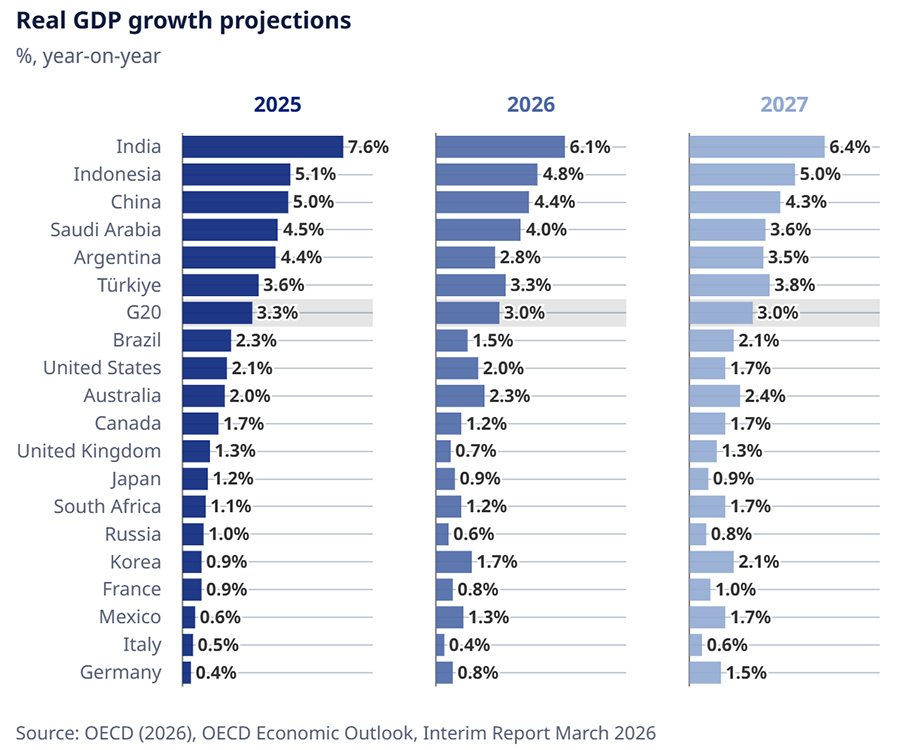
As a result of these developments, the Outlook projects global growth of 2.9 % in 2026 and 3.0 % in 2027. The evolution of the conflict in the Middle East is highly uncertain and poses considerable risks to these baseline projections. A more long-lasting disruption, with energy prices remaining elevated beyond mid-2026, would further reduce growth prospects.
GDP growth in the United States is projected at 2.0 % in 2026, before moderating to 1.7 % in 2027. In the euro area, growth is projected to be 0.8 % in 2026 and 1.2 % in 2027. China’s growth is projected to slow to 4.4 % in 2026 and 4.3 % in 2027.
Inflation pressures will persist for a longer period, with inflation now expected to be higher in 2026 than previously projected, reflecting the surge in global energy prices. Headline inflation in G20 countries is projected to be 4.0 % in 2026, easing to 2.7 % in 2027.
(Photo: OECD)
“The energy supply shock from the evolving conflict in the Middle East is testing the resilience of the global economy. We project global growth will remain robust, but it will be slower than the pre-conflict trajectory, with significantly higher inflation,” OECD Secretary-General Mathias Cormann said. “Any policy measures adopted to cushion the impact of the energy price shock should be targeted towards those most in need, temporary, and ensure incentives to save energy are preserved. Increasing renewable energy generation and energy efficiency can enhance economic security while boosting resilience to future price shocks.”
The Outlook highlights a range of risks. The expected decline in future energy prices is based on assumptions that current disruptions to supply will ease over time, and be limited in 2027. Longer-lasting closure of oil and gas production facilities in the region or persistent disruptions to exports through the Strait of Hormuz would likely have more significant adverse consequences on energy prices, inflation expectations and future growth.
The Outlook points out that higher energy and fertiliser prices could spur increases in food prices, particularly affecting vulnerable households. Higher energy prices could also increase the cost for European countries carrying out necessary annual replenishing of natural gas stocks. Financial markets may experience additional volatility while rising long-term sovereign yields increase fiscal risks.
Given these challenges, the Outlook highlights key priorities for policymakers. Central banks should remain vigilant and ensure expectations are well-anchored. Stronger efforts are needed to safeguard the sustainability of public finances. Any measures to cushion the economic impact of the energy shock will need to be targeted, temporary and take into account limited fiscal space facing most governments. Lowering trade barriers would boost output and reduce inflationary risks. Over the medium term, improving energy efficiency and reducing dependency on fossil fuel imports can lower exposure to future supply shocks.
International, innovative and the highest possible quality—that’s how best to describe drinktec, which was held from September 12 to 16, 2022, at the Munich trade fair center. A total of 1,002 exhibitors from 55 countries and nearly 50,000 visitors from 169 countries came to the world’s leading trade fair for the beverage and liquid food industry.
drinktec—the world’s leading trade fair
With 65 percent of exhibitors and more than 70 percent of visitors coming from countries outside of Germany, drinktec has impressively bolstered its status as the world’s leading trade fair. Dr. Reinhard Pfeiffer, Messe München CEO: “drinktec shows us that world fairs in Europe are possible again. Most visitors came from abroad, and almost 40 percent of these from outside of Europe, such as Mexico, Brazil, South Africa, Japan and India. And it’s quite revealing that the third strongest visitor country after Germany and Italy is the USA.” Volker Kronseder, drinktec Chairman of the Advisory Board, adds: “When you go through the halls, you discover a multitude of new and further developments, you see that people from different countries are at last communicating with one another in person again. The innovation density is also extremely high again this year.”
drinktec—highest possible visitor quality
Richard Clemens, Managing Director of the Process Plant and Equipment Association, German Engineering Federation (VDMA), sums up: “The industry has been waiting for drinktec in particular with bated breath. The atmosphere is simply superb. The exhibitors are impressed by the internationality and high quality of the visitors.” An observation that Florian Schneider, Chief Commercial Officer at ZIEMANN HOLVRIEKA, seamlessly adds to: “drinktec is back, and with it our customers and interested parties from all over the world. The numbers do appear on the whole to be lower than in the past. But the quality is high. drinktec once again proves that it is the most important international platform.”
drinktec—innovation and incentive generator
drinktec also lived up to this claim with the innovations on display. Overall the exhibitors presented more than 700 new products and solutions in the Innovation Guide and Solution Guide digital offerings. Dr. Johannes T. Grobe, Head of Sales and Service at the KHS Group, explains why drinktec in particular is the place for premieres: “The world’s leading trade show enjoys a high standing in the industry as the most important source of innovation and incentive. It offers us the perfect opportunity to get together with our customers and partners at an international level. We enjoyed numerous chats and discussions on new investments during the show.” Marcus Ley, Vice President Global Accounts at Ecolab, adds: “In our view, drinktec is the leading marketplace where global industry experts and decision makers meet to identify innovations and state-of-the-art technologies to advance their operations. We have once more been able to connect with high quality and top management level visitors to advance our business objectives. Another unforgettable show!“ And Reinhard Streit, Vice President and Managing Director Food & Beverage Europe at CCL Label summarizes: “In a nutshell, drinktec is the best global platform if you are in the beverage business.”
drinktec—the networking platform
For visitors drinktec is also the beverage and liquid food industry’s major networking platform, as Gary Guo, Vice President, Global Supply Chain with the Coca Cola Company, confirms: “It’s so good to be back here in Munich at drinktec after five years. This is one of the premier events in our business calendar and is a must-attend for us. Together with our global bottling partners we use drinktec to explore the latest developments and emerging technologies in areas such as supply chain, manufacturing, digital transformation and sustainability, and look for opportunities to transform our business. The event this year is better than ever.”
For drinktec Director Petra Westphal and her team, the customers’ feedback is more than positive: “The preparations for this year’s event really were something of a rollercoaster ride. The effects of the pandemic and geopolitical tensions have resulted in volatile framework conditions and uncertainties. And suddenly the first trade fair day is there. The world meets here with us in Munich after five years. The joy of getting together again is indescribable. The challenges of the day are intensively discussed and solutions are presented at all of the stands – the industry’s future is being shaped here.”
The next drinktec will be held in fall 2025. The exact date will be announced in plenty of time.
In times of instability, crisis and major global events, how do we make sense of trends which are likely to influence the beverage market?
While it is too early to predict the full impact of the conflict in Ukraine, when considering the trends within the beverage industry, it is important to take the macro drivers influencing the global economy into consideration.
Even before the latest current events, the global economy continues to be in a state of flux with recovery moving at varying speeds across regions and nations because of the pandemic.
In a report published in 2021, PwC reported that by the end of 2021, early 2022, they expect the global economy to revert to its pre-pandemic level of output. Noting however, that the recovery will be uneven across sectors, countries, and income levels.
As 2022 gets well underway, and the world pivots from pandemic to recovery, consumer behaviour and purchasing power remain highly dependent on economic realities, and perhaps now more than ever, understanding some of the key factors impacting the economic landscape is crucial for business strategy.
In its report „5 economic factors influencing the global beverage market“ Treatt takes a closer look at:
Economic recovery post Covid-19
Public debt levels
Globalisation
Higher value-add activities
Generation Z
Please download the full report as pdf-file under: www.treatt.com
You need to load content from reCAPTCHA to submit the form. Please note that doing so will share data with third-party providers.
You are currently viewing a placeholder content from Turnstile. To access the actual content, click the button below. Please note that doing so will share data with third-party providers.