Higher production estimates for the Brazilian citrus belt (São Paulo and the Triângulo Mineiro) in the 2019/20 season were confirmed by Fundecitrus (Citrus Defense Fund) in a report released on Dec. 10. Although estimates were 0.8 % lower than that reported in September, data indicate that the current crop should be 34.7 % larger than the previous, totaling 385.31 million 40.8-kilo boxes of oranges.
According to Fundecitrus, new estimates were based on the lower rains in the citrus belt in 2019 (from May to November). With lower rains and high production, the size of the oranges produced in the citrus belt is shrinking – from 260 fruits per box, estimated by Fundecitrus in May, to 262 in December, 0.77 % down. As regards the drop rate, new estimates increased from 17.60 % to 17.63 %, on average, considering all citrus varieties. If the drop rate remains at this level until the end of the crop, it will be the highest in all times, based on data from Fundecitrus.
Still according to the report, the harvesting of pera rio oranges has already reached 85 %, against 50 % for valencia and folha murcha varieties. Natal orange harvesting, in turn, has totaled 45 % so far. As regards the total volume harvested, 74 % of the 2019/20 crop has been harvested, against 78 % in the same period last season.
This scenario indicates that, although estimates point to a smaller amount of late oranges this year – due to fruitlet losses in December/18 and lower flower settlement in mid-January/19 –, low supply, which is usual at the beginning of the year, may be postponed. The end of pear orange supply has been reported by Brazilian citrus farmers, but there still are some amounts of late oranges (mainly natal) available to be harvested in December and January.
Thus, based on the higher volume forecast for the current crop, agents from processors believe orange crushing will not be interrupted between a crop and the other – although the crushing pace may be slower than that in 2019/20. It is worth to mention that the crushing pace has been fast at processors since the beginning of activities this year, reaching 100 % of the capacity in almost all plants.
MARKET IN BRAZIL – Despite the nearness of the holiday season, when the demand for citrus fruits usually decreases, farmers reported firm demand in the first fortnight of December. According to agents, this scenario may be linked to the beginning of the month, when workers’ wages are paid.
As regards tahiti lime, quotes have been dropping, due to growing supply. According to Cepea collaborators, the supply of small-sized fruits is still high in the market of São Paulo State.
All Oranges 74.0 Million Boxes
The 2019-2020 Florida all orange forecast released by the USDA Agricultural Statistics Board is 74.0 million boxes, unchanged from the October forecast. If realized, this forecast will be 3 percent more than last season’s final production. The forecast consists of
32.0 million boxes of the non-Valencia oranges (early, midseason, and Navel varieties) and 42.0 million boxes of the Valencia oranges. A 9-year regression has been used for comparison purposes. All references to “average”, “minimum”, and “maximum” refer to the previous 10 seasons, excluding the 2017-2018 season, which was affected by Hurricane Irma. Average fruit per tree includes both regular and first late bloom.
Please download the full citrus crop production forecast: www.nass.usda.gov
Updated orange1 crop forecast totals 385.31 million boxes
The 2019-2020 orange crop forecast update for São Paulo and West-Southwest Minas Gerais citrus belt, published on December 10, 2019 by Fundecitrus – performed in cooperation with Markestrat, FEA-RP/USP and FCAV/Unesp2 – is of 385.31 million boxes of 40.8 kg each. This figure corresponds to a decrease of 0.80 % in relation to the previous update published in September 2019, and of 0.92 % compared to the first estimate of the crop, disclosed in May 2019. Out of the total crop, about 26.88 million boxes are estimated for the Triângulo Mineiro region.
Heavy rains in November on virtually the entire citrus belt eased the drought, but since May total rainfall stood at 17 % below the historical average (1981-2010): 409 millimeters in the average across regions, while historical average is 495 millimeters, according to data from Somar Meteorologia. The driest period was at the beginning of the crop season, from May to August, when the negative deviation reached 32 % in relation to the climatological standard normal. Although rains resumed in the first week of September, this followed a two-week window of dry weather on most of the belt, which characterized the occurrence of an Indian summer. It was not until mid-October that the rainy season began to set in, although the monthly accumulated rainfall rate was still below average. In November, rainfall was abundant and well distributed throughout the month, with accumulations ranging from 95 to 265 millimeters among the citrus belt regions. …
Please download the complete forecast under: www.fundecitrus.com.br/pdf
1Hamlin, Westin, Rubi, Valencia Americana, Seleta, Pineapple, Pera Rio, Valencia, Valencia Folha Murcha and Natal.
2Departament of Math and Science at FCAV/Unesp Campus Jaboticabal
Updated orange1 crop forecast totals 388.42million boxes
The 2019-2020 orange crop forecast update for São Paulo and West-Southwest Minas Gerais citrus belt, published on September 10, 2019 by Fundecitrus – performed in cooperation with Markestrat, FEA-RP/USP and FCAV/Unesp2 – is of 388.42 million boxes of 40.8 kg each. This figure corresponds to a decrease of 0.12 % in relation to the estimate published in May/2019. Approximately 27,14 million boxes of the total crop should be produced in the Triângulo Mineiro region. …
Please download the complete forecast under: www.fundecitrus.com.br/pdf
1Hamlin, Westin, Rubi, Valencia Americana, Seleta, Pineapple, Pera Rio, Valencia, Valencia Folha Murcha andNatal.
2Departamentof Math and Science at FCAV/Unesp Campus Jaboticabal.
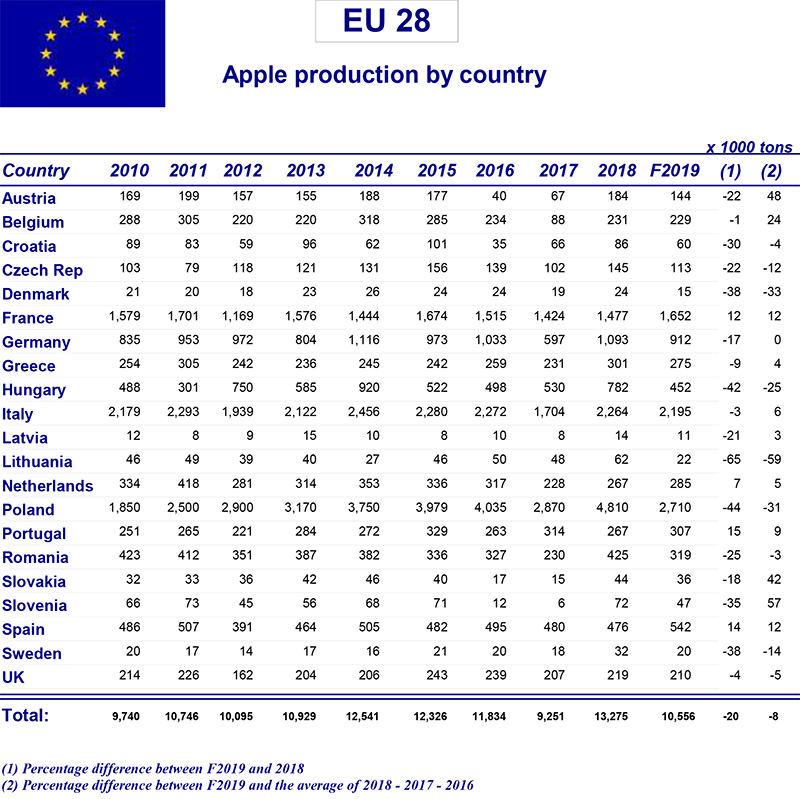
The 2019 European apple and pear crop forecast estimates that most European countries are expecting a rather low apple and pear crop for the coming season. On 8 August 2019, close to 300 representatives of the international apple and pear sector met at the Prognosfruit Conference in Alden Biesen, Belgium. During the conference, the 2019 European apple and pear crop estimate was released. This year, the apple production in the EU is set at 10.5 million T as a result of climatic events and the alternation of last year’s bumper crop. This is a decrease of 20 % compared to last year’s record high crop and of 8 % compared to the average crop of the three previous years. The pear crop is predicted at 2 million T, a decrease of 14 % compared to 2018. Nevertheless, comparisons with previous years need to be handled with much caution, given last two years’ exceptional variation.
Apart from crop alternation after a bumper, this year’s crop estimation has been influenced by several factors, including in particular a mild winter, a cold and wet May, late frost, a sunny and warm June, heat wave and drought in July, abrupt changes in temperature, and low blossoming. However, these events were scattered, and their impact differs significantly between regions. Additionally, for pear, the overall low figure is mainly due to a decrease in estimation of Italian pears which caused the overall forecast to be the second lowest of the decade. The drop was mainly the result of low blossoming, influenced by the high crop, heat of last season and rain.
A general comment for apple is that the crop in the Eastern part of the EU has been affected by the cold snap in May, with losses of 44 % of last year’s record high in Poland. In most apple producing countries, however, there were moderate decreases or stabilisation of the crop. France, Spain and Portugal are recording an increase of their crop. In terms of quality, there might be issues with sunburn and sizing. For pear, there are estimations of moderate to more serious decreases in all major pear producing countries, except for a small increase in Spain. Overall, there are still overhanging stocks on the market, but the late start of the season by up to two weeks might contribute to a better balance of the market.
The crop estimation needs to be held against a complex market situation, given the ongoing consequences of an increasingly more challenging global trading environment. Therefore, efforts to boost consumption need to be continued. WAPA will continue to monitor the developments of the Northern Hemisphere crop and will issue updates when appropriate.
Brazilian exports of Frozen Concentrate Orange Juice (FCOJ) Equivalent decreased 19 % in the 2018/19 crop – compared to the previous season), as expected. Between July/18 and June/19, shipments totaled only 982.24 thousand tons, according to Secex. As for the revenue, it totaled 1.8 billion USD, 19 % down in the same comparison.
The volume exported from Brazil in the 18/19 season was the second smallest in the last 20 years of Secex historical series, only larger than that from 2016/17, when the Brazilian citrus belt harvested a small crop – which, in turn, resulted in the lowest inventory of all times, according to data from CitrusBR (Brazilian Association of Citrus Exporters).
The bad performance in 2018/19 was linked to two factors: lower orange supply in the Brazilian citrus belt (São Paulo and Triângulo Mineiro) and a decrease in the international demand, mainly from the United States. Lower exports, however, prevented juice inventories at Brazilian processing plants from decreasing to critical levels at the end of the season (June 30 2019).
According to a report from CitrusBR, in June/19, inventories at Brazilian processing plants closed at only 224.51 thousand tons, which is considered low compared to that in recent years – inventories in June/19 were only lower than in 2010/11 and in 2016/17.
Brazilian shipments to the United States decreased a steep 38 % compared to that last season, totaling only 196.4 thousand tons. Revenue, in turn, dropped 39 %, to 340.96 million USD. Besides lower consumption in America, this result is linked to expectations for a crop recovery in Florida in 2018/19. According to a report from the USDA released today, July 11th, Florida should harvest 71.6 million boxes of 40.8 kilos, 59 % more than in 2017/18.
To the European Union, the biggest importer of the Brazilian orange juice, shipments totaled 643.74 thousand tons, 11% down compared to that last season. Revenue, in turn, reached 1.19 billion USD, 9 % down in the same comparison.
BRAZILIAN MARKET IN JULY – The cold weather in São Paulo State reduced citrus consumption in the first fortnight of July. According to Cepea collaborators, despite the occasional frosts in some producing regions (mainly in southwestern SP), there were no losses at orchards. Between July 1 and 15, pear orange prices averaged 18.07 BRL per 40.8-kilo box, on tree, stable (-0.05 %) compared to that between June 1 and 15.
Concerning tahiti lime, besides lower supply (due to the harvesting end for the fruits produced in the first semester of 2019), rains pushed up quotes in the first half of July. Between July 1 and 15, tahiti lime quotes averaged 25.19 BRL per 27-kilo box, harvested, a staggering 84.5 % up compared to that in the same period of the previous month.
The 2018-2019 Florida all orange forecast released today by the USDA Agricultural Statistics Board is now 71.6 million boxes. The total is comprised of 30.4 million boxes of non-Valencia oranges (early, midseason, and Navel varieties), unchanged from the June forecast, and 41.2 million boxes of Valencia oranges, up 200,000 boxes from the June forecast. The forecast of all Florida grapefruit production is unchanged at 4.51 million boxes. Of the total grapefruit forecast, 770,000 boxes are white and 3.74 million boxes are the red varieties. The Florida all tangerine and tangelo forecast remains at 990,000 boxes. …
Please download the full citrus crop production forecast: www.nass.usda.gov
Wageningen University & Research (WUR) and Tencent, will organise the 2nd edition of its International Autonomous Greenhouse Challenge in which multidisciplinary teams from around the world will use artificial intelligence to remotely produce vegetables. The goal is to explore how artificial intelligence (AI) can produce greenhouse grown vegetables more efficiently and effectively.
In the future more greenhouses will be needed to produce food. Autonomous greenhouses and remote digital farming can help feed more people with vitamin and mineral rich produces, increase food security and produce more vegetables with fewer resources such as water and energy. Significant advances are being made in automation, information technology and artificial intelligence, which will help growers to better analyse and process information and make better decisions.
Production of a cherry tomato crop within six months
WUR and Tencent invite artificial intelligence and horticultural experts to participate in the second edition of the International Autonomous Greenhouse Challenge, which begins this autumn. The goal of the challenge is to produce a cherry tomato crop within 6 months with high quality, high productivity and high resource efficiency in greenhouses of WUR, the Netherlands, remotely. Teams will get their own greenhouse compartment and make choices with respect to the control settings of greenhouse actuators and crop management in order to control the tomato production and quality remotely. Teams can also add their own sensors/cameras to generate additional information. Each team will be able to extract data from their greenhouse compartment and couple it to their own machine learning algorithms to decide on the control settings for the next day/period. They will also send the control settings back to the system so it can control the actuators automatically or send instructions for crop handling to reach a pre-defined goal. WUR will continuously measure performance criteria per compartment and share them with each team and the public.
Artificial Intelligence algorithms to control cucumber production
During the first edition of the Autonomous greenhouse challenge in 2018, five international teams were challenged to control a greenhouse cucumber production during a four-month period with their artificial intelligence algorithms. The first edition resulted in a successful benchmark experiment demonstrating that these algorithms can control greenhouse climate, irrigation and crop growth remotely. The winning team outperformed experienced manual growers.
Who can join?
Teams must consist of experts with a proven background in different fields such as artificial intelligence, sensor technology, crop physiology and horticultural production. Companies and start-ups are invited as well as scientists and students. Team must include at least three members. At least one team member must be a student. WUR and Tencell encourage teams from all countries to participate.
How to join?
Registration will be open from 22 May – 15 July 2019. Information on the International Autonomous Greenhouse Challenge and how to register can be found at www.autonomousgreenhouses.com
Florida Orange and Grapefruit production both decreased by 500,000 boxes in the April U.S. Department of Agriculture crop forecast.
The report projects Florida Orange production for the 2018-19 season at 76.5 million boxes after a slight decline in Non-Valencia orange production. Florida Grapefruit production is now estimated at 4.9 million boxes.
“We’re an industry catching glimpses of recovery, but this estimate certainly points out that we are not there yet,” said Shannon Shepp, executive director of the Florida Department of Citrus. “It’s still a great year, but we are anxious for better.”
The numbers remain an increase from the previous season, devastated by Hurricane Irma, when production dropped to 45.05 million boxes of Florida Oranges and 3.88 million boxes of Florida Grapefruit.
Final orange1crop forecast totals285.98 million boxes
The 2018-2019 final orange crop forecast for São Paulo and West-Southwest Minas Gerais citrus belt, published on April 10, 2019 by Fundecitrus – performed in cooperation with Markestrat, FEA-RP/USP and FCAV/Unesp2 – is of 285.98 million boxes of 40.8 kg each, which is 28.2 % smaller in comparison to the previous crop (2017-2018) of 398.35 million boxes, and 11.6 % below the crop average in the last ten years3. The survey’s data show that final production was 0.8 % smaller than the initial projection carried out in May 2018, of 288.29 million boxes. Final crop total includes:
- 50.70 million boxes of the Hamlin, Westin and Rubi varieties;
- 14.66 million boxes of the Valencia Americana, Seleta and Pineapple varieties;
- 79.12million boxes of the Pera Rio variety;
- 107.91 million boxes of the Valencia and Valencia Folha Murcha varieties;
- 33.59million boxes of the Natal variety.
Approximately 16.02 million boxes of the finalcrop were produced in West Minas Gerais.
This crop season, adverse weather conditions in the citrus belt, with the exception of the Southwest region, resulted in a lower yield in groves. Irregular climate in the crop season set in back in 2017 with delayed spring rains, which caused orange trees to bloom late. High temperatures after flowering hindered fruit set, ultimately reducing the number of oranges per tree.
During fruit development and harvesting from May 2018 to March 2019, the accumulated rainfall in the citrus belt was 1,295 millimeters, which is 3 % below historical average (1981-2010), according to data from Somar Meteorologia.The months of May 2018 to July 2018 were drier than expected, with rainfall well below average. With decreased rainfall, fruit size did not reach the average 256 fruits per box (159 grams per fruit) projected in May 2018. Threefruits above projection were necessary to fill a 40.8 kg box. Therefore, the final average size for all varieties was 259 fruits per box (158 grams per fruit). The deviation between final average size (April 2019) and projected size (May 2018) was small, although deviation for each variety was more significant due to irregular rainfall distribution and fruit harvesting time. …
Please download the full update.
- 1Hamlin, Westin, Rubi, Valencia Americana, Seleta, Pineapple, Pera Rio, Valencia, Valencia Folha Murcha and Natal.
- 2Department of Math and ScienceatFCAV/Unesp, Jaboticabal Campus.
- 3Average production for the last decade is of 323.34 million boxes. Data for crops 2008/2009 to 2014/2015 supplied by orange juice companies associated to Fundecitrus –Citrosuco, Cutrale and Louis Dreyfus, which, individually, have estimated their crop for the citrus planted area since 1988, through objective methodology. Data for the 2015/2016 and 2016/2017 crops supplied by Fundecitrus.
The harvesting of the oranges out of the ideal period from the 2018/19 crop was ending in São Paulo State in March, while the availability of the first early oranges from the new season (2019/20) was increasing, helping to supply the market.
Although still low, the availability of the first oranges from the 19/20 crop in the market limited the upward trend of pear orange quotes, observed in the first two months of the year. In March, pear orange quotes averaged 42.23 BRL per 40.8-kilo box, 3.8 % up compared to that in February.
However, most of the early oranges from 2019/20 had not reached the ideal maturation stage demanded in the in natura market, which limited new deals. Concerning the pear and late oranges remaining from the 2018/19 season, only a few growers still had available amounts to sell in the in natura market – and, in general, lower quality also hampered trades.
The low supply scenario in the offseason period resulted from the lower production (almost 30 %) in the citrus belt in 2018/19 – estimated by Fundecitrus at only 284.88 million boxes of 40.8 kilos, according to the report released in February. Thus, in March, pear orange quotes increased sharply compared to the same period last year (in nominal terms): a staggering 46.3 %.
For April (mainly the second fortnight), the agents consulted by Cepea expect the supply of all varieties from the 2019/20 to increase, based on the possible favorable weather to the development of the fruits that are still on tree. Besides, it is worth to remember that crushing is currently at a slow pace at the processing plants from SP, which should allocate all the fruits available to the in natura market in April.
TAHITI LIME – As for tahiti lime, international demand helped to lower supply in the Brazilian market in March. Thus, quotes averaged 16.87 BRL per 27-kilo box, harvested, last month, 11.7 % up compared to that in February.
Demand from processing plants was low and the availability of fruits from the second blossoming was gradually increasing, which may press down quotes in April, mainly in the second fortnight – if the weather favors fruits growth.
According to tradition, the World Apple and Pear Association (WAPA) held its Annual General Meeting on the last day of the Fruit Logistica fair in Berlin, 8 February 2019. Representatives of the key global apple and pear producing and exporting countries met to discuss the Southern Hemisphere production forecast, the final update of the Northern Hemisphere production forecast that was released in August 2018, and the season developments.
WAPA discussed and released the consolidated crop forecasts for the forthcoming southern hemisphere apple and pear seasons (see tables in annex). Collected from industry associations in Argentina, Australia, Brazil, Chile, New Zealand and South Africa, the forecast showed that the 2019 apple and pear Southern Hemisphere crops are expected to reach 5.261.000 T and 1.327.000 T, respectively. For apples, this represents an increase of 2 % compared to the 2018 crop. Export is expected to remain stable at 1.738 million T. The pear crop is expected to increase by 2 % compared to 2018. Export is expected to remain stable at 712.154 T.
Other topics on the agenda were marketing, promotion and consumption trends, research and innovation activities among the members, and global initiatives to preserve the biodiversity of the many apple varieties.
Finally, WAPA elected a new president, Nicholas Dicey from HortGro, South Africa, formerly WAPA’s vice-president. As new vice-president, Dominik Wozniak from the Polish Society for Promotion of Dwarf Fruit Orchards was elected. The WAPA secretariat and members are looking forward to continuing the good trends in the coming years with its new presidency and thanked Todd Fryhover from Washington Apple Commission for his time and efforts as WAPA’s vice- president and president over the last four years.
All Oranges 77.0 Million Boxes
The 2018-2019 Florida all orange forecast released by the USDA Agricultural Statistics Board is 77.0 million boxes, unchanged from the November forecast. If realized, this forecast will be 71 percent more than last season’s final production. The forecast consists of 32.0 million boxes of the non-Valencia oranges (early, midseason, and Navel varieties) and 45.0 million boxes of the Valencia oranges. Regression data used are from the 2008-2009 through 2016-2017 seasons. All references to “average”, “minimum”, and “maximum” refer to those 9 seasons unless noted. The hurricane affected 2017-2018 season is excluded from the regressions.
Non-Valencia Oranges 32.0 Million Boxes
The forecast of non-Valencia production is unchanged at 32.0 million boxes. Current fruit size is below the minimum and projected to be below the minimum at harvest. Current droppage is above average and is projected to be above average until harvest. The Navel forecast, included in the non-Valencia forecast, is unchanged at 800 thousand boxes, and is 3 percent of the non-Valencia total. Final Navel size is below average and droppage is close to the maximum.
Valencia Oranges 45.0 Million Boxes
The forecast of Valencia production is unchanged at 45.0 million boxes. Current fruit size is below the minimum and is projected to be below the minimum at harvest. Current droppage is above average and projected to be above average at harvest.
Please download the full citrus crop production forecast: www.nass.usda.gov
The trading pace in the market of in natura orange was slow in Brazil in the first fortnight of October. Besides the lack of high quality fruits, rains in São Paulo State limited harvesting activities and lowered the available supply even more. Demand, in turn, was low too, mainly due to the Brazilian holiday on October 12, when liquidity usually decreases.
Purchasers reduced pear orange acquisitions, opting for lower priced varieties, such as valencia. From October 1 to 15, pear orange quotes averaged 32.90 BRL per 40.8-kilo box, on tree, 6.8 % up compared to that in the same period of September. Valencia oranges, however, were traded at 28.89 BRL per box, 8.9 % up in the same comparison.
Regarding tahiti lime, rainy weather hampered fieldwork and prices rose in the first fortnight of October. From Sept. 30 to Oct. 15, tahiti lime quotes averaged 81.98 BRL per 27-kilo box, harvested, 21.6 % up in the same comparison. Precipitation, on the other hand, should favor fruit growth on tree, based on the estimates for a slight supply increase this month.
2019/20 SEASON – The first purchase offers for the oranges from the 2019/20 crop have started to be reported in the market of São Paulo State. On an ad hoc basis, large-sized processors have bid prices around 22 BRL per 40.8-kilo box, harvested and delivered at processors, with the possibility of a bonus in the sales price of orange juice in the international market. Processors bidding prices have been lower than in the spot market this season (at 24 BRL per box for prompt-delivery).
In general, according to agents from processors, farmers are cautious regarding closing trades in advance, since the next season output is still uncertain. Although blossoming was considered positive in most orchards, the weather will be crucial for a good flower settlement – in the same period last year, many fruitlets were lost, reducing production in the 2018/19 season.
Besides, the result of the Presidential Election in Brazil may influence both the exchange rate and, consequently, the price received by processors for orange juice sales in the international market. The farmers consulted by Cepea that have already been contacted by processors, mainly for renegotiation, say they will wait for a better definition in the coming months to decide whether to sell or not their fruits.
Brazilian citrus farmers believe the next orange crop in São Paulo will have positive results, mainly in the orchards located in southern state, where the weather is more favorable (with rains interleaved with sunny days). Farmers are focused on the central area of the state, where intense heat and smaller rain volumes have already caused fruitlets to drop.
Citrus utilized production for the 2017-18 season totaled 6.13 million tons, down 20 percent from the 2016-17 season and 66 percent lower than the record high production of 17.8 million tons for the 1997-98 season. Florida accounted for 36 percent of total United States citrus production; California totaled 59 percent, and Texas and Arizona produced the remaining 5 percent.
Florida’s orange production, at 45.0 million boxes, is down 35 percent from the previous season. Grapefruit utilization in Florida, at 3.88 million boxes, is down 50 percent from last season’s utilization. Florida’s total citrus utilization decreased 37 percent from the previous season. Bearing citrus acreage, at 400,900 acres, is 9,800 acres below the 2016-17 season.
Utilized citrus production in California decreased 7 percent from the 2016-17 season. California’s all orange production, at 45.4 million boxes, is 6 percent lower than the previous season. Grapefruit production is down 9 percent from the 2016-17 season and tangerine and mandarin production is down 19 percent. Utilized production of citrus in Texas is up 9 percent from the 2016-17 season. Orange production is up 37 percent from the previous season but grapefruit production was unchanged. Lemon production in Arizona is down 35 percent from last season.
The value of the 2017-18 United States citrus crop decreased 7 percent from last season, to $3.28 billion (packinghouse- door equivalent). Total value of production for 2017-18 is lower for all citrus crops. Orange value of production decreased 9 percent from last season and grapefruit value is down 14 percent. Tangerine and mandarin value of production is 1 percent higher than last season but lemon value of production is down 6 percent. Beginning in 2016-2017, tangelos are included in tangerines and mandarins for Florida.
Overall comparisons discussed above are based on similar fruit types. The revised production and utilization estimates are based on all data available at the end of the marketing season, including information from marketing orders, shipments, and processor records. Allowances are made for recorded local utilization and home use. Estimates for the 2017-18 California Valencia oranges and grapefruit are preliminary, since the marketing season is not complete at publication time. Revisions to the utilized production estimates for all citrus for the 2017-18 season will be published in the April 2019 Crop Production. …
Ponkan tangerine season is near the end in São Paulo State. According to agents consulted by Cepea, only a few crops still have some volume to be harvested in early July. In most of the regions, production has already ended. Now, the in natura market from SP has been supplied by other states, mainly Minas Gerais (MG).
According to Cepea collaborators, the crop period (mature fruits) should last for two or three more weeks in that state. However, the fruits from the second flowering event have not been harvested yet. Thus, farmers estimate production to continue until September.
As for quality, agents have reported that fruit growth in MG was hampered by the weather, since it has not rained significantly in that region since April. Thus, ponkan tangerine from that state are mid-sized.
SP – As expected by agents, the harvested volume of ponkan tangerine in São Paulo State is smaller this year. While in 2017 supply lasted for seven months, this year, availability is already low – June is the fourth production month and the crop peak occurred between April and May.
However, the available volume decreased in late May, since some farmers from SP reported fruit losses during truckers’ strike, due to the long period on trucks and higher sensibility of that variety (which was already more mature than oranges).
Prices for ponkan tangerine in 2018 are above the monthly averages last year (from March to June). Lower supply this year, in turn, is linked to unfavorable weather during the development of the fruits, in the second semester of 2017, and the lower vigor of plants, after a large crop last year.
In general, production was low in the last years, with well-distributed crops, no crop peak and not lasting longer than four months. The 2017 season was atypical, due to the different development stages of the fruits at groves, which allowed the harvesting to last longer than in previous years.
In June, supply decreased and prices rose in São Paulo. According to Cepea collaborators, the demand for ponkan was firm in that period – higher than for other citrus varieties. Thus, from June 1 to 20, quotes for ponkan tangerine averaged 36.80 BRL per 27-kilo box, on tree, 10% up compared to that in May (2 – 30).
ORANGE – In June, orange prices were underpinned by low supply of fruits at the ripening stage required by the in natura market. Moreover, the industrial demand is already stepping up, reducing supply in the spot market from São Paulo.
The smaller crop forecast for the Brazilian citrus belt in 2018/19 (São Paulo and Triângulo Mineiro), at 288.29 million 40.8-kilo boxes (almost 30 % lower than the 2017/18 season), should result in critical inventories at processors from São Paulo State on June 30 2019. In 2017//18, despite the larger crop, supply was not significant, only enough to slightly increase the low inventories from 2016/17.
Thus, by June 2019, inventories should be 50 % smaller, considering forecasts for the 2018/19 crop. Data released by CitrusBR (Brazilian Association of Citrus Exporters) on May 22 estimated ending stocks of Frozen Concentrate Orange Juice (FCOJ) Equivalent from 55.9 thousand tons to 154.7 thousand tons in June 2019. CitrusBR forecasts were based on the volumes crushed in the 2017/18 season, at around 243.4 million 40.8-kilo boxes, 34 % down compared to the 370 million boxes crushed in the current season (2017/18).
Cepea calculations, however, indicate inventories are more likely to be from 55.9 and 102.6 thousand tons, not reaching the maximum level estimated by CitrusBR (at 154.7 thousand tons). To forecast that scenario, CitrusBR considered exportations will keep firm. Now, if processors do not aim to reduce inventories that much, the volume shipped may decrease in 2018/19.
The 2017/18 ending stocks of orange juice should be at 305.9 thousand tons by June 30 2018, 20.3 % up compared to that forecast in February/18. The positive 2017/18 harvesting ensured comfortable inventories to processors this year.
In general, the global demand for orange juice has been firm, mainly from the United States, Considering Florida crop may be 35 % lower, according to the USDA, juice availability should continue low in the next season (2019/20).
Regarding growers’ revenue, forecasts for the short-term indicate prices may not change much. Most farmers have already closed contracts with processors, and even if bidding prices rise from now onward, only a few growers would have fruits available for trading. Besides, productivity should be low, since the number of boxes produced per hectare results in a higher cost per unit and lower margins.
BRAZILIAN MARKET – Orange sales were slow in the in natura market in May, due to both colder weather in São Paulo and truckers’ strike, which halted transportation. With the protests, which started on May 21, part of the fruits harvested stayed on trucks.
In that scenario, growers preferred to interrupt harvesting late in the month, aiming to avoid losses. In May (2 – 30), pear orange quotes averaged 26.33 BRL per 40.8-kilo box, on tree, 11.7 % down compared to that in April (2 – 30).
TAHITI LIME – The strike has affected the domestic and international markets of tahiti lime as well. According to Cepea collaborators, purchasers were concerned about acquiring fruits and not receiving them, while growers feared to be affected by flow difficulties. Farmers consulted by Cepea affirmed that the fruits that are still on tree should not be damaged by the harvesting interruption.
In May (2 – 30), tahiti lime quotes averaged 45.13 BRL per 27-kilo box, harvested, 142.5 % up compared to that in April (2 – 30).
Chr. Hansen and FMC Corporation have announced a five-year extension of their collaboration to develop and commercialize natural solutions for the agricultural industry
The collaboration, which has launched several successful natural solutions over the last five years, has enabled both Chr. Hansen and FMC to join resources and expertise to accelerate entry into the rapidly growing biological crop protection market. The newly extended agreement continues to leverage the resources and expertise of both companies, while allowing for more flexibility.
During the last five years, Chr. Hansen and FMC have had an exclusive relationship regarding crop protection. While the mutual development pipeline will continue to be exclusive, both companies will be able to pursue development and commercial relationships with other partners, if desired.
“Chr. Hansen and FMC have enjoyed a successful relationship, including the launch of new products that provide natural alternatives for farmers to significantly boost crop yield,” said Christian Barker, Chr. Hansen executive vice president, Health & Nutrition. “Now, with our continued collaboration confirmed, we look forward to launching our strong pipeline of new products together in the years ahead. Beyond that pipeline, the new agreement provides full flexibility for both parties which will enable Chr. Hansen to further leverage our distinctive microbial capabilities by also collaborating with additional partners.”
Marc Hullebroeck, president, FMC Europe, Middle East and Africa, added:
“We are pleased to extend our relationship for at least another five years as we continue to collaborate on commercializing technologies that have been jointly developed. In addition, FMC will continue its own efforts on discovery, development and commercialization of new innovative technologies at our state-of-the-art laboratory facilities at FMC’s European Innovation Center near Copenhagen, Denmark. Our priority is to focus on differentiated solutions for growers throughout the world.”
On Wednesday, May 9, Fundecitrus (Citrus Defense Fund) released new estimates for the 2018/19 season, reducing production in the citrus belt (São Paulo State and Triângulo Mineiro) by 27.6 % compared to that in the previous crop. According to the report, harvesting in that region should total only 288.29 million orange boxes (40.8-kilo) in 18/19, 11 % down compared to the historical average of the sector.
Lower estimates from Fundecitrus have confirmed Cepea forecasts for a smaller output in 2018/19, due to the damages and losses observed in the main flowering event (from August to October last year), mainly for pear oranges. That scenario was linked to the dry weather and high temperatures during the settlement of the flowers that would become the oranges from the new season. Still, the first estimates indicated losses around 20 %, which could result in a higher production than that forecast.
Ending stocks for orange juice should be 22 % larger on June 30, 2018 (at 254.2 thousand tons), according to CitrusBR (Brazilian Association of Citrus Exporters), but that is still the fourth lowest volume in the last 20 years. Thus, the citrus belt would have to harvest, once again, high amounts, in order to ensure comfortable inventories at processors. The demand for orange juice has been firm, mainly from the United States, making the global supply and demand scenario even more difficult.
However, in the short-term, growers’ revenue may not increase significantly, since most of them have already closed anticipated trades with processors – trades have been closed since November last year. Thus, only a few growers still have fruits available for trading.
Currently, only one of the large-sized processors has been purchasing fruits in the spot market. Before the new estimates were released, quotes for all varieties were at 15 BRL per 40.8-kilo, harvested and delivered at the processor. However, prices may increase as the crop nears and more processors enter the market.
In the mid-term, on the other hand, forecasts for the next season (2019/20) are more positive, considering juice inventories may be empty by June 2019. Besides, with the smaller output in Florida, international demand for the commodity should continue firm during the season. There are concerns with the weather in the coming months as well, which may lower the volume forecast even more.
BRAZILIAN MARKET – Orange sales increased in the in natura market in early May. According to growers, the beginning of the month, when workers’ wages are paid, may have favored demand. However, the average price for that variety in the first fortnight of the month was 19 % lower than in the first fortnight of April. That scenario is linked to higher supply in São Paulo, as well as the slow crushing pace at processors, which led orange sales exclusively to the in natura market (these fruits would be allocated to processors for crushing). Between May 2 and 15, pear orange quotes averaged 25.81 BRL per 40.8-kilo box, on tree, 19 % down compared to that in the first fortnight of April (2 – 13).
Tahiti lime quotes, however, continued at high levels in that period, both in the domestic market and for exportation. According to growers, the fruits still on tree have a good quality, but have not reached the ideal size to be harvested yet – due to the lack of rains in São Paulo. Thus, tahiti lime quotes averaged 49.17 BRL per 27-kilo box, harvested, between May 2 and 15, a staggering 174.2 % up compared to the price average in the first fortnight of April.
The 2018/2019 orange crop forecast published on May 09, 2018 by Fundecitrus, in cooperation with Markestrat, FEA-RP/USP and FCAV/Unesp1 is of 288.29 million boxes of 40.8 kg each. This total includes:
- 55.81 million boxes of the Hamlin, Westin and Rubi varieties;
- 16.55 million boxes of the Valencia Americana, Seleta and Pineapple varieties;
- 81.16 million boxes of the Pera Rio variety;
- 99.80 million boxes of the Valencia and Valencia Folha Murcha varieties;
- 34.97 million boxes of the Natal variety.
1. Bearing trees
Bearing trees of the varieties which make up this estimate total 175.27 million. Information about bearing trees was obtained from the Tree Inventory for São Paulo and west-southwest of Minas Gerais citrus belt: March 2018 status, defined by the new mapping of groves performed from September 08, 2017 to January 29, 2018 and by counting of trees present in 5% of plots mapped, from January 29 to March 07, 2018
The georeferenced mapping, carried out for the first time at the 2015 Inventory, has been through a complete update for this 2018 Inventory. New high definition orthorectified images were obtained by the satellites SPOT 6&7 from European Airbus Defence and Space between May and August, 2017. In September, 2017 images were made available to survey agents, together with drawings of plots identified in the previous mapping, which were superimposed to the images for easier visualization of areas that should be visited to collect in loco data. Scanning or visual inspection of images were also employed by survey agents before they went to the field to pre-identify citrus groves planted after the previous mapping from 2015 to 2017, which should also be visited.
No information relative to the plot other than their outlines was supplied to survey agents, which required all new data to be collected on: variety, year set, spacing, visual aspect of plants and irrigation system, when present2. Recently collected data relative to the variety and year set that differed from the previous register were audited for validation. Outlines of plots were redrawn to correspond to their present area, whenever their area was changed after plots having been registered in the previous mapping. Field visits identified plots that were abandoned or eradicated after the 2015 Inventory, and those identified in that mapping as being in a similar situation, so that they were also revisited for updating data. A new feature in the current mapping is the delimitation of farms, which more precisely quantifies farms present in the citrus belt…
Please download the complete forecast under: www.fundecitrus.com.br/pdf
Orange production final1 estimate totals 398.35 million boxes
The 2017-2018 orange production final estimate for the São Paulo and West-Southwest of Minas Gerais Citrus Belt, published on April 10, 2018 by Fundecitrus – Fund for Citrus Protection, carried out in cooperation with Markestrat, FEA- RP/USP and FCAV/Unesp2 – is of 398.35 million boxes of 40.8 kg each, 62 % higher in comparison to that of the previous crop (2016-2017) with a final figure of 245.31 million boxes, and 25 % above the average of the seasons of the last ten years3. All crop estimate updates published along the season showed positive change as compared to the previous expectation. The final figure represents an increase of 0.27 % in relation to the update published in February 2018 and 9.30 % in relation to the initial May 2017 forecast.
The closing figure for total production includes:
- 77.48 million boxes of the Hamlin, Westin and Rubi varieties;
- 18.02 million boxes of the Valencia Americana, Valencia Argentina, Seleta and Pineapple varieties;
- 118.47 million boxes of the Pera Rio variety;
- 139.62 million boxes of the Valencia and Valencia Folha Murcha varieties;
- 44.76 million boxes of the Natal variety.
Approximately 30.51 million boxes of the final estimated crop were produced in the West of Minas Gerais.
Regarding the productivity index, the crop 2017-2018 showed a remarkable performance: 1,033 boxes were harvested per hectare, against 634 boxes per hectare in 2016-2017. The significant variation between the two crops was triggered by a favorable conjunction of factors. Suitable weather for citrus growing and improved cultural practices in groves in 2016, evidenced by the increased demand of inputs for crop nutritional and phytosanitary management, influenced positive results…
1 Hamlin, Westin, Rubi, Valencia Americana, Valencia Argentina, Seleta, Pineapple Pera Rio, Valencia, Valencia Folha Murcha and Natal.
2 Department of math and science.
Please download the complete forecast under: https://bit.ly/2JGhOMT
Rains were below the average for October in three of the four main citrus regions in São Paulo State; therefore, growers were very concerned with the development of the 2018/19 crop. Although it rained in early October, the soil was really dry and the volume was not enough to recover moisture for flower settlement. This scenario, added to high temperatures, favored fruitlet drops.
Fruitlets had already dropped more intensely in the non-irrigated groves from central and northern SP, where the weather is usually drier and warmer – even before it rained in early October.
Agents do not expect significant sprouts in the plants with flower buds, even with the return of rains. Others, in turn, believe new flowering events may occur if rains are enough, but not as significant as the main event (from late August to early September).
On the other hand, in southwestern SP, the rain volume until October 19 had surpassed the average volume expected for the month, according to Climatempo (weather forecast agency). The only concern, according to growers consulted by Cepea, was with sharp temperature oscillations, which may lead to a higher rate of fruitlet drops.
CROP 2017/18– Regarding the current crop (2017/18), high temperatures led oranges on trees to wilt again, making it difficult for fruits to remain on the trees in the rainy period. The losses early in the month were estimated at around 20 % in older groves and at around 15 % in younger groves, mainly in the plants affected by greening.
In this scenario, the quality of in natura oranges was lower than that demanded by the segment, justifying price rises. In October, pear orange quotes averaged 19.24 BRL per 40.8-kilo box, on tree, 11 % up compared to that in September.
Hurricane Irma, which hit Florida on September 10, should damage the local citrus groves. Since it reached a wide area, all citrus producing regions should be affected, mainly central and southwestern state.
In an interview for ABC News, the executive director of the Florida Citrus Department, Shannon Stepp, said that production was likely to surpass 75 million boxes, as estimated by Elizabeth Steger before the hurricane hit. Now, the director expects numbers to decrease sharply.
There are no official estimates regarding the damages caused by Irma hurricane yet, but the press has reported damages between 10 % and 80 %, depending on the area and the variety. The press has also released reports from local growers estimating damages at 1.2 billion USD to the agricultural production, including citrus, sugarcane, tomatoes, green beans, cucumber and others. Besides, fruits and trees drops were observed, as well as floods in citrus groves from Florida.
ORANGE JUICE – At the New York Exchange Stock (ICE Futures), the future contracts of Frozen Concentrate Orange Juice (FCOJ) due in November/17 increased in the second week of September, with the announcement of hurricane Irma by the United States. Thus, between September 5 and 12, values rose 19.12 %, averaging 2,191.59 USD per ton.
In this scenario, citrus growers from all over the world are focused on the impacts of Irma hurricane on global demand for orange juice. For Brazil, that scenario would only reinforce the need of importation from the United States, since inventories from North-American processors are low. Therefore, a larger crop in the citrus belt from São Paulo may help Brazil to meet that demand.
According to the last report from Fundecitrus (Citrus Defense Fund), released on September 11, the 2017/18 crop was estimated at 374.06 million 40.8-kilo boxes in São Paulo and Triângulo Mineiro. That volume is 2.63 % larger than that first estimated in May, and 52.5 % higher than that in the previous season (2016/17), which ended with 245.3 million boxes. This inventory increase was favored by rains in the first semester (April to June/17), which boosted fruits growth, mainly for the early fruits, whose harvest had reached 75 % of the total area in mid-July.
All major citrus growing regions in Florida were indeed affected by Hurricane Irma which devastated our state for more than 24 hours September 10th and 11th. At this time there are no precise reports giving an accurate measure of the full impact. Please keep this in mind as you read and hear those that are surfacing.
RC Treatt continues to provide contingency for the US operation should it be required, however the good news for our customers is that Treatt USA are already back up and running. We are also happy to remind our customers that we source raw materials from all over the globe, and operate in this manner to provide the best possible quality and service, continuity of supply, and risk mitigation.
Unfortunately we cannot yet say with any certainty exactly how much of Florida’s orange and grapefruit crops were lost or how many trees have been damaged. We do know there will be a reduction in the crop, which was previously forecasted to increase for the first time in five years. We have heard losses for oranges as low as 30 % and up to 80 %. Only time will tell. We anticipate the crop now being somewhere in the neighborhood of 40-55 million boxes, a huge decrease from last season’s 68.7 million boxes.
While we certainly appreciate everyone’s anxiety over the crops, we also recognize that our Florida growers have not only groves to rebuild but also lives, and we offer heartfelt sympathies to these men and women who have an unbelievable amount of drive and resilience.
We must also consider that Mexico was hit by not only Hurricane Katia, which will have an impact on both grapefruit and orange crops, but also with an incredibly strong earthquake measuring 8.2 on the Richter scale. Damages from these natural disasters are also still being assessed.
Confirming initial expectations of Cepea, ending stocks of orange juice at processors from São Paulo State should be recovered by the end of the 2017/18 season (June/18), but the levels stored continue to indicate low orange juice supply.
Data from CitrusBR (Brazilian Association of Citrus Exporters) indicate that inventories at Cutrale, Citrosuco and Louis Dreyfus should total only 207.6 thousand tons of frozen concentrate orange juice (FCOJ) Equivalent on June 30, 2018. That amount, however, is 93 % higher than the 107 thousand tons observed at the end of the 2016/17 season.
This increase of inventory is based on crushing forecasts of CitrusBR at 314.47 million boxes, with an average processing yield at 267.33 boxes to produce one ton of FCOJ Equivalent, and sales (domestic and international) at 1.107 million tons of the product. All these items are forecast to recover from the scenario observed last season (2016/17); however, yield should remain at levels below the historical average.
A significant recovery will only be possible due to a large crop in the citrus belt (São Paulo and Triângulo Mineiro), forecast by Fundecitrus (Citrus Defense Fund) at 364.47 million boxes. However, the possibility of replenishments of inventories (greater than 200 thousand tons) in June 2019 will depend, once again, on a large production at the citrus belt in the 2018/19 season. According to Cepea data, if sales, yield and volume from other states continue stable, processors will need to crush around 290 million boxes in 2018/19, meaning a crop in the citrus belt from SP + Triângulo Mineiro similar or greater than 340 million boxes (in natura consumption forecast at 50 million).
The replenishment of inventories at processors from São Paulo is a relief in light of the very low supply in the previous crop, when the Brazilian exportations of FCOJ Equivalent dropped 17 %. Therefore, forecasts for a higher orange juice supply may increase the Brazilian exportations in the 2017/18 season.
DOMESTIC MARKET – Pear orange quotes increased in the domestic market in the first fortnight of August, due to higher demand for the in natura fruit (favored by warmer weather in SP and the return of school classes) and crushing intensification in processors from São Paulo, which gradually reduced the volume available in the market. Between August 1 and 15, pear orange quotes averaged 16.54 BRL per 40.8-kilo box, on tree, 1.4 % up compared to the first fortnight of July (3-14).
Close to 300 representatives of the international apple and pear sector met at the Prognosfruit Conference on 10th August 2017 in Lleida, Spain. During the Prognosfruit conference, the World Apple and Pear Association (WAPA), released the 2017 European apple and pear crop estimates. The 2017 apple production in the EU will decrease by 21 % compared to last year’s crop, standing at 9.343.000 T. The pear crop is predicted by European growers to be relatively stable at 2.148.000 T and to only decrease by 1 % compared to 2016.
The figures released at Prognosfruit leave room for careful optimism for the coming season, with a more balanced situation between supply and demand after the last three years, which registered in particular for apples, a peak crop.
The 2017 European forecast for apple is 9.343.000 T, which is 21 % down to last year’s figure, and 23 % less than the average of the last three years. This figure is based on the estimates from the top 21 Member States of the EU-28, having contributed to this report. In regard to varieties, Golden Delicious production will decrease by 18 % to 1.982.000 T. Gala is also estimated to decrease, by 3 % to 1.276.000 T. Idared will be down by 30 % to 679.000 T, while the production of Red Delicious is estimated at 576.000 T, which is a 9 % decrease compared to last year. Also, other new varieties (i.e. club varieties) will decrease by 15 %, from 157.000 T to 133.000 T. A particular point of concern this year was the intense frost during blossoming, and the drought during spring and early summer. In other non-EU Northern Hemisphere countries, significant decreases were noted: Russia (-37 %), Mexico (-30 %), Switzerland (-21 %), Belarus (-19 %), Ukraine (-10 %), and Canada (-5 %), while the USA is expecting a stable crop around 4.800.000 T. Additionally, China is expecting a further growth by 3 % compared to last year’s crop of 43.800.00 T. The US apple forecast will be updated after the US Apple Outlook conference in Chicago 24-25 August.
More specifically about the EU apple market, it is to be reminded that, over the last years, the market suffered the consequences of the Russian embargo and were more recently confronted by lower export volumes to North African markets. The new crop could therefore lead to a better balance of the supply. The market will start clearing stocks for most varieties, with expected good hand over from the Southern Hemisphere. Overall, the new season is due to start with two weeks earlier than average. There might be different market trends for each of the varieties, with better balance for Gala and more reduced volume for Golden or Jonagold, and Elstar. In the coming weeks, growers will closely monitor the quality, which could still influence the balance of the market between fruit destined for the fresh market and the fruit destined for processing. It is currently forecasted that ca 6.200.000 T will be moving on the fresh market and 3.200.000 T for processing.
In regard to pear, the total European pear crop in 2017 is estimated to reach 2.148.000 T, which is 1 % lower than last year, and 8 % less compared to the average of the last three years. This figure relates to the production of the top 19 Member States of the EU-28 growing pears and contributing with their data to this report. In 2017, the Conference variety will see its production decrease by 7 % to 844.000 T, and William BC will decrease by 6 % to 247.000 T. Abate F, on the other hand, is estimated to increase by 12 % to reach 332.000 T. Elsewhere in the Northern Hemisphere, crops increased, compared to last year, in Turkey (+11 %), Canada (+20 %) and Moldova (+50 %), whilst decreases are estimated for the production in Russia (-37 %), Belarus (-20 %), Switzerland (-34 %), and the US (-3 %).
In regard to the specifics, the market will be experiencing different trends between the Southern and Northern EU markets, reflected as well in higher volume of Abate and Rocha, while the Conference pear will be down. The pear season will start with less pressure than last year. There has been some positive development in the exports to new markets during the last years, but the effects of the Russian embargo will still be felt by the growers.
Overall, the European apple and pear sector stays committed to the best quality produce to be placed on the market and continues to adapt the orchards to varieties with taste and crunchiness adapted to evolving consumers’ expectations.
WAPA will continue to monitor the development of the Northern and Southern Hemisphere crop, and will issue updates whenever feasible and necessary.
The smaller volume of oranges allocated to processors in the 2016/17 season (due to one of the smallest crops in the citrus belt, with only 245.3 million boxes of 40.8 kilos) has affected not only orange juice exportations, but shipments of orange by-products as well. While in the 2015/16 season exportations of these products increased, shipments of all items from the crop that officially ended in June (July/16 to June/17) had the worst individual performance, mainly in terms of volume.
The revenue from by-products exportations in the 2016/17 season, however, was 390.08 million USD, 22 % up compared to the previous crop (Secex). Except for lemon and lime oil, prices of all the other by-products increased significantly in the season. These exportations include citrus pulp pellets, citrus terpenic, D-limonene, lemon, lime and orange essential oils and other citrus products.
As for the individual performance, only two by-products had higher shipments compared to the previous season: D-limonene and lemon essential oil. On the other hand, the volume of citrus pulp pellets exported decreased a staggering 68 %, totaling 68.6 thousand tons.
FCOJ – Exportations of frozen concentrate orange juice equivalent (FCOJ Equivalent) decreased 17 % compared to the previous crop. From July/16 to June/17, exportations of FCOJ Equivalent totaled 950.92 thousand tons, according to Secex. Revenue totaled 1.73 billion USD, 6 % down compared to the same period last crop. In Real, revenue totaled 5.57 billion BRL, 18 % down in the same comparison.
Brazilian exportations should increase next season, based on the partial recovery of the orange juice inventories.
BRAZILIAN MARKET – Demand for in natura oranges weakened in the second week of July, due to the mild temperatures in São Paulo State and the school vacations period. Thus, pear orange quotes averaged 16.30 BRL per 40.8-kilo box (on tree) between July 3 and 14, 7.1 % down compared to the same period in June.
Purchases from processors were limited as well. Receiving previously purchased fruits, processors from SP State did not trade much in the spot in the first fortnight of July, mainly due to maturation out of the ideal period for some fruits, mainly the mid-season ones. Thus, bidding prices continued between 16.00 BRL and 18.00 BRL per 40.8-kilo box, harvested and delivered at the processor, and between 18.00 BRL and 20.00 BRL per box for the mid-season fruits.