The third production estimates for the Brazilian citrus belt (São Paulo and the Triângulo Mineiro) in the 2020/21 season, released by Fundecitrus on Wednesday, February 10, indicates that orange supply should total 269.01 million boxes of 40.8-kilograms each. This volume is 6.52 % lower than that initially estimated and 30.45 % below that in the previous season. This is also the worst annual decrease in all times.
As low supply has been confirmed, orange prices continue firm in the Brazilian market. According to Fundecitrus estimates, 81 % of the fruits had been harvested up to mid-January. The harvesting of pear oranges has reached 82 % of the volume forecast, and for the late varieties (valencia, folha murcha and natal), 75 %.
According to Fundecitrus, the biennial production cycle and the unfavorable weather (drought and high temperatures) in the second semester of 2019 (flowering) and 2020 (fruit-filling stage) led to the current crop failure. The report from Fundecitrus also points that, although rainfall was higher in the citrus belt in December 2020 (8 % up from the average), it was lower, irregular and short in January, due to the La Niña phenomenon.
Thus, the average weight of the oranges harvested was lower – usually, 261 fruits fill up a box, meaning that each orange should weight 156 grams, 8 % down from the average of the last five crops.
PRODUCTIVITY – Low productivity this season has been majorly linked to late varieties and pear oranges. Thus, with lower volumes, the demand from processors continues high, which is controlling both supply and prices in the first months of 2021.
PRICES – In the market of tahiti lime, supply was high in the first fortnight of February, due to the peak of harvest, however, sales were firm. According to Cepea collaborators, the increase of crushing was leading agents from processors to search for fruits in the in natura market, pushing up quotes in São Paulo. It is important to highlight that the supply of lower quality fruits is high, which is discouraging exports.
On the other hand, orange prices were fading in the first half of the February. Despite the beginning of the month (when workers’ wages are paid) and the low supply of high-quality fruits, low demand was limiting sales. Farmers expect demand to increase when the first oranges harvested are available, since their quality should be higher – however, this is forecast for mid-March only.
Updated orange1 crop forecast totals 269.01 million boxes
The 2020-2021 orange crop forecast update for the São Paulo and West-Southwest Minas Gerais citrus belt, published on February 10, 2021 by Fundecitrus – performed in cooperation with Markestrat, FEA-RP/USP and FCAV/Unesp2 – is 269.01 million boxes of 40.8 kg each (90 lbs). Approximately 19.27 million boxes of the total crop should be produced in West Minas Gerais.
In this third update on a downward trend, the crop accumulates a decrease of 6.52 % in relation to the initial estimate. In comparison to the previous crop, the reduction is 30.45 %, the worst index of all years in which the crop also withstood the physiological effects of the negative biennial bearing. This crop loss, unprecedented in the history of citriculture, evidences the severity of climatic issues in this season, although production losses due to orange trees that died from drought before harvest have not yet been included. The number of dead trees and fruit unharvested is being determined by a sample survey encompassing 5 % of plots distributed throughout the citrus belt, aiming to update the tree inventory for the next crop season. The reduction in production of the 2020-2021 cycle, caused by this atypical tree mortality, will be presented on the final crop estimate of April 12, 2021. …
Please download the complete forecast under: www.fundecitrus.com.br/pdf
1Hamlin, Westin, Rubi, Valencia Americana, Seleta, Pineapple, Pera Rio, Valencia, Valencia Folha Murcha and Natal.
2Department of math and science, FCAV/Unesp Jaboticabal Campus.
Price averages of all orange varieties were firm in January in São Paulo state and may continue high in February. The lower production in the citrus belt (São Paulo and Triângulo Mineiro) in the 2020/21 season and difficulties to harvest in some areas, due to rains, underpinned values. Moreover, the supply of high-quality orange was low – most fruits available in January had characteristics unwanted by consumers, such as large size and thick peel.
In January/21, pera rio orange quotes averaged 39.06 BRL per 40.8-kilo box, on tree, 27.9 % up compared to January/20, but a decrease of 3.6 % in relation to December/20, in nominal terms. As for lima orange, the average was 73.85 BRL/box, 101 % up in the annual comparison, but 8.6 % lower in relation to December/20. Natal orange values averaged 35.07 BRL per box (+29.9 % in one year, but -3.4 % compared to the month before).
Values may continue at high levels to citrus growers in February, mainly for high-quality fruits in the in natura market. The loss of fruitlets and the low rate of established flowers last year that now result in a limited volume of out-of-season oranges favor this scenario. As for the demand, it can increase in February because of high temperatures.
As for the first oranges harvested in the 2021/22 season in Jales, where major flowerings are advanced, they can be available from March onwards. However, due to the dry weather in the second semester of 2020 and the consequent low rate of flowers established, the volume may not be very high.
TAHITI LIME – The peak season in São Paulo continued to press down tahiti lime prices in late January. However, producers reported problems brought by hot weather and rains, which can increase the allocation of fruits to crushing activities and limit the supply in the in natura market.
Crown Holdings, Inc. announced that its Brazilian subsidiary CROWN Embalagens S.A., plans to build its sixth beverage can plant in Brazil. The new two-line facility will produce two-piece aluminum cans in multiple sizes and have annual capacity of 2.4 billion cans when fully operational. The first line is expected to begin production in the second quarter of 2022, followed by the second line in the fourth quarter of 2022.
The new plant will be located in Minas Gerais State, southeast Brazil to meet the growing demand in the region for beer and soft drink cans. Crown has been operating in Brazil since 1942 and has a strong presence with two-piece aluminum beverage can plants in Cabreúva (São Paulo State), Estância (Sergipe State), Ponta Grossa (Paraná State), Rio Verde (Goiás State), Teresina (Piaui State) and a beverage end plant in Manaus (Amazonas State). The new plant will expand Crown’s annual production capacity in Brazil to 13.3 billion cans.
“Brazil is an important growth market for us and our partner, Évora S.A. This expansion will help meet the country’s increased demand for beverage cans and demonstrates Crown’s continuing commitment to grow with our customers,” commented Djalma Novaes, President of Crown’s Americas Division. “The aluminum beverage can is perfect for the Brazilian market; it is recyclable and sustainable, is shipped easily and most efficiently preserves the quality of the beverage product for the ultimate consumer.”
After the low production in the 2020/21 season, agents expect a limited orange crop in 2021/22 in São Paulo State and the Triângulo Mineiro, due to unfavorable weather conditions. This scenario tends to underpin orange prices in 2021.
The first estimates for the 2021/22 crop, released by the USDA in December/2020, indicate that the harvest in SP and the Triângulo Mineiro should total 315 million boxes of 40.8-kilos each, 17 % up from that in the previous season. Despite this recovery, this volume does not mean the productive potential of crops will be recovered because of the bad weather conditions in these regions.
Thus, a harvest of 315 million boxes is not high, and therefore may not be enough to totally offset orange juice inventories. On the other hand, it should favor farmers’ revenue for one more year, due to the firm industrial demand. It is worth to mention that these estimates may change, since it is still early to assess production, majorly this year. Fundecitrus should release estimates only in May 2021.
INVENTORIES – Data from CitrusBR indicate that initial inventories in the 2021/22 season may be from 240 to 280 thousand tons in July/21. Although this volume is not lower than the strategic level established, the small harvest in the 2021/22 season may limit the volume by the end of the season, in June 2022.
CONTRACTS WITH THE INDUSTRY – Deals for the new season have not been closed. As the volume produced is still uncertain, reasonable prices cannot be fixed either. Besides, in the 2020/21 season, many processors closed deals for the following crop. Thus, a higher volume of fruits from the coming season has already been sold. Still, prices are expected to be positive in this segment, since the demand from the industry should be high.
IN NATURA MARKET – Higher industrial demand should keep orange prices on the rise in the in natura market in 2021/22. As the 2021/22 crop is expected to be late again, the prices of early oranges should be favored, and quotes should be underpinned, since the pear orange crop may be late.
The Brazilian orange crop for Marketing Year (MY) 2020/21 is forecast at 415 million 40.8-kg boxes (MBx), equal to 16.93 million metric tons (mmt), an increase of 14 percent relative to the current season. The forecast assumes normal weather conditions will prevail as of mid-December 2020 to support fruit setting and development of the second blossoming in the Sao Paulo and Minas Gerais commercial citrus belt. The current orange crop estimate in the Sao Paulo and Minas Gerais citrus belt was revised downward from 287.8 to 269.4 MBx (11.74 mmt to 10.99 mmt) as a consequence of the lack of rain fall and high temperatures between September and October. Total Brazilian FCOJ 65 Brix equivalent exports for MY 2020/21 are forecast at 1.08 mmt, similar to revised figure for MY 2019/20 …
Please download the full citrus crop production forecast: www.nass.usda.gov
In general, citrus prices were high in São Paulo State in 2020. With the lower orange production in the Brazilian citrus belt (São Paulo and the Triângulo Mineiro) in the 2020/21 season due to bad weather conditions, the demand from processors for fruits continued high along the year, which underpinned prices.
According to a report released by Fundecitrus on December 10, crop failure in the citrus belt (SP and the Triângulo Mineiro) should be the worst since 1988/1989, when the series began. In total, orange production should be 30 % lower in the 2020/21 season, totaling 269.36 million boxes of 40.8 kilos each.
INDUSTRIAL PRICES – Although processors began the 2020/21 season with high volumes of juice stocked – 471 thousand tons of Frozen Concentrate Orange Juice (FCOJ) Equivalent, according to CitrusBR –, low orange supply kept the demand for fruits high, which reflects on bidding prices.
On the average of the 2020/21 season, prices in the spot market between July and November closed at 23.51 BRL/box, 17.8 % up from that in the same period of 2019 and 7 % above that in the same period of 2018, in nominal terms.
IN NATURA MARKET – Higher demand from the industry lowered the availability of fruits in the in natura market, since some farmers who usually sell to the in natura market preferred to allocate their fruits to processors, due to the uncertainties caused by the covid-19 pandemic and the attractive prices bid by processors. This scenario added to the weather issues and high demand pushed up orange prices (in natura) all the year. For the variety pera rio, prices hit the highest level of the year in November, when the average was 43.35 BRL/box, on tree, 54.6 % up from that in Nov/19, in nominal terms.
Updated orange1 crop forecast totals 269.36 million boxes
The 2020-2021 orange crop forecast update for the São Paulo and West-Southwest Minas Gerais citrus belt, published on December 10, 2020 by Fundecitrus – performed in cooperation with Markestrat, FEA-RP/USP and FCAV/Unesp2 –, is 269.36 million boxes of 40.8 kg each. The first forecast update, published in September, already showed a drop as compared to the initial projection, but the expected production was significantly hindered by late rainfall in the spring and intense heat. In this second forecast update, a decrease of 18.40 million boxes represents a drop of 6.39 % in relation to the initial forecast. Should this new projection hold true until harvest ends, it will result in the largest crop loss for the citrus belt since the beginning of the historical series in 1988-1989 and a downturn of 30.36 % in comparison to the previous crop season. Approximately 19.35 million boxes of the total crop should be produced in West Minas Gerais.
A poor outlook for rainfall was expected in 2020 due to the possibility of the climate event La Niña forming, which was officially confirmed in September. However, other phenomena, such as the so-called Atlantic Multidecadal Oscillation, simultaneously contributed to less rainfall and increased temperatures that reached unprecedented levels in several regions of the citrus belt. Consequently, the effects on groves resulting from adverse weather conditions this year were much worse as compared to those observed during the last La Niña, between November 2017 and April 2018. …
Please download the complete forecast under: www.fundecitrus.com.br/pdf
1Hamlin, Westin, Rubi, Valencia Americana, Seleta, Pineapple, Pera Rio, Valencia, Valencia Folha Murcha and Natal.
2Department of math and science, FCAV/Unesp Jaboticabal Campus.
There is a saying among those who have been in the industry for a long time: “there is no harvest like the other”. The current one is overcoming itself; such are the difficulties faced.
The first signs that the season would be different were given by last year’s bloom. Blooming in August and September 2019 was very good. However, a period with no rain in the following months accompanied by intense heat has caused an expressive fruitlet fall. The fruits developed until a 2-3 cm diameter size but were overturned by excessive heat. Rains came up in the end of October and a new flowering is expected.
The harvest season was preceded by the arrival of the COVID-19 pandemic. The great demand for labor, much of it coming from northeastern states in the country, concerned everyone and made us take extraordinary care to preserve the health of workers involved in the harvest and of other collaborators from other sectors of the properties.
Thus, the current harvest has been one of great surprises and has presented unusual challenges to citrus growers of the Brazilian citrus belt. The main consequences are presented below.
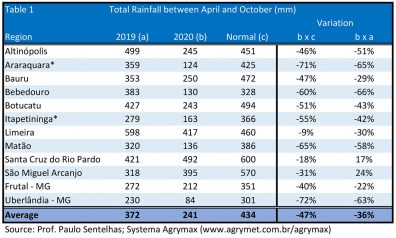
The period without rain, from May of this year until this last month of October, was one of the most extensive ever recorded in the state of São Paulo, according to the graphs and tables below. In addition to drought, very high maximum temperatures were recorded, even at night, causing considerable weight loss and lower fruit quality. The water deficit was very significant in all regions. This is the main reason for the significant decrease in the volume of fruit produced in the “citrus belt”. The losses are more accentuated in the north of the state of São Paulo and in the Triângulo Mineiro, warmer and drier regions.
- However, even further south in the state, losses were above normal. The first harvest estimate released by Fundecitrus, last May, brought an amount of 287.8 million boxes, 25% less than the previous harvest (2019/2020). What you see in the field is a volume of oranges quite below that number. The common perception among consulted technicians and citrus growers is that the final figure is expected to be below 250 million, perhaps below that.
- The period without rain and with temperatures well above the average resulted in extremely withered orchards – plants even died in orchards without irrigation. Another aggravating factor this year was the scarcity of water for irrigation. There are properties that have an installed irrigation structure; however, they do not have enough water available to meet the needs of the plants.
 Due to the flowering in non-traditional months (December and January) there are a large number of “green”, not yet ripe fruits mixed with ripe fruits from the normal flowering (August-September 2019). This brings an additional difficulty to the harvesting operation that has to be carried out in at least two different times, resulting in an increase of the production cost for the citrus growers.
- This mix of fruits with different level of ripeness, impair the quality of the juices, especially due to the greater amount of limonin present in the green peels of oranges. On the other hand, in the northern regions of the citrus belt, the fruits are getting ripe much faster than normal, producing juices with a ratio (ratio between the amount of sugars divided to acidity) much higher than the average for the period of the year. Industrial income has been better this year than in the previous two years, at least until this time of the harvest (November 2020).
- As a further consequence of this year’s climate events, we will see an increase in the effects of HLB or greening. The symptoms of the disease, such as early fruit fall and low production, usually express themselves more strongly when there is a water deficit. In addition, the psilideo, vector of the disease, presented very high rates even in winter, indicating that we will have a greater number of infected plants in the next years. This has probably occurred because of the warmer climate which resulted in a very irregular or uneven plant vegetation.
What can we expect from the next crop?
The northernmost regions only flourished after the rains that fell in the last days of October. This late blooming should not have a good fruit set because they will be still small in the higher summer temperatures. Moreover, the loss of leaves was very great in the recent drought period, and this will not allow for a large amount of fruit for the next season, since the plant will not be able to provide the metabolites necessary for an expressive fruit set. A good 21/22 harvest is not to be expected for these regions.
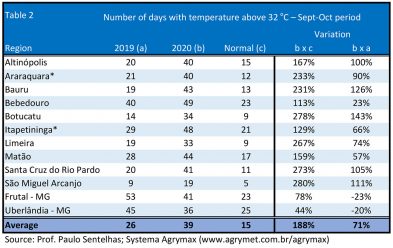
In the most southern regions, which suffered less from water deficit, the flowering came in the normal period, between August and September. However, irregular rainfall and high winter temperatures (table 2), after flowering, have worried producers. What they see in their orchards does not indicate a good harvest for the second year in a row. My experience shows that the harvest after a year as irregular as this one is also not usually good.
Price of juice should go up
Although it is common for citrus to have alternate crops, i.e., smaller crops followed by larger crops, the climatic factors presented in this article should result in two “small” crops in a row, the current and the next seasons.
Thus, Brazilian orange juice industries should process fewer oranges for two consecutive years. This reduction in supply, combined with the growing demand for juices in times of pandemic, should cause increases in the price of juices on the international market.
Author:
Mauricio Mendes
Citrus Consultant
Agriplanning Brazilian Agribusiness Company
GCONCI (Citrus Consultant Group)
Mauricio Mendes is a citrus consultant sine 1980 and Citrus grower since 1988. Has worked to major Citrus Farms in Brazil. Is COO of a 6.000 ha Citrus Farms operation in the SW od Sao Paulo State. Mauricio is also Beachead Advisor for New Zealand Trade and Enterprise (NZTE) . Also has been partner and CEO, for 14 years, of Informa FNP which is one of the most important Agribusiness consultant company in Brazil. FNP was recently acquired by IHS Markit.
Mauricio is also member of GCONCI (Citrus Farming Consultants Group) which gathers 17 Consultants. GCONCI provide direct technical assistance to over 40 million citrus plants (25 % of the Brazilian Citrus Belt)
*Araraquara and Itapetininga are major production citrus regions in São Paulo State.
Although the harvesting of the 2020/21 orange crop is advancing in Brazil, delivery to processors in São Paulo State (SP) was slow in November. According to Cepea collaborators, this scenario is linked to the lack of rains in the citrus-producing regions in SP in the last months, which limited both quality and supply, hampering activities at processing plants. On the other hand, rainfall in late November increased ratio and brix, favoring the juice produced in that period.
As regards the deals for the coming season (2021/22), the large-sized processors of orange juice in SP have been more interested in closing deals. However, bids have not been fixed and there may be an additional for participation in juice sales to the international market. Most citrus farmers are waiting for a better definition of the crop, since it seems the bad weather conditions this year may affect results.
SPOT – In the current season, large-sized processors are bidding prices up to 24.00 BRL per 40.8-kilo box, while bids from smaller-sized processors have been up to 28.00 BRL/box – late and pear oranges account for the most varieties processed. In November (until Nov. 26), prices averaged 24.46 BRL/box, 20.7 % up from the average in Nov/19, in nominal terms.
However, it is worth to mention that one of the large-sized processors was not closing deals in the spot market in November because of both the low supply of higher quality and larger-sized fruits and the competition with the domestic market, since prices have been attractive in this segment, and farmers are opting for selling fruits in natura.
Orange supply should continue low in the in natura market of São Paulo State (SP) in November. Besides the lower harvest in SP and the Triângulo Mineiro in the 2020/21 season, the current high temperatures and rains below average are debilitating plants and constraining fruits development on tree. However, the warmer weather in November should keep demand firm, which may underpin prices, at least in the first fortnight of the month.
As regards the return of rains to the citrus-producing regions in Brazil in late October, the farmers consulted by Cepea indicate that volumes were low, and precipitation was irregular. Thus, the current scenario continues unfavorable to quality and limiting an increase in supply (primarily of pear and late oranges, whose sales are generally higher at this time of the year).
In general, the rains registered in October are a lot lower than the average in the last 30 years. For the first 10 days of November, Climatempo (weather forecast agency) forecasts rains to several areas in SP. If moisture conditions get back to normal, the quality of the oranges may be recovered, and new flowers may open, resulting in a season with crops at different stages and fruits getting ready out of the ideal harvesting period.
2021/22 SEASON – Brazilian agents from the citrus sector have been concerned about the development of next season’s crops (2021/22). As leaves and many flowers have dropped, forecasts are negative.
In some groves in northern SP, where rains were higher, flowers have been reported, but flowering is considered sporadic. Flower settlement will depend on the weather from now onwards, but agents are concerned, since plants are very debilitated.
TAHITI LIME – The availability of tahiti lime should still be low in early November, tending to gradually increase with fruits from irrigated groves. According to agents, rains in late October, although low and sporadic, tend to favor growth – thus, the harvesting may step up in the second fortnight of the month.
However, the volume of tahiti lime should be lower than that initially forecast, since the high price levels in September and early October led some farmers to harvest small-sized fruits, which had not reached the ideal maturation either (these fruits were supposed to be ready in November). However, with the lower number of containers sent to the international market, supply should stay mostly in Brazil.
Orange prices have been on the rise in the Brazilian in natura market this month – the upward trend of quotes has been observed since July. Although the share of late varieties is increasing in the in natura market, in general, supply is low, while consumption is increasing sharply, due to the current high temperatures in Brazil.
Between October 1st and 15th, the average price for pear oranges was 36.52 BRL per 40.8-kilo box, on tree, 14.7 % higher than that in the first fortnight of September.
Low supply, mainly of high-quality oranges, is expected to keep prices on the rise in Brazil in the coming weeks. Besides, estimates for a 26 % decrease in the output of the 2020/21 crop should be revised, due to the drought and high temperatures in São Paulo State, which should reduce even more the volume harvested compared to the official estimates.
Data released in early October by the ABCM (Brazilian Association of In Natura Citrus) indicate that the 2020/21 citrus crops in São Paulo and in Minas Gerais States are, indeed, going to be lower. The drought faced by the sector in the major producing months hampered the development of fruits, which are small-sized. ABCM reported that, soon, the retail market and distributors may have lower supply of in natura citrus – or even a lack of products.
ABCM entrenches that the high temperatures and low rains between July and August damaged the fruits from the second flowering in the 2020/21 crop, which accounted for most of the output. In this scenario, agents believe that Fudencitrus’ next estimates, forecast to be released in December, may be revised down.
ORANGE JUICE – The 2020/21 orange crop in Florida was damaged by the hot and dry weather, which constrained groves’ productivity. Thus, the American orange output should be lower, which may lead the country to import higher amounts of orange juice. This scenario may favor the Brazilian sector, since Brazil is the top supplier of orange juice to the United States.
Between Oct/19 and Jul/20 (2019/20 season), the USA imported lower volumes of orange juice: 38 % of concentrated juice and 39.5 % of fresh juice, compared to that in the previous season, according to the Florida Department of Citrus (FDOC).
Although the Brazilian juice is losing market share to that from Mexico, the orange harvest from Mexico in the 2019/20 season (Nov/19 to Oct/20) decreased sharply, which may constrain juice production. According to the USDA, the Mexican supply should be 45 % lower than that in the previous season, and orange juice production, 60 % lower. Although initial inventories are high, juice supply should be 50 % lower.
However, it is worth to mention that the crops from São Paulo and the Triângulo Mineiro should also be lower in 2020/21. According to a report from Fundecitrus released last month, the harvest in the Brazilian citrus belt should total 286.72 million boxes, 26 % down compared to that in the previous season. This volume may decrease even more because of the drought in this region in the past months, which may even reduce supply in the 2021/22 season.
The dry weather and high temperatures in São Paulo State are concerning Brazilian citrus farmers. Besides limiting the supply of higher quality fruits in the current crop (2020/21), this scenario may affect the output next season (2021/22), since trees are very weak, and the current stage (fruit settlement) is very critical – some farmers have already reported fruitlet drops.
Data from Somar Meteorologia (weather forecast agency) show that it rained in southwestern SP (Avaré and surroundings) between May and June, while in central and northern state, precipitation was extremely low. In July, the scenario became worse, with mostly dry weather in all the areas – the monthly average of rains was below 10 mm.
In August, rains returned to SP, but were concentrated in the southwestern region – in some areas, the monthly rain volume hit 140 mm. Thus, this area is the least affected by the weather, with larger-sized fruits and, so far, higher flower settlement (for the fruits from the 2021/22 season). On the other hand, northern SP (Bebedouro and surroundings) has been the most affected region, mainly non-irrigated groves, with many trees almost totally dry and weak. In central SP, the scenario is concerning too, while in eastern SP, the situation is intermediate.
It is worth to mention that, concerning the output in the 2021/22 crop, the current development period is critical and largely influenced by the water availability in the soil, temperatures and air moisture.
Although it is still early to confirm, farmers have reported that settlement of the first flowering (which occurred mostly in mid-July) has been compromised in most regions. New flowering may occur if rains are enough to interrupt the water stress (more than 40 mm). In this context, flowering may be heterogeneous, depending on the region and plants conditions, which would result in trees with fruits in different development stages.
GREENING – High temperatures and low air moisture are also favoring an increase in the psyllids’ population. According to Fundecitrus (Citrus Defense Fund), the incidence of this bug in SP was high in the second fortnight of August, increasing the risk of spread in groves.
BRAZILIAN MARKET IN SEPTEMBER – With the high temperatures in Brazil, the sales pace has been fast in the market of in natura oranges. This scenario and the lower supply of quality fruits (due to low rains) underpinned pear orange prices in September. Between September 1 and 30, the average price for pear oranges closed at 32.78 BRL per 40.8-kilo box, on tree, 9.2 % up compared to that in August.
In the market of tahiti lime, prices oscillated in September, but drops were more frequent. The number of fruits within the standard required in the in natura market was low, since most of them are wilted and small-sized, due to low rains.
The average price for tahiti lime last month closed at 59.38 BRL per 27-kilo box, harvested, 16% down compared to that in August. With the new devaluations, prices are now lower than that in the same period last year, in nominal terms.
Orange juice inventories ended the 2019-20 season (on June 30, 2020) on the rise, as already expected by agents from the Brazilian citrus market. According to CitrusBR (Brazilian Association of Citrus Exporters), the volume stocked by then totaled 471.138 thousand tons, a staggering 86 % up compared to that in the previous season, due to the higher orange production.
However, although the 2020-21 crop started with high volumes stocked, production is forecast to be low in São Paulo State and the Triângulo Mineiro, which is keeping firm the demand from processors for oranges. This scenario should lower inventories by the end of the current crop.
A report released by Citrus BR in late August estimates that, on June 30 2021, the inventories of Frozen Concentrate Orange Juice (FCOJ) Equivalent from the 20-21 crop will total from 240 to 280 thousand tons, 49 % down compared to that in the previous season.
These estimates consider that around 238 million boxes of 40.8 kilos of oranges will be processed (with 50 million boxes left to be sold in the in natura market), average yield of 268 boxes to produce a ton of FCOJ Equivalent and stable sales, at 1.15 million tons. These results are similar to that estimated by Cepea in May, at 250 thousand tons. It is worth to mention that both estimates (from CitrusBR and Cepea) take into consideration the fact that there may be adjustments in industrial yield, due to the multiple flowerings registered in 2020-21.
According to agents from processors, yield has been low, and much more than the 268 boxes are needed to produce a ton of juice, as estimated by CitrusBR. Although this number tends to decrease along the season, it is concerning, since the prices paid for the fruits have been higher this season, meaning that remuneration for lower quality oranges is currently higher. In this scenario, the only processors that has been purchasing oranges in the Brazilian spot market is bidding prices according to yield: when more than 290 boxes are needed for a ton of juice, prices average 21.60 BRL/box, while for the fruits with higher yield, prices reach 24.00 BRL/box.
BRAZILIAN MARKET IN AUGUST – Despite the weak demand, due to the colder weather, orange prices remained firm in August, underpinned by the lower supply of higher quality fruits in the in natura market. Besides, the fast crushing pace at the large-sized processors in SP helped to reduce availability in the market. Thus, between August 1st and 31, the average price for pear oranges closed at 30.01 BRL per 40.8-kilo box, on tree, 11.8 % higher than that in July.
TAHITI LIME – Tahiti lime supply was low in the Brazilian market in August, forecast to increase only from mid-September. The fruits that were on tree had not reached the ideal size and maturation to be harvested, since the weather was dry in the last months.
Thus, prices were firm last month, which limited deals in the in natura market of São Paulo State. In August, the average price for tahiti lime was 85.15 BRL per 27-kilo box, harvested, 40 % up compared to that in July.
The 2019-20 exporting season of orange juice and citrus by-products had a good performance. This result was already expected by the agents from the sector, who were based on the higher orange supply in the citrus belt from São Paulo State, which favored inventories building up at processors. With the covid-19 pandemic, agents also reported occasional higher demand for orange juice, due to the nutritional values of the product as well as higher breakfast consumption at home.
As regards orange juice, the volume of Frozen Concentrate Orange Juice Equivalent (FCOJ Equivalent) was higher, but revenue remained stable. According to data from Secex, between July/19 and June/2020, Brazil shipped 1.11 million tons of the product to all destination countries. Revenue from these shipments totaled 1.8 billion USD, stable compared to that in the previous season. In Real, revenue totaled 8.09 billion (boosted by the strong dollar), 16 % higher than that received in the 2018-19 season.
Despite the good exports performance to the European Union, the major purchaser of the Brazilian orange juice, shipments to the United States decreased, ending the season with an 11 % lower volume (174.76 thousand tons) and a 19 % lower revenue (276.93 million USD). Brazilian exports to the EU totaled 768.15 thousand tons, 20 % up compared to that in the previous season. Revenue totaled 1.26 billion USD, 7 % up in the same comparison.
As for the Brazilian exports of citrus by-products, revenue in dollar dropped during the season, totaling 369.43 million USD, 25 % lower than that received in 2018-19, according to Secex,. Among the products exported are citrus pulp pellets, citrus terpenes, d-limonene and lemon, lime and orange essential oils. Except for the citrus pulp pellets, prices for all the other by-products dropped sharply during the season.
For citrus pulp pellets, the average exports price increased during the season, but the volume shipped decreased. According to Cepea collaborators, this may be linked to the recent price rises for corn and soybean in the Brazilian market, which boosted the demand, primarily from livestock farmers, for citrus pulp pellets.
BRAZILIAN MARKET – Tahiti lime supply has been low in the major citrus-producing regions in São Paulo State. In this scenario, prices skyrocketed in June, hitting the highest average for the month, in nominal terms, in all Cepea series.
In general, tahiti lime quotes have been on the rise in the in natura market since April, due to the sales increase – related to the covid-19 pandemic – and the slower harvesting pace in May and in June – growers decided to control the harvesting in order to keep prices at higher levels. Thus, in late June, prices rose up to 60.00 BRL per 27-kilo box, harvested, averaging 32.42 BRL/box in the month, more than two-fold that registered in June 2019 (+124 %).
JULY – In the first fortnight of July, lower supply continued to push up prices in the Brazilian market. In general, quality was considered satisfactory, as well as fruits size and color, which favored exports. It is worth to mention that, in the first semester of 2020, the Brazilian shipments of lemon and lime hit a record for the period – compared to that in the same period last year, the volume exported was 12 % higher, and revenue, 7 % higher.
Between July 1st and 15, the average price for tathiti lime was 52.19 BRL per 27-kilo box, harvested, 59.6 % up compared to that in the first half of June. On the other hand, the demand from the industry continued low, with only two small-sized processors receiving tahiti lime (in Artur Nogueira and Itajobi, both in SP State). Remuneration varied according to quality, ranging from 12 to 15.00 BRL per 27-kilo box, harvested and delivered to processors.
ORANGE – The trading pace for in natura oranges was faster in the Brazilian market in the first fortnight of July. Although the demand for pear oranges did not increase much – because of the social distancing advice in many cities in São Paulo State –, the volume of early oranges available in the market decreased slightly (because of purchasers’ firm stance), underpinning prices.
Between July 1st and 15, the average price for pear orange was 26.01 BRL per 40.8-kilo box, on tree, 3 % up compared to that in the first half of June.
Until May, only one of the large-sized processors was crushing oranges from the 2020/21 crop in São Paulo State (in Araraquara) and in June, three more plants started activities, one in Colina and the other two in Matão.
Although there were more plants crushing oranges in June and processors had started crushing the fruits purchased through contracts, the crushing pace was still slow compared to that in previous crops, due to the crop delay in most citrus-producing regions in Brazil, except for northern São Paulo, where fruits development was more advanced.
Most processors were crushing their own fruits or those previous purchased, however, one large-sized processors was purchasing oranges in the spot market. Bidding prices for pear or early oranges were ranging from 21.60 BRL and 24.00 BRL per 40.8-kilo box, harvested and delivered to processors, depending on fruits yield – when less than 290 boxes are needed to produce a ton of concentrate orange juice, remuneration is higher.
The volume of fruits available in the spot market this season is expected to be low, since the attractive prices paid to growers (up to 26.00 BRL/box) tend to increase the preference for purchases through contracts. It is worth to mention that, according to agents from processors, only a few growers have not traded their fruits from the 2020/21season yet.
BRAZILIAN MARKET IN JUNE – Sales were low in the in natura market in June, due to the colder weather in São Paulo. As restaurants are not working and schools are closed, the demand for larger-sized fruits was higher, resulting in a surplus of smaller-sized oranges. Although these fruits may be allocated to processors, pear oranges quotes did not rise last month. Between June 1 and 30, pear orange prices averaged 25.26 BRL per 40.8-kilo box, on tree, stable (-0.1%) compared to that in May.
As regards tahiti lime, agents reported a slight reaction in the demand in late June – both domestic and international. Besides, the harvesting pace was controlled, in order to avoid price drops. Thus, amid lower supply, prices increased in June. The average price for tahiti lime last month closed at 29.49 BRL per 27-kilo box, harvested, 9.9% higher than that in May.
The Brazilian exports of Frozen Concentrate Orange Juice (FCOJ) Equivalent (2019/20 crop) are ending, and the volume sold to all destinations continues higher than that last season.
From July/19 to May/20, Brazil shipped 1.03 million tons of juice, 13 % more than that exported in the first 11 months of the 2018/19 season (913.4 thousand tons), according to data from Secex. Revenue, in turn, rose by 1 % (in the same comparison), totaling 1.7 billion USD.
To the European Union, specifically, Brazilian juice shipments totaled 723.7 thousand tons, 23 % up compared to that in the same period last season (587.7 thousand tons). Revenue amounted 1.2 billion USD, for an increase of 10 %. To the United States, Brazilian exports have decreased by 19 % this season, to 154.5 thousand tons, and the revenue downed 25 %, to 248.96 million USD.
Low demand explains the decrease in the volume sent to the US, due to the forecast for a recovery in the 2019/20 season in Florida for the second consecutive year. The state has faced several problems involving weather and plant health this season and in previous crops.
However, due to the covid-19 pandemic, juice sales in the American retail market have increased significantly – data from Nielsen indicate that, this season (from October/19 to April 11, 2020), the volume sold was 6.1 % higher than that in the same period of the crop before.
In this scenario, local juice stocks are being consumed. Although inventories are higher than that in the season before, projections indicating an increase in stocks are lower than those at the beginning of the year.
BRAZILIAN MARKET IN JUNE – The trading pace for citrus was weak in the first half of June, but the volume of oranges available in the in natura market was lower, since processing plants were receiving fruits in that period. Therefore, the average price for pear oranges in the first fortnight of the month was 25.25 BRL per 40.8-kilo box, 4.7 % down compared to that in the first half of May.
Players surveyed by Cepea reported higher sales of ponkan tangerine in São Paulo between June 1 and 15. Thus, the harvesting of this variety stepped up in that period, so that growers could take advantage of the high price levels, although fruits have not reached the ideal maturation stage yet.
In April, the citrus growers from São Paulo State fastened the harvesting pace of the 2020/21 orange crop. Although supply was not high, the volume harvested was enough to press down citrus quotes in the in natura market during the month. Besides, the demand for oranges decreased in April, due to the social distancing advice – because of the coronavirus pandemic –, constraining fruits sales to restaurants and other food services. Supply should continue higher than demand in May, which has been concerning citrus growers about prices.
As regards early varieties (rubi, hamlin and western, for instance), deals have been closed since March. However, only in late April these fruits were near the ideal maturation stage, when baía oranges started to be supplied. Sales and the harvesting of these varieties should step up from May, but the crop peak should occur only in June, when crushing is supposed to start. In April, the average price for hamlin oranges was 25.02 BRL per 40.8-kilo box, on tree, 18.7% down compared to that from March.
For pear oranges, the gradual decrease in the demand pressed down quotes in April. Thus, the average price for this variety was 8.15% lower than that from March, closing at 32.47 BRL per 40.8-kilo box, on tree. According to Cepea collaborators, the harvesting of the first pear oranges in the 2020/21 crop should step up from the second fortnight of May, once crops development is late and phased. However, some growers preferred to anticipate the pear orange harvesting, aiming to take advantage of the price levels – these citrus growers fear that prices may drop sharply in May, due to forecasts for higher volumes of early oranges in the market.
As regards processors, although supply is forecast to increase in May, crushing should be lower early in the month. This scenario has led the early fruits to be exclusively allocated to the in natura market. On the other hand, late oranges harvesting (valencia, natal and folha murcha) should end in the coming weeks.
Crop loss of 25.6 % in relation to previous crop is due to lower nutrient reserves in plants and adverse climatic conditions
The 2020-2021 orange crop for the São Paulo and West-Southwest Minas Gerais citrus belt is estimated at 287.76 million boxes of 40,8 kg, according to the online announcement made May 11 by Fundecitrus. This number is 25.6 % smaller than the previous crop of 386.79 million boxes, and 12.5 % below the average crop size for the last 10 years. Approximately 20.56 million boxes are expected to be produced in the Triângulo Mineiro.
Expected yield is estimated at 790 boxes per hectare, as compared to the 1,045 boxes per hectare in the previous crop.
“It is a small crop, considering the productive potential of groves, but that is due to the biennial production cycle of orange trees”, explains Fundecitrus general manager Juliano Ayres. “Since the previous crop was large, nutrient reserves this year are smaller. In addition, climatic conditions were adverse during fruit setting and the first phase of fruit growth”, he states.
Influence of the climate and late blooms
Crop loss was caused by a reduced number of fruits per tree in comparison to the previous crop. The large production in the previous season increased the consumption of nutrient reserves in plants, which became scarce and triggered the phenomenon known as alternate bearing. Furthermore, the climate was also a negative influence: high temperatures in September and October 2019 affected the setting of newly formed fruit.
Adverse climatic conditions were also seen in March and April 2020, affecting fruit at a more advanced stage of development. According to data from Somar Meteorologia, the accumulated rainfall volume in that period was not even half the historical average (1981-2010), which restricted fruit growth.
245.15 million boxes of the estimated production are of fruit from the first and second blooms (85.2 % of the total), 34.64 million boxes are of fruit from the third bloom (12 %) and 7.97 million boxes are of fruit from the fourth bloom (2.8 %).
Dry weather in March and April 2020 restricted the growth of fruits that should still be small at harvest. Oranges are expected to weigh 159 grams at harvest.
Alternate bearing in regions
Yield per sector this crop season, as compared to last year’s, shows significant variations among locations. The Northwest sector, encompassing the regions of Votuporanga and São José do Rio Preto, ranks first in yield drop. 492 boxes per hectare expected to be produced in that sector represent a drop of 46.7 % in relation to the 2019-2020 crop. Next comes the North sector (regions of Triângulo Mineiro, Bebedouro and Altinópolis), with an expected yield of 686 boxes per hectare (-35.9 %); then the Central sector (regions of Matão, Duartina and Brotas), with 721 boxes expected per hectare (-30.1 %); the South sector (regions of Porto Ferreira and Limeira), with 781 boxes expected per hectare (-16.5 %); and the Southwest (regions of Avaré and Itapetininga), where 1.185 boxes should be harvested per hectare (-2.7 %) (see the graph below).
“The greater drop in yield expected for this current crop, the larger the increment observed in the previous crop. This is one evidence of the biennial production cycle of orange trees, showing that usually the fruit load one year is inversely proportional to the fruit load in the previous year, causing variations in yield per hectare that alternate with the crop seasons”, analyzes PES coordinator Vinícius Trombin. “But the main reason for crop fluctuations is the climatic change that often occurs from one year to the next. In regions with more stable climate, such as Avaré and Itapetininga, yield variations are smaller”, adds the survey coordinator.
Recovery of orange juice consumption
The São Paulo and West-Southwest Minas Gerais citrus belt is the largest worldwide producer of orange for processing. According to PES methodological coordinator and Professor at USP and FGV Marcos Fava Neves, the 2020-2021 crop and the inventory volume are now balanced due to the recovery of the demand for juice, heated up in major markets as a result of the COVID-10 pandemic.
“In view of an attempt to boost immunity, the citrus sector sees an increasing consumption of orange juice. It is an extremely nutritious liquid food”, he states.
Citriculture and sustainability
This year, based on methodology developed by Embrapa Territorial, PES has estimated the area of conserved woods on citrus farms: 182 thousand hectares throughout the citrus belt. On average, there is one hectare dedicated to conservation on farms for every 2.52 hectares of citrus groves. Data was obtained from cross-checking the information collected in the field by Fundecitrus with data from the Rural Environmental Registry (CAR).
“This work shows the important role of citriculture in environmental conservation and biodiversity, with large conserved areas integrated within farms”, says Trombin.
Methodology
For the estimate, orange trees were counted one by one in 2,557 plots and fruits from 1,590 trees were harvested throughout the citrus belt. “The reduced number of samples due to COVID-19 caused minor impact in the general survey result, which can be verified by the error of ±2.65% in the average number of fruits per tree”, PES methodology analyst and Professor at the department of engineering, math and science at FCAV/Unesp José Carlos Barbosa states.
The Crop Forecast Survey is carried out by Fundecitrus in cooperation with Markestrat, school of economics, business administration and accounting (FEA) of the university of São Paulo (USP) and the “Júlio de Mesquita” school of agricultural science and veterinary medicine (FCAV) of the São Paulo state university (Unesp).
Please download the complete forecast under: www.fundecitrus.com.br/pdf
Orange supply should continue to increase in São Paulo State in April. Although some oranges among the early varieties were traded in March, this month, availability should grow, offsetting the low supply of pear oranges in the market. Still, supply should not be considered high, since flower settlement in the first flowerings was reduced.
Thus, the upward trend of orange prices, observed until March, has been interrupted. Demand, in turn, should be affected (positively and negatively) by the covid-19 pandemic – on the one hand, citrus fruits are supposed to strengthen immunity, on the other hand, the demand for school meals, company meals and from food services should continue low.
It is also important to mention that the oranges from SP should reach the ideal maturation stage this month, which may allow these fruits to stay longer on trees while demand is low. However, growers tend to opt for closing deals at this time of the year, before availability grows too much (possibly pressing down quotes), from May.
Besides, crushing is currently at a slow pace at the processing plants from SP, and should step up again only in May, when early varieties start to be crushed. Thus, this month, oranges should be allocated exclusively to the in natura market and small-sized processors. However, as the market has been oscillating and uncertain, due to the changes caused by the pandemic, orange prices may rise again, changing the scenario forecast by growers.
TAHITI LIME – As the fruits from the second flowering have ripened, supply should continue high between April and early May. Quality should be high, reflecting the regular rains in March. Still, it should be lower than that available in the first quarter of the year (crop peak period). In this scenario, a considerable supply with fruits within the required standard may continue to favor exports if international demand keeps firm.
In the first quarter of 2020, the Brazilian exports of lemon and lime were records for the period. According to data from Secex, Brazil shipped 34.7 thousand tons of these fruits, a staggering 46 % up compared to that in the same period last year. Revenue, in turn, totaled 25.9 million USD in January, February and March, 42 % higher in the same comparison.
Orange production for the 2019-2020 crop season totals 386.79 million boxes1
The final 2019-2020 orange crop forecast for São Paulo, Triângulo Mineiro and West-Southwest Minas Gerais citrus belt, published on April 09, 2020 by Fundecitrus – performed in cooperation with Markestrat, FEA-RP/USP and FCAV/Unesp2 – is 386.79 million boxes of 40.8 kg each, which represents a decrease of 0.54 % in relation to the first crop forecast carried out in May 2019 of 388.89 million boxes. This crop is 35.3 % larger in comparison to the previous season (2018-2019), when 285.98 million boxes were produced, evidencing the biennial production cycle of orange trees, that is, larger crops alternated with smaller ones. …
1Hamlin, Westin, Rubi, Valencia Americana, Seleta, Pineapple, Pera Rio, Valencia, Valencia Folha Murcha and Natal.
2Departament of Math and Science at FCAV/Unesp Campus Jaboticabal.
Please download the complete forecast under: www.fundecitrus.com.br/pdf
Opposite to the expected by the agents from the Brazilian citrus sector, tahiti lime prices increased in São Paulo State in March, despite the crop peak. The boost came from higher demand, since, in the second fortnight of the month, people were trying to eat healthier, increasing the consumption of vitamin C, because of the coronavirus outbreak worldwide.
However, most of the demand was linked to the increase in the purchases from distributors, retailers and consumers for stocking. Besides, the closure of schools, street markets and grocery stores, and lower sales in restaurants may also reduce the demand for the fruit.
In March, the average price for tahiti lime was 22.2 % higher than that in February, at 12.52 BRL per 27-kilo box.
As regards exports, agents reported a decrease in the volumes shipped, since the coronavirus outbreak affected Europe more severely, so far. Besides, the lower availability of containers for exports and the cancelation of air deliveries also reduced sales to the international market. Thus, tahiti lime prices for exports were lower than quotes in the Brazilian market in March, averaging 12.29 BRL per 27-kilo box.
ORANGE – The demand for oranges was firm in March, and prices remained stable in the Brazilian market. According to growers, the quarantine decree in São Paulo State and the consequent halt in some activities reduced labor, limiting supply and logistic operations. Thus, orange availability was low and, now, many agents are waiting for some early varieties, such as westin and rubi, to ripen in order to start trading.
In March, the average price for pear oranges was 35.35 BRL per 40.8-kilo box, on tree, 6.9 % up compared to that in February. The maturation stage requested by the in natura market is forecast to be reached in most groves between April and May.
Orange crushing in the 2019/20 crop slowed down in the first fortnight of March at most of the processors in São Paulo State, due to the low supply in the Brazilian citrus belt. Currently, only one plant (in Araraquara) among the three large-sized processors is crushing oranges, primarily early pera rio and late varieties (natal and folha murcha). As usual, this plant should keep activities going until the crushing beginning for the 2020/21 crop.
Besides the lower orange supply, the quality of the fruits allocated to the industry is below the expected. Although yield is considered satisfactory this season, it has been affected by the frequent rains in the first two months of 2020.
BRAZILIAN SPOT MARKET – As both supply and quality decreased in the first fortnight of March, the prices paid for oranges dropped – the quotes paid for the fruits harvested and delivered at processing plants averaged 18.00 BRL per 40.8-kilo box in the first half of the month, against 20.00 BRL/box in February.
At smaller-sized processors, remuneration ranged from 18 BRL to 24 BRL per box, according to yield and quality (the processors that make fresh juice were paying higher prices for the fruits).
As regards the oranges from the 2020/21 crop, sales have not started yet – opposite to the scenario in the two previous seasons, when, between October and November, agents from plants started to bid in order to close deals. Uncertainties about the output in the 2020/21 season may be hampering price fixing by processors – it is worth to mention that production estimates should only be released in May.
MARCH – The firmer weather in tahiti lime producing regions favored the harvesting of the variety in the first fortnight of March, which, added to the lower demand from both the international market and domestic processing plants (since a large-sized processors has ended activities), pressed down quotes in that period. Between March 2 and 13, tahiti lime prices averaged 9.86 BRL per 27-kilo box, harvested, 7.9 % down compared to that in the first half of February.
As regards oranges, sales increased in that period, while supply decreased. The growers consulted by Cepea reported the harvesting end for late oranges, which should increase the share of early oranges in the total volume traded this month. In general, the harvesting pace is expected to be slow for these varieties, which may underpin orange quotes in the in natura market. In the first fortnight of March, pear orange prices averaged 34.86 BRL per 40.8-kilo box, on tree, 6.7 % up compared to that in the same period of the previous month.
PONKAN TANGERINE – The harvesting of ponkan tangerine started in late February in the citrus producing regions from São Paulo State – despite the slow pace. Supply (mainly of higher quality ponkan tangerine) should only increase from the second fortnight of March, when the variety starts to reach the ideal maturation to be traded in the in natura market.
Some growers harvested ponkan tangerine before the ideal maturation for trading, aiming to take advantage of the attractive price levels and the offseason period for pear and late oranges from the 2019/20 crop.
Agents expect the volume of ponkan tangerine to be lower than that in the previous season, based on the dry weather between September and October – when fruits were developing – and on the lower vegetative vigor of plants, after a large crop. In general, production was low in the last years, with well-distributed and sparse crops.
This season, fruits quality should be lower than in 2019, due to the weather. Frequent and high rains in the first two months of 2020 favored the incidence of fungal diseases and rotting after the harvesting.
As orange production is higher this season (2019/20), orange juice inventories should increase again until the end of the crop. According to a report from CitrusBR (Brazilian Association of Citrus Exporters) released on February 18, ending stocks of Frozen Concentrate Orange Juice (FCOJ) equivalent should total 412.83 thousand tons at the processing plants from São Paulo by June 30, 2020. This is the highest volume registered in five seasons (since 2014/15), considering CitrusBR’s historical series.
If this volume is confirmed, it would account for a 63 % increase compared to that in the 2018/19 season (253.18 thousand tons). This scenario was already expected, since orange production in the citrus belt (São Paulo and the Triângulo Mineiro) increased 34.6 % between the last season and the current one, according to Fundecitrus (Citrus Defense Fund).
Of the total volume produced, still according to CitrusBR, 59.7 million boxes (40.8-kilo box) will be allocated to the in natura market and 325.17 million, to processing. The average crop yield is estimated at 270.1 boxes for a ton of FCOJ Equivalent, and the total juice production is forecast at 1.2 million tons.
In August/19, Cepea calculations had pointed to the possibility of inventories to increase at processors to levels similar to that estimated by CitrusBR, at 400 thousand tons.
REFLEXES IN 2020/21 – Although estimates point to a recovery in the volume stocked (the last four seasons closed with lower volumes), the effects on juice inventories in 2020/21 will depend on the amount to be produced in the coming season. However, since citrus growers expect next crop to be at least 30% smaller than the 2019/20, inventories should decrease to lower levels in June/21.
If production decreases, the prices paid to growers by the industry may rise, since demand should remain firm in this segment, despite the high inventories. In the in natura market, quotes may be favored by low supply, since processors should try to purchase the largest possible amount of fruits, to prevent inventories from decreasing to critical levels in June/2021.
MARKET IN FEBRUARY – Orange consumption decreased in the in natura market in the second fortnight of February, due to the rainy weather in some regions of São Paulo State and fruits’ lower quality. However, the low supply of higher quality pear oranges underpinned prices during the month. Between February 3 and 28, pear orange prices averaged 33.06 BRL per 40.8-kilo box, on tree, 8.3 % up compared to that in January.
TAHITI LIME – The harvesting pace for tahiti lime was fast in February in the major producing regions from São Paulo State. Supply, which has been increasing since December, hit its peak last month, and according to agents consulted by Cepea, it may continue high until late March.
Besides that, rains influenced the in natura market too, hampering activities in the field and lowering fruits quality. Moreover, the sales pace was slow in February, due to the carnival season in Brazil.
Thus, in February, tahiti lime quotes averaged 10.24 BRL per 27-kilo box, harvested, the lowest for the month since 2017, in nominal terms, and 14.9 % down compared to that in January.
Updated orange1 crop forecast totals 384.87 million boxes
The 2019/2020 orange crop forecast update for São Paulo and Triângulo Mineiro/Southwest Minas Gerais citrus belt, published by Fundecitrus – performed in cooperation with Markestrat, FEA-RP/USP and FCAV/Unesp2 – is 384.87 million boxes of 40.8 kg each. This figure corresponds to a decrease of 0.11 % in relation to the previous forecast update published in December 2019 and is 1.03 % smaller as compared to the first crop forecast announced in May 2019. Approximately 26.85 million boxes of the total crop should be produced in the Triângulo Mineiro region.
Rainfall remained below normal for most of the citrus belt from May 2019 to January 2020, according to data from Somar Meteorologia. Accumulated rainfall in this period averaged 836 millimeters for all regions, which is 14% or 139 millimeters below the historical average of 975 millimeters (1981-2010). Rainfall shortage was more pronounced in the Central, South and Southwest sectors, including regions such as Limeira, where the accumulated amount was only 690 millimeters, that is, 33% or 341 millimeters below normal. …
Please download the complete forecast under: www.fundecitrus.com.br/pdf
1 Hamlin, Westin, Rubi, Valencia Americana, Seleta, Pineapple, Pera Rio, Valencia, Valencia Folha Murcha and Natal.
2 Departament of Math and Science at FCAV/Unesp Campus Jaboticabal.
Despite the higher orange supply in the 2019/20 crop, quotes for all the varieties surveyed by Cepea in São Paulo State remained firm in January – similar to the levels observed in January last year, in nominal terms.
This scenario is linked to the lower volume of early and late oranges this season – the fruitlet losses and the lower flower settlement between December/18 and January/19 are now reflecting in a lower amount of early oranges. Prices could even be at higher levels, but the high number of lower quality fruits is constraining the average prices. This scenario helps to widen the gap between quotes.
Between January 2 and 31, the average price for pera rio oranges was 30.53 BRL per 40.8-kilo box, on tree, stable (+ 0.3 %) compared to that in Jan/19, but 8.2 % higher than that in December/19, in nominal terms. For the late varieties, natal orange quotes averaged 26.99 BRL per 40.8-kilo box, 2.4 % and 8.2 % up, respectively, compared to that in Jan/19 and Dec/19, also in nominal terms. As regards valencia oranges, the average price in January was 25.47 BRL per 40.8-kilo box, stable (- 0.5 %) compared to that in January/19, but 5.1 % higher than that in December/19.
SUPPLY – In general, the low supply of pear oranges has been reported by citrus growers since late 2019, but there still are remaining volumes of late varieties (mainly natal and folha murcha) available to be harvested in February. Therefore, the low supply of high quality fruits and the high temperatures this month, which usually favor citrus consumption in São Paulo, may underpin prices.
From March onwards, according to Cepea collaborators, the first oranges among the early varieties from the 2020/21 crop should be harvested, but only in the groves where activities have advanced. According to collaborators, most part should come from northern SP, since the weather is warmer in that area, which usually fastens fruits maturation. Still, as the harvest should not be large compared to the usual demand in that period, prices may be even higher in the in natura market.
TAHITI LIME – Growing supply and medium quality influenced tahiti lime quotes in January. From Jan. 2 to 30, quotes averaged 12.04 BRL per 27-kilo box, harvested, 28.1 % down compared to that in the same period last year and 46.9 % lower than that in December/19.
As the harvesting stepped up last month, crushing increased. In late January, four plants were operating, purchasing the fruit between 12 BRL and 14 BRL per box, harvested and delivered to the plant.
EXPORTS – The Brazilian exports of Frozen Concentrate Orange Juice (FCOJ) Equivalent increased in the first six months of the current season (2019/20). Between July and December 2019, Brazil shipped 665.85 thousand tons of the product to all dentitions, 22 % more than that from the same period of 2018, according to data from Secex. Revenue from these shipments, in turn, rose 10 % (in the same comparison), totaling 1.13 billion USD.
This result was already expected by agents from the sector, due to both the higher production in the Brazilian citrus belt (São Paulo and Triângulo Mineiro) in 19-20 and some bottling plants needs to replenish inventories. It is worth to mention that these increases also reflect the inventory flow from Brazilian terminals to terminals abroad, and not necessarily a sales increase in the same proportion.
To the European Union (the number one destination for the Brazilian juice), Brazil has exported 460.37 thousand tons of juice this season, 30 % up compared to the volume shipped between July and December 2018. To the United States, however, Brazilian shipments are decreasing, due to the crop recovery in Florida in the 18-19 season and perspectives for a positive scenario in the 19-20 season.
Higher orange supply in both Brazil and Florida in 19-20 and lower demand in the United States, in turn, are pressing down orange juice quotes this season.
Brazilian agents expect orange production in São Paulo and the Triângulo Mineiro region to be low in the 2020/21 season. Although lower productivity constrains growers’ revenue, a smaller harvest tends to underpin the prices paid by the industry, despite higher ending stocks in June 2020.
In general, the biggest flowerings (observed in August) were considered positive by most of the growers consulted by Cepea. However, the dry and hot weather between September and October damaged plants and delayed their development during the fruit-fixing period. Besides, new flowerings (although occasional and smaller than that from August) were spotted in early December, favored by November rains.
Thus, trees development has been heterogeneous in the Brazilian citrus belt, even within a single region. However, it is worth to mention that the flower settlement period lasts until mid-January, which makes it difficult to measure the results for the coming season. Besides, the scenario is still uncertain and depends on the flowers that are now opening, the percentage of fixed fruitlet and fruits development in January.
INVENTORIES – Higher orange production in the current season (2019/20) has allowed crushing to be high at the processors from São Paulo State. In this scenario, perspectives for June 2020 indicate higher inventories of Frozen Concentrate Orange Juice (FCOJ) Equivalent, possibly surpassing 400 thousand tons, according to Cepea estimates – higher than the strategic level. Isolated, this scenario may press down quotes at processors in the coming season, but, with the low production estimates for 2020/21 in São Paulo and the Triângulo Mineiro, quotes may continue firm.
Thus, in 2020/21, prices should be largely influenced by production – the agents consulted by Cepea believe the harvest will be smaller than 300 million boxes. If that is confirmed, this scenario may stabilize quotes in 2020, since it would keep the demand from processors high, and there would not be pressure on quotes in the in natura market.
Production in the citrus belt (São Paulo and Triângulo Mineiro) is higher in the 2019/20 season. The demand for fruits, in turn, was firm in 2019 because of low ending stocks of orange juice at processing companies from São Paulo. Therefore, higher demand and the record productivity in the field kept profitability positive. Moreover, the fact that most trades with the industry had been closed previously and at the same price levels observed on 2018/19 also favored profitability.
Fundecitrus (Citrus Defense Fund) released a report in December indicating that the orange production in the citrus belt may increase 34.7 % in 2019/20, totaling 385.31 million 40.8-kilo boxes. Productivity per hectare is likely to reach 1,041 boxes, a record. The good result is attributed to favorable weather during flower development (in the second semester of 2018) and to the fact that plants recovered after the previous lower production.
INDUSTRY – Prices for the industrial sector concerning the contracts closed in October and November 2018 ranged from 20.00 to 22.00 BRL per 40.8-kilo box, harvested and delivered at processors, similar to that in the previous crop, despite the current high supply. However, for the producers who trade with companies in the spot market, values were at 20.00 BRL per box – in the previous season, they reached 26.00 BRL per box.
However, quotes in the spot market increased in December, scenario that may be related to perspectives for lower production in the 2020/21 season. As a result, one of the major processing companies started to purchase fruits at 20.00 BRL per box from December onwards – the average price most part of the crop was 18.00 BRL per box, harvested and delivered. Another major company continued to bid 18.00 BRL per box in the last month of 2019, but the price was 16.00 BRL/box during the season.
INVENTORIES – In 2019/20, the industrial demand was firm, due to low stocks at processing companies in São Paulo, of 253.18 thousand tons of orange juice in June/19, according to CitrusBR. This volume is 26.2 % lower compared to that in the 2017/18 season.
IN NATURA MARKET – Higher orange supply pressed down quotes in the in natura market in 2019. Between July and November, the average price for pear oranges was 29 % below that in the same period of 2018, in nominal terms.
However, the 2018/19 harvest was small, pushing up quotes, which hit nominal records from July to December 2018, considering Cepea series (since 1994). Compared to quotes in the 2017/18 season, price averages between July and November 2019 were 20 % higher, in nominal terms.
EXPORTS – After a season with low shipments, orange juice trades to the international market have recovered in 2019/20. The good performance is linked to the higher production in São Paulo and the possible needs to build stocks from juice bottling companies. In the partial of the season (from June to November/19), 550.13 thousand tons of orange juice were exported to all destinations, 46 % more compared to the same period last crop.
TAHITI – The market behavior was atypical in 2019. Despite the higher production, values were high throughout the year, sustained by firm demands (domestic and international). The average from January to November was 34.58 BRL per 27-kilo box, harvested, only 4.3 % down compared to that in 2018, in nominal terms.
Brazilian exports of tahiti lime hit a record last year. The dry weather in Mexico, major competitor regarding shipments to the European Union, favored exports good performance.
Brazilian exports of Frozen Concentrate Orange Juice (FCOJ) Equivalent increased in October for the fourth consecutive month. This season (July to October/19), Brazil has shipped 390.5 thousand tons of the product to all destinations, 19 % more than that exported in the same period last year, according to data from Secex. Revenue, in turn, rose 8 %, in the same comparison, totaling 672.27 million USD.
This result was already expected by agents from the sector, who were based on the needs of bottling plants from the European Union (number one destination for the Brazilian juice) to replenish inventories – it is worth to mention that, last season, national shipments to the EU decreased. This season (2019/20), exports to the EU have already reached 284.3 thousand tons, 25 % up compared to the volume shipped between July and October 2018.
Shipments to the United States continue to decrease – between July and October/19, Brazilian exports to the USA decreased 6 %, totaling only 53.5 thousand tons, still reflecting the 2018/19 harvest offset in Florida as well as perspectives for a positive scenario in the American state in 2019/20.
Brazilian juice exports should continue on the rise in the coming months, due to the higher orange production in the citrus belt (São Paulo and Triângulo Mineiro) and the needs of European bottling plants to replenish inventories. Shipments to the USA, in turn, will depend on the output from Florida (although greening has been controlled, it still damages local groves).
BRAZILIAN MARKET – The demand for oranges was firm in the in natura market in the first fortnight of November, according to Cepea collaborators, pushing up prices. As regards supply, the low availability of higher quality fruits and the reduction in the pear orange harvesting helped to underpin quotes. Between Nov. 1 and 14, pear orange quotes averaged 28.04 BRL per 40.8-kilo box, on tree, 31.1 % up compared to that in the first half of October.
As regards tahiti lime, the volume available in the in natura market of SP is increasing – although most are small-sized fruits, which are traded at lower prices. According to agents consulted by Cepea, the gradual supply increase tends to press down quotes from now onwards. Between Nov. 1 and 14, tahiti lime prices averaged 91.37 BRL per 27-kilo box, harvested, 14.3 % down compared to that in the first fortnight of October.
EXPORTS – Brazilian shipments of tahiti lime continue at record levels, both in terms of volume and revenue, favored by the higher supply between April and May. Between January and October/19, exports of lemon and lime totaled 93.3 thousand tons, 13.6 % up compared to that from the same period last year, according to Secex. Revenue, in turn, totaled 78.5 million USD, 3.2 % higher, in the same comparison. As supply increases in Brazil, which is expected between late November and early December, agents expect quotes to drop and shipments to increase, since lower prices favor the competitiveness of the Brazilian product in the international market.
The availability of citrus fruits should increase in the in natura market of São Paulo State in November. Besides the harvesting of late oranges, the supply of tahiti lime should also grow until late November, after the rains in late October (despite the small amount). The warmer weather in November, however, should boost the demand for these fruits, which may underpin quotes, at least in the first fortnight of the month.
As regards orange, the supply of late oranges should increase sharply – the harvesting of valencia oranges started in August (a month before the usual period) and for natal oranges, in mid-October. The wilted-leaf variety should also be available starting November, as it reaches the ideal maturation stage to be traded in the in natura market. According to growers consulted by Cepea, quality has been higher for these varieties than for pear oranges, which should favor sales in the in natura market.
Concerning mid-season varieties, the amount of high quality fruits is becoming lower and lower, due to the dry and hot weather in September and October (when many oranges wilt and crystallize). Thus, in October, pear orange prices averaged 22.99 BRL per 40.8-kilo box, on tree, 17.8 % up compared to that from September.
Citrus growers from SP have also reported losses of mature fruits, due to recent rains, which came along with strong winds in some areas. According to recent reports from citrus growers consulted by Cepea, the groves in regions near Catanduva and Jales may have been the most damaged by winds.
TAHITI LIME – The availability of tahiti lime in early November should be even lower, but it may gradually increase in irrigated groves. According to agents, rains in late October, although occasional, may have favored tahiti lime growth, which should be harvested from the second fortnight of November.
The volume, however, may be smaller than that previously estimated, since in October, high price levels for this variety led some growers to harvest the fruits at a small-size and out of the ideal maturation stage (these fruits would only be ready in November). In October, tahiti lime prices averaged 83.64 BRL per 27-kilo box, harvested, 33.3% up compared to that in September.
Higher supply should also favor tahiti lime exports, which have been low since July, due to the price rises for the variety in the Brazilian market and the low supply of fruits in the required standard for the international market. It is worth to mention that, despite the slower pace, the performance of Brazilian tahiti lime exports has been positive this year, with record volumes registered (until September).
The Brazilian exports of Frozen Concentrate Orange Juice (FCOJ) Equivalent have been increasing for two consecutive months. This season (July to August/19), Brazil has shipped 199.6 thousand tons of FCOJ Equivalent – to all destinations –, 19 % more than that from the same period last year, according to data from Secex. Revenue, in turn, rose 6 %, in the same comparison, totaling 336.64 million USD.
To the European Union, the number one destination for the Brazilian orange juice, national exports have totaled 140.3 thousand tons, 22 % up compared to that between July and August/18. To the United States, on the other hand, Brazilian shipments have decreased again, by 13 %, totaling only 32.8 thousand tons between July and August/19 – this result reflects the higher supply in Florida in the 2018/19 season and perspectives for a positive scenario in 2019/20.
PERSPECTIVES – Concerning production in Brazil, new estimates for the 2019/20 season released by Fundecitrus (Citrus Defense Fund) on September 10 indicate that the orange harvest in the citrus belt should total 388.42 million boxes (40.8 kilos each). This volume is only 0.12 % smaller than that reported in May, but 35.8 % higher than the amount harvested last season (2018/19).
According to Fundecitrus, lower estimates are based on the smaller rain amounts in São Paulo starting May, which reduced the average weight for the early varieties (hamlin, westin and rubi), from 138 to 136 grams, as well as the size, from 296 to 300 fruits per box.
Still according to the report from Fundecitrus, the harvesting of early oranges has totaled 96 %, against 23 % for pear oranges and 6 % for late oranges. So far, the total volume harvested in the 2019/20 season is at 35 %.
BRAZILIAN MARKET – Tahiti lime quotes increased in São Paulo State in the first fortnight of September, reflecting lower supply, since the fruits still on tree have not reached the ideal maturation and size to be harvested yet. Between September 2 and 13, tahiti lime prices averaged 47.48 BRL per 27-kilo box, harvested, 50.73 % up compared to that in the first half of August.
Tahiti lime exports have reached record volumes this year, largely favored by the higher supply in Brazil between April and May. From January to August/19, exports of lemon and lime totaled 83.1 thousand tons, 9.3 % up compared to that in the same period last year, according to Secex.
Concerning oranges, supply was still low in the in natura market, due to the fast crushing pace in the large sized processing plants from SP. In the in natura market, the demand for oranges was high in the first fortnight of the month. Thus, between Sept. 2 and 13, pear orange quotes averaged 18.99 BRL per 40.8-kilo box, on tree, 4.05 % up compared to that in the first half of August.
Updated orange1 crop forecast totals 388.42million boxes
The 2019-2020 orange crop forecast update for São Paulo and West-Southwest Minas Gerais citrus belt, published on September 10, 2019 by Fundecitrus – performed in cooperation with Markestrat, FEA-RP/USP and FCAV/Unesp2 – is of 388.42 million boxes of 40.8 kg each. This figure corresponds to a decrease of 0.12 % in relation to the estimate published in May/2019. Approximately 27,14 million boxes of the total crop should be produced in the Triângulo Mineiro region. …
Please download the complete forecast under: www.fundecitrus.com.br/pdf
1Hamlin, Westin, Rubi, Valencia Americana, Seleta, Pineapple, Pera Rio, Valencia, Valencia Folha Murcha andNatal.
2Departamentof Math and Science at FCAV/Unesp Campus Jaboticabal.
In June 2019, the inventories of Frozen Concentrate Orange Juice (FCOJ) equivalent at Brazilian processing plants closed at 253.18 thousand tons, 26.2 % smaller than that in the 2017/18 season, according to data from CitrusBR (Brazilian Association of Citrus Exporters).
This volume is considered small in light of historic inventories – in recent years, inventories were only lower than that in 2010/11 and in 2016/17. The worse performance of Brazilian juice exports in 2018/19, therefore, prevented juice inventories at Brazilian processing plants from decreasing to critical levels.
CitrusBR should only release data about the ending stocks from 2019/20 and 2020/21 (June/20) next year. However, according to Cepea calculations, inventories should bounce back at the processing plants from São Paulo in 2020/21, due to the large 2019/20 crop in the citrus belt.
Considering initial inventories at 253.18 thousand tons in June/19, the demand in the in natura market, between 50 and 60 million orange boxes (the remaining production is allocated to crushing), and the increase in exports, to around 1.05 million tons, Cepea estimates inventories to be around 400 thousand tons by June/20, much higher than the current levels.
Although this scenario points to high inventories (the last four seasons ended with lower inventories), the effect on orange quotes in 2020/21 will depend on the volume to be produced next season. If production is average or high, the season tends to end with large volumes stocked again, which may constrain remuneration to growers as well as price rises for orange juice.
According to Fundecitrus (Citrus Defense Fund), the annual orange production in the Brazilian citrus belt has been oscillating between high and low. However, it is still early to forecast the 2020/21 season, since flowering is still beginning in some groves from SP – but, considering the long drought, flowerings may be favored.
With the higher juice supply in 2019/20, shipments may bounce back from 2018/19. The needs of European distributors may favor exports, but higher demand from the United States will still depend on Florida’s production.
BRAZILIAN MARKET – The high price levels for tahiti lime hampered new deals in the in natura market from SP in August. According to agents, supply was low, since, until the end of the month, the fruits still on tree had not reached the ideal size and maturation stage to be harvested.
Drier weather limited fruits growth, which should underpin tahiti lime prices in September. Between August 1 and 31, quotes averaged 30.03 BRL per 27-kilo box, harvested, 20.1 % up compared to that in July.
In the in natura market of pear oranges, the trading pace was slow and demand decreased in August. However, low supply underpinned prices. Thus, pear orange quotes averaged 18.26 BRL per 40.8-kilo box, on tree, in August, 1.1 % up compared to that in July.
Brazilian exports of Frozen Concentrate Orange Juice (FCOJ) Equivalent decreased 19 % in the 2018/19 crop – compared to the previous season), as expected. Between July/18 and June/19, shipments totaled only 982.24 thousand tons, according to Secex. As for the revenue, it totaled 1.8 billion USD, 19 % down in the same comparison.
The volume exported from Brazil in the 18/19 season was the second smallest in the last 20 years of Secex historical series, only larger than that from 2016/17, when the Brazilian citrus belt harvested a small crop – which, in turn, resulted in the lowest inventory of all times, according to data from CitrusBR (Brazilian Association of Citrus Exporters).
The bad performance in 2018/19 was linked to two factors: lower orange supply in the Brazilian citrus belt (São Paulo and Triângulo Mineiro) and a decrease in the international demand, mainly from the United States. Lower exports, however, prevented juice inventories at Brazilian processing plants from decreasing to critical levels at the end of the season (June 30 2019).
According to a report from CitrusBR, in June/19, inventories at Brazilian processing plants closed at only 224.51 thousand tons, which is considered low compared to that in recent years – inventories in June/19 were only lower than in 2010/11 and in 2016/17.
Brazilian shipments to the United States decreased a steep 38 % compared to that last season, totaling only 196.4 thousand tons. Revenue, in turn, dropped 39 %, to 340.96 million USD. Besides lower consumption in America, this result is linked to expectations for a crop recovery in Florida in 2018/19. According to a report from the USDA released today, July 11th, Florida should harvest 71.6 million boxes of 40.8 kilos, 59 % more than in 2017/18.
To the European Union, the biggest importer of the Brazilian orange juice, shipments totaled 643.74 thousand tons, 11% down compared to that last season. Revenue, in turn, reached 1.19 billion USD, 9 % down in the same comparison.
BRAZILIAN MARKET IN JULY – The cold weather in São Paulo State reduced citrus consumption in the first fortnight of July. According to Cepea collaborators, despite the occasional frosts in some producing regions (mainly in southwestern SP), there were no losses at orchards. Between July 1 and 15, pear orange prices averaged 18.07 BRL per 40.8-kilo box, on tree, stable (-0.05 %) compared to that between June 1 and 15.
Concerning tahiti lime, besides lower supply (due to the harvesting end for the fruits produced in the first semester of 2019), rains pushed up quotes in the first half of July. Between July 1 and 15, tahiti lime quotes averaged 25.19 BRL per 27-kilo box, harvested, a staggering 84.5 % up compared to that in the same period of the previous month.
Major processing companies in São Paulo say that, in July, they are likely to increase the receiving of mid-season fruits from contracts of the 2019/20 season. According to players surveyed by Cepea, pear orange has been received in June, but in small volumes, because the quality was not good for juice production.
Besides, the volume of early varieties continued high in late June, which increased acquisitions of the industry – some companies reported that processing activities increased at the end of the month. As a result, the supply of these fruits may continue high, even with the availability of mid-season fruits increasing gradually.
As for trades in the spot market, only two of major processors were purchasing in late June, with values between 16.00 and 18.00 BRL per 40.8-kilo box, harvested and delivered – the value may change during the season. For small processing companies, in turn, quotes reach up to 20.00 BRL per box, depending on the company and the quality.
CONTRACTS – As for mid and long term trades (two or more crops), players surveyed by Cepea say that the demand is high until December/18, when contracts were established between 20.00 and 22.00 BRL per 40.8-kilo box, harvested and delivered.
BRAZILIAN MARKET – Players expect that, in July, as processing companies are receiving oranges, the volume in the in natura market may reduce, preventing prices to decrease sharply. Agents say that the demand for pear orange increased in late June because the supply of early varieties reduced in the in natura market.
Concerning ponkan tangerine, the crop from São Paulo, which started in February in some areas of the state, is about to end. According to agents consulted by Cepea, only a few orchards still had fruits to be harvested at the end of the month.
The Brazilian exports of Frozen Concentrate Orange Juice (FCOJ) Equivalent in the 2018/19 season are ending and the volume shipped to all destinations is still low – May was the ninth consecutive month of lower sales (this scenario has been observed since September/18).
This scenario, which was already expected by agents, is linked to the lower orange production in the Brazilian citrus belt (São Paulo and Triângulo Mineiro) this season as well as lower demand from the international market, mainly the United States. The exports decrease, in turn, prevents orange inventories of Brazilian processing plants from decreasing to critical levels by the end of the season (June 30 2019).
This season (July/18 to May/19), Brazilian juice exports to all destinations have decreased 18 % compared to the same period in the 2017/18 season, totaling 918.46 thousand tons, according to Secex. Revenue, in turn, has dropped 17%, totaling 1.69 billion USD.
Exports to the European Union, the biggest purchaser of the Brazilian juice, totaled 592 thousand tons, 8 % down compared to that in the same period last year. Revenue, in turn, totaled 1.09 billion USD, 6 % down in the same comparison.
Shipments to the United States had the steepest decrease in the season, of 38 % compared to the previous crop, totaling 190.71 thousand tons of juice. This result is linked to the lower demand from the USA, due to the estimates for the recovery of the 2018/19 crop from Florida as well as lower consumption. Revenue, in turn, dropped 39 % in the same comparison, totaling 331.55 million USD.
ESTIMATES – According to a report released by the USDA on June 11, the orange crop from Florida should increase by 58.4 % compared to the previous, totaling 71.4 million boxes (1.3 % down compared to that forecast in May).
Despite the decrease in the consumption of orange juice in the United States, the demand from the country for the Brazilian orange juice may not decrease too sharply in the coming seasons, due to the effects of greening on American crops in the long term.
BRAZILIAN MARKET – The trading pace was slow in the Brazilian citrus market in the first fortnight of June. However, the volume of oranges in the ideal stage for the in natura market was gradually decreasing in São Paulo, due to the increase in the deliveries to processing plants. Thus, between June 3 and 14, pear orange quotes averaged 18.08 BRL per 40.8-kilo box, on tree, 21.5 % down compared to that in the first half of May.
As for tahiti lime, despite the large volume available for harvesting, the current weather allows the fruits to stay on tree for longer. Thus, growers reduced the pace of activities in the field, aiming to prevent prices from dropping too much. In the first half of June, tahiti lime quotes averaged 13.65 BRL per 27-kilo box, harvested, a slight 20.6 % down compared to that in the first fortnight of May.
EXPORTS – Lemon and lime shipments were positive in May, surpassing, for the first time in the year, the amount exported in 2018. Last month, exports hit a record (revenue and volume) in all Secex series, which started in 1997.
According to Brazilian exporters consulted by Cepea, as the weather delayed the maturation of tahiti lime crops in SP, shipments decreased from March to April, increasing again in May. According to data from Secex, Brazil exported 18.94 thousand tons of lemon and lime in May, almost two-fold the amount shipped in May 2018 and 57% more than that exported in April/19.
The Brazilian orange crop for 2019/20 (MY 2018/19) is projected at 494 million boxes, a 26 percent increase vis-a-vis the previous season. Citrus trees are vegetatively recovered from the previous year and weather conditions supported good blossoming, fruit setting and development. Total frozen concentrate orange juice (FCOJ) production is forecast at 1.397 mmt, a sharp increase in relation to the previous year (1.004 mmt) due to expected higher fruit availability for crushing. Cumulative orange juice exports to the United States during the July 2018 – May 2019 cycle are reported at 185,000 mmt of FCOJ equivalent, significantly down from the previous cycle (302 mmt FCOJ equivalent), due to the recovery of the crop in Florida. FCOJ ending stocks are projected at 240,000 mt, 65 Brix, an increase of 140,000 mt compared to MY 2017/18, due to projected higher juice availability.
Read the complete report
Orange prices were weakened in the Brazilian market in May, due to both the colder weather and high supply at the orchards from SP.
As crushing increases in Brazil, citrus farmers tend to reduce orange supply to the in natura market, aiming to prioritize the trades already closed with processing plants – which may prevent prices from dropping more sharply – many farmers allocated large volumes of early oranges to the in natura segment in May, waiting for crushing to start at the industry.
Between May 2 and 31, pear orange quotes averaged 21.17 BRL per 40.8-kilo box, on tree, 33.4 % down compared to that between April 1 and 30.
Concerning tahiti lime, besides the higher supply, quotes were pressed down by the low demand, from both the Brazilian and the international markets. In May, tahiti lime quotes averaged 15.21 BRL per 27-kilo box, on tree, 36.8 % down compared to that in April.
The larger crop estimated by Fundecitrus (Citrus Defense Fund) for the Brazilian citrus belt (São Paulo and Triângulo Mineiro) in 2019/20, at 388.89 million boxes of 40.8 kilos (36 % larger than that from the 2018/19 season), should offset the inventories at processing plants from São Paulo in June 2020, according to Cepea estimates. However, this is not a high supply scenario, since the volume produced in 2018/19 was small and processing plants need to purchase raw material in order to replenish the low inventories forecast for June 2019.
According to CitrusBR (Brazilian Association of Citrus Exporters) estimates from Feb/19, the 2018/19 season should end, in June/19, with the smallest output since June/11, smaller than the strategic amount (of 250 thousand tons). Thus, if these estimates are confirmed, industrial demand may be firm in 2019/20, offsetting higher orange supply – this context has practically been confirmed, considering the anticipated trades closed in late 2018 at firm prices.
According to Cepea’s first estimates, by the end of the 2019/20 season (in June/20), juice inventories may surpass 300 thousand tons (Frozen Concentrate Orange Juice – FCOJ – Equivalent). For this calculation, Cepea considered the initial inventories forecast by CitrusBR (200.6 thousand tons), 300 million boxes crushed (88 million boxes allocated to the in natura market), average yield at 260 boxes for each ton of orange juice and sales at 1.05 million tons.
Thus, although 300 thousand tons are higher than the strategic level stablished, it is important to consider that production has oscillated in the citrus belt from year to year, with periods of larger volumes followed by years of low production. In this scenario, taking into consideration that the 2020/21 crop may be smaller, inventories should be kept stable at processing plants, aiming to avoid major decreases in the global supply.
PRICES PAID TO CITRUS GROWERS IN 2019/20 – Despite the larger volume forecast for the citrus belt, growers’ revenue should be positive in 2019/20, due to high productivity (which may reduce the cost per unit). Besides, much of the output has been purchased at the same price levels from 2018/19, between 20 and 22 BRL per 40.8-kilo box, harvested and delivered at processing plants (counting or not on a participation additional in the juice selling price in the international market).
One of the large-sized processing plants from São Paulo State started purchasing oranges in the spot market in the first fortnight of May – early varieties from the 2019/20 crop as well as fruits out of the ideal period from the 2018/19 season. Two plants of this large-sized processing plant were crushing oranges in that period, one in Araraquara and the other in Colina.
Bidding prices were around 18 BRL per box, harvested and delivered at the processing plant, lower than that observed until December/18 for mid and long-term contracts, which ranged from 20 to 22 BRL per box – with the possibility of a participation additional in the international juice market. At smaller-sized processing plants, in turn, quotes ranged from 14 to 20 BRL per box in the spot market – depending on both the processing plant and the quality desired.
For mid and long-term contracts, the purchases of oranges from the new crop have been occasional this year, with no fixed prices and deals closed between some of the large-sized processors only.
The citrus farmers consulted by Cepea are concerned about the effects of the higher production expected for the citrus belt (São Paulo and Triângulo Mineiro) in 2019/20 on orange prices.
Higher supply estimates are based on the good development of orange orchards in all Brazilian regions, favorable weather in the second semester of 2018 (with mild heat and well-distributed rains) and the resume of investments. Still, greening should constrain yield at many orchards in SP.
Although higher productivity in 2019/20 may lower the unit cost of production, the new bidding prices are considered low compared to expenses, which may constrain the revenue paid to the growers who will depend on sales in the spot market. Concerning fruit volume, most oranges have already been traded, through contracts – either previously closed or closed in late 2018. However, a high number of farmers, probably smaller-sized ones, may have been waiting for prices to be fixed this year in order to sell their fruits.
THE MARKET IN MAY – Oranges quotes dropped in the first fortnight of May, pressed down by both higher supply and low purchases from processing plants. Between May 2 and 15, pear orange quotes averaged 23.03 BRL per 40.8-kilo box, on tree, 34.5 % down compared to that in the first fortnight of April.
TAHITI LIME – The demand for tahiti lime was low in the first half of May, while supply continued high in the field of São Paulo State – due to the delay in fruit maturation in the first months of 2019. Between May 2 and 15, tahiti lime was traded for 17.20 BRL per 27-kilo box, harvested, 26.8 % down compared to that in the first fortnight of April.
EXPORTS – In the international market, the demand for tahiti lime was firm, due to the higher quality of the fruits available. However, this year, the Brazilian exports of tahiti lime have been lower than in 2018. In April/19, shipments totaled 10.6 thousand tons, according to Secex, 9 % down compared to that in April/18. Between January and April 2019, exports were 20 % lower than in the same period last year.
As the harvesting of the 2019/20 orange crop steps up in the orchards of São Paulo, citrus prices dropped in the in natura market in April – this scenario should still be observed in May. Besides the higher supply of all varieties, the share of fruits that have not reached the ideal maturation stage for the in natura sector yet increased pressure on quotes.
Concerning early oranges (rubi, hamlin and westin, for instance), trades have been closed since March. However, only in late April these fruits reached a maturation stage closer to that demanded by the in natura market. Thus, the average price for hamlin oranges last month was 23.78 BRL per 40.8-kilo box, on tree, 14 % down compared to that in March.
As for pear oranges, the first fruits from the 2019/20 crop that were harvested had lower quality for the in natura sector, which pressed quotes in April. Thus, the price average last month, at 31.80 BRL per 40.8-kilo box, was 24.7 % lower than that from March. According to Cepea collaborators, the harvesting anticipation was an attempt of taking advantage of the high price levels – as growers are aware of the estimates indicating that the 2019/20 crop should be larger than the 2018/19, they fear that the prices paid for the fruits may drop sharply in the coming months.
For May, oranges quotes are expected to keep dropping, at least in the first fortnight. Besides the forecast for higher quality and supply in São Paulo, the crushing pace at processing plants should continue slow in the first days of the month. This scenario leads the early oranges that would be allocated for crushing to be sold in the in natura market.
2019/20 CRUSHING – The growers from São Paulo believe that the orange production in the 2019/20 season may be up to 40 % higher than that from 2018/19, based on orchards higher productivity. Higher supply in the new season, however, should allow the opening of new plants of the large-sized processing plants from SP this month. Higher crushing, however, is forecast only for June, when most fruits should reached the maturation stage desired by the sector.
Currently, only two plants of the large-sized processing plants are operating, in Araraquara and Matão. However, while one of them is still receiving fruits in the spot market, remaining from 2018/19, at 18 BRL per 40.8-kilo box, harvested and delivered at processing plants, the other is only receiving the oranges previously purchased, at more advanced maturation stages. Concerning the prices for the next season, remuneration in the spot market has not been defined yet.
The combination of lower orange supply in the Brazilian citrus belt (São Paulo and Triângulo Mineiro) in the 2018/19 crop with the recovery of Florida production is keeping the Brazilian exports of Frozen Concentrate Orange Juice (FCOJ) Equivalent low. This season (from July/18 to March/19), Brazilian juice shipments to all destinations have totaled 783.4 thousand tons, 14 % down compared to that in the same period last season, according to Secex. Revenue, in turn, has reached 1.4 billion USD, 12 % lower in the same comparison.
To the European Union, the biggest purchaser of the Brazilian juice, shipments have totaled 506.29 thousand tons this season, 8 % down compared to the same period last year. Revenue, in turn, has reached 941.2 million USD, 6 % down in the same comparison.
To the United States, the Brazilian exports of FCOJ Equivalent totaled 167.8 thousand tons between July/18 and March/19, 26 % less than in the same period of the previous season. Revenue reached 296.7 million USD, 27 % down in the same comparison.
The American demand for the Brazilian orange juice should not decrease too much in the coming seasons, due to the damages caused by greening, a disease with severe effects on production in the long term.
CROP END – Fundecitrus (Citrus Defense Fund) announced, on April 10, that the orange production in the citrus belt (São Paulo and Triângulo Mineiro) has totaled 285.98 million boxes of 40.8 kilos this season, 28.2 % down compared to the output in 2017/18 (398.35 million boxes). Compared to the average in the last 10 years, the current production is 11.6% lower.
Lower productivity was triggered by the weather (heat and drought) during fruit development. Low supply, in turn, kept high the need of Brazilian processing plants for oranges in 2018, limiting availability in the in natura segment.
MARKET IN APRIL – The higher availability of early oranges in the 2019/20 crop pressed down the quotes of all varieties surveyed by Cepea in the first fortnight of April. With the maturation stage below that demanded in the in natura segment, trades were limited. Between April 1 and 15, pear orange prices averaged 35.17 BRL per 40.8-kilo box, on tree, 18.8 % down compared to that in the first fortnight of March.
TAHITI LIME – Tahiti lime prices have been firm in Brazil this year, which is not typical for a first quarter. Although harvesting stepped up (which is common for the beginning of the year, due to the crop peak), high demand for exports as well as from Brazilian processing plants is controlling supply in São Paulo State.
In this scenario, the average price in April (until April 15) is already the second highest for the month, in nominal terms, considering Cepea series, which started in 1996 for this product. The same was observed in the first quarter of 2019, when the nominal average in January was only lower than in Jan/18 and the nominal averages in February and March were only lower than in the same months of 2016 – tahiti lime quotes reached nominal records in Feb. and Mar. 2016 and in Jan. 2018, in the historical series.
Agents’ initial expectations were that the harvesting of the fruits from the second blossoming would increase tahiti lime supply in the in natura market in April, despite the smaller volume compared to that in the crop peak. However, mainly in January and February, the demand from processing plants was high and prices, appealing. Thus, many growers harvested all the fruits early in the year, reducing supply in March.
Some citrus farmers accelerated the tahiti lime harvesting early in the year, aiming to prepare the trees for production in the second semester of 2019 (when prices usually rise).
In early April, according to purchasers, it was still difficult to find high quality tahiti lime in the in natura market. While mature fruits were missing, the new ones were still green – for that reason, harvesting was postponed. Higher quality fruits, in turn, were allocated to the international market. Thus, between April 1 and 15, tahiti lime quotes averaged 23.49 BRL per 27-kilo box, harvested, a staggering 63.6 % up compared to that in the first fortnight of March.
Final orange1crop forecast totals285.98 million boxes
The 2018-2019 final orange crop forecast for São Paulo and West-Southwest Minas Gerais citrus belt, published on April 10, 2019 by Fundecitrus – performed in cooperation with Markestrat, FEA-RP/USP and FCAV/Unesp2 – is of 285.98 million boxes of 40.8 kg each, which is 28.2 % smaller in comparison to the previous crop (2017-2018) of 398.35 million boxes, and 11.6 % below the crop average in the last ten years3. The survey’s data show that final production was 0.8 % smaller than the initial projection carried out in May 2018, of 288.29 million boxes. Final crop total includes:
- 50.70 million boxes of the Hamlin, Westin and Rubi varieties;
- 14.66 million boxes of the Valencia Americana, Seleta and Pineapple varieties;
- 79.12million boxes of the Pera Rio variety;
- 107.91 million boxes of the Valencia and Valencia Folha Murcha varieties;
- 33.59million boxes of the Natal variety.
Approximately 16.02 million boxes of the finalcrop were produced in West Minas Gerais.
This crop season, adverse weather conditions in the citrus belt, with the exception of the Southwest region, resulted in a lower yield in groves. Irregular climate in the crop season set in back in 2017 with delayed spring rains, which caused orange trees to bloom late. High temperatures after flowering hindered fruit set, ultimately reducing the number of oranges per tree.
During fruit development and harvesting from May 2018 to March 2019, the accumulated rainfall in the citrus belt was 1,295 millimeters, which is 3 % below historical average (1981-2010), according to data from Somar Meteorologia.The months of May 2018 to July 2018 were drier than expected, with rainfall well below average. With decreased rainfall, fruit size did not reach the average 256 fruits per box (159 grams per fruit) projected in May 2018. Threefruits above projection were necessary to fill a 40.8 kg box. Therefore, the final average size for all varieties was 259 fruits per box (158 grams per fruit). The deviation between final average size (April 2019) and projected size (May 2018) was small, although deviation for each variety was more significant due to irregular rainfall distribution and fruit harvesting time. …
Please download the full update.
- 1Hamlin, Westin, Rubi, Valencia Americana, Seleta, Pineapple, Pera Rio, Valencia, Valencia Folha Murcha and Natal.
- 2Department of Math and ScienceatFCAV/Unesp, Jaboticabal Campus.
- 3Average production for the last decade is of 323.34 million boxes. Data for crops 2008/2009 to 2014/2015 supplied by orange juice companies associated to Fundecitrus –Citrosuco, Cutrale and Louis Dreyfus, which, individually, have estimated their crop for the citrus planted area since 1988, through objective methodology. Data for the 2015/2016 and 2016/2017 crops supplied by Fundecitrus.
The harvesting of the oranges out of the ideal period from the 2018/19 crop was ending in São Paulo State in March, while the availability of the first early oranges from the new season (2019/20) was increasing, helping to supply the market.
Although still low, the availability of the first oranges from the 19/20 crop in the market limited the upward trend of pear orange quotes, observed in the first two months of the year. In March, pear orange quotes averaged 42.23 BRL per 40.8-kilo box, 3.8 % up compared to that in February.
However, most of the early oranges from 2019/20 had not reached the ideal maturation stage demanded in the in natura market, which limited new deals. Concerning the pear and late oranges remaining from the 2018/19 season, only a few growers still had available amounts to sell in the in natura market – and, in general, lower quality also hampered trades.
The low supply scenario in the offseason period resulted from the lower production (almost 30 %) in the citrus belt in 2018/19 – estimated by Fundecitrus at only 284.88 million boxes of 40.8 kilos, according to the report released in February. Thus, in March, pear orange quotes increased sharply compared to the same period last year (in nominal terms): a staggering 46.3 %.
For April (mainly the second fortnight), the agents consulted by Cepea expect the supply of all varieties from the 2019/20 to increase, based on the possible favorable weather to the development of the fruits that are still on tree. Besides, it is worth to remember that crushing is currently at a slow pace at the processing plants from SP, which should allocate all the fruits available to the in natura market in April.
TAHITI LIME – As for tahiti lime, international demand helped to lower supply in the Brazilian market in March. Thus, quotes averaged 16.87 BRL per 27-kilo box, harvested, last month, 11.7 % up compared to that in February.
Demand from processing plants was low and the availability of fruits from the second blossoming was gradually increasing, which may press down quotes in April, mainly in the second fortnight – if the weather favors fruits growth.
The first oranges from the 2019/20 season started to arrive at the market of São Paulo State in the first fortnight of March. Despite the small volumes harvested, trades started in the same month as production did last year. Thus, Brazilian citrus growers believe the output of early oranges will be able to supply the Brazilian in natura market.
Considering the favorable weather during the development of the flowers of these varieties (second semester of 2018), the citrus growers consulted by Cepea have reported a satisfactory flower settlement –, resulting in a positive volume harvested in all producing regions this new season. For now, supply has been controlled, due to the delay in fruits growth, which, in turn, reflects the lack of rains in January. In this scenario, most early oranges have not reached the ideal maturation stage for the in natura segment yet.
According to growers, among the fruits supplied in the first fortnight of March, the main varieties were rubi, hamlin and lima sorocaba – traded at 30 BRL per 40.8-kilo box, on average, on tree. The remaining varieties, such as westin and baía, may arrive at the market starting the second half of the month, as they reach the ideal stage.
However, supply should not be large enough to lead too many processors to start activities. Thus, until mid-April, the main destination of these fruits should be the in natura market – mainly to offset the low supply of pear oranges in the offseason period.
BRAZILIAN MARKET – The Carnival period in Brazil (March 2 to 6) weakened the demand for oranges in early March. Supply, in turn, was limited by the rains in São Paulo, which lowered fruits quality, mainly for late oranges. The growers consulted by Cepea reported the harvesting end for pear and late oranges.
Thus, between March 1 and 15, pear orange quotes averaged 43.32 BRL per 40.8-kilo box, on tree, 15.1% up compared to that in the first fortnight of February.
Data released in late February reinforced perspectives that the inventories of Frozen Concentrate Orange Juice (FCOJ) Equivalent should decrease to critical levels at the end of the current season (2018/19). Although estimates were revised up (by 36.7 %) compared to the first report, released in August/18, the volume forecast is still one of the lowest in the recent citrus activity (the second lowest since 2010/2011).
According to the report, released by CitrusBR on Feb. 26, ending stocks of FCOJ Equivalent at processors from São Paulo State (on June 30 2019) should total only 200.56 thousand tons. If confirmed, this volume would account for a 41.5 % reduction compared to that in 2017/18 (at 342.96 thousand tons). Thus, even if higher production estimates for 2019/20 are confirmed in the citrus belt (São Paulo and the Triângulo Mineiro), low juice supply may again boost the orange prices paid to Brazilian citrus farmers next year.
This scenario, in turn, reflects both the lower production in the current season (2018/19), which is almost 29 % smaller than the previous one, according to Fundecitrus (Citrus Defense Fund), and the ending stocks in June/18 (related to the 2017/18 crop), which, although positive, were not considered too high. Besides, yield has decreased at processors this crop, due to the weather, demanding larger amounts of orange for juice production.
The increase in the volume estimated back in August/18 compared to that from February/19 may be linked to the reduction in the Brazilian juice exports, due to both lower demand from the main importing countries and processors strategy of keeping larger volumes stocked at the end of the 2018/19 season. Still, ending stocks in the new season will be lower than the strategic level established, at 300 thousand tons, reinforcing the predictions for firm prices paid to Brazilian citrus farmers – for both those who sell oranges to the industry and the ones who sell to the in natura market.
In fact, the first bids from large-sized processors for the oranges from the 2019/20 season started earlier again (in October/18). Bidding prices were around 22 BRL per 40.8-kilo box, harvested and delivered at processors, to which may still be added a participation additional to the juice selling price in the international market. In 2018/19, the first bidding prices were up to 20 BRL per box. Trades, however, have already been reduced or ended.
BRAZILIAN MARKET – The availability of high quality oranges was low in SP State in February, pushing up quotes of all the varieties surveyed by Cepea. Between Feb. 1 and 28, pear orange quotes averaged 40.66 BRL per 40.8-kilo box, on tree, 33.6 % up compared to that in January (2 – 31).
The EU Member State’s experts endorsed – on 22 February – in the context of a Standing Committee a European Commission’s proposal to prolong the emergency measures with specific import requirements for citrus fruits from Argentina, Brazil, South Africa and Uruguay, and strengthened the import requirements for citrus fruits originating in Brazil, to prevent the introduction into and the spread within the European Union of citrus black spot (CBS). This measure sets out specific growing and inspection requirements for citrus fruits originating in those countries that had recurrent interceptions of CBS at the entry into the EU, with the aim to ensure that the fruits arriving to the EU are free from this disease.
The Decision on the prolongation and reinforcement of this emergency measure will be formally adopted by the European Commission in the coming weeks.
For more information on emergency measures on import of plants and plant products, see SANTE’s webpage.
The average prices of all orange varieties (in natura) surveyed by Cepea in São Paulo State were considered satisfactory in January/19 compared to January and December of 2018. This scenario was linked to the lower orange supply in the citrus belt (São Paulo and Triângulo Mineiro) in 2018/19. Thus, it seems the prices paid to the citrus farmers from SP will continue at high levels in February, mainly for the higher quality fruits, since the availability of early oranges should only grow from April onwards, when the first fruits of the 2019/20 can be harvested.
In the first quarter of 2019, harvesting should be limited to both the fruits that are out of the ideal period and the remaining of the late oranges. Some farmers have even ended activities related to the current crop (2018/19). Besides, the high temperatures usually observed in February may boost the consumption of citrus fruits in SP, reducing supply even more.
According to the citrus growers consulted by Cepea, although perspectives regarding the volume to be produced are positive, the weather is still crucial for a good crop development – it needs to rain significantly in the citrus-producing regions this month so that fruits growth and new blossoming are favored.
PRICES – In January/19 the average price of the pera rio orange closed at 30.42 BRL per 40.8-kilo box, on tree, 52 % higher than in Jan/18 and 12 % higher than in Dec/18, respectively, in nominal terms. For natal oranges, the price average was at 26.34 BRL per 40.8-kilo box, 45.6 % and 8.6 % higher in the same comparison.
TAHITI LIME – For tahiti lime, on the other hand, the crop peak in São Paulo continued to press down quotes in January. However, farmers have reported problems caused by the high temperatures: some fruits were becoming yellowish and dropping down from trees, which may lower supply and push up the quotes of the higher quality fruits.
In January, the average price for tahiti lime was at 16.76 BRL per 27-kilo box, harvested, 18.2 % down compared to that in the same period last year and stable (-0.5 %) compared to the average price in December/18.
The prices paid to the orange growers from São Paulo and the Triângulo Mineiro region in the 2019/20 season should be positive, despite the larger production, since inventories are forecast to, again, decrease to critical levels at the processors from SP State (because of the lower production in 2018/19), underpinning the demand for the fruit.
According to estimates from CitrusBR (Brazilian Association of Citrus Exporters) released in August/18, the ending stocks of Frozen Concentrate Orange Juice (FCOJ) Equivalent forecast to June 30 2019, at 146.7 thousand tons, would only be enough for a two-month exporting period. Therefore, this scenario could underpin orange prices in the Brazilian market in 2019, despite the high production in the 2019/20 season – although positive, the ending stocks in June/18 (related to the 2017/18 crop) were not too large.
Indeed, the first bids from large-sized processors for the oranges from the 2019/20 crop started early again (in October/18). Bidding prices were around 22 BRL per 40.8-kilo box, harvested and delivered at processors (with the possibility of a bonus added to the orange selling price in the international market). In the 2018/29 crop, the first bids were around 20 BRL per box.
Although cautious at first, citrus growers accepted to trade in mid-November, fearing that bidding prices could drop in the following months. Early purchases have been a strategy of large-sized processors since 2016 (when they started closing deals in October, although the 2017/18 crop was one of the largest in all times).
PRODUCTION – Citrus growers believe that the 2019/20 crop will be positive, based on the weather, which favored plants development during blossoming and fruitlet settlement. The main blossoming, which occurred between August and September in most orchards, were large.
In mid-December, the wide temperature range led part of the fruitlets to drop in some regions, mainly in late orange orchards, which are more sensitive to the weather. However, citrus farmers believe these losses should not be significant to the next season results. Still, some growers do not expect a super crop and believe the volume harvested will only recover in 2019/20; others forecast a 40% increase compared to 2018/19.
TAHITI LIME – The tahiti lime volume forecast to be harvested during the crop peak in São Paulo State, in the first quarter of 2019, is also positive. According to Brazilian agents, production may be higher than that from 2018, since the rains in the second semester last year were more frequent and well distributed.
Despite the higher supply, the demand from processors may help to underpin the prices paid to growers, controlling availability in the in natura segment. The good exports performance should also help to underpin tahiti lime quotes, even during the crop peak – shipments may continue at a fast pace, due to the firm demand for the fruit, mainly from Europe, where consumption has been increasing.
The production decrease in the citrus belt (São Paulo and Triângulo Mineiro) in 2018/19 was confirmed by Fundecitrus (Citrus Defense Fund) in a report released on December 10. Despite the increase compared to that estimated in September, data indicate that the current crop should be 30.8 % smaller than the previous, totaling only 275.7 million 40.8-boxes of oranges.
In this scenario, orange juice inventories at processors are predicted to decrease to critical levels again by June 2019, which may ensure a balanced supply for the following year, even if orange production increases in 2019/20 – as expected by agents. According to CitrusBR (Brazilian Association of Citrus Exporters), juice inventories are forecast at 146.7 thousand tons, only enough for two months exports, at the most.
According to Fundecitrus, estimates increased because of the higher moisture in the citrus belt, which allowed the fruits to grow, mainly pear and late oranges.
However, in the first semester of 2018, the lack of rains hampered oranges growth and weakened plants vigor, and the fruits were vulnerable to drops and diseases. Thus, the drop rate this year (until November) is already higher than Fundecitrus expected.
In the field, pear orange harvesting has already reached 83% of the total volume expected, while the harvesting of valência and natal oranges has reached 66 %. Considering all varieties, 78 % of the total production has been harvested, similar to that from the same period last year (75 %). In light of that, agents expect the 2018/19 harvesting to end earlier, which may push up orange quotes in early 2019, when supply is usually low.
Despite the smaller volume forecast for the coming months, agents from processors believe crushing should not be interrupted between the end of 2018 and the beginning of 2019 (when at least one plant of each processor should be operating). With the slower fruits growth in the first semester, crushing increased in mid-August, due to the ratio out of the standard desired for pear oranges.
BRAZILIAN MARKET – Orange consumption increased in early December, boosted by the payment of workers’ wages and the warmer weather in São Paulo State. However, rains accelerated fruits growth, which led farmers to fasten the harvesting pace in order to avoid losses. In that scenario, supply increased and pressed down quotes.
Besides, the higher availability of stone fruits, which is common for this time of the year, hampered the demand for oranges in the Brazilian market in the first fortnight of December, helping to lower prices.
The supply of larger-sized tahiti lime increased in São Paulo State in November, due to rains. And as larger-sized fruits arrived at the market, the availability of small-sized tahiti lime decreased – until mid-November, the supply of small-sized fruits was high, since farmers were interested in trading them at high price levels.
In that scenario, quotes were 47.7 % lower than in October, averaging 39.57 BRL per 27-kilo box, harvested, last month. As for liquidity, sales decreased in the Brazilian market too.
PERSPECTIVES – At processors, crushing is forecast to step up only in mid-January – prices have not been estimated yet. This year, the average tahiti lime quotes were higher than in 2017 most part of the year (except for March, July and August), pushed up by lower supply and firm demand, from both Brazilian processors and the international market.
ORANGE – Higher supply and weakened demand pressed down pear orange quotes by 7.9 % from October to November, to the average of 30.24 BRL per 40.8-kilo box, on tree, last month. In general, rains and the slight cold front during the month halted the citrus market. However, although demand decreased, the harvesting was limited by precipitation, constraining sharper price drops.
FIELD – The heavy rains from October and November in the main citrus producing regions from São Paulo State concerned Brazilian citrus growers regarding the quality of the mature oranges from the current season (2018/19). High moisture was leading the late fruits to grow up to large sizes before the ideal harvesting period (due to the higher water concentration), reducing acceptance in the in natura market.
This scenario may also reduce yield at processors. Still, farmers believe these fruits may be accepted for crushing, which may limit volume reductions, based on the smaller production in 2018/19.