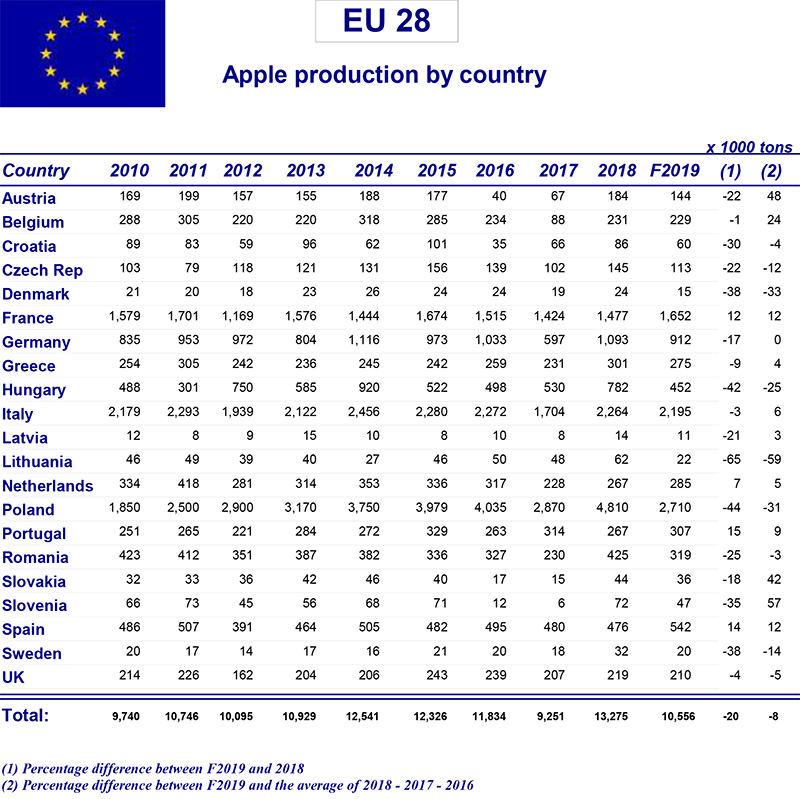
The 2019 European apple and pear crop forecast estimates that most European countries are expecting a rather low apple and pear crop for the coming season. On 8 August 2019, close to 300 representatives of the international apple and pear sector met at the Prognosfruit Conference in Alden Biesen, Belgium. During the conference, the 2019 European apple and pear crop estimate was released. This year, the apple production in the EU is set at 10.5 million T as a result of climatic events and the alternation of last year’s bumper crop. This is a decrease of 20 % compared to last year’s record high crop and of 8 % compared to the average crop of the three previous years. The pear crop is predicted at 2 million T, a decrease of 14 % compared to 2018. Nevertheless, comparisons with previous years need to be handled with much caution, given last two years’ exceptional variation.
Apart from crop alternation after a bumper, this year’s crop estimation has been influenced by several factors, including in particular a mild winter, a cold and wet May, late frost, a sunny and warm June, heat wave and drought in July, abrupt changes in temperature, and low blossoming. However, these events were scattered, and their impact differs significantly between regions. Additionally, for pear, the overall low figure is mainly due to a decrease in estimation of Italian pears which caused the overall forecast to be the second lowest of the decade. The drop was mainly the result of low blossoming, influenced by the high crop, heat of last season and rain.
A general comment for apple is that the crop in the Eastern part of the EU has been affected by the cold snap in May, with losses of 44 % of last year’s record high in Poland. In most apple producing countries, however, there were moderate decreases or stabilisation of the crop. France, Spain and Portugal are recording an increase of their crop. In terms of quality, there might be issues with sunburn and sizing. For pear, there are estimations of moderate to more serious decreases in all major pear producing countries, except for a small increase in Spain. Overall, there are still overhanging stocks on the market, but the late start of the season by up to two weeks might contribute to a better balance of the market.
The crop estimation needs to be held against a complex market situation, given the ongoing consequences of an increasingly more challenging global trading environment. Therefore, efforts to boost consumption need to be continued. WAPA will continue to monitor the developments of the Northern Hemisphere crop and will issue updates when appropriate.
Wonder Melon juice comes in two varieties
Kayco introduced Wonder Melon, a watermelon juice it said builds on consumer demand for the summer staple. Wonder Melon is made from 100 % organic cold-pressed juice with no added sugar, artificial ingredients or artificial colorings.
The healthy drink comes in two varieties. Watermelon Cucumber Basil is a concoction of real watermelon juice, lemon juice, apple juice, cucumber juice and basil, with only 80 calories per 8.45-ounce bottle. Watermelon Lemon Cayenne has real watermelon juice, lemon juice, apple juice and a dash of cayenne and just 100 calories per 8.45-ounce bottle.
Both juice varieties are Non-GMO Project Verified, Fair Trade Certified, certified USDA organic and certified OU kosher. The suggested retail price of the juice is $ 3.99 per 8.45-ounce bottle. Wonder Melon is available in the US in the refrigerator section at Shop-Rite, Fairway, Best Market and many independent grocers, and is also available through Amazon.
Artificial intelligence for the apple harvest
A world first goes into operation: The apple harvest has begun in New Zealand and the BayWa subsidiary T&G Global is using a commercial picking robot alongside human pickers for the first time. The robot was developed by the US start-up Abundant Robotics, in which the Munich-based Group acquired a stake in 2017. BayWa believes it is possible that apples from German orchards will be harvested with the help of artificial intelligence (AI) for the first time in approximately two years.
A lack of workers and increasing costs represent growing challenges, particularly in the speciality crops segment, which is heavily dependent on manual labour. “Without the limitations imposed by these external conditions, producers can use AI to increase productivity and thereby ensure that they remain sustainably competitive,” says Klaus Josef Lutz, Chief Executive Officer of BayWa AG. The use of robots to pick fruit from hard-to-reach parts of the tree also reduces the physical strain on employees. “We are investing in innovation and digitalisation to give fruit producers and downstream areas early access to such smart technologies – in New Zealand, Germany and other apple growing regions around the world.” If the external conditions, for example the way trees are planted and pruned in the growing region, are suitable, then such robots could also be used in Germany in approximately two years, says Lutz.
It took four years to develop the first commercial harvesting robot. In order to allow development throughout the year, the technology was tested and developed in the USA and New Zealand – in the latter case at orchards in the Hawkes Bay region owned by T&G Global. The successful use of the robots depended on the orchards being prepared accordingly, through higher density planting and special pruning measures. “The robot’s requirements are very complex,” says Dan Steere, CEO of Abundant Robotics. “The AI has to visually recognise fruit that is ripe for picking, pick it without damaging it, and navigate the orchard safely.”
Abundant Robotics will analyse the experience and data of using the picking robot during the current harvest season in New Zealand and use the information to help build the next generation of robots. T&G Global expects to phase in the use of robots over time as the technology develops and orchard planting systems are available to use more harvesting robots of this type at its orchards.
Odwalla is bringing a smooth, tasty twist to the kombucha craze.
Odwalla Smoobucha, which hits stores in the U.S. after a buzzed-about unveiling at Natural Products Expo West tradeshow in Anaheim, Calif., blends the great taste and texture of fruit smoothies with the boldness of pasteurized kombucha.
Three flavors – Citrus & Guava, Berry & Ginger and Apple & Greens – offer a unique mashup of flavor and function, with 40 percent less sugar and fewer calories than leading smoothies. The cleverly named beverage also includes 500 million colony-forming units of “good” bacteria, an excellent source of fiber that helps support digestive health and delivers 100 % daily value of antioxidant Vitamin C. Odwalla Smoobucha, offered in 15.2-oz. bottles, can be enjoyed as a nutritious, on-the-go snack.
Odwalla also is introducing two limited-edition flavors inspired by the vibrant essence of spring. Hot Tropics and Mint to Be Berry offer a refreshing blend of 100 % juice, coconut water and trendy botanical ingredients such as jalapeño and mint.
RUSSIAN APPLE is a business event of a closed format, consisting of a Regional Forum and Technological Exhibition dedicated to industrial gardening in the South of Russia as well as two days of onsite visits to the most promising orchards in the region. This event involves key decision-makers in the development of the industry, top management of various companies, directors and divisional managers, government officials, banks and investors.
The forum consists of strategic sessions to discuss the most important issues of the industry, such as:
- Prospects for gardening in Russia and development strategy;
- Investment potential of the industry;
- The development of nurseries in Russia;
- Storage and recycling issues;
- Internal sales;
- Other important issues for the industry.
During the Forum, a specialized exhibition of equipment and technologies for industrial gardening is held where service companies can talk about their products with their potential customers. It is a unique opportunity for companies that provide products or services for industrial gardening to make new business contacts with their direct consumer.
Advantages of the event:
- Full view of what is happening in the industry from experts and market professionals;
- Onsite visits allow to make new business contacts and partnerships, exchange of experience with leading industry enterprises and agreements on new contracts;
- Informal communication during a gala dinner or cocktail reception with colleagues and potential customers.
The RUSSIAN APPLE Forum is dedicated to the orchards of the Southern Region of Russia, with the presentation of 50+ investment horticultural projects, with 4 strategic sessions on top industry issues, with 20+ reports from leading industry experts, and 2 days of onsite visits to 4 most promising orchards in Krasnodar and Stavropol regions.
Request a program and participation: https://soforogroup.com/en/russian-apple-en/
According to tradition, the World Apple and Pear Association (WAPA) held its Annual General Meeting on the last day of the Fruit Logistica fair in Berlin, 8 February 2019. Representatives of the key global apple and pear producing and exporting countries met to discuss the Southern Hemisphere production forecast, the final update of the Northern Hemisphere production forecast that was released in August 2018, and the season developments.
WAPA discussed and released the consolidated crop forecasts for the forthcoming southern hemisphere apple and pear seasons (see tables in annex). Collected from industry associations in Argentina, Australia, Brazil, Chile, New Zealand and South Africa, the forecast showed that the 2019 apple and pear Southern Hemisphere crops are expected to reach 5.261.000 T and 1.327.000 T, respectively. For apples, this represents an increase of 2 % compared to the 2018 crop. Export is expected to remain stable at 1.738 million T. The pear crop is expected to increase by 2 % compared to 2018. Export is expected to remain stable at 712.154 T.
Other topics on the agenda were marketing, promotion and consumption trends, research and innovation activities among the members, and global initiatives to preserve the biodiversity of the many apple varieties.
Finally, WAPA elected a new president, Nicholas Dicey from HortGro, South Africa, formerly WAPA’s vice-president. As new vice-president, Dominik Wozniak from the Polish Society for Promotion of Dwarf Fruit Orchards was elected. The WAPA secretariat and members are looking forward to continuing the good trends in the coming years with its new presidency and thanked Todd Fryhover from Washington Apple Commission for his time and efforts as WAPA’s vice- president and president over the last four years.
The calamondin is one of the most exciting new discoveries that tropextrakt has in store for its customers in 2019. Although it sounds like an exotic, unknown fruit right now, it has the potential to start a new taste trend in foods and beverages that can already be seen in the USA, for example. The calamondin, with its scientific name of “Citrofortunella microcarpa”, conceals powerful potential under its delicate peel with a great variety of flavours: sweet-sour and refreshing, it is reminiscent of mandarin orange, bitter orange, lime and pink grapefruit.
A wide variety of flavours for the food and beverage industry
“The unique flavour of the calamondin is perfect for exotic taste experiences and can make a subtle difference in many foods and beverages”, explains Ingo Kniepert, Managing Director of tropextrakt. “The calamondin, for example, corresponds perfectly with familiar ingredients like orange juice or vanilla.” The refreshing and sweet-sour nuances also develop very well in combination with grapefruit in soft drinks, alcoholic and non-alcoholic beers and many other drinks, including milkshakes. The juice is also suitable for fruity blends in dairy products, ice cream, marmalades, jams, fruit sauces and sweets. Its taste components also come into their own in dressings, chutneys and desserts. The calamondin harmonises well with apple, mirabelle and blackcurrant, and herbs and spices including cinnamon, peppermint and vanilla. Tropextrakt has tested these and other combinations in its own application lab, where special applications for customers in the food and beverage industry can be developed on request.
Year-round harvest – transparent production
The calamondin, a particularly small type of citrus fruit, is a hybrid between the mandarin orange and the oval kumquat. Externally, it resembles a lime, but is much smaller. Unlike other citrus fruits, the calamondin has a thin, delicate peel, which is why the fruit has to be cut from the tree by hand. tropextrakt obtains the unadulterated calamondin juice from Vietnam, where the fruits grow, are harvested and processed into pure calamondin juice in NFC quality all year round. “It’s very important to us that our products are left in their natural state, thus complying with the Clean Label standard”, says Kniepert. tropextrakt imports its raw materials from the producers themselves in order to be able to influence the corresponding quality and hygiene standards on site. Every batch can be traced back directly to one of the 500 family businesses with calamondin plantations. Additionally, the producer guarantees the fruit will be processed in accordance with ISO 2000 and the BRC Food and HACCP standards. Both the Vietnamese producer and tropextrakt are Sedex-certified and have made a commitment to sustainable supply chains. In doing so, tropextrakt also makes a contribution to the small plantations in Vietnam, where calamondin cultivation with controlled labour conditions helps in the fight against poverty.
Revolution Brands LLC announced it had begun accepting wholesale pre-orders for Slice – a new sparkling water flavoured only with USDA-certified organic fruit juices, organic flavors and carbonated water.
Intellectual property attorney Joseph C. Gioconda of the Gioconda Law Group PLLC represented New Slice Ventures in acquiring the federally registered trademark rights to the Slice brand. Spiral Sun Ventures, a seed capital fund that invests in early-stage companies that create better-for-you consumer products, has invested in New Slice Ventures.
Slice is now available in four flavours in 12-ounce cans: Raspberry Grapefruit, Blackberry, Mango Pineapple and Apple Cranberry. Slice will be sold by the 4-pack, but is also available in single serve cans.
Slice has no added sugar, no artificial sweeteners, no artificial colors or caffeine. Slice is only 25 calories per can which is up to 80% fewer calories than most regular cans of soda.
Mark Thomann, CEO of New Slice Ventures LLC, which now owns the Slice trademarks in the United States, said: “We are excited about the launch of Slice. Slice is a great brand and one that can connect with a new generation of consumers who want something a little healthier than soda, but just as delicious.”
Glenn Backus, a former executive with H-E-B, Trader Joe’s and Supervalu is with Revolution Brands, which handled the creation and launch of the new Slice. “We worked very hard to create an organic sparkling water that tastes amazing and has a sweetness much closer to soda than any other sparkling water on the market. Customers have asked for a healthier alternative to their usual soda, but traditional sparkling water brands lack the flavour they crave. So, we created the new Slice. Only 25 calories per can with a refreshing sweetness that everyone will love.”
Patented natural process converts sugar to fibers in just one-step
Better Juice Ltd. has developed innovative technology to reduce the load of simple sugars in orange juice. The patent-pending enzymatic technology uses all-natural ingredients to convert monosaccharides and disaccharides (fructose, glucose, and sucrose) into prebiotic and other non-digestible fibers and sugars, while keeping the juicy flavor of the beverage.
Popular juices, such as orange juice and apple juice, have nearly 1 oz. (25 g) of sugar per 1-cup serving (250 ml). Although juice contains the vitamins and minerals you’d find in fresh produce, it’s devoid of most of the natural dietary fiber as an outcome of traditional methods of juicing. In addition to its intrinsic health benefits, fiber also adds to the feeling of fullness.
Better Juice’s process harnesses a natural enzymatic activity in non-GMO microorganisms to convert a portion of the simple fructose, glucose, and sucrose sugars into fibers and other non-digestible natural sugars. The process works on all types of sugars. Yet the process preserves the great flavor and the full complement of vitamins and other nutrients inherent in the fruits. The technology was developed in collaboration with Hebrew University in Rehovot, Israel.
“This natural a non fermentative process occurs without adding or removing ingredients,” says Eran Blachinsky, PhD, Founder and CEO of Better Juice. “It also will not alter the flavor or aroma of the juice.” Better Juice uses an advanced solution that involves just one short and simple pass-through step in the juice-making process, allowing the product to be marketed at a price point comparable to other premium juice products.
”While the process does slightly reduce the sweetness of the juice,” explains Blachinsky, “It actually brings out more of the fruit flavor, making for a better-tasting juice product overall.”
Better Juice conducted several trials with different beverage companies and succeeded in reducing sugars in orange juice from 30 %, up to 80 %. The start-up can now provide proof of concept for orange juice.
Mono-and disaccharides – often called “simple sugars” – are easy for the body to digest and thus quickly metabolized. If the energy they provide can’t be used, it is converted to fat and stored. But when these individual sugar molecules link up, they become prebiotic fibers that are non-digestible. The shorter of these fibers, called oliggosaccharides, are still sweet yet have been shown to bestow a number of health benefits, from protecting against disease to helping manage weight. There are other natural monosaccharides that are not easily digested. These sugars have no glycemic index and low caloric values.
“Consumers, especially children, enjoy drinking natural juices but are not always aware of the less nutritious aspects of juice,” notes Blachinsky. “They want the whole package — great flavor, health, and natural ingredients, including the fibers that are essential part of fruits.”
The company will market an advanced device with the unique technology to fruit juice producers and, eventually, to cafés and restaurants.
International trade show for production, storage and marketing of apples
Bolzano, 15 – 17 November 2018
With its motto “Bolzano loves apples”, Interpoma, the only international trade show dedicated to the apple, from November 15 to 17 will be welcoming guests from all over the world with a program of events and themed initiatives outside the trade show and across the whole city. Bolzano, as the international capital of the apple, will itself be turned into a true “big apple” during this period.
Interpoma 2018, the two-yearly international trade show dedicated entirely to the apple sector, is scheduled for November 15 to 17 this year at the Bolzano trade show center: there will be a special program of evening events, themed exhibitions and tastings of apple-derived products, featuring numerous enterprises from right across the city, including restaurants and hotels, as well as bars, bakeries and confectioners.
Interpoma is a major event capable of attracting 20,000 visitors to Bolzano from over 70 countries around the world and, with 500 enterprises present, makes South Tyrol a unique market place for the apple sector. With its program “Bolzano loves Apples”, Interpoma offers guests a unique sensory experience for their business trip that can be enjoyed all over the city.
Origins: an exhibition between past, present and future
Interpoma 2018 invites visitors on a journey through the history of the apple, with an exhibition that shows the origins of the apple in Kazakhstan, explains new possibilities for refining and processing, and offers a view of the technologies of the future.
Interpoma Taste
For the first time, Interpoma will this year feature an area inside the pavilion where visitors can taste apple-derived products and much more besides. The Laimburg Research Center for Agriculture and Forestry is presenting innovative apple juices, with tastings and judgings of ciders arranged by its Evaluation Lab. VOG PRODUCTS, the producer of natural ingredients for the food and beverage industry, will put the focus on apple juice, with a special section dedicated to “Pink Lady” products; while, in partnership with Red Rooster farm holidays, the Ausserloretzhof and Gasserhof farms and the Knöspele distillery will be presenting their natural products based upon ancient and traditional recipes, such as preserves and liquors.
The apple in the city
The entire city of Bolzano will for three days dedicate itself to the fruit that symbolizes the regions of Trentino and South Tyrol. In partnership with the Association of Hoteliers and Restaurateurs (HGV), the Unione HDS and BZ Heartbeat, 30 hotels and restaurants and 20 bakeries and confectioners in Bolzano are preparing apple-based menus and specialties for the entire duration of the event.
Interpoma Delicious Events
Trade shows are places to meet and do business, but they also represent an opportunity to get to know new cultures and taste the culinary delights of the host territory. For the opening night on Thursday, November 15, Interpoma is organizing the Golden Delicious Night at the on-site Forst Season restaurant; a “golden” night for locals, but also a chance for enterprises to dine with their customers or meet each other in an elegant and pleasant environment.
Then, on the evening of Friday, November 16, two parties will be held at the Bolzano exhibition center; one, “Rouge et Noir”, is organized by the Forst Season restaurant, while the other will be staged at the Hotel Four Points by Sheraton.
In marketing year 2018/19 FAS Warsaw expects that Polish apple producers will see a record-level harvest. Post forecasts Poland’s apple production to reach 4.0 million metric tons, a 43-percent increase from marketing year 2017/18. Post also expects marketing year 2018/19 fresh-apple exports to increase significantly over the previous year, due to record production and good dessert-fruit quality. …
Please download the full report as pdf-file under: https://bit.ly/2NejBtU
Ocean Spray, an agricultural cooperative owned by more than 700 cranberry farmers, announced that it has added two beverage lines to its extensive product portfolio: Ocean Spray® Organic 100 % Juice Blends and Ocean Spray® Pure Cranberry (Unsweetened) 100 % Juice.
Ocean Spray® Organic 100 % Juice Blends are the perfect combination of organically grown North American cranberries from family farms, with other organic fruit juices. Organic 100 % Juice Blends contain no added sugars1, preservatives or artificial flavors and are available in three delicious flavors: Cranberry, Cranberry Apple and Cranberry Blueberry. All Ocean Spray® Organic 100 % Juice Blends are non-GMO2 and feature the USDA Organic seal (certified organic by QAI). Each flavor has 100 % Vitamin C per serving and each 8-ounce glass is equivalent to one cup of fruit. An 8-ounce glass of these blends contains 100-130 calories, depending on the flavor.
For the pure, authentic taste and unique health benefits of the cranberry, Ocean Spray’s Pure Cranberry (Unsweetened) 100 % Juice contains no added sugars1, artificial flavors, preservatives or colors and is non-GMO2. Each one-liter bottle provides the health benefits from the juice of more than 900 cranberries! An 8-ounce serving is only 60 calories and is equivalent to one cup of fruit to support daily nutritional needs. The juice can be enjoyed on its own or added to smoothies or sparkling water for an extra health boost.
“By adding Organic and Pure (unsweetened) beverages to our line up, we’ve rounded out our portfolio of “good-for-you” juices and juice drinks,” said Patrick Cramb, Ocean Spray’s Director of Beverage Marketing. “We continue to develop innovative products to deliver the cranberry’s healthy attributes in formats that fit the lifestyles of consumers around the world.”
Ocean Spray® Organic 100 % Juice Blend and Ocean Spray® Pure Cranberry (Unsweetened) 100 % Juice are available nationally in the US. The suggested retail price of Ocean Spray® Organic 100 % Juice Blends is $3.99 per 1 liter bottle, while Ocean Spray® Pure Cranberry (unsweetened) 100 % Juice is $5.98 per 1 liter bottle.
1 These products are not low calorie foods – see Nutrition Facts for sugar and calorie content.
2 These products do not contain genetically engineered ingredients.