The Supervisory Board of GEA Group Aktiengesellschaft and Steffen Bersch (50), member of GEA’s Executive Board, have mutually agreed to prematurely terminate his service agreement due to expire on December 31, 2021. In doing so, the Board honored Steffen Bersch’s request for a termination of his service agreement to seek new challenges outside of GEA Group.
As a consequence, GEA will shrink its Executive Board to three members. As of March 1, 2020, the latter will comprise the Chairman of the Executive Board Stefan Klebert, the Chief Financial Officer Marcus A. Ketter as well as the company’s Chief Operating Officer Johannes Giloth.
Since January 1, 2016, Steffen Bersch has been a member of the Executive Board of GEA Group Aktiengesellschaft, where he has been responsible for the Liquid & Powder Technologies, Food & Healthcare Technologies and Refrigeration Technologies Divisions as well as Global Technology since the start of the year.
Joining GEA back in 2000, Steffen Bersch has held various leadership positions within the company. This included several years as Managing Director of GEA Middle East in Dubai, United Arab Emirates, as well as a stint as head of a business unit in the Separator business. On the Executive Board, he was in charge of the Business Area Equipment until the end of 2019. When the new divisional organization entered into force at the start of the year, he took up his current responsibilities.
For the purpose of giving the Division CEOs and the Regional CEOs responsible for operational business a greater say in corporate decision-making, the company will set up a Global Executive Committee immediately below Executive Board level.
Fresh lemon production for MY 2019/2020 is forecast at 1.6 MMT, down 11 % from 2018/19, as trees cyclically lower production in response to a heavy blossom the prior marketing year. Orange and tangerine production is projected at 720,000 MT and 390,000 MT, down 10 % and 13 % respectively, due to unfavorable weather conditions which affected fruit blossom.
MY 2019/2020 lemon exports are forecast at 300,000 MT, up 25% from 2018/19 primarily due to lower global supplies, reduced domestic demand for processing and expanded export market opportunities. Sweet citrus exports are expected to decrease slightly to 70,000 MT for oranges and 35,000 MT for tangerines. Smaller production and relatively high production costs have reduced Argentina’s ability to compete in international markets for sweet citrus against other Southern Hemisphere exporters, mainly South Africa.
Domestic consumption of lemons for MY 2019/2020 is forecast to remain stable at 150,000 MT, and fresh orange and tangerine consumption is projected to fall to 300,000 MT and 220,000 MT, respectively, due to smaller production. …
MACA ENGINEERING S.r.l of San Quirino (Pordenone, Italy), specialist in designing and manufacturing machines for the production, assembly and cut of aluminium and plastic caps and closures, joined the AROL Group, world leader in capping equipment.
AROL Group thus confirms its industrial project and strategy to vertically expand its range of high-tech machines for primary packaging, in order to ensure the ever-increasing safety standards in the final customer’s interest.
“We are particularly pleased to welcome in our family the MACA ENGINEERING team, which for over 30 years has been designing and manufacturing equipment synonymous of robustness, precision and reliability, perfectly in line with our values and objectives. We are fully aware of the the growing quality expectations of the bottling lines – in every product sector and country in the world – and the possibility of adding to AROL’s know-how the technologies related to caps production, so strong and firmly rooted in MACA ENGINEERING, will result in a unique offer in the industrial landscape, which will increase the skills of both companies, bringing a sure added value to our respective clients “commented Alberto Cirio, CEO of AROL S.p.A.
“This collaboration will allow us to accelerate in the innovation and development of our products and services, relying on the experience of AROL Group companies and on an incredible R&D team that has been able to fully understand the need for integration of the equipment in the smart factories of the latest generation”, said Andrea Marchioro, CEO of MACA ENGINEERING.
The UK non-alcoholic spirits category has grown to be worth £37m in 2019, up 506 % versus 2014, and is forecast to more than double in size again over the next five years, according to GlobalData, a leading data and analytics company.
David Harris, Consumer Analyst at GlobalData, says: “Younger generations are drinking less, with Gen-Z only strengthening this trend as they reach legal drinking age. This is hardly ground-breaking news. Adult soft drinks, premium juices and a growing range of high-quality non-alcoholic beers are all targeted at this demographic, in addition to older consumers who simply want to moderate their alcohol consumption.”
So what about consumers who don’t want a non-alcoholic beer, but still want an ‘alcohol-alike’ beverage? This may be at a party, on a night out, or at home when everyone else is enjoying their gin and tonics. This is the specific opportunity non-alcoholic spirits are targeting. Where craft beers targeted consumers turned off by mainstream German and US lager brands, non-alcoholic spirits aim to engage consumers who want to feel part of the party, but who don’t want a sore head in the morning.
Harris adds: “Talking of craft beer, what is notable is how the rise of non-alcoholic spirits mirrors the rise of craft beer, arguably the beverage trend of the last decade. With laser targeting of a specific need, from a specific demographic, there are clear similarities between non-alcoholic spirits and craft beer.
“Both target younger legal age consumers. Both target consumers who are either tired of, or have no interest in, the mainstream variant of the offering, and both use flashy, stylized and no-nonsense packaging to engage with their audience.”
Excited with the prospect, major players in spirits are increasingly looking to get involved, with William Grant and Sons launching their Atopia range, Pernod-Ricard launching Celtic Soul, as well as the Diageo-funded Seedlip, which has now expanded out of the UK and into overseas markets.
Retailers also seem to agree that this is a category to watch too, with Tesco, Lidl, Asda, and more major UK retailers all stocking at least one non-alcoholic spirit.
Harris concludes: “While this may not be the next craft beer, the opportunity is certainly there, and both brands and retailers agree that this in an opportunity which is too big to miss.
What can fresh produce companies do to combat climate change and to protect the people who work in their supply chains, while at the same time maintaining viable, profit-making enterprises? With sustainability becoming an increasingly urgent challenge in so many different areas, FRUIT LOGISTICA has published the most far-reaching investigation ever undertaken into the environmental and ethical sustainability challenges faced by today’s fruit and vegetable business.
Entitled Do The Right Thing (Right) and produced by RaboResearch Food & Agribusiness, the FRUIT LOGISTICA Trend Report 2020 outlines the most important sustainability issues for the industry, including key areas of concern like water conservation, food waste, packaging, chemical use, energy consumption and treatment of workers.
It also sets out what has become a compelling business case for a range of sustainable practices, as well as offering compelling examples of how producers, distributors and retailers are treating people and the planet better by making important changes to the way they operate. Finally, it presents a proposed roadmap towards making sustainability an integral part of any company.
“There is a strong business case for sustainability, including a reduction of risks and establishing a long-term position as a trusted partner for internal and external stakeholders,” says report author Cindy van Rijswick. “There are, of course, challenges too, which the industry must address.”
Available as a free download from the FRUIT LOGISTICA website, Do The Right Thing (Right) incorporates information and insight from across the global fruit and vegetable marketplace, making it a valuable resource for anyone working in the industry.
Bucher Unipektin, a business unit of the Swiss based Bucher Industries AG within the division Bucher Specials, is acquiring 100 % of the Spanish citrus processing equipment supplier Luzzysa. With the acquisition Bucher Unipektin further strengthens its presence in the citrus juice industry.
Industria de Maquinaria Luzzisa, S.L was founded in 1975, is privately owned and operates under the brand “Luzzysa”. The company supplies processing equipment for the production of citrus juices. The administration and production of the company is located in El Puig (Valencia),
supported by a sales and after sales service network in the main citrus markets.
Bucher Unipektin is the world market leader for production equipment of apple, pear and berry juices and also supplies refinement systems and evaporators to the citrus industry. The business unit is operating globally with production sites in Switzerland and China, supported by a global agent network and own sales and service organisations in Poland, Ukraine, Russia, New Zealand and Mexico.
With this acquisition, Bucher Unipektin is in the position to supply its citrus juice customers with entire processing lines, complementing its refinement systems and evaporators with Luzzysa’s juice extractor EXZEL, the industry standard for juicing of citrus fruits.
The company will be operated by the existing management team out of its original location in El Puig under the new name Bucher Exzel, S.L.
A study published in the Journal of Nutrition examined the diets of over 36,000 adults in the Netherlands and reports that the intake of pure fruit juice, such as 100 % orange juice, was not associated with a higher risk for type 2 diabetes.
Consumption of any amount of fruit juice, including the highest intake category of eight or more glasses per week, was not associated with an increased risk for type 2 diabetes, according to the study. When the researchers isolated citrus juice intake (orange and grapefruit juice combined), the results were consistent – intake of citrus juices was not associated with an increased risk for diabetes.
This study reinforces the case that fruit juices are not the same as sugar-sweetened beverages (SSBs), particularly with respect to metabolic effects and risk for diabetes. One hundred percent fruit juices have lower glycemic index compared to SSBs and contain beneficial nutrients not found in SSBs, including vitamins, minerals, and bioactive/polyphenolic compounds.
An 8-ounce glass of 100 % orange juice is an excellent source of vitamin C, a good source of potassium, folate, and thiamin, and supplies hesperidin, a polyphenol that has been shown to have health benefits. Orange juice also counts as a fruit serving to help meet fruit intake recommendations.
The study used data from the European Prospective Investigation into Cancer and Nutrition-Netherlands cohort, which began collecting diet and health data in 1993 through 1997 from adults age 20 through 70. The study examined dietary records completed at baseline and categorized fruit juice intake into several intake categories ranging from none to eight or more glasses per week (one glass was considered to be approximately 5 ounces). The study identified 1,477 verified cases of type 2 diabetes over an average 14-year follow up period.
The advantage of this study is that it examined data from a large number of individuals who were followed for a long period of time. However, as a prospective cohort study, data are self-reported, and it cannot show cause and effect. While the analysis took into account important factors that could affect results, such as age, sex, education level, physical activity level, body mass index and overall diet quality, prospective cohort studies are not able to consider each and every factor that could potentially affect results.
Reference:
Pure Fruit Juice and Fruit Consumption Are Not Associated with Incidence of Type 2 Diabetes after Adjustment for Overall Dietary Quality in the European Prospective Investigation into Cancer and Nutrition–Netherlands (EPIC-NL) Study
Floor R Scheffers, Alet H Wijga, WM Monique Verschuren, Yvonne T van der Schouw, Ivonne Sluijs, Henriëtte A Smit, and Jolanda MA Boer.
Journal of Nutrition. 2020 Jan 14. pii: nxz340. doi: 10.1093/jn/nxz340. [Epub ahead of print]
AGRANA, one of the leading food and industrial goods groups from Austria, is increasing its focus on innovations and investing around € 3.4 million at two R&D sites in France and Austria this year. The annual R&D expenditures of the AGRANA Group amount to around € 20 million. AGRANA employs a total of approximately 300 personnel in the area of research and development.
In a highly competitive environment, the strategic objective of AGRANA is to differentiate itself from competitors by means of new product developments in its fruit, starch and sugar business segments.
Fruit preparations: new development centre in France
For its fruit preparations business, AGRANA maintains 17 development centres around the world which work on new formulations, special ingredients and raw materials as well as new application areas for existing products. Five of these so-called New Product Development Centres are located in Europe, namely in Gleisdorf (Austria), Ostroleka (Poland), Serpukhov (Russia), Vinnytsia (Ukraine) and in Mitry-Mory (France), where the development centre has recently been upgraded for € 2.6 million, including the addition of 700 m2 of laboratory space (see image).
“AGRANA is the global market leader in fruit preparations. That’s why it is important to be an innovator and not a market follower with me-too products. In our role as a first mover in regional markets, we try to pick up on new development trends as early as possible. We develop products in close collaboration with our customers in order to reflect local market requirements and these latest trends. Our global network of product developers enables us to launch over 1,000 new fruit preparation products on the market every year”, explains AGRANA CEO Johann Marihart.
In response to specific regional demands and the latest nutritional trends, the portfolio of fruit preparations ranges from top quality fruit purées and inclusions for dairy products, ice creams and bakery products to the latest solutions for plant-based spoonable and drinkable yoghurt products. In addition to fruit preparations, AGRANA also offers brown flavours such as caramel, coffee or vanilla as well as products with inclusions (e.g. chocolate balls).
€ 800,000 invested in expansion of the AGRANA Research & Innovation Centre (ARIC) in Tulln
The AGRANA Research & Innovation Centre (ARIC) in Tulln is the main research and development subsidiary within the AGRANA Group. On an area of around 4,000 m2 at ARIC, 85 employees work on research projects related to fruit, starch and sugar. ARIC is currently undergoing expansion work, with the aim being to create a further 300 m2 for research purposes by the end of the year. The investment volume amounts to € 800,000.
In its fruit segment, AGRANA conducts research into the development of innovative natural stabilisers for fruit preparations as well as processes for sensitively handling fruit ingredients. The aim is to optimally maintain the natural properties of the fruit.
In the starch segment, AGRANA works in accordance with its specialities strategy on the development of special applications. Current focus areas related to food starches, for example, include the development of organic and clean-label products which have not been chemically modified. In the case of technical starches, the focus is on the development of special starches, such as those for use in tile adhesives or green glues as alternatives to synthetic adhesives, as well as on compostable starch-based films.
In the sugar segment, the focal point of work ongoing is on the development of new, environmentally-friendly and energy-saving processes and process steps in the area of production as well as on maximising the efficiency of sugar beet utilisation and the optimal exploitation of by-products, such as extracting betaine.
ZoCal popsicles, sorbet and ice cream will change what it means to eat healthy
ZoCal, the California-based frozen desserts company that has created the world’s first zero and ultra-low calories desserts, announced the release of its premier line of frozen treats, including the first-ever zero calorie Popsicle and Sorbet bars.
ZoCal is a treat like no other in its commitment to use real, high quality ingredients such as whole milk, real fruit, and the rare sugar allulose. The result is desserts with:
NO/Ultra-Low calories
NO Sugar or sugar alcohols
NO fat
NO cholesterol
Good source of Vitamin C and E
ZoCal Sorbet
Each five-pack of ZoCal sorbet bars comes individually wrapped in a reusable glass jar. These bars are unbelievably smooth and also boast zero calories. Like all ZoCal products the sorbet bars have no Sugar or sugar alcohols. They are made with real fruit and only have 1g net carb per serving. MSRP: $5.99 for a jar of 5 bars.
Available flavors are:
Strawberry Lemonade
Blueberry Acai
Orange Creamsicle
Passion Fruit
Zocal Ice Cream
ZoCal Ice Cream is made with real whole milk, natural ingredients, no Sugar or sugar alcohols. The result is real ice cream that ranges from 60-80 calories for the entire pint. MSRP: $6.49 per pint.
Available flavors are:
Cotton Candy
Key-Lime Pit
Burnt Caramel
Cookies and Cream
Banana Cream
Mint Chip
Strawberry
Vanilla Bean
ZoCal Popsicles
ZoCal Popsicles come in six all-natural flavors. With zero net calories, the act of eating them actually burns calories. MSRP: $6.49 for a box of 5.
Available flavors are:
Cherry Hibiscus
Lemonade
Fruit Punch
Orange
Strawberry Guava Lemonade
Passion Fruit
About ZoCal™ ZoCal™ is the first to the market line of zero-calorie and extremely low calorie desserts. ZoCal™ was founded by award-winning food scientist, Dr. Jareer Abu-Ali. After spending over twenty years working with some of the world’s largest food companies, he launched ZoCal as a company that would take the negative health implications out of desserts while retaining all its delicious indulgences.
On 4 February, the World Citrus Organisation (WCO) held its first official meeting at Fruit Logistica, Berlin. Following its presentation in October 2019 during Fruit Attraction, WCO members discussed the overall trends of the global citrus market and the draft Statutes of the organisation, which will define the future structure and functioning of WCO. The WCO will be the first and only global platform for dialogue and action among the citrus producing countries worldwide.
During the meeting, the relevance of such a platform was highlighted in the light of the latest world citrus trade and production trends, as presented by CIRAD, the French Agricultural Research Centre for International Development. Participants from Argentina, Bolivia, Brazil, Chile, Dominican Republic, Egypt, Israel, Italy, Morocco, Peru, South Africa, Spain, Tunisia, Turkey, Uruguay and the USA also reaffirmed the consensus of the sector on the need for a global discussion platform. Prospective members have now until mid-March to register following their internal procedures. Other citrus producing countries are also invited to join the organization, as well as private entities interested in the fresh and processed citrus markets, which can become affiliated members of WCO.
During the meeting, WCO founding members also re-confirmed the mandate of the organisation:
Discuss common issues affecting citrus producing countries.
Exchange information on production and market trends to prepare for the next decade to come.
Foster dialogue on policy issues of common concern.
Identify and promote Research and Innovation projects specific to the citrus sector.
Liaise with public and private stakeholders on citrus-related matters to highlight the importance of citrus producers and the need for a fair return.
Promote the global consumption of citrus.
Freshfel Europe, the European Fresh Produce Association, whose Secretariat is based in Brussels, Belgium, will coordinate and administer the WCO. CIRAD was also appointed as market analyst expert to advise the Organisation with analysis of trends for the citrus industry globally.
Following the Berlin discussions, the statutes of the organisation will go through a period of final consultations. WCO will then resume work on the collection of production and marketing data for this season. Discussions are also ongoing with a view to organise a first World Citrus Conference either in late 2020 or in 2021.
Despite the higher orange supply in the 2019/20 crop, quotes for all the varieties surveyed by Cepea in São Paulo State remained firm in January – similar to the levels observed in January last year, in nominal terms.
This scenario is linked to the lower volume of early and late oranges this season – the fruitlet losses and the lower flower settlement between December/18 and January/19 are now reflecting in a lower amount of early oranges. Prices could even be at higher levels, but the high number of lower quality fruits is constraining the average prices. This scenario helps to widen the gap between quotes.
Between January 2 and 31, the average price for pera rio oranges was 30.53 BRL per 40.8-kilo box, on tree, stable (+ 0.3 %) compared to that in Jan/19, but 8.2 % higher than that in December/19, in nominal terms. For the late varieties, natal orange quotes averaged 26.99 BRL per 40.8-kilo box, 2.4 % and 8.2 % up, respectively, compared to that in Jan/19 and Dec/19, also in nominal terms. As regards valencia oranges, the average price in January was 25.47 BRL per 40.8-kilo box, stable (- 0.5 %) compared to that in January/19, but 5.1 % higher than that in December/19.
SUPPLY – In general, the low supply of pear oranges has been reported by citrus growers since late 2019, but there still are remaining volumes of late varieties (mainly natal and folha murcha) available to be harvested in February. Therefore, the low supply of high quality fruits and the high temperatures this month, which usually favor citrus consumption in São Paulo, may underpin prices.
From March onwards, according to Cepea collaborators, the first oranges among the early varieties from the 2020/21 crop should be harvested, but only in the groves where activities have advanced. According to collaborators, most part should come from northern SP, since the weather is warmer in that area, which usually fastens fruits maturation. Still, as the harvest should not be large compared to the usual demand in that period, prices may be even higher in the in natura market.
TAHITI LIME – Growing supply and medium quality influenced tahiti lime quotes in January. From Jan. 2 to 30, quotes averaged 12.04 BRL per 27-kilo box, harvested, 28.1 % down compared to that in the same period last year and 46.9 % lower than that in December/19.
As the harvesting stepped up last month, crushing increased. In late January, four plants were operating, purchasing the fruit between 12 BRL and 14 BRL per box, harvested and delivered to the plant.
EXPORTS – The Brazilian exports of Frozen Concentrate Orange Juice (FCOJ) Equivalent increased in the first six months of the current season (2019/20). Between July and December 2019, Brazil shipped 665.85 thousand tons of the product to all dentitions, 22 % more than that from the same period of 2018, according to data from Secex. Revenue from these shipments, in turn, rose 10 % (in the same comparison), totaling 1.13 billion USD.
This result was already expected by agents from the sector, due to both the higher production in the Brazilian citrus belt (São Paulo and Triângulo Mineiro) in 19-20 and some bottling plants needs to replenish inventories. It is worth to mention that these increases also reflect the inventory flow from Brazilian terminals to terminals abroad, and not necessarily a sales increase in the same proportion.
To the European Union (the number one destination for the Brazilian juice), Brazil has exported 460.37 thousand tons of juice this season, 30 % up compared to the volume shipped between July and December 2018. To the United States, however, Brazilian shipments are decreasing, due to the crop recovery in Florida in the 18-19 season and perspectives for a positive scenario in the 19-20 season.
Higher orange supply in both Brazil and Florida in 19-20 and lower demand in the United States, in turn, are pressing down orange juice quotes this season.
The fruit, starch and sugar group AGRANA is expanding its distribution activities in its starch segment and has acquired 100 % of shares in the US distribution company Marroquin Organic International Inc. based in Santa Cruz (California). Marroquin Organic has 29 years of experience supplying organic and non-GMO ingredients and has grown to over $20 Million in annual revenue. Marroquin Organic International is a long-standing distribution partner of AGRANA Stärke-GmbH.
AGRANA CEO Johann Marihart: “Marroquin Organic International is a pioneer in the organic and non-GMO food ingredient sector in the USA and enjoys a correspondingly high reputation in the market. This acquisition is a perfect fit in terms of implementing our specialities strategy in the starch segment. AGRANA possesses many years of experience in the production of specialty starches and is increasingly focusing on baby food and clean label starches which have not been chemically modified. The organic origins and non-GMO status of our products are increasingly appreciated by customers and users alike, particularly in the USA where, with starch largely being based on genetically-modified corn, demand for non-GMO starches is rising.” With a volume of USD 17 billion (2017), the US market for packaged organic foods, the world’s largest according to Euromonitor, is forecast to grow 8.2% per year in the period to 2023.
Grace Marroquin, founder of Marroquin Organic International: “Teaming up with AGRANA is a natural choice for us. We’ve been working with their outstanding product line for over 20 years, helping the industry to grow and innovate. AGRANA is well-positioned to support the organic and non-GMO market as it continues to grow in North America”. Marroquin Organic International was founded by Grace Marroquin in 1991, when she recognized the need for certified organic, specialty ingredients in the US market.
Specialities strategy
In its starch segment, AGRANA processes potatoes, corn and wheat to make numerous different starch products for the food, cosmetic and pharmaceutical industries as well as for numerous technical applications. With three starch mills in Austria and a production site in both Hungary and Romania respectively, AGRANA has established itself as a key producer of customer-oriented speciality products. As part of its specialities strategy, AGRANA offers the food industry a wide range of non-GMO and organic products.
Effective January 1st, 2020, the KROHNE Group (Ludwig Krohne GmbH & Co. KG) is appointing a new Chairman of the Advisory Board and a changed Executive Board. The changes herald a generational change in the family-run company and ensure that the KROHNE Group will continue to be successfully positioned to meet the challenges of the market in the future.
After almost 40 years as Chairman of the Advisory Board of the KROHNE Group, Prof. Dr. Rolf Theenhaus retires. The Advisory Board and all employees thank Rolf Theenhaus for his commitment and creative capabilities, with which he has continuously introduced and promoted innovations and new business areas for KROHNE.
Michael Rademacher-Dubbick, who has successfully led the KROHNE Group for over 25 years as managing shareholder, is the new chairman of the advisory board. With this step, he underlines the constant and close connection of the owner family with the company and its activities.
Dr. Attila Bilgic is the new Chief Executive Officer and Speaker of KROHNE Group’s executive board. He has been on the Board since 2017 and has been Chief Technical Officer for KROHNE since 2009. Dr. Bilgic is responsible for the areas of research and development, intellectual property, production, quality management, marketing and product management. Stephan Neuburger, member of the Management Board since 1999, will drive growth in new business areas as Chief Business Development Officer.
Effective January 1st, 2020 Ingo Wald and Ansgar Hoffmann are newly appointed to the executive board. As Chief Financial Officer, Ingo Wald heads the finance and human resources departments. He has been Managing Director for KROHNE Messtechnik GmbH since 2006 and will continue to hold this position in parallel to his executive board activities for the KROHNE Group. As the fourth board member, Ansgar Hoffmann takes over responsibility for sales of the KROHNE Group as Chief Sales Officer and will also be responsible for IT. Ansgar Hoffmann changed from GEA Group to KROHNE and has many years of experience in leading positions, particularly in sales, most recently as Executive Vice President DACH Eastern Europe.
The new executive board of the KROHNE Group (from left to right): Ingo Wald (CFO), Ansgar Hoffmann (CSO), Dr. Attila Bilgic (CEO and speaker) and Stephan Neuburger (CBDO) (Photo: Krohne)
Refresco Europe was awarded the first-ever European Lean & Green Star for their transport operations in their European business. Refresco earned the Star for having transport emissions that are 20 % lower than the industry benchmark. This was achieved by implementing a range of optimization programs in their European operations.
Since 2018, Refresco implemented a number of projects and initiatives, including:
driving with fully loaded trucks as much as possible, including cross-border traffic,
entering into strategic partnerships with transport companies and suppliers to optimize transport efficiency,
and optimizing the production footprint, thus reducing the distance from production location to customer sites.
All of these initiatives were aimed at increasing transport efficiency and reducing transport emissions. Case in point: Refresco Italy introduced a longer lightweight truck with 8 % more loading capacity, and two new external warehouses located closer to the plants. Both initiatives contribute to a permanent and sizable reduction of transport emissions.
Ms. Minna Lyijynen, Refresco Group Sustainability Manager: “We are excited to have received this first-ever European Lean&Green Star. While there are many other elements involved, the way we handle transportation has a large impact on the sustainability of our business. Thanks to our pan-European manufacturing footprint we are able to supply with short transport lines and provide our customers the proximity they need. Our aim is, together with our carriers and suppliers, optimal transport efficiency and minimum impact on the environment. The Lean & Green program is a valuable tool to help us to realize this ambition and improve as we go. ”
Adds Nico Anten, Executive Chairman Lean&Green Europe: “New technologies might help facilitate more sustainable transport, but the most important element in success is a company’s dedication to making it happen. This first-ever European Lean & Green Star is well-deserved and reflects the emphasis Refresco places on making transport more sustainable.”
Ball Corporation launches infinitely recyclable aluminum bottle line
Ball Corporation is launching a new impact extruded aluminium bottle line that provides a circular solution to plastic pollution. In the hands of our sustainability, innovation and product design experts, aluminum is taking shape as a new bottle – the Infinity™ Aluminum Bottle – that is designed to be made again. Available in various shapes and sizes, this impact extruded aluminum bottle can be customized for numerous food and beverage products. Unlike other substrates in these categories, such as plastic shampoo bottles or jars for cosmetics, Ball’s aluminium bottles are infinitely recyclable, and can be turned into other aluminum products over and over again.
“Plastic waste that ends up in the natural environment has led to more public discussion about packaging, its life cycle and recyclability,” said Jason Galley, director of innovation and sustainability, Ball Corporation. “Consumers are demanding more environmentally friendly solutions for packaging their everyday products. We combined our product design and sustainable aluminium packaging expertise to develop another truly circular packaging solution – the Infinity™ Aluminum Bottle.”
Ball’s new impact extruded product line is suitable for packaging almost any liquid. The innovative aluminum bottles are available in a range of sizes and formats, and are customizable for various products. Ideal categories for the Infinity™ Bottles include shampoos and conditioners, soaps, body creams, spirits, energy shots, yogurt, dressings, syrups, condiments and more. The bottles are available with a re-closable threaded cap that allows consumers to twist the top on and off.
An infinitely recyclable package
The Infinity™ Aluminum Bottle line features all of the sustainability credentials of aluminum. Like Ball’s aluminum beverage cans, cups and Alumi-Tek® bottles, the impact extruded aluminum bottle is monomaterial – it consists of only one material and can be easily sorted and recycled. In fact, aluminum can be recycled an infinite number of times without losing quality. Aluminum also retains its value throughout the recycling process, so it can be kept in circulation indefinitely without becoming waste and ending up in the ocean or in landfills. In fact, 75 percent of aluminum ever produced (since 1888) is still in use today.1 After use, an aluminum bottle can be recycled and returned as a new packaging format in just 60 days. It can also be recycled to take on a new life as another aluminum product, such as consumer electronics or a bicycle. Other substrates achieve much lower recycling rates and, if recycled, are in many cases down-cycled and eventually become waste.
Lightweight product with endless branding options
In addition to strong recycling credentials, aluminum bottles have a number of other advantages that help improve resource efficiency and enable circularity. For example, aluminum is lightweight, which saves energy in transportation. Once bottles are ready for design, they can be branded without the use of sleeves or labels. Even the most creative and complex designs can be printed on aluminum using the full circumference of the bottle. Ball’s innovative high-definition printing and graphic design technologies such as Eyeris® HD printing, UV light reactive ink, Matte & Gloss, or Tactile printing help
1Source: The Aluminum Association
Over the past 10 to 20 years, the ripples of change in the global soft drinks market have threatened to become tidal waves, with new categories emerging constantly and genuine novelty flooding the shelves.
According to a new report from Innova Market Insights, which highlights that in the global shift in soft drinks, juices and carbonates may still be the two most active sub-categories worldwide but growth is clearly much faster in alternative areas. For example, Ready-to-drink (RTD) sports drinks saw launch numbers increase at a CAGR of 26 % over 2014-2018, compared with 12 % CAGR for iced tea and coffee and 10 % CAGR for ‘other’ soft drinks, including novelties such as herbal drinks, jelly drinks and vinegar drinks.
Flavor trends also demonstrate the changing face of the market. The fastest growing flavors in recent years include matcha tea (+49 % CAGR 2013-2018), apple cider vinegar (+21 % CAGR) and kombucha (+21 % CAGR), all of which are thriving concepts from Asia that are now distinguishing themselves on a global platform.
As well as the emergence of new categories, overlap between existing varieties is continuing. ‘Hello Hybrids’, one of Innova’s Top 10 Trends for 2020, is perhaps nowhere as important as in the soft drinks arena. ‘Category definitions are blurring all the time,’ says Lu Ann Williams, Director of Innovation at Innova Market Insights. “For example, in the US, Odwalla has recently developed the Smoobucha, which is a blend of fruit smoothie with fermented kombucha.”
At the same time, as suppliers seek new platforms for success, segmentation is also changing the face of the soft drinks shelves. For example, Water+ is an established concept but is continuing to evolve beyond vitaminization and added energy, with fiber, probiotics, collagen and mood ingredients all finding their way into modern waters.
Brazilian agents expect orange production in São Paulo and the Triângulo Mineiro region to be low in the 2020/21 season. Although lower productivity constrains growers’ revenue, a smaller harvest tends to underpin the prices paid by the industry, despite higher ending stocks in June 2020.
In general, the biggest flowerings (observed in August) were considered positive by most of the growers consulted by Cepea. However, the dry and hot weather between September and October damaged plants and delayed their development during the fruit-fixing period. Besides, new flowerings (although occasional and smaller than that from August) were spotted in early December, favored by November rains.
Thus, trees development has been heterogeneous in the Brazilian citrus belt, even within a single region. However, it is worth to mention that the flower settlement period lasts until mid-January, which makes it difficult to measure the results for the coming season. Besides, the scenario is still uncertain and depends on the flowers that are now opening, the percentage of fixed fruitlet and fruits development in January.
INVENTORIES – Higher orange production in the current season (2019/20) has allowed crushing to be high at the processors from São Paulo State. In this scenario, perspectives for June 2020 indicate higher inventories of Frozen Concentrate Orange Juice (FCOJ) Equivalent, possibly surpassing 400 thousand tons, according to Cepea estimates – higher than the strategic level. Isolated, this scenario may press down quotes at processors in the coming season, but, with the low production estimates for 2020/21 in São Paulo and the Triângulo Mineiro, quotes may continue firm.
Thus, in 2020/21, prices should be largely influenced by production – the agents consulted by Cepea believe the harvest will be smaller than 300 million boxes. If that is confirmed, this scenario may stabilize quotes in 2020, since it would keep the demand from processors high, and there would not be pressure on quotes in the in natura market.
With mousesports and Prime League Rockstar Energy goes all in on e-sports in 2020
Rockstar Energy will intensify on being “Louder. Harder. Drüber.” in 2020: for years the energy drink brand has been very active in the gaming scene and this year Rockstar Energy is stirring up the strongly growing e-sports sector with the global team sponsoring of mousesports and the league sponsoring of Prime League. Gaming-affine fans can count on energetic activations in the style of Rockstar Energy.
As of now Rockstar Energy kicks off the premium partnership with the German #1 e-sports team mousesports (“mouz”). mousesports are internationally successful and currently #2 in the Counter-Strike world ranking. The team stands for top performances in Counter-Strike, League of Legends and many other games.
Just as exciting is the cooperation of Rockstar Energy as official advertising partner with the #1 e-sports Liga Prime League for “League of Legends” in the DACH region. Prime League is the official circuit of the American computer game developer Riot Games for Germany, Austria and Switzerland and the largest tournament platform for the #1 gaming title “League of Legends”1 in this region. mousesports also performs in the Prime League and could celebrate its triumph in 2019.
With these powerful partnerships in the e-sports sector, Rockstar Energy is taking its gaming activation to new dimensions and is focusing especially on areas relevant to energy. “The partnerships with mousesports and the Prime League provide a real added value for our target group, as they meet their interests exactly”, says Carl Windfuhr, Commercial Director Beverages PepsiCo. “Therefore we are taking Rockstar Energy’s success story to a new level that our retail partners will also benefit from”.
Rockstar Energy will be represented as jersey sponsor for all the teams of mousesports as well as through instream placements. At Prime League, Rockstar Energy will be involved in instream and in the Top 5 Plays, providing players and fans alike with the necessary Rockstar Energy kick for a legendary performance. In addition to multi-packs and on-pack promotions with great prizes Rockstar Energy is taking it up to the max: e-sports fans can expect meet & greets with mouz, cool raffles and exciting content. Another highlight is the Prime League final during Gamescom 2020, taking place in Cologne at the end of August.
Striking communication measures support the new cooperations with mousesports and the Prime League. With social media activities in particular – such as on the live gaming platform Twitch – the brand is addressing the young and gaming-affine target group in its unique “Louder. Harder. Drüber.” style. Other digital measures and PoS campaigns are also being carried out to position Rockstar Energy even more strongly as the brand for the gaming scene.
The Coca-Cola Company has been present in France for the last 100 years, serving as a key contributor to the food and beverage industry. The Coca-Cola system has always been an integral part of the French economic ecosystem, especially through the production and distribution activities of bottling companies in the country.
The Coca-Cola Company and Coca-Cola European Partners (CCEP), the primary bottling partner in the country, together plan to invest as much as one billion euros behind the introduction of new products in the French market; the expansion of bottling capacity and modernization at CCEP’s manufacturing plants; innovations; and ongoing support of company brands. Both companies will support the hosting of the Paris 2024 Olympic Games, following the extension of a partnership between Coca-Cola and the IOC, which was announced in July 2019.
CCEP has earmarked €500 million to further strengthen its production and distribution network.
After investing €350 million since 2013, CCEP continues to invest to adapt its manufacturing network to changes in consumer preferences and to accelerate its transition to a circular economy, including packaging transformation.
For example, after adding a bottling line dedicated to glass bottles in 2019, CCEP will invest in the plant in Socx (Dunkerque) to equip the site with a state-of-the-art aseptic bottling line in mid-2020, which will enable CCEP to meet the increasing consumer demand for Fuze Tea, the ready-to-drink tea brand launched in 2018, and for Tropico, the juice drink company acquired by The Coca-Cola Company in September 2018. Additional investments across all five CCEP plants in France will enable the introduction of a higher quantity of recycled material in bottles and cans and the replacement of plastic by cardboard for secondary packaging.
The €500 million in investments will be progressively committed over the next five years in production and commercialization and will include a provision for CCEP to invest in new cooling equipment for its customers and in accelerating the company’s digitalization journey.
In parallel, The Coca-Cola Company will invest €500 million to support the development of its current brands and introduce new products in the French market.
Coca-Cola is evolving as a total beverage company that focuses on better satisfying consumer needs. Following the successful launch of Fuze Tea and the acquisition of Tropico in 2018, the company today confirmed its intent to strengthen its existing positions and accelerate its entry into new categories.
Coca-Cola will invest as much as €500 million in France over the next five years. These investments will be a combination of media, brand experiences or strategic partnerships, such as the support of the Paris 2024 Olympic Games.
Pectin market value is expected to surpass USD $1.8 billion by 2026, owing to a growing necessity for organic and herbal cosmetic products among the young population.
Global pectin market research studies the types of application (food & beverages: jams, dairy, non-dairy beverages, confectionery), their type (high methylated ester pectin, low methylated ester pectin, and amidated pectin), their function (gelling agents, thickener, stabilizer, fat replacer and others), regional outlook, price trends, growth potential, competitive market share and provides forecasts for 2019–2025. Global Market Insights, Inc., forecasts more than a 7.6 % CAGR for the worldwide pectin industry up to 2025.
Driven by the growing need for plant-based ingredients, the global pectin market is projected to observe significant gains over the forthcoming years. Plant-based ingredients are witnessing this upsurge since they offer immense health benefits.
Pectin products help to control blood sugar levels. These products also help to maintain proper bowel health. Owing to these multiple benefits, pectin products are best suited for nutritional needs, which is likely to foster their market share in the coming years.
Along with health concerns, rising applications of the product in confectionery fillings and sweets would possibly augment the market outlook. Additionally, the increasing usage of pectin in fruit juices and milk drinks as a stabilizer would add up to the industry’s expansion. Pectin helps decrease syneresis in marmalades and jams.
With respect to the raw material segment, apples have dominated the market outlook in recent years. The product is anticipated to witness similar growth in the forthcoming timeframe. This development is attributed to the use of apple pomace in production. Apple peel is one of the major wastes in preserve manufacturing. This peel contains about 1.3 percent of pectin. Apple peel yields more pectin in comparison to sugar beet and citrus peels. In addition, it has better gelling characteristics which further makes it a major raw material in the beverage and food market.
With reference to the geographical landscape, the Asia-Pacific pectin market is predicted to observe significant growth throughout the forthcoming years. Rapidly transforming customer lifestyles is the key factor augmenting the market outlook in the region.
In addition, the increasing demand for consumables that are organic in nature is likely to add up to the growth of the overall market trends. China would possibly lead the market expansion in the region. The country is among the largest producers of pectin. It is also observing mounting demand for health and wellness products due to the increasingly growing middle-class population. Furthermore, rising applications of citrus-based products in the cosmetics sector would further outline the market growth in the region.
Some of the key players in the pectin market includes Cargill, Dupont, Krishna Pectins Pvt Ltd, AEP Colloids, Silvateam S.p.a, CP Kelco U.S., Inc., TIC Gums, Inc. (Ingredion), Compania Espanola de Algas Marinas, S.A., Merck KGaA, Lucid Colloids Ltd., Herbstreith & Fox, Nikunj Chemicals, Pure Ingredients, Cifal Herbal Private Ltd, California Ingredients Inc, Calleva Ingredients Limited etc.
Ocean Spray Cranberries, Inc., the agricultural cooperative owned by more than 700 farmer families, introduced Ocean Spray® Brew, a first-of-its kind hybrid drink made with real fruit juice and cold brew coffee. With its nearly 90-year old, iconic Ocean Spray® brand, the cooperative is relentlessly driving innovation to accelerate Ocean Spray’s evolution toward health and wellness. The launch of Brew builds on a pipeline of innovation coming from the cooperative, bolstering its mission of connecting farms to families for a better life by delivering a new beverage that is both nutritious and provides natural energy. Brew marks yet another expansion for Ocean Spray into a new category of coffee, and Ocean Spray will continue to drive future growth opportunities for the cooperative this year.
Ocean Spray® Brew will be available in two flavors, Cranberry Lemonade with Cold Brew Coffee and Cranberry Blueberry with Cold Brew Coffee. Brew features 100 % Colombian Coffee, with each 8 oz serving containing 40 milligrams of naturally sourced caffeine from green coffee beans, which is equal to a 1/2 cup of coffee. In addition, Brew contains antioxidant vitamin C, as well as vitamin B and real fruit juice, with no added sugar, no preservatives, and no artificial flavors or colors.
Ocean Spray® Brew will be on-shelf in the USA this month in Target, Stop & Shop, Shaw’s, Albertsons, Vons, and Safeway, and will continue to expand to more stores throughout the year.
2019 broke records again for the number of food and drink transactions around the world, with 789 registered on the Zenith Global mergers and acquisitions database, an average of 15 each week.
The total is 12 more than in 2018 and 41 % higher than 5 years ago. The number has increased every year since a dip in 2013.
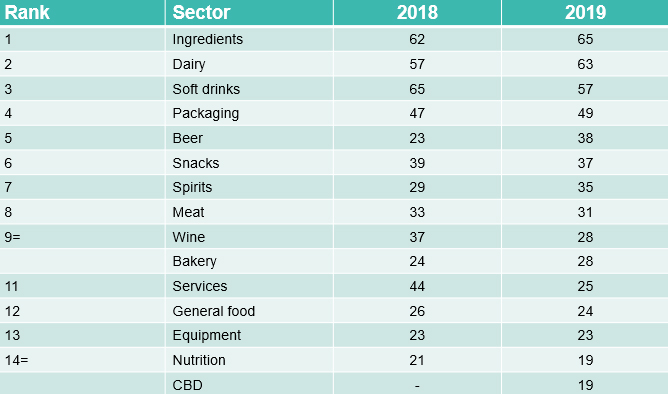
The most active sectors were ingredients on 65, dairy on 63, soft drinks on 57 and packaging on 49. Beer on 38 was ahead of spirits on 35 and wine on 28.
Global food and drink acquisitions by sector 2018-2019 (Photo: Zenith Global)
The top 15 sectors were the same as 2018, with the exception of CBD replacing confectionery. The combination of plant-based (15) with dairy-free (14) and meat-free (11) totalled 40. Bottled water and water coolers added up to 23. Vertical farming was a newcomer with 8.
The biggest increases were for CBD (+19) and beer (+15). Many of the main categories saw declines, led by services (-19), confectionery (-18) and wine (-9).
SIG has set a bold new climate target that is one of the first in its industry to be approved by the Science Based Targets Initiative (SBTi) as being in line with the latest climate science to limit global warming to 1.5°C above pre-industrial levels to prevent the worst effects of climate change. SIG is committed to cutting its Scope 1 and 2 emissions by 60 % by 2030 (from the 2016 baseline).
The ambitious new target places SIG among an elite group of companies leading efforts to reduce greenhouse gas emissions in line with the global Paris Agreement to pursue efforts to limit the temperature increase to 1.5°C.
Around 300 companies have targets approved by the SBTi. Fewer than 100 are currently approved as being in line with the 1.5°C goal. SIG is one of the first in its industry to have a 1.5°C target approved by the SBTi.
SIG’s new target compresses the timeline to achieve a 60 % absolute reduction in Scope 1 and 2 emissions by a full 10 years compared with its previous target, which was already approved by the SBTi as in line with keeping global warming well below 2°C.
A strong focus on renewable energy underpins the company’s efforts to achieve this target. SIG has already switched to 100 % renewable electricity for global production and is exploring opportunities to expand on-site renewables, such as its award-winning rooftop solar array in Thailand.
SIG is not only committed to cutting emissions from its own operations. The company also commits to reduce value chain greenhouse gas emissions by 25 % per litre packed by 2030 (from the 2016 baseline). This target includes scope 1, scope 2 & scope 3 emissions from Purchased Goods and Services, Use of Sold Products, and End of Life Treatment.
“The world’s most sustainable company 2019” ranks no. 2 on Corporate Knights’ list for 2020
Today, Corporate Knights, a specialized Toronto-based media and investment research firm, published their annual ranking “Global 100 Most Sustainable Corporations in the World” 2020 in Davos, Switzerland. Last year’s no. 1 in the ranking, global bioscience company Chr. Hansen, cements its position at the top by coming out second on the list for 2020.
A catalyst for change
The renewed ranking in the world elite of most sustainable companies comes after a remarkable 2019 for the 145-year-old company. Highlights of the year included the no. 1 position on Corporate Knights’ list, inclusion on Fortune Magazine’s Change the World List of 50 companies that do well by doing good and the Golden Peacock Global Award for Sustainability presented in London as recently as November.
Another milestone in Chr. Hansen’s sustainability journey was reached when the company announced a groundbreaking agreement with Better Energy of switching 100 % to green electricity from two new solar parks, wind energy and bio gas for its Danish operations by April 2020. Through its engagement in establishing the new solar parks, Chr. Hansen is contributing positively to the transition to green energy in Denmark as a whole. While its Danish operations account for almost half of the company’s total electricity consumption, the model is scalable and can be introduced in other countries going forward.
The background for ranking Chr. Hansen the second most sustainable company in the world 2020:
Chr. Hansen improved its total score against Corporate Knights’ indicators. Although this was not enough for a first place this year, the company is still ranked as the number 1 most sustainable food ingredient company.
Clean revenue: Chr. Hansen has been able to account for and document its direct product impact on the UN Global Goals. 82 % of the revenue directly supports the UN Global Goals, and PWC has reviewed the methodology to document this.
The UN Global Goals are used as a framework to link the impact of the corporate strategy to sustainable development, and the performance is measured and reported on an annual basis.
Environmental performance: Chr. Hansen scored high relative to its peers on its environmental performance, specifically related to energy, CO2, water and waste. Continuously reducing its environmental footprint has been a priority during the past year. During 2019 it led to the partnership with Better Energy where Chr. Hansen committed to switching 100 % green electricity from two new solar parks, wind energy and bio gas for its Danish operations by April 2020
Diversity: Chr. Hansen score high on % of female directors, and also get some points from female senior executives and sustainability pay link
About Corporate Knights and the ranking “Global 100” Corporate Knights Inc., the company for clean capitalism, includes the sustainable business magazine Corporate Knights and a research division that produces rankings and financial product ratings based on corporate sustainability performance. The Global 100 Most Sustainable Corporations in the World is an annual project initiated by Corporate Knights. Launched in 2005, the Global 100 is announced annually on the sidelines of the World Economic Forum in Davos.
Production in the citrus belt (São Paulo and Triângulo Mineiro) is higher in the 2019/20 season. The demand for fruits, in turn, was firm in 2019 because of low ending stocks of orange juice at processing companies from São Paulo. Therefore, higher demand and the record productivity in the field kept profitability positive. Moreover, the fact that most trades with the industry had been closed previously and at the same price levels observed on 2018/19 also favored profitability.
Fundecitrus (Citrus Defense Fund) released a report in December indicating that the orange production in the citrus belt may increase 34.7 % in 2019/20, totaling 385.31 million 40.8-kilo boxes. Productivity per hectare is likely to reach 1,041 boxes, a record. The good result is attributed to favorable weather during flower development (in the second semester of 2018) and to the fact that plants recovered after the previous lower production.
INDUSTRY – Prices for the industrial sector concerning the contracts closed in October and November 2018 ranged from 20.00 to 22.00 BRL per 40.8-kilo box, harvested and delivered at processors, similar to that in the previous crop, despite the current high supply. However, for the producers who trade with companies in the spot market, values were at 20.00 BRL per box – in the previous season, they reached 26.00 BRL per box.
However, quotes in the spot market increased in December, scenario that may be related to perspectives for lower production in the 2020/21 season. As a result, one of the major processing companies started to purchase fruits at 20.00 BRL per box from December onwards – the average price most part of the crop was 18.00 BRL per box, harvested and delivered. Another major company continued to bid 18.00 BRL per box in the last month of 2019, but the price was 16.00 BRL/box during the season.
INVENTORIES – In 2019/20, the industrial demand was firm, due to low stocks at processing companies in São Paulo, of 253.18 thousand tons of orange juice in June/19, according to CitrusBR. This volume is 26.2 % lower compared to that in the 2017/18 season.
IN NATURA MARKET – Higher orange supply pressed down quotes in the in natura market in 2019. Between July and November, the average price for pear oranges was 29 % below that in the same period of 2018, in nominal terms.
However, the 2018/19 harvest was small, pushing up quotes, which hit nominal records from July to December 2018, considering Cepea series (since 1994). Compared to quotes in the 2017/18 season, price averages between July and November 2019 were 20 % higher, in nominal terms.
EXPORTS – After a season with low shipments, orange juice trades to the international market have recovered in 2019/20. The good performance is linked to the higher production in São Paulo and the possible needs to build stocks from juice bottling companies. In the partial of the season (from June to November/19), 550.13 thousand tons of orange juice were exported to all destinations, 46 % more compared to the same period last crop.
TAHITI – The market behavior was atypical in 2019. Despite the higher production, values were high throughout the year, sustained by firm demands (domestic and international). The average from January to November was 34.58 BRL per 27-kilo box, harvested, only 4.3 % down compared to that in 2018, in nominal terms.
Brazilian exports of tahiti lime hit a record last year. The dry weather in Mexico, major competitor regarding shipments to the European Union, favored exports good performance.
2020 will be a period of ground-breaking innovations in the food and beverage (F&B) sector, with a focus on health and sustainability, says GlobalData, a leading data and analytics company.
Hakan Demirci, Consumer Analyst at GlobalData, comments: “Over the last couple of years, we have seen vast strides in the development of technology for the F&B sector. This year is set to become a watershed year as these technological innovations experience an expansion in their application across the industry.”
With the year promising a flurry of innovations in the industry – from personalized nutrition to alternative proteins, GlobalData lists five of the top F&B trends to watch out for in 2020, ranked:
5) Personalized Nutrition:
“Personalized nutrition will aim to revolutionize consumption habits among health-conscious consumers using nutrigenomics. The future will see targeted nutrition accounting for both genetic and environmental factors, to maximize the nutritional value of certain diets for consumers.
“One example of this is a company called Sun Genomics, who are currently testing tailored probiotics by sequencing the human gut and analyzing the distribution of the different types of microbes.”
4) 3D Printed Food:
“While 3D-printed food has been around for quite some time, it is an expensive and time-intensive method of producing food. Nevertheless, in 2019, 3D printing of plant-based meat received heavy investment due to its efficiency in comparison to current methods of extrusion, and for its ability to replicate the texture of meat.
“Innovations in 3D-printing technology throughout 2020 will see an increase in speed to delivery, a reduction in costs and an expansion of the types of products that can be created using 3D printing.”
3) Alternative Proteins:
“As veganism continues to become mainstream, so too will efforts in replicating certain animal proteins. This will range from the development of egg white cell cultures to lab grown cultured meat – bypassing the impact on sentient animals.
“Throughout the year, we will see these methods replicating a more diverse and niche variety of meats. For example, Impossible Burgers released their first vegan pork in early January 2020.
“Moreover, investment in this sector will flourish in 2020 as a growing coterie of fast-food conglomerates pour funds into the research and development (R&D) of vegan alternatives to their own meat-based products.”
2) Traceability:
“The next decade will see the transparent documentation of a product’s life cycle. This will improve food safety, as potential bacteria-related hazards can be pinpointed for detection and eliminated with ease and speed. This will be achieved as technological innovations such as the Internet of Things (IoT) and blockchain improves in application and efficiency.
“For example, blockchain can map a products lifespan on the chain, providing a transparent chain of ownership for a particular asset. These records cannot be erased or altered, ensuring accountability throughout the whole process, an important aspect of transparency.”
1) Biotechnology:
“The advent of biomolecular sciences and improvements in genetic editing and sequencing will aid in the development of highly nutritious crops, with extended expiration dates and improving resistance against genetic and environmental diseases and infections.
“For example, a current innovation underway aims to improve the shelf life of melons with a non-GMO molecular breeding technique, seeking to halt the ripening process after cultivation whilst simultaneously preventing this from negatively impacting upon the taste of the final product.”
Use of polyphenols in the analysis of fruit and vegetable juices and purées
Anthocyanins and flavanone glucosides have been used for years as part of the authenticity assessment of red/black and citrus juices, typically using IFU 71 & 58 respectively. These components comprise only a small selection of the polyphenolic compounds that are available to the analyst for the assessment of juices. The generalised use of polyphenolic compounds as a means of detecting mixtures of juice was developed by Wade’s group at Procter and Gamble in the late 80’s. This procedure works well in juices where there is a reducing environment, such as citrus juices, and produces stable peak profiles. However, in systems with active polyphenol oxidase (PPO) enzymes, such as apple, pear and bananas, some peaks can be lost, due to oxidation and subsequent polymerisation, so these profiles tend to be less stable.
Unlike the chromatograms seen with the anthocyanin procedure, which often only contain a few peaks , traces for the polyphenols are much more complex and generally contain many more peaks. Due to the complex nature of these chromatograms, it is generally impossible to use reference libraries for positive peak identification due to small shifts in retention times between chromatographic runs. This means that control samples should be run with each batch of test samples for comparison purposes unless positive identifications can be made by using more specific detectors, such as diode array (DAD) and/or ideally mass spectrometer (MS), where a positive identification can be made either from an accurate mass measurement or by specific “mother/daughter” transitions.
This recommendation has been published and is available via the IFU website under Methods of Analysis
Euromed, a leading producer of standardised herbal extracts, has appointed Xavier Ragàs as new Head of Quality Control. Xavier has a PhD in Chemistry, covering organic and analytical chemistry, photochemistry and microbiology.
After finishing his degree in 2010, Xavier began working as a lab technician at Bunge, an international agribusiness and food company. Having been promoted to the position of Quality and Food Safety Manager, he was responsible for implementing new analytical techniques, supervising internal laboratories and monitoring and adapting plant processes, in line with ISO standards and feed safety certifications.
In 2015, Xavier joined Morchem, an adhesive producer mainly focused on flexible packaging. As Quality Manager, he led the quality control department in its transition from an old ERP to a brand new SAP system.
In his new role as Head of Quality Control at Euromed, Xavier is responsible for quality and process control from the raw materials to the finished products. Euromed products begin with botanicals that are verified, grown and harvested properly to preserve plant integrity and bioactive profiles. Each production batch – from the herb to the final extract – undergoes several laboratory tests for identity, potency and potential impurities to guarantee the highest standards. From botanical macro- and micro-identification and control of active principles and potential impurities to chromatographic analyses, the company tests botanical raw materials exhaustively, in accordance with international regulations.
For many consumers, the desire to nurture and protect the environment has motivated the decision to follow a vegan diet. However, the ‘low carbon’ diet could potentially attract a greater following than veganism due its relatively more flexible approach to reducing the greenhouse gas emissions associated with our diets, says GlobalData, a leading data and analytics company.
In fact, when asked what they find to be an appealing food and drink claim, 60 %* of global consumers answered ‘low carbon footprint’, compared with 39 %* of global consumers who answered ‘vegan’.
Lia Neophytou, Consumer Analyst at GlobalData, says: “Whereas veganism does not permit the consumption of any animal or animal-derived products, the low carbon diet allows for the consumption of any food/drink items as long as they align with the broader goal of reducing the carbon emissions of one’s overall diet. This could include reducing meat and dairy consumption, increasing one’s intake of local foods, and reducing food and packaging waste.”
This diet also recognizes that not all vegan foods have a low carbon footprint. For example, exotic fruits which require importation from abroad. It is for this reason that Lele’s vegan café in London recently announced that it will no longer include avocado in its dishes to avoid ‘indirectly fuelling illegal deforestation and environmental degradation’.
The appeal of a low carbon diet therefore spans consumers who are already vegan and those who simply want to reduce their carbon footprint, hence its broader appeal.
Neophytou concludes: “In future, ‘low carbon’ certifications could become mainstream and serve as a way of verifying the environmental impact of food and drink. This goes beyond simply indicating the absence of animal or animal-derived products which vegan certifications signal.”
*GlobalData’s 2019 Q3 global consumer survey
The global apple concentrate market witnessed substantial growth in the past few years, and this growth is expected to continue throughout the forecast period of 2019 – 2029. Towards the end of forecast period, the sales of apple concentrate will translate into revenues exceeding US$ 5 Bn, as per the projections of a new study.
The shelf life of apple concentrate ranges from months to several years, depending on the strength and type of concentrate, as compared to the significantly shorter shelf life of fresh juices. Thus, finished products such as apple juice, sparkling drinks, and soft drinks made from apple concentrate have a longer shelf life than those made from fresh fruit juices.
Longer shelf life of products made from apple concentrate reduces transportation costs and enables manufacturers to export their products and expand their geographical reach. It also allows manufacturers to offer specialized products for the military and astronauts. These products have a longer shelf life than the products made from apple concentrates for civilians.
Key takeaways – Apple concentrate market study
Liquid concentrates hold the largest share in the global apple concentrate market by form. Powdered concentrates are expected to witness a slower adoption, owing to its high cost of production.
China accounts for the largest share in the global apple concentrate market as it is the largest producer and exporter of apples and apple concentrate offerings in the global market.
The beverage industry accounts for the largest share among all segments by application in the apple concentrate market and is expected to grow at the fastest rate during the forecast period.
Manufacturers can gain significant profits from focusing on the B2C channel, which has a limited number of market players.
Apple concentrate market: Competitive landscape
Key players in the global apple concentrate market strive to increase their production capacity by focusing on acquisitions, mergers, and expansion of their own production units. Such investments are also helping manufacturers to expand their geographical reach and penetrate more markets across the globe. Manufacturers are also investing in product innovation and developments for cost-effective processing methods for production of apple concentrate.
For instance, In July 2015, Britvic PLC acquired Empresa Brasileira de Bebidas e Alimentos SA (“ebba”) with an investment of US$ 174.9 Mn.
These insights are based on a report on Apple Concentrate Market by Persistence Market Research.
9,925 visitors, 201 exhibitors and a total floorspace of 11,400 square meters (gross) – these are the figures achieved by drink technology India (Messe München), co-located with pacprocess and food pex India (Messe Düsseldorf). The growth of drink technology India remains strong. The trade fair that is taking place in a yearly rotation between Mumbai and New Delhi is now well established in the Indian Capital. The supporting program was expanded and addressed all segments and topics of the beverage, dairy and liquid food industry in conferences and seminars. Together with its partners, drink technology India underlines its status as India’s leading knowledge platform.
Dr. Reinhard Pfeiffer, Deputy Chairman of the Board of Messe München, is very pleased with how the trade fair went: “The event’s sizable growth demonstrates the fact that the trade fair has also become the most important industry event for solutions, networking and knowledge sharing at its location in New Delhi.” “This confirms our strategic decision of organizing drink technology India every year at alternating locations—Mumbai and New Delhi—to cover the Indian market,” adds Petra Westphal, Exhibition Group Director at Messe München. Bhupinder Singh, CEO of Messe München India, comments: “The 30 percent increase in exhibition floorspace is proof that companies are responding to the continued high demand in India for machinery for producing, processing and packaging beverages, dairy and liquid food products.”
Richard Clemens, Managing Director of the VDMA’s Food Processing and Packaging Machinery Association, also confirms the importance of the event: “Demand amongst Indian consumers is growing across all segments of the beverage and liquid food industry and is expected to have risen by around 89 percent by 2022 according to market researchers. Indian suppliers are therefore importing systems and machinery in order to be able to meet this demand. This represents a great opportunity for international companies wishing to gain a foothold in the Indian market.”
At drink technology India, international exhibitors accounted for 12 percent, with China being the most represented country, followed by other international exhibitors from Germany, Italy, Spain and Turkey.
Supporting program – A 360 degree view oft he industry’s topics
Avisha Desai, Group Project Director of Messe München India, is pleased with the new value added for customers: “drink technology India has been successful in setting up valuable partnerships with associations from all the industry’s segments. All the areas from the beverage, dairy and liquid food industry were covered by exhibitors as well as by the trade fair’s supporting program.”
The Packaging Design Innovation & Technology Conference was held for the first time at the trade fair. Companies operating in the consumer goods industry presented interesting solutions and thought-provoking impulses relating to packaging design, sustainability, food safety and smart packaging. The supporting program also included the Indian Dairy Association’s Conference, which showcased packaging solutions for the dairy industry, as well as the FSSAI seminar, which highlighted regulations and initiatives as part of India’s “Eat Right Movement”. The Oil Technologists’ Association of India (OTAI) hosted a seminar on oils and fats. Special focus was given to food and non-food-related uses of palm oil. The place2beer and the Buyer Seller Meetings, which were with more than 400 business talks extremely popular again, are now firm fixtures of drink technology India.
drink technology India, pacprocess and food pex India
drink technology India is staged yearly in conjunction with the pacprocess and food pex India trade fairs of Messe Düsseldorf. Exhibitors and visitors can benefit from the advantages given by this unique combination of three trade fairs as this means they can leverage synergies given by the co-location. The three trade fairs cover the entire bandwidth of the beverage, dairy and liquid food technology (drink technology India), packaging and related processes (pacprocess India) as well as food and confectionery processing and packaging (food pex India) all under one roof and is unrivaled in the region.
drink technology India alternates every year between Mumbai and New Delhi. The next drink technology India will take place in Mumbai from December 9 to 11, 2020.
It’s been 15 years since the first Starbucks soy latte (and soy chai tea latte and soy cappuccino) was served. The company launched its first dairy alternative in 2004 just as plant-based milks were starting to gain in popularity.
Starbucks added coconutmilk to its lineup in 2015 and almondmilk in 2016. The company’s Research & Development team also began creating new beverages to highlight the flavors of the non-dairy milks like Coconutmilk Mocha Macchiato and Horchata Almondmilk Frappuccino® blended beverage.
Now, the first new Starbucks beverages of the decade feature these plant-based milk alternatives with the arrival of the Almondmilk Honey Flat White and Coconutmilk Latte. The beverages join the permanent menu in stores in the United States and Canada as part of the new winter food and beverage lineup. This also marks the regional introduction of oatmilk as a new non-dairy option as the Oatmilk Honey Latte arrives in select U.S. markets in the Midwest.
The war on packaging waste is fought on many fronts in the beverage industry – from the manufacturers of packaging materials to the bottler. KHS is helping to develop new standards in this field, from which beverage producers and consumers alike are set to profit.
The way to produce ever more sustainable primary and secondary packaging involves two major lines of approach: recycle and reduce. The first requires that packaging materials are kept in constant circulation by them being reclaimed, processed and continuously reused. The second entails finding many different ways of using less and less packaging material in order to save on resources and avoid waste. “The greatest challenge for us is the processability of the packaging materials,” says Karl-Heinz Klumpe, packaging product manager for KHS in Kleve. He explains what he means in the following example. “Shrink film made of recycled plastic demonstrates very different shrinking properties versus film made of new material. As an engineering company we can’t provide all the answers ourselves but instead have to coordinate closely with the film manufacturers.”
To this end KHS is staging a number of workshops this year. These aim to find out how the percentage of recyclate in film – as stipulated by the new German Packaging Law, for example – can be increased. “You make a few changes to the chemicals or recipe of your film and we adjust the air fl ow or temperature accordingly,” is how Klumpe loosely summarizes the topics up for discussion. “Providing that there’s a standard of quality which is accepted by the big bottlers’ marketing departments, of course. With film made of 100 % recyclate the shrink results aren’t yet satisfactory. Together we still have to work out how to close the gap here between recycling requirements on the one hand and the demand for packs of ever increasing quality on the other.”
Another avenue film manufacturers are exploring is to reduce the thickness of their film. “The material’s getting thinner and thinner,” states Klumpe. “To provide the same stability the materials have to be more and more complex. This has its limitations when used for beverage packaging: below a thickness of 35 microns it’s possible that the price per kilogram for film then again rises. When it comes down to it, neither bottlers nor their customers want to pay for this.”
Spotlight on economy
Klumpe well realizes that the striving for greater sustainability is often rooted in aspects of economy rather than ecology. “Everything we do to reduce the amount of material used primarily has a financial motive and aims to cut costs for bottlers. Or – if we’re talking about recycling – film manufacturers of course have to continue to develop and adapt so that their business model can be further maintained even in the face of stricter legal requirements.”
What applies to plastics also applies to cardboard – chiefl y when it comes to reducing the amount of material used. Paper factories are experimenting with thinner cover layers and lower ridges in the manufacture of corrugated cardboard. “The stability and durability are OK,” assures Klumpe. “However, we have to answer the question of how suitable these materials are for use with machinery. What happens when the cardboard absorbs moisture? If the cardboard is thicker on the outside than the inside, it bends rather like a bimetal and can only be processed on machines with certain restrictions or not at all. What can we do to counteract this?”
In terms of recycling less attention is paid to cardboard than to plastic. Yet here, too, the reuse of this material is an issue, for example in how far print can affect the recyclability of the paper.
KHS is itself also experimenting with new packaging materials. For instance, a manufacturer from Sweden recently approached the company with a newly developed, award-winning cardboard looking for partners for a market launch. “Our top requirement is that we can be sure that we can process the cardboard without any problems,” Klumpe stresses.
Constant process
The packaging experts in Kleve are also in constant dialog with the manufacturers of adhesives and adhesive application systems. “Here, we explore how we can avoid having to heat the glue so intensely or how we can reduce our consumption of adhesive,” says Klumpe. “We’re now applying smaller and smaller dots of adhesive as opposed to the diamond shapes we used to use.” All told, sustainable product innovation is a constant process which KHS is undergoing with both proven and new partners. The focus is always on the question of which approach can be adopted to save on materials, time and energy on the machines.
One example of how energy can be saved is the shrink tunnel with porous gas burners. To heat the air KHS has decided not to use electricity as the energy transfer medium but to work directly with gas to prevent energy being lost during transport from the producer to the consumer. This saves up to 50 % in energy costs and CO2 emissions are cut by as much as 60 %.
In the last few years KHS has also set standards in many other areas with its resource-saving packaging machines. Both Fully-Enclosed FilmPacks and nested and shifted packs have done away with the need for stabilizing cardboard pads or trays. “We don’t need any more cardboard at all here,” smiles Klumpe. “The taut film gives us a good shrink pattern and a sturdy pack.” In a countermove the DisplayPacker has also been developed where large packs are placed directly onto cardboard trays without the need for an extra wrapping of stabilizing film.
However, one of the most outstanding examples of how material can be reduced is the Nature MultiPack™. In 2018 it was launched to market as a six pack of cans by the Carlsberg Group under the name of Snap Pack. A few dots of adhesive developed specifically for this pack which hold the cans together and a stabilizing carrying handle make any further packaging material redundant. Once the new pack format has been fully rolled out, by completely eliminating the use of shrink film for cans Carlsberg is set to make a plastics saving of up to 76 % – that’s more than 1,200 metric tons a year. Danone Waters first made successful use of the Nature MultiPack™ to launch its prestige PET bottle for Evian in 2016.
“In the development of sustainable packaging we see ourselves acting as an interface between all those involved and the beverage industry,” Klumpe sums up. “We’re helping to develop new standards which marry ecological demands and legal provisions with bottlers’ economic interests.” A challenge which is sometimes tantamount to the squaring of a circle.
Higher production estimates for the Brazilian citrus belt (São Paulo and the Triângulo Mineiro) in the 2019/20 season were confirmed by Fundecitrus (Citrus Defense Fund) in a report released on Dec. 10. Although estimates were 0.8 % lower than that reported in September, data indicate that the current crop should be 34.7 % larger than the previous, totaling 385.31 million 40.8-kilo boxes of oranges.
According to Fundecitrus, new estimates were based on the lower rains in the citrus belt in 2019 (from May to November). With lower rains and high production, the size of the oranges produced in the citrus belt is shrinking – from 260 fruits per box, estimated by Fundecitrus in May, to 262 in December, 0.77 % down. As regards the drop rate, new estimates increased from 17.60 % to 17.63 %, on average, considering all citrus varieties. If the drop rate remains at this level until the end of the crop, it will be the highest in all times, based on data from Fundecitrus.
Still according to the report, the harvesting of pera rio oranges has already reached 85 %, against 50 % for valencia and folha murcha varieties. Natal orange harvesting, in turn, has totaled 45 % so far. As regards the total volume harvested, 74 % of the 2019/20 crop has been harvested, against 78 % in the same period last season.
This scenario indicates that, although estimates point to a smaller amount of late oranges this year – due to fruitlet losses in December/18 and lower flower settlement in mid-January/19 –, low supply, which is usual at the beginning of the year, may be postponed. The end of pear orange supply has been reported by Brazilian citrus farmers, but there still are some amounts of late oranges (mainly natal) available to be harvested in December and January.
Thus, based on the higher volume forecast for the current crop, agents from processors believe orange crushing will not be interrupted between a crop and the other – although the crushing pace may be slower than that in 2019/20. It is worth to mention that the crushing pace has been fast at processors since the beginning of activities this year, reaching 100 % of the capacity in almost all plants.
MARKET IN BRAZIL – Despite the nearness of the holiday season, when the demand for citrus fruits usually decreases, farmers reported firm demand in the first fortnight of December. According to agents, this scenario may be linked to the beginning of the month, when workers’ wages are paid.
As regards tahiti lime, quotes have been dropping, due to growing supply. According to Cepea collaborators, the supply of small-sized fruits is still high in the market of São Paulo State.
As this year saw the rise of the sober-curiousness trend, non-alcoholic drinks such as wine waters have a great market potential, due to their natural antioxidants content and their functionality. Wine water, either still or sparkling, is promoted as healthy and naturally functional, with a distinctive wine taste. According to GlobalData’s Q3 2019 global consumer survey, 92 % of surveyed consumers consider that eating healthily creates a feeling of wellness and 60 % say they believe antioxidants have a positive impact on their health.
Ana-Maria Iscru, Consumer Analyst at GlobalData, explains: “A new water concept, wine water is different from alcoholic seltzers, non-alcoholic wine and fruit flavored waters, in that it does not contain alcohol but does have a wine-infused flavor, for a more sophisticated taste. The wine essence water from Wine Water Ltd., for instance, was released last year and has already sparked interest. The brand taps into a few consumer trends, namely the absence of alcohol, low sugar content, low calories and an elegant glass bottle packaging instead of plastic.”
Another slightly similar brand is Napa Hills, flavored water ‘with red wine’s natural antioxidants’, but without a wine flavour. PepsiCo also gave the trend a try, releasing a limited-edition rosé-flavored sparkling cola, which was served at the first edition of the BravoCon in November. Moreover, Walmart recently introduced a rosé wine drink enhancer, but it is not expected to come too close to the wine taste.
Iscru adds: “Wine waters are seen as much lower in calories and sugar than actual wine, enough to respond to the growing health & wellness demands. All of this while not ditching the classic wine taste that a lot of people love.
“The category is yet to grow, as there is not a large variety of wine waters, but it has potential in the way it is presenting itself: natural, sustainable and tasty. However, until wine water as a category grows globally, for now consumers are just left wanting more.”
Fi Europe & Ni 2019: the most successful edition of the world’s leading trade show in France to date
With an enormous thematic and geographical scope – exhibitors from 74 countries and visitors from 173 countries – Fi Europe & Ni once again proved that it is the trusted and chosen meeting place for the international food and beverage industry. The three-day event attracted almost 25.000 visitors at the beginning of December – despite the all-out strike on the third day of the show.
In the 33rd year of Fi Europe & Ni, 1,700 exhibitors presented more than 15,000 ingredients and a wide range of related services – from processing and packaging technology to contract manufacturing. To provide a platform for the growing globalisation of the industry, Fi Europe & Ni this year welcomed 26 country pavilions, including six new ones for suppliers from Japan, India, Georgia, Nigeria, Sri Lanka and Peru. For the next event in Frankfurt, 84 per cent of the available exhibition space has already been booked. This high number of stand reservations for 2020 is once again a proof that Fi Europe & Ni remains a successful and respected business platform for exhibitors.
With 24.415 attendees, this edition of Fi Europe & Ni was the most successful one in France so far. Recent analyses show that mainly representatives of sales, procurement and purchasing, general management and R&D attended the show at Parc des Expositions Paris Nord, Villepinte. 33 per cent of the visitors were managers at C-level or higher, and 71 per cent had budget responsibility.
Rüdiger Schock, Director, Innovation Acceleration EMEA at Ingredion, commented: “We have been exhibiting our innovative ingredient portfolio at Fi Europe & Ni for more than 20 years, and we will definitely be back. 2019 was another very successful fair for us. It was a great opportunity to meet with customers old and new to discuss global key trends such as clean label, protein enrichment, sugar reduction and plant-based ingredients, and the solutions we have to support them.”
Continuous development
Since its launch in 1986, the event has always had its finger on the industry pulse and has continually expanded. First, Ni (Natural ingredients) joined the exhibition and has established itself as a forum for future-oriented natural ingredients. In addition, an extensive conference and educational programme has been added and this year attracted more than 300 delegates, offering in-depth insights into key trends such as “Healthy & Functional”, “Plant-derived Ingredients”, “Clean Label” and “Reduction & Reformulation”. The Future of Nutrition Summit on the day before the fair proved highly successful, attracting more than 100 participants and showcasing outstanding and game-changing innovations, with a focus on sustainable food systems and new food technologies.
Firmenich’s Global Director Marketing and Communication Ingredients, Virginie Gervason, stated: “As we are involved in flavour ingredients and flavour solutions, Fi Europe & Ni is the best place for us to showcase our innovations and insights, and demonstrate the best use of these solutions. It’s a good opportunity to show the versatility of Firmenich, and how our ingredients embody our purpose ‘For Good Naturally’.”
Within the Expo FoodTec, which was added to the Fi Europe & Ni line-up to mirror the interplay between ingredients and technology, the Expo FoodTec Content Hub presented valuable advice, especially in the field of food safety. In a time where flexitarian and vegan consumers fuel the market, the new Plant-based Experience showed, through panel discussions, how to strike the balance between consumer-expected low price and high quality.
A New Gen trade show: Fi and Hi co-located under one roof
2020 in Frankfurt, Fi Europe and Hi Europe will join forces for the first time. This co-location is a strategic response to the fact that the health and nutrition economic sectors are merging at a fast pace. Consequently, the boundaries between standard ingredients, functional ingredients with added health benefits, and dietary supplements are blurring.
As many companies also have much shorter innovation cycles than a few years ago, Fi Europe and Hi Europe will take place annually starting next year. Messe Frankfurt will be first to host the largest trade show for the food and beverage industry, from 1 to 3 December.
From a visitor’s point of view, the show is still highly relevant in a digital age: “It’s difficult sometimes when you’re trying to source a new ingredient – yes, you can do a Google search to find the data, but you don’t get that full insight into what each supplier is doing. So this show really brings it all together under one roof,” said Suzanne Salt, Procurement Manager, Symingtons Ltd.
Fi Europe Brand Director Julien Bonvallet was delighted with this year’s event: “Thirty-three years of Fi Europe & Ni are a reason to celebrate! We are grateful that so many visitors made their way to Paris despite the strike warning. But it also shows that Fi Europe & Ni is simply the place to be for the industry’s thought leaders. I am now looking forward to this great new development and can already promise many exciting inclusions for the show in 2020.”
Moriyama first to run commercial production using SIG filling technology in Japan
Tokyo-based 50-50 joint venture DNP • SIG Combibloc Co., Ltd has announced that pioneering dairy manufacturer Moriyama is the first customer in Japan to run commercial production using SIG filling technology and the first to offer premium ready-to-drink (RTD) products in SIG carton packs locally filled in Japan.
Japan is one of the most competitive and highly developed markets for food and beverages in the world, with innovation being the key to success. Food safety and quality is of paramount importance with extremely high requirements on both aseptic and industrial standards. SIG’s market entry in Japan with Moriyama clearly demonstrates such high-quality standards, for both filling technology and packaging.
Moriyama’s new premium RTD products, in combifitMidi and combiblocMidi 1000 ml aseptic carton packs from SIG, will be filled at the company’s production plant in Kanagawa Prefecture on a CFA 812 filling machine from SIG. The new products, including cocoa, organic tea and organic coffee, and packaging fit perfectly within Moriyama’s extensive and diverse product portfolio, offering a high level of differentiation in such a mature and challenging environment.
Moriyama is also an important co-packer within the Japanese market and the new filling technology from SIG will benefit this side of its business, helping to expand its market position in the longer term.
DNP • SIG Combibloc Co., Ltd and Moriyama work together on product innovation and differentiation as part of SIG’s Value Proposition, which aims to deliver innovative product and packaging solutions that enable businesses to satisfy ever-changing needs.
Over 30 international journalists from 20 countries attended the Geisenheim Conference on Climate Change
A Media Summit with a strong international attendance took place in Geisenheim on November 21, 2019. The Summit featured the publication of the third ProWein Business Report on the special topic of climate change, prepared by Hochschule Geisenheim University. Over 30 journalists from 20 countries attended nine presentations by international speakers on the effects of climate change on the wine industry, as well as adaptation and sustainability strategies. Two Geisenheim professors Prof. Dr. Hans Reiner Schultz and Prof. Dr. Claudia Kammann kicked things off by addressing the causes and existential significance of climate change for humankind.
In a live stream from Australia, Prof. Dr. Markus Herderich and Dr. Mardi Longbottom from the Australian Wine Research Institute (AWRI) reported on the impact of climate change on Australia’s wine industry, the adaptation strategies that have been in place there since 1980, as well as Australia’s sustainable wine-growing program. The presentation of the ProWein Business Reports on Climate Change by Prof. Dr. Simone Loose was streamed as a webinar to journalists worldwide. In underlining the significance of the report, Loose said: “this is the first time the ProWein Business Report has quantified the extent to which the various players in the international wine industry have already been affected by climate change, the comprehensive measures that have been taken to respond to it, as well as those that will be necessary in the future.”
Dr. Cristina Carlos from the Association for the Development of Viticulture in the Douro Region (ADVID) gave a very vivid account of the extent to which the winegrowers in Portugal are already suffering from water shortages and heat stress and the adjustments that are currently being made in order to sustain winegrowing in the region. Dr. Lukas Egarter Vigl of EURAC Research in Bolzano gave a talk on the systematic shift by South Tyrolean winegrowers to higher and cooler vineyards. Dr. Hervé Hannin from INRA Montpellier said France is thus far the only country to have systematically discussed local strategies for adapting to climate change with its winegrowers, which it intends to transform into a national strategy. The ecological sustainability of the wine industry was the focus of the two concluding lectures. Marcus Ihre from Systembolaget explained the role sustainability standards play in the purchasing of wines by the Swedish state-run retailer monopoly for alcoholic beverages,and how these standards are set and monitored. Keith Ulrich highlighted the fact that Fair’n Green is the only German standard in the wine industry to date to encourage members to make continuous improvements in all three areas of sustainability. As a member of Fair’n Green, winegrower Jochen Schmidt from the Palatinate region spoke about the measures he has successfully taken to make his winery CO² neutral.
The three-day Media Summit was rounded off by a tasting of sustainable wines presented by Stuart Piggott and Paula Sidore in the Geisenheim wine cellar, a tour of the Geisenheim FACE facility, a dinner at Schloss Vollrads, a demonstration of steep-slope viticulture in the Assmannshausen domain and a visit to the Steinberg cellar.
All Oranges 74.0 Million Boxes
The 2019-2020 Florida all orange forecast released by the USDA Agricultural Statistics Board is 74.0 million boxes, unchanged from the October forecast. If realized, this forecast will be 3 percent more than last season’s final production. The forecast consists of
32.0 million boxes of the non-Valencia oranges (early, midseason, and Navel varieties) and 42.0 million boxes of the Valencia oranges. A 9-year regression has been used for comparison purposes. All references to “average”, “minimum”, and “maximum” refer to the previous 10 seasons, excluding the 2017-2018 season, which was affected by Hurricane Irma. Average fruit per tree includes both regular and first late bloom.
Please download the full citrus crop production forecast: www.nass.usda.gov
Updated orange1 crop forecast totals 385.31 million boxes
The 2019-2020 orange crop forecast update for São Paulo and West-Southwest Minas Gerais citrus belt, published on December 10, 2019 by Fundecitrus – performed in cooperation with Markestrat, FEA-RP/USP and FCAV/Unesp2 – is of 385.31 million boxes of 40.8 kg each. This figure corresponds to a decrease of 0.80 % in relation to the previous update published in September 2019, and of 0.92 % compared to the first estimate of the crop, disclosed in May 2019. Out of the total crop, about 26.88 million boxes are estimated for the Triângulo Mineiro region.
Heavy rains in November on virtually the entire citrus belt eased the drought, but since May total rainfall stood at 17 % below the historical average (1981-2010): 409 millimeters in the average across regions, while historical average is 495 millimeters, according to data from Somar Meteorologia. The driest period was at the beginning of the crop season, from May to August, when the negative deviation reached 32 % in relation to the climatological standard normal. Although rains resumed in the first week of September, this followed a two-week window of dry weather on most of the belt, which characterized the occurrence of an Indian summer. It was not until mid-October that the rainy season began to set in, although the monthly accumulated rainfall rate was still below average. In November, rainfall was abundant and well distributed throughout the month, with accumulations ranging from 95 to 265 millimeters among the citrus belt regions. …
1Hamlin, Westin, Rubi, Valencia Americana, Seleta, Pineapple, Pera Rio, Valencia, Valencia Folha Murcha and Natal. 2Departament of Math and Science at FCAV/Unesp Campus Jaboticabal
Mintel, the experts in what consumers want and why, announced three key trends that will shape the global food, drink, and foodservice industries over the next 10 years:
Change, Incorporated: Successful companies will be those that improve the health of the planet and its population.
Smart Diets: Technology will enable consumers to construct hyper-individualised approaches to physical and mental health.
High-tech Harvests: Consumer trust in food science and technology will strengthen as these become vital tools to save the food supply.
Expect to see consumers further prioritise plants in their diets, with the planet’s health in mind as much as their own. From beer made from rejected cereal pieces to containers made from organic mushroom waste, food waste will lead the way for more sustainable consumption and innovation.
Consumers will gain a better understanding of what makes them unique using health testing services, artificial intelligence-enabled apps, and increased personal data collection. Meanwhile, with consumers expected to live longer, many will want to learn how their diet can benefit long-term cognitive health.
Following in the footsteps of molecular whiskey, expect to see brands use science and technology to create new products, shorten production time, and confirm trustworthiness. Meanwhile, new ingredient growing regions, such as those in Africa and India, and agricultural innovations, including floating farms, will emerge to tackle global food insecurity.
Looking ahead, Sam Moore, Global Food and Drink Analyst, discusses how issues of health, technology, and trust will inspire formulation, packaging, marketing, and more in the years to come.
Change, Incorporated
“In the next decade, consumers will be hungry for leadership and demonstrable change on environmental issues, ethical business practices, public health, and other important causes. Consumers will reward brands that take action and improve important societal issues. The companies that will win in the next 10 years will be those that fuel the new era of conscious consumption. Tomorrow’s conscious consumers will be looking for eco-friendly packaging and products, while also seeking guidance on how to make their diets more sustainable.”
Smart Diets
“Looking ahead, more consumers will be able to gain in-depth knowledge of their biology through personal health testing kits which will empower them to personalise their diet and health regimes. Analysis of these tools will inform consumers of the steps they need to take to address every aspect of their health, including brain and emotional wellbeing. As a result, in order to succeed over the next decade, brands will need to offer more personalised product offerings, develop smart home solutions, and assist consumers in addressing mood and brain health.”
High-tech Harvests
“Science will interlace with the food supply chain to boost yields and combat climate change. Celebrating the sustainable, health, and cost benefits of lab-grown food will be crucial in educating consumers about nature-identical alternatives. But the food and drink industry will be compelled to elevate the role of nature, and humans, in the storytelling of these new, modern solutions. Transparency of information is essential to building trust in a future where scientists play as integral a role as farmers. And championing the people behind the food—whether it is grown in a laboratory or a field—will remain a timeless way of building trust with consumers.”
Compared to the rest of Europe, Germans attach particular importance to naturalness when buying food. Only taste and consumer friendliness are more important to German citizens. Consumers in France and the UK also pay particular attention to these two factors, followed by value for money and naturalness. In the future, the demand for natural foods could increase, especially in China. These are the results of six studies carried out by Symrise over the past two years. The Group surveyed around 15,000 consumers ages 16 to 70 from 12 countries in Europe, Asia, North America and Latin America.
The importance of naturalness differs greatly from country to country. At the same time, the researchers also identified overarching common aspects. They found that the explicit use of the word “natural” has a great influence on the perception and acceptance of a product or its ingredients. In addition, consumers around the world reject ingredients with scientific-sounding names because they do not perceive them as natural. In order for the consumer to understand and trust the content of the label, it needs concrete and transparent information. Another finding was that consumers prefer familiar methods of food preparation. Artificial sweeteners are also considered unhealthy and too sweet.
“Many consumers today want to buy the most natural food possible,” says Stefanie Hartwig, Global Marketing Engagement Manager at Symrise. “At Symrise, we respond to this preference with our code of nature® platform. This means that we value natural ingredients, gentle processing and authentic taste in our products.”
Germans want understandable ingredients
Especially in Europe, consumers are very interested in the ingredients of food. They thoroughly read even long lists of ingredients as long as they can understand them. In general, respondents attach importance to ingredients they know. On the other hand, they mostly reject unfamiliar ingredients. This also applies to very general disclosures such as the ones on vegetables. Concrete content information significantly improves acceptance. The disclosure of food additives in the form of E numbers, as practiced in the European Union, is also poorly received by consumers, especially in Germany.
In Asia, the proportion of consumers interested in natural foods varies relatively widely. While in Japan almost half of consumers prefer natural raw materials, in Thailand the proportion is about a third and in China about a quarter. China holds the greatest future potential. There are particularly good prospects in the yogurt drink and flavored water categories, if manufacturers simultaneously consider the need for health and safety.
“Natural foods offer an enormous growth market with great opportunities for manufacturers,” says Mathias vom Weg, SVP Global Purchasing Flavor at Symrise. “The challenge is to ensure naturalness throughout the value chain. We focus on transparency and traceability. With clear guidelines, we ensure that our suppliers meet our requirements for naturalness.”
Similar perception of naturalness in North America and Latin America
In the USA, consumers particularly expect naturalness in the yogurt (68 percent), soup (55 percent) and flavored water (50 percent) product categories. Respondents there primarily associate naturalness with the terms “fresh,” “natural,” “local ingredients” and “free of additives and preservatives.” This also applies to Latin America. Consumers there understand naturalness as describing a product that is real and pure without additives. Especially in beverages, Latin American consumers value natural taste, natural sweeteners and a healthy product.
Sulapac and Stora Enso launch a renewable and microplastic-free straw to combat the global problem of plastic waste. The straw has strong usability and works just like a traditional straw. The new straws are available to brands and consumers looking for more eco-friendly solutions.
The first customers include Finnair’s lounges in Helsinki replacing their plastic and paper straws, food delivery platform Wolt, the alcoholic beverage brand company Altia, Hotel St. George, and vegan café Kippo, among the others. The first customers represent different business sectors but have one common interest: to be in the forefront of sustainability. For end-consumers, the straws will be available in January via Biofutura.com, an online store specialised in compostable tableware and packaging, and an online retailer Verkkokauppa.com.
“There’s clearly a large demand for our product that both fulfills the sustainability criteria and has superior usability. Like all Sulapac materials, the straw is 100 % microplastic-free. It is designed to mimic nature; if the straw accidentally ends up in the ocean, it acts like a birch leaf and does not harm the ecosystem,” says Sulapac CEO Suvi Haimi.
The straws are based on Sulapac’s patent pending material innovation. The main components are renewable materials such as wood and plant-based binders. The straw is microplastic-free, meaning that it is designed to be fully biodegradable in different environments. The straw complies with existing waste systems and is designed to be recycled via industrial composting.
“Billions of plastic straws are produced and used every week, creating harmful waste that often end up in the sea. This renewable and biodegradable material can replace fossil-based materials and help combat plastic waste. Our cooperation with Sulapac allows us to explore new types of innovative and scalable materials and widen our offering of renewable solutions”, says Marcus Dehlin, Head of Business Alliances, Stora Enso.
In the first phase the straws will be available in Europe and a global roll out will follow. The straws are produced with machinery originally designed to produce plastic straws.
‘Hive’ will address major global food system challenges
Unilever has invested €85m in the new center, named ‘Hive’ for its location amidst leading academic research centres, start-ups and external partners. From Hive, Unilever will lead its global Foods innovation programs for brands like Knorr, Hellmann’s, The Vegetarian Butcher and Calvė. Areas of research will include: plant-based ingredients and meat alternatives, efficient crops, sustainable food packaging and nutritious foods.
Together with its partners, Unilever aims to transform the food industry into a healthy and sustainable system, driving innovations that are healthier for people and for the planet.
Alan Jope, Unilever CEO, said: “We need a fundamental transformation of the food system if we are to feed more than 9 billion people sustainably and nutritiously. Malnutrition, obesity, climate change and food waste are issues that can only be addressed if we work in partnership to accelerate technology and innovation. Having a global research and development centre in Wageningen will enable us to do exactly this.”
The Wageningen area in the Netherlands is often nicknamed “Food Valley” – a nod to Silicon Valley – in recognition of the breakthroughs in agri-food tech being generated by start-ups, science institutes, NGOs and companies located in the area.
Unilever’s Hive has the highest certification for sustainable buildings: ‘BREEAM-NL Outstanding’. Large parts of the fully circular interior are accessible to the public. Earlier this year, the building won two prestigious design awards: the Global Design Award for Commercial Projects and the Global Public Award.
On 13 November 2019 in Brussels the European Commission launched the new Market Observatory for Citrus fruit. On this occasion the European Commission requested Jose Antonio Garcia Fernandez, Director of Ailimpo and one of the initiators of the World Citrus Organization (WCO), to present the structure, the role and the objectives of this newly created platform for the global citrus category.
The European Commission welcomed this global initiative taken under the lead of Ailimpo, underlying the relevance of such a platform for the citrus sector to exchange information and debate on matters of common concern to enhance the citrus category.
Such a platform is fully aligned with the objectives of the European Market Observatory, which aim to provide market transparency and trends. Therefore, the work of the World Citrus Organization will be beneficial for the deliberation of the European Market Observatory for Citrus. Following their on-going collaboration with other similar international fruit platforms, the European Commission looks forward to having a fruitful cooperation with the new citrus structure once it is fully operational.
Freshfel Europe with its experts and the support of its Brussels based secretariat is eager to contribute to the success of the Market Observatories and the various sub sections such as citrus, peaches and nectarines, apples and pears, and tomatoes.
The global Probiotics Market value is projected to surpass USD $3.5 billion by 2026, according to a new research report by Global Market Insights, Inc. Changing consumer perception towards easily digestible food and beverages and the rising awareness of the potential benefits of probiotic-enhanced supplements may boost market share.
Increasing probiotics industry demand for high-quality food additives, owing to the changing perception towards overall wellness and rising disposable income, may boost market share. Probiotics-strain-enhanced additives are widely used to improve the nutritional profile of non-dairy, meat, and baked preparations, owing to their rich concentration of antioxidants and vital amino acids, which are likely to encourage market demand. Consumers are shifting towards alternate versions of their favorite snacks, which are fortified by probiotic strains, as they aid in healthy digestion, which may augment market share.
A rising prevalence of poor diets, an increasing elderly population with reduced nutritional uptake capability, and growing health awareness may promote the growth of the probiotics market for food supplement applications. Food supplements offer various advantages, such as offering multiple bacterial strains in a potent dose, correcting bacterial concentrations in the digestive tract, and alleviating abdominal discomfort which should boost market demand. Moreover, they boost the immune system and prevent bacterial and fungal infections by resisting against airborne pathogens, which is likely to boost market share.
Some major findings of the probiotics market report include:
The demand for probiotics is increasing due to their benefits, such as their immune system strengthening nature and for the regulation of insulin and bile
Rising market demand for high-quality dietary additives in Europe due to a rising geriatric population and increasing awareness towards the potential benefits of probiotics strain-induced diets.
Changing perceptions towards animal rights and increasing demand for high-quality animal derivative products, such as eggs, meat, and milk in Asia-Pacific is expected to open new avenues for probiotics industry expansion.
Some of the major players operating in the probiotics market include Arla Foods, BioGaia AB, DuPont Danisco, Danone, I- Health, Nestle, and Nebraska Cultures
Companies are investing in R&D to develop hybrid varieties of strains to counter side effects and diversify product portfolio, which is likely to foster industry growth
Supportive government regulations in Europe and North America towards the use of probiotic strains in the food and beverage market and in animal feed may boost market share. Manufacturers are expanding product portfolios and diversifying segments by introducing probiotics enhanced alternatives, which may boost industry growth.
Browse key industry insights spread across 310 pages with 363 market data tables and 51 figures and charts from the report, “Probiotics Market Share By Ingredients (Lactobacilli, Bifidobacterium, Streptococcus, Bacillus), By End-Use (Human, Animal), By Application (Food and Beverages {Dairy Products, Non-Dairy Products, Cereals, Baked Food, Fermented Meat Products, Dry Food}, Dietary Supplements {Food, Nutritional, Specialty Nutrients, Infant Formula}, Animal Feed), Industry Analysis Report, Regional Outlook, Application Potential, Price Trends, Competitive Market Share & Forecast, 2019 -2026,” in detail along, with the table of contents: www.gminsights.com
Health is at the top of the list for the majority of consumers globally; just *6 % of consumers say they are not worried about their health. Moreover, around *92 % of global consumers believe that eating healthily is important in creating wellbeing/wellness feelings and 66 % think that sugar-free products are somewhat or very appealing, according to GlobalData, a leading data and analytics company.
Ana-Maria Iscru, Consumer Analyst at GlobalData, comments: “With increasingly more big brands switching to zero-calorie alternatives, such as Coca-Cola Zero and Fanta Zero, the market is changing to reflect consumers’ mindful, healthier choices.”
In fact, according to GlobalData, low calorie and sugar formats drive growth as an increasing number of consumers are choosing healthier beverages.
Iscru adds: “Consumers tend to move towards ‘better-for-you’, premium products when it comes to soda, reducing or avoiding sugar altogether. This choice is part of the growing health & wellness trend.”
These concerns have been addressed by Turtle Sodas, a new UK carbonates company, whose zero-sugar and zero-calories sodas, packaged in aluminium cans, were launched in October.
The brand only commercialises zero calories and zero-sugar sodas, with no artificial sweeteners and no plastic packaging. The novelty is that all its stevia-sweetened products are meant to have zero impact on the body and the environment, without compromising on taste.
Iscru adds: “Brands that take into consideration this type of consumer trends will benefit from it in the long run.”
*GlobalData’s 2019 Q3 global consumer survey
Starbucks Coffee Japan, Ltd. announced that it will eliminate single-use plastic straws from nearly 1,500 stores across Japan and begin providing paper straws to customers starting in January 2020. The new paper straws are made from responsibly-sourced paper certified by the Forest Stewardship Council® (FSC), available in standard sizes for iced beverages and large sizes for Frappuccino® blended beverages.
The new standard-sized paper straws will be available in select stores beginning in January, with a complete rollout to all stores across the Japan market by March. Large-sized straws for Frappuccino blended beverages will be available in all store by May. All paper straws will come in paper packaging with positive messages about sustainability.
“Since we announced our global commitment to eliminate single-use plastic straws across all stores by the end of 2020, Starbucks Japan has focused tirelessly on finding a straw alternative that meets our quality standards,” said Takafumi Minaguchi, representative director and ceo, Starbucks Japan. “We’re pleased to announce that we’ve achieved our goal. As technologies and innovations evolve, we see opportunities to continue to develop the premium Starbucks Experience our customers love in a sustainable way.”
Starbucks continues to explore innovative ways to reduce single-use plastics in stores throughout Japan. Since the first store opened in Ginza, Tokyo in 1996, Starbucks stores in Japan have offered a 20 yen discount for customers who bring their own cups or tumblers.
As the market for oat drinks grows, Novozymes has developed a new toolbox to guide producers to expand their businesses into oat drinks.
Half a billion people worldwide are either vegan or vegetarian, 26 % of millennials have already embraced this lifestyle and 73 % among them are willing to pay more for sustainable food and drinks1. The combination of these trends is giving the sale of oat drinks a boost, with an expected growth of 30 % a year2.
“A new market is opening up and booming. To help dairies and beverage producers expand their portfolio and create new types of oat drinks, we have developed a toolbox that can help them expand their business into this new territory,” says Alessandro Palumbo, Market Development Manager at Novozymes.
Oat drinks is the fastest growing category in the plant based beverage segment. This is mainly due to the fact that oat drinks have one of the best nutritional profiles among dairy alternatives. Oat drinks is also known for its benefits when it comes to sustainability.
In spite of huge interest and a growing market, a study finds only 2 in 10 consumers think that plant protein is extremely good tasting2.
“The fast-growing demand gives producers the opportunity to develop and market new types of oat drinks. But at the same time, it’s also a challenge to come up with products that match the consumer’s taste and preference,” Alessandro Palumbo says.
Speed up development and help match consumer’s taste and preference
The new enzymatic toolbox is developed by Novozymes and is the first of its kind. It provides insights into how to use and combine enzymes, raw material and production parameters to adjust sweetness, mouthfeel and nutritional profile in oat drinks. It also provides insights for producers into how to optimize the production process and save costs.
“The toolbox gives dairy and beverage producers the opportunity to develop the oat drinks consumers want. By teaming up with Novozymes, they will be able to select the flavor and nutritional profile of their drink, starting from a prototype and quickly scale it up using the perfect combination of enzymes, raw materials and equipment,” says Alessandro Palumbo.
“This will help them to speed up the go-to-market process while reducing their risks related to new product development”.
By working with Novozymes, producers will also have access to a team of experts, who can provide 360° technical support from raw material to finished product. The toolbox can be accessed from here.
1Vegans, millennials and willingness to pay a premium 2Findings from Quid platform on healthy eating and a Novozymes’ plant protein consumer research conducted in the USA in December 2018 with an online panel of 1,000 respondents, carried out by Natural Marketing Institute (NMI).
European Bioplastics (EUBP), the association representing the interests of the bioplastics industry, has elected a new Board. The new Chairman, François de Bie (Total Corbion PLA), together with EUBP’s new Vice Chairpersons, Mariagiovanna Vetere (NatureWorks) and Lars Börger (Neste), will lead the association’s continuous support towards achieving a circular economy. “It is a pivotal time for our industry as the European Union is serious in developing from a linear to a circular economy. This provides us with a unique opportunity”, says François de Bie.
“The new EU Commission recently announced a Green Deal for Europe and bioplastics will play a crucial role in helping to achieve this deal. They are a major driver for the continued change in the plastics industry towards an innovative, sustainable, and resource-efficient economy. Over the past years, European Bioplastics has positioned itself as an important and trusted player in the advancement of the bioplastics industry across Europe. I am honoured to assume this position and look forward to working closely with the new Board as well as our management team”, he added.
Michael von Ketteler (BASF SE), Patrick Zimmermann (FKuR), Paolo La Scola (Novamont), Jean-Marc Nony (Spère) and Erwin Lepoudre (Kaneka) will also form part of the new Board. Latter will serve as the new Treasurer.
“I would like to express my gratitude to all members of the previous board for their considerable contributions to our association over the past two years”, says de Bie and adds: “We already have been very successful in raising awareness for bioplastics and the many intelligent solutions they provide. Our aim for the next years is to take EUBP’s efforts to a new level and further strengthen our role in the important processes that lie ahead”.
You need to load content from reCAPTCHA to submit the form. Please note that doing so will share data with third-party providers.
You are currently viewing a placeholder content from Turnstile. To access the actual content, click the button below. Please note that doing so will share data with third-party providers.