Refresco Group B.V., the global independent beverage solutions provider for Global, National and Ernerging (GNE) brands, and retailers in Europe and North America, announced that Adee Packer has stepped down as Chief Financial Officer (CFO) and Member ofthe Executive Board.
Bill McFarland, CFO of Refresco North America, will be appointed as CFO for the Group, effective 1 July 2022. Bill joined the Company through the acquisition of Cott Beverages, where he was CFO since 2013, and has over 20 years of experience in the FMCG industry. Prior to his career at Cott, Bill held several finance rotes at Molson Coors, an international beverage company. He has worked and lived in the US, Canada, Australia, and the UK.
Andre Voogt, M&A Director Refresco North America, will step into the rote of CFO Refresco North America, also effective 1 July 2022. Andre has been with Refresco for over 15 years, mainly in senior finance rotes. When Refresco set its first steps in North America in 2016, Andre led the local finance organization. From 2018 to2020, Andre was responsible for the integration of Cott Beverages into Refresco, and member of the North America Leadership Team.
The 2022-2023 orange crop forecast for the São Paulo and West-Southwest Minas Gerais citrus belt, published on May 26, 2022 by Fundecitrus in cooperation with Markestrat, FEA-RP/USP and FCAV/Unesp, is 316.95 million boxes (40.8 kg). Total orange production includes:
59.48 million boxes of the Hamlin, Westin and Rubi varieties;
17.52 million boxes of the Valencia Americana, Seleta, Pineapple and BRS Alvorada;
93.95 million boxes of the Pera Rio variety;
106.78 million boxes of the Valencia and Valencia Folha Murcha varieties;
39.22 million boxes of the Natal variety.
Approximately 22.99 million boxes are expected to be produced in the Triângulo Mineiro.
The projected volume is 20.53 % higher than the previous crop that totaled 262.97 million boxes and represents an increase of 1.11 % in relation to last ten years’ average, …
Adding cranberries to your diet could help improve memory and brain function, and lower ‘bad’ cholesterol – according to new research from the University of East Anglia (UK).
A new study published highlights the neuroprotective potential of cranberries. The research team studied the benefits of consuming the equivalent of a cup of cranberries a day among 50 to 80-year-olds. They hope that their findings could have implications for the prevention of neurodegenerative diseases such as dementia.
Lead researcher Dr David Vauzour, from UEA’s Norwich Medical School, said: “Dementia is expected to affect around 152 million people by 2050. There is no known cure, so it is crucial that we seek modifiable lifestyle interventions, such as diet, that could help lessen disease risk and burden. “Past studies have shown that higher dietary flavonoid intake is associated with slower rates of cognitive decline and dementia. And foods rich in anthocyanins and proanthocyanidins, which give berries their red, blue, or purple colour, have been found to improve cognition. “Cranberries are rich in these micronutrients and have been recognized for their antioxidant and anti-inflammatory properties. “We wanted to find out more about how cranberries could help reduce age-related neurodegeneration.”
The research team investigated the impact of eating cranberries for 12 weeks on brain function and cholesterol among 60 cognitively healthy participants. Half of the participants consumed freeze-dried cranberry powder, equivalent to a cup or 100 g of fresh cranberries, daily. The other half consumed a placebo. The study is one of the first to examine cranberries and their long-term impact on cognition and brain health in humans. The results showed that consuming cranberries significantly improved the participants’ memory of everyday events (visual episodic memory), neural functioning and delivery of blood to the brain (brain perfusion).
Dr Vauzour said: “We found that the participants who consumed the cranberry powder showed significantly improved episodic memory performance in combination with improved circulation of essential nutrients such as oxygen and glucose to important parts of the brain that support cognition – specifically memory consolidation and retrieval. “The cranberry group also exhibited a significant decrease in LDL or ‘bad’ cholesterol levels, known to contribute to atherosclerosis – the thickening or hardening of the arteries caused by a build-up of plaque in the inner lining of an artery. This supports the idea that cranberries can improve vascular health and may in part contribute to the improvement in brain perfusion and cognition. “Demonstrating in humans that cranberry supplementation can improve cognitive performance and identifying some of the mechanisms responsible is an important step for this research field. “The findings of this study are very encouraging, especially considering that a relatively short 12-week cranberry intervention was able to produce significant improvements in memory and neural function,” he added. “This establishes an important foundation for future research in the area of cranberries and neurological health.”
The study was supported by a grant from The Cranberry Institute. It was led by the University of East Anglia in collaboration with researchers at the Leiden University Medical Center (Netherlands), the University of Parma (Italy) and the Quadram Institute (UK).
‘Chronic consumption of Cranberries (Vaccinium macrocarpon) for 12 weeks improves episodic memory and regional brain perfusion in healthy older adults: A randomised, placebo-controlled, parallel-groups study’ is published in the journal Frontiers in Nutrition on May 19, 2022.
As observed for other agricultural products, the production costs of citrus farming have increased sharply in Brazil, due to higher inputs prices, majorly fertilisers. This scenario is concerning farmers in Brazil, considering that citrus production was low in the two previous seasons, which resulted in higher costs per unit.
Even if productivity and production increase in the 2022/23 season – compared to that in 2020/21 and 2021/22, because of the slightly more favourable weather –, higher inputs prices are expected to limit a possible reduction in the production cost per unit. Thus, profit margins may be lower than the expected, despite orange valuations in 2022/23 – so far, the ceiling orange price is at BRL 32.00 per 40.8-kilo box, harvested and delivered to processing plant (considering only large-sized processors).
Tight profitability may continue to constrain investments in both crops’ renewal and replating, mainly because shorter-cycle crops, such as soybean crops, are currently more attractive and bring better opportunities to farmers.
Last year, after five consecutive years of stability, the area allocated to citrus farming shrank in São Paulo and the Triângulo Mineiro (citrus belt), according to data from Fundecitrus, which may happen again in 2022.
Lower profit margins may also hamper adequate crop management in the citrus belt. Lower investments in crops’ renewal and replanting added to difficulties related to crop management may reduce orange production even more in the mid-term. Low supply may underpin prices, since the stocks of orange juice at the processing plants in SP are not high, and production needs to be higher for inventories to be replenished.
Citrus market
The domestic demand for oranges has not been high enough to raise prices. According to Cepea collaborators, many purchasers are trying to pay lower prices, putting farmers off selling oranges in the domestic market.
Brazilian citrus farmers claim that, if prices drop lower than the current levels, sales in the in natura market will become unviable. Currently, juice processors are bidding prices up to BRL 32/box (harvested and delivered). Although the values paid by processors include the harvesting and freight, the quality standard required by this segment and the risks of default are lower, making sales to the industry more attractive.
In this scenario, if the demand from processors continues high and prices, attractive, sales to the in natura market are expected to decrease, at least during the Winter and the beginning of Spring, when supply increases, while demand decreases. Also, most oranges have not reached the ideal maturation stage yet, allowing farmers to wait and sell the oranges when the processing activities in the 2022/23 season begin, forecast to late May/early June.
Symrise continues to develop its health expertise with the launch of a new range of aronia health actives. The range contains an aronia extract and aronia juice powder, both standardized in polyphenols and anthocyanins. The company has filed a patent application for the aronia extract, which has a unique polyphenols profile in addition to strong multiple cellular antioxidant effects. This range expands the diana food™ portfolio of health actives, which forms a part of the Taste, Nutrition & Health segment.
Aronia (Aronia melanocarpa), also known as black chokeberry, contains a high concentration of potent antioxidants such as polyphenols, particularly anthocyanins. Plants produce these antioxidants to protect themselves from environmental stress. While few consumers know aronia, this little berry can be characterized as a superfruit and thus as a key component of the better-for-you health trend. Literature has well-documented the antioxidative properties of aronia. This relates specifically to cardiovascular health, metabolic health, and immune system support. Symrise has demonstrated the specific cellular antioxidative properties of the aronia extract on different cell types, including intestinal cells, using a novel cellular model.
Under the diana food™ portfolio brand of health actives, the aronia extract comes with a unique polyphenols profile: high total polyphenolic content, high proanthocyanins content, and a specific proanthocyanidins-to-anthocyanins ratio. The carrier-free, free-flowing aronia extract in powder form features a minimum of both fifty percent total polyphenols and ten percent anthocyanins. Suggested applications include capsules, tablets, powder sticks, nutritional shots, and supplement gummies. The spray-dried, soluble aronia juice powder features a minimum of both two percent total polyphenols and 0.2 percent anthocyanins. Applications for the juice powder include powder drinks, healthy beverages, snacks, and foods.
New South African facility will produce sustainable nutrition solutions for consumers across the continent
Kerry, one of the world’s leading taste and nutrition companies, officially opened the largest and most advanced taste manufacturing facility on the African continent. The new EUR 38 m facility is located in KwaZulu-Natal, South Africa, and will produce sustainable nutrition solutions that will be consumed across the African continent.
The new 10,000 m2 facility is one of the company’s most environmentally efficient manufacturing sites with numerous sustainability features including low energy usage equipment, solar power generation to reduce consumption from the local grid, waste heat capture and efficient water capture, reuse and reduction.
Kerry is also expanding its Development and Application Centre in Nairobi, Kenya to further support customers in East Africa and the development of sustainable food processing for the continent.
Alexander Lenz has taken on the newly created position of Head of Sales Key Account Management at ZIEMANN HOLVRIEKA. In this role, Alexander Lenz is the main contact for international key customers from the brewing, beverage and liquid food industry. “Alexander Lenz is an experienced and well-connected expert, who will help us to further intensify contact with our most important customers” emphasizes Florian Schneider, CCO of ZIEMANN HOLVRIEKA GmbH.
In 2005, Alexander Lenz successfully completed his training as a brewmaster at Doemens. This was followed by positions as a commissioning engineer and group leader for the consulting division at an international plant engineering company for beverage production, as well as at another company as a department head and Director of Project Management / Project Engineering & Key Account Manager. About his new role at ZIEMANN HOLVRIEKA, Alexander Lenz says: “My main goal for our key customers is to make communication and our service even more effective and to establish strategic partnerships. I am looking forward to tackling this challenge together with our dedicated team and our customers.” Alexander Lenz took up his position in January 2022 and will be in charge of his area of responsibility from the Ludwigsburg location.
Performance Drink Group, Inc, a new force in the manufacturing of unique Sports Nutrition and Energy Drinks, announced that “Pro Boost”, a new 2 FL OZ (60 ml) zero-calorie, zero-sugar energy supplement drink, is now available to order in the US.
Pro Boost is available to order through www.proboostenergy.com and the Company has already begun taking pre-orders direct from retailers who see this as an explosive space to be entering. Consumers are able to place orders now through the website and product will start to be delivered both to retailers and consumers alike from June 1, 2022.
Management is focused on driving sales of Pro Boost by targeting distribution through specialty-supplement retail, as well as the traditional grocery and convenience store space. The direct to consumer model via the Company’s website is said to also be crucial in the success of the product.
James Gracely, Senior Vice President of Performance Drink Group stated that “Pro Boost will mobilize an often undervalued beverage consumer by focusing on the gamer/streamer community. Pro Boost will have a wide appeal in all classes of trade as we seek placement across a broad spectrum of high-impact high-volume retail end-points.”
In addition to energizers like Taurine, Malic Acid, N-Acetyl L-Tyrosine, Glucuronolactone, Caffeine, and L-Phenylalanine, Pro Boost features a robust burst of B Vitamins, including 100 % of the recommended daily value for Niacin, 2,000 % of the recommended daily value for Vitamin B6, 100 % of the recommended daily value for Folic Acid, and 8,333 % of the recommended daily value for Vitamin B12.
Pro Boost contains no calories, no sugar, no GMO, no gluten, no artificial colours, and no preservatives.
New products in the health and wellness space will be released this year as part of the collaboration
Smart Cups, the sustainability-driven technology company with a mission to provide a mindful path forward for the beverage industry and beyond, announced their multi-year deal with IFF, an industry leader in food, beverage, scent, health and biosciences. Smart Cups will further expand the foundational platform of its Smart Cups TechnologyTM, which is anchored on the printing platform developed through IFF’s acquisition of The Additive Advantage in 2019. The collaboration, led and managed through IFF’s Integrated Solutions group, will enable the creation of several lines of innovative and sustainable consumer products, beginning in the health and wellness space.
“We’re excited to combine IFF’s expansive ingredient portfolio with Smart Cups Technology and Smart Cups’ manufacturing capability under IFF’s new Integrated Solutions group,” said Auroni Majumdar, VP Strategy and Business Development, Integrated Solutions.
“Smart Cups is continually innovating new products, which is why we are excited to collaborate with IFF to access their unparalleled and expansive portfolio of ingredients, which will be used to enhance existing product lines and incorporated into the development process for new products,” said Chris Kanik, Founder and CEO of Smart Cups. “By working with IFF, our applications have the ability to help each company reach their eco-forward goals. Smart Cups Technology allows for a true revolutionary new standard of environmentally conscious products that will usher in a brighter and more sustainable future for everyone.”
In addition to incorporating IFF ingredients into the development process for new products, Smart Cups will also utilise IFF ingredients to enhance their current product line of energy drinks and caffeine-free Refreshers, which are produced by Smart Cups Technology a patented delivery system based on proprietary printing technology which allows the printing of ingredients on any surface. The technology allows Smart Cups to print drink ingredients onto the inside of cups and containers, eliminating the need to ship liquids. The inherent waterless nature of Smart Cups Technology significantly reduces the resources needed to transport products from the manufacturer to the consumer, which can offer a significant reduction of carbon footprint across a multitude of industries.
“IFF has always been at the forefront of innovative technology. By gaining exclusive access to Smart Cups’ manufacturing technology and this collaboration, we will focus on the development of new innovative print products that will help lead the future of sustainability, manufacturing, and enable new product formats for consumer packaged goods,” said Dr. Gregory Yep, Executive Vice President, Chief Global Scientific & Sustainability Officer at IFF. “This collaboration highlights our continuing R&D tech expansion as well as our commitment to sustainability.”
Currently, the collaboration is focused on products within the health and wellness industry. The products, which are currently in development, are expected to be released in 2022.
About Smart Cups Smart Cups is a sustainability-driven technology company with a mission to provide a mindful path forward for the beverage industry and beyond. Having created the world’s first printed beverage, an energy drink, Smart Cups eliminates the need to bottle and ship liquids, which, in turn, significantly reduces our carbon footprint. With the unique ability to print ingredients on any type of surface, Smart Cups’ technology can be easily implemented across a myriad of industries—offering an eco-forward approach. Founded by Chris Kanik, the Southern California-based company is revolutionizing the beverage industry by disrupting the way products are manufactured, packaged, shipped and consumed. Smart Cups aims to give every customer the tools they need to drink healthier, happier, eco-friendly and more conveniently, as well as bringing better beverages to their customers through their revolutionary technology. Most recently, Smart Cups was honored by TIME Magazine, receiving high recognition for their proprietary technology with a Special Mention in TIME’s 2021 Best Inventions.
All Oranges 40.2 Million Boxes
The 2021-2022 Florida all orange forecast released today by the USDA Agricultural Statistics Board is raised 2.00 million boxes to 40.2 million boxes. If realized, this will be 24 percent less than last season’s revised final production. The forecast consists of 18.2 million boxes of non-Valencia oranges (early, mid-season, and Navel varieties) and 22.0 million boxes of Valencia oranges. …
Please download the full citrus crop production forecast: www.nass.usda.gov
Simply Spiked Lemonade, Molson Coors Beverage Company’s latest collab with The Coca-Cola Company, is set to hit shelves in the U.S. this June.
The flavoured malt beverage segment is growing, up 11 % in dollar sales between 2020 and 2021, according to IRI. Moreover, the lemonade-flavour subsegment is exploding, up 49 % since 2018, with more than USD 254 million in dollar sales, according to IRI.
Known for its real, high-quality juices and variety of flavours, Simply Lemonade is the nation’s best-selling refrigerated lemonade. It is found in half of American households and already is routinely used by consumers to make cocktails. Simply Spiked Lemonade products check in at 5 % alcohol by volume and are made with real fruit juice.
It will launch in variety packs of 12-ounce slim cans featuring four flavours: Signature Lemonade, Strawberry Lemonade, Watermelon Lemonade and Blueberry Lemonade. Select flavours also will be available in stand-alone 24-ounce cans.
Simply Spiked Lemonade is the latest collaboration between Molson Coors and The Coca-Cola Company, which also combined to turn Topo Chico Hard Seltzer into a top-4 hard seltzer in the U.S. market. Topo Chico Hard Seltzer went national earlier this year, and the brand recently launched Topo Chico Ranch Water Hard Seltzer and Topo Chico Margarita Hard Seltzer.
Citrus-based flavours are a top consumer taste preference and will be a driving force of market-leading innovation in the years ahead. The Flavorchem team developed an exclusive collection of six true-to-fruit citrus flavours inspired by their associated health halo, global appeal, and consumer demand for authenticity.
Fresh calamansi lime
The fruit itself is very sour, while the peel is sweet. Our calamansi lime type flavour has a familiar juicy lime profile with elements of tangerine and orange.
Fruity kumquat
Kumquat has a sweet, tangy taste that is reminiscent of a cross between an orange and grapefruit. Our kumquat type flavour has notes of orange and grapefruit with fruity and floral undertones.
Juicy blood orange
Blood orange has a complex flavour that’s reminiscent of navel oranges, but is more floral and tart. Our extract is sweet and juicy, fresh and pulpy, and has a fruity aroma similar to tangerine.
Sweet tangerine
Characterized by its coarse peel and tangy flesh, tangerines are typically sweeter and less tart than oranges. Our tangerine extract has a sweet and fresh aroma with a zesty and refreshing taste.
Yuzu citrus
Yuzu’s sophisticated flavour profile is often considered an exotic hybrid of the citrus family. Our yuzu type flavour has notes of grapefruit, lemon, and mandarin.
Zesty key lime
Valued for its characteristic flavour, Key limes are smaller, seedier, and have a stronger aroma than the Persian limes. Our key lime extract, reminiscent of fresh limes, features a sweet, juicy, tangy, and aldehydic top note.
Flavorchem’s citrus varietals can be optimised for any food or beverage application.
Swiss-Ghanaian start-up Koa secures USD10 million growth capital to accelerate its disruptive up-cycling business around the cocoa fruit. The investments will allow Koa to scale its production capabilities tenfold and thereby allowing the company to cooperate with an additional 10,000 cocoa smallholders in Ghana.
Koa is taking the next step to scale its impact in the cocoa sector. Today, the Swiss-Ghanaian start-up announces the completion of its Series A equity round as well as the closing of additional senior and junior ranking debt for a total of USD 10 million of financing from both institutional and private investors. “We are excited that we won strong and reputable partners for the further growth of our business. It shows that our way of responsibly doing business and our value proposition are meeting the pulse of the time. With these investments, we will be setting up Africa’s largest cocoa pulp processing plant in West Africa which is the world’s largest cocoa growing region,” Benjamin Kuschnik, Co-Founder and Group Finance Director of Koa, says.
Founded in 2017, Koa is disrupting the cocoa industry through its innovative upcycling of the cocoa fruit. Koa is the first company in West Africa to have unlocked a new value chain around the so far discarded cocoa pulp. Working closely with cocoa smallholders, Koa reduces on-farm food waste around the cocoa fruit, generates additional farmer income while at the same time bringing unique new ingredients to the food and beverage industry for applications ranging from chocolate, confectionery, ice cream to drinks.
Bringing together private and institutional investors into an impactful venture
To finance its next expansion plans, Koa has successfully completed its Series A round raising a total of USD 4.7 million in equity. The investment round was led by Haltra Group, a Luxembourg-based family investment company which is joined by a group of other like-minded family offices all sharing Koa’s conviction to establish a business that creates real impact while being profitable and sustainable on the Triple Bottom Line “People, Planet and Profit”.
“As a family investment group focused on managing assets and having a positive impact, we promote the emergence of disruptive and sustainable economic models for future generations. We are delighted to participate in this exciting venture at the edge of Circular Economy and Food Transition, two of our core investment themes, and to contribute to impacting the local communities in Ghana,” Matthieu Baumgartner, Co-Founder of Haltra, says.
The equity round is complemented by a USD 3.5 million long-term debt facility from impact funds and USD 2.0 million of shareholder loans. The long-term debt facility is coled by the IDH Farmfit Fund and the Landscape Resilience Fund coming together in a unique partnership for this investment with the aim of improving smallholders’ incomes and their transition to climate resilient agriculture.
“Koa’s innovation makes it possible for farmers to increase their living income significantly by selling their waste product, without having to make additional investment costs at their farms,” Barbara Visser, COO of the IDH Farmfit Fund, says. “Koa furthermore aims to create gender equal employment opportunities in rural communities and targets to reach 40 % women farmers, which are in line with core objectives of the IDH Farmfit Fund. We are very pleased that today’s investment will support Koa in responsible value creation in the cocoa supply chain. These kind of disruptive and innovative solutions are key to catalyse the system change that is needed to improve the lives of these cocoa farmers.”
Looking at strengthening cocoa farmers’ climate resilience, Urs Dieterich, Managing Director of the Landscape Resilience Fund, emphasises that “increasing investment in adaptation will save and improve many lives in the communities hardest hit by climate change. That’s what today’s investment is all about – supporting an inspiring, socially and environmentally grounded business to reach greater heights and have even more climate impact.”
Increasing the production capacity tenfold to meet customer demand
Koa is investing the funds from the debt financing into a new production plant in Akim Achiase, in the Eastern Region of Ghana. This will be Koa’s second factory which is already in construction and is planned to start its operations by the end of 2022. “As the food industry is discovering the cocoa fruit, we need to grow in line with the demand from our customers. Once fully operational, the new factory will increase our production capacity by tenfold, while generating 250 new jobs in rural Ghana and allowing us to extend our cocoa fruit upcycling to an additional 10,000 cocoa farmers,” Daniel Otu, Production & Operations Director at Koa, explains.
The new caps, introduced by BBL in Ireland, Cido Grupa in the Baltics, LY Company Group and Lactalis Puleva in Spain and Weihenstephan in Germany, have been designed to prevent litter and accelerate transition to renewable materials.
Joining forces with leading beverage producers, Tetra Pak is launching tethered caps on carton packages. Marking a significant milestone in the company’s long-term work on design for recycling, five new tethered cap solutions are currently being introduced across Ireland, the Baltics , Spain and Germany in different product categories – a market first for these geographies. As part of a wider programme, this development paves the way for Europe-based customers to stay ahead of schedule and meet the Single Use Plastics (SUP) Directive coming into force by 2024.
Julia Luscher (Photo: Tetra Pak)
Julia Luscher, Vice President Marketing, Tetra Pak, comments: “We are delighted to be supplying a number of customers with tethered cap solutions, helping them to ‘walk the talk’ towards their sustainability ambitions. Understanding our customers’ needs and having collected consumer insights through multiple pieces of research across various markets, our new tethered caps have been designed to enhance convenience. For instance, they are easy to open and re-close for subsequent consumption, while featuring carefully sized diameters for smooth pouring and drinking.”
Tethered caps play an important role in preventing litter, as the cap will stay attached to the package. They could also help reduce the carbon footprint of the carton when they are chosen by food manufacturers as plant-based options, made from polymers derived from responsibly sourced sugarcane, thereby increasing the renewable content of the package. Additionally, a majority of Tetra Pak’s tethered cap portfolio features a reduced amount of plastic. Depending on the various solutions, the company achieved a plastic content reduction ranging between 7 % and 15 %.
Marco Marchetti, Vice President Packaging Materials, Sales and Distribution Solutions, Tetra Pak, adds: “Starting with these five new introductions, we are planning to equip approximately 300 packaging lines with tethered caps in Europe by the end of 2022. Considering the scale of change required across the value chain, early collaborations like these are putting the food and beverage industry on a fast track to accelerate the transition to a low carbon circular economy.”
In May, Borrisoleigh Bottling Ltd (BBL) is set to start commercial production of the new plant-based C38 Pro tethered cap on Tetra Top® 330 and Tetra Top® 500 carton packages. Based in Ireland, BBL is an experienced and awarded water producer, who’s seeking ‘to lead the industry towards a more responsible and sustainable future’.
The new HeliCap 26™ Pro closure – on a Tetra Prisma® Aseptic 1000 Square package – is being tested since February 2022 in the Baltics with Cido Grupa, who is leading the juice segment in that region since many years and exporting its products to over 20 countries across the globe.
In Spain, LY Company Group – that is driving the growth of carton-packaged water in the country, with the mission of ‘reaching a turning point in which both society and companies are aware of the importance of choosing sustainable packaging for the conservation of the planet’ – will soon start commercial production of the new plant-based DreamCap™ 26 Pro closure on a Tetra Prisma® Aseptic 330 Square package.
In the same country, Lactalis Puleva – part of the Lactalis Group, a world leading dairy company – has chosen to test the new HeliCap™ 23 Pro closure. The cap, in its plant-based option, has been applied to Tetra Brik® Aseptic 1000 Slim packages for the brand Lauki, on shelf since March this year.
Weihenstephan, one of the oldest and most popular German dairy brands, will soon test the production of the new LightWing™ 30 closure, on a Tetra Brik® Aseptic 1000 Edge carton.
The company has also heavily invested towards an improved manufacturing experience for customers. Tetra Pak’s new high quality, automated production lines for tethered caps utilise Artificial Intelligence technology for increased efficiency.
Marco Marchetti (Foto: Tetra Pak)
Marchetti concludes: “We are on a journey towards creating the world’s most sustainable food package, a carton that is fully made from responsibly sourced renewable or recycled materials, is fully recyclable and carbon-neutral. We are ramping up investment in the development of alternative solutions across our packaging portfolio such as tethered caps and other drink-from systems, to reduce littering while increasing the renewable share of our cartons.”
“In total, we are investing around EUR 400 million in the development and roll-out of tethered cap solutions, including a EUR 100 million investment last year in our Châteaubriant plant in France to accelerate the production of tethered closures. By working seamlessly across multiple project streams and covering approximately 40 different packages with tethered caps, we expect to sell over 1.5 billion such closures by year end.”
EXBERRY® colouring foods supplier GNT has published a major new report that sets out its plans to become the leader in its field on sustainability.
Each year, GNT produces more than 11,500 metric tons of EXBERRY® concentrates from edible fruit, vegetables, and plants – enough to colour over 40 billion servings of food and drink.
To ensure the company is fit for the future, it has unveiled a sustainability roadmap for 2030 to optimize its environmental and social impacts across its global operations. The full plans feature in GNT’s new ‘Sustainability Report 2021,’ which also includes detailed information on its performance last year.
Frederik Hoeck, Managing Director at GNT Group B.V., said: “Since GNT was founded in 1978, we’ve been revolutionising the food colouring industry with our plant-based EXBERRY® solutions. Today, we’re known for offering the most natural solutions on the market. We now want to take this to the next level and lead the industry in sustainability too. As a family business, sustainability and caring for future generations have always been part of our DNA.”
GNT’s sustainability strategy is built around four key pillars: better products, better operations, better agriculture, and better for people. It features a total of 17 targets for 2030, including cutting the Product Environmental Footprint for EXBERRY® product ranges by 25 % and reducing the intensity of factories’ CO2-equivalent emissions by at least 50 %.
Furthermore, due to GNT’s strong vertical integration, the company will soon be in a position to report on greenhouse gas emissions for 80 % of EXBERRY® products. Covering scopes 1, 2 and 3, this data will provide important advantages for food and beverage brands as it will enable them to calculate final products’ total environmental footprint.
Rutger de Kort, Sustainability Manager at GNT Group B.V., said: “We’re positioning our EXBERRY® brand as the most sustainable food colouring solution on the market. GNT is committed to driving industry standards higher than ever before by providing colours that deliver on cost-in-use, performance, naturalness, and sustainability. Achieving our goals won’t be easy, but we’re already making excellent progress across multiple areas.”
In the Netherlands, Lipton Ice Tea, a leading global ice tea brand, has made the decision to switch to SIG aseptic carton packs with SIGNATURE FULL BARRIER packaging material, where all the polymers used are linked to certified forest-based renewable materials via a mass-balance system. This decision by Lipton Ice Tea, a Unilever brand, is an important step and contributes to the bigger Unilever sustainability goal of becoming fully net zero by 2039. The switch to SIGNATURE FULL BARRIER is also a significant step forward on Lipton’s commitment to contributing to the circular economy and becoming a fully circular brand.
Lipton has been appreciating the benefits of SIG aseptic carton packs in the Netherlands for many years and its ice tea will now use carton packs with SIGNATURE FULL BARRIER from May 2022. With around 20 million packs sold yearly, this important next step matches the brand’s strong sustainable ambition and meets the demands and expectations of Dutch retailers and consumers.
Lipton, who is committed to using the most sustainable packaging solutions, has chosen SIG’s combifitMagnum 1,500 ml carton pack with SIGNATURE FULL BARRIER. Carton packs with SIGNATURE FULL BARRIER reduce carbon footprint compared to a standard pack*, as a result of the substitution of fossil polymers with mass-balanced plant-based polymers made from tall oil – a by-product of paper manufacturing. All three key raw materials come from certified responsible sources via mass-balance systems: paperboard is from FSC™-certified forests and other controlled sources; forest-based renewable polymers certified according to ISCC PLUS; and an ultra-thin layer of aluminium which protects against light and oxygen is covered by ASI (Aluminium Stewardship Initiative) certification.
The harvesting of early oranges is expected to advance in May, which may raise supply and press down quotations. In general, availability has been growing since mid-April, weakening prices.
In April (until April 28th), the average price for pear oranges closed at BRL 42.10 per 40.8-kilo box (on tree), a slight 4.96 % down from that in March (BRL 43.00/box). Before that, values had increased for two months.
On the other hand, for early oranges, quotations were firm in April – the average price for rubi oranges closed at BRL 35.71/box, 3.63 % higher than that in March. As the values for this group of oranges have been lower than that for pear oranges, the competitiveness of early oranges has increased.
For the coming weeks, if prices drop, sales tend to increase, since demand may be higher. However, if values decrease too steeply, farmers may reduce the harvesting, since the oranges on tree have not reached the ideal maturation stage yet. Thus, citrus farmers may prefer to wait for the beginning of activities at processing plants. The industry’s purchase proposals for the oranges from the 2022/23 season have been up to BRL 32.00/box (harvested and delivered).
Although two plants of the large-sized processors were processing oranges in late April, activities were slow because of low supply. By the end of last month, only one plant was purchasing early oranges (as long as ratio is near or higher than 14).
Over 1,000 exhibitors and around 25,000 trade visitors at the Special Edition in Cologne
For four days, from April 26 to 29, 2022, the food and beverage industry met with its supplier sector at Anuga FoodTec – Special Edition – in Cologne, Germany. “Anuga FoodTec is and remains the central and international meeting place for the industry. And this leading position has been clearly underlined by the successful re-launch of the trade show here in Cologne. The right concept, at the right time,” said Gerald Böse, President and Chief Executive Officer of Koelnmesse GmbH. “The high-caliber trade audience that traveled from more than 120 countries met excellently positioned and committed exhibitors here in Cologne. Intensive effective discussions characterized the course of the trade fair. The exhibitors’ feedback confirmed to us once again how important personal encounters are for successful business,” added Oliver Frese, Chief Operating Officer of Koelnmesse GmbH.
Dr. Reinhard Grandke, Chief Executive Officer of DLG (German Agricultural Society) and Chairman of the Anuga FoodTec Advisory Board, clarifies: “The mix of physical and digital offerings underscored the high professional relevance of the international Anuga FoodTec platform and provided the right setting for successful business deals and investments. Compact, innovative formats offered numerous opportunities to take an in-depth look at the intelligent automation of production processes in the food and beverage industry. Along the entire value chain, new technologies and concepts were presented that push the sustainable use of natural resources. The important networking of science and business practice was again achieved in an exemplary manner in Cologne.”
The opening of Anuga FoodTec by Federal Minister Cem Özdemir also underscored the outstanding importance of the trade show for the industry. During his tour of the trade show, Minister Özdemir learned about a wide variety of new concepts and solutions for meeting the challenges facing food and beverage producers worldwide.
A total of around 25,000 trade visitors from over 120 countries were counted. The attendance from other European countries and from Germany was very strong. Visitor numbers from the Middle East and some African countries were also gratifyingly good. The proportion of visitors from abroad was around 57 percent.
As the most important platform of the year, Anuga FoodTec thus successfully launched the re-launch of the entire industry. The great need for investment and, at the same time, the high level of willingness to invest on the part of the inquiring industry was expressed, among other things, by the fact that many of the managing directors and plant managers who attended approached the exhibitors with concrete project ideas. In some cases, machines and equipment were even purchased on the spot. The current world situation has increased the need for answers to questions in areas such as energy efficiency, resource conservation and sustainability. In addition to key players, numerous medium-sized companies, smaller specialists and 28 start-ups also showed innovative concepts tailored precisely to the industry.
“Smart Solutions – Higher Flexibility” was the highly relevant guiding theme of the trade show and its extensive technical program, which was very well received by the international audience with over 200 specialist events. The DLG played a leading role, using its expertise to organize the numerous events in a variety of formats. For example, specialist forums highlighted a wide range of current topics in food technology and linked scientific findings with business practice. Visitors also received a compact overview and orientation with regard to pioneering innovations in the field of food technology during the Guided Tours on the exhibition grounds.
Until June 30, visitors will have the opportunity to network with exhibitors at the Anuga FoodTec @home digital extension, watch missed presentations from the congress program and pick up a wealth of other industry information. Visitors to Anuga FoodTec can use the platform, free of charge, while the rest can access the content after registering free of charge.
AIJN joined forces with NMWE, UNESDA, the Changing Markets Foundation and Zero Waste Europe to call on EU decision-makers to create the right enabling policy framework and help our industries accelerate the transition to a circular economy.
AIJN, together with Europe’s non-alcoholic beverage industry represented by Natural Mineral Waters Europe (NMWE) and UNESDA Soft Drinks Europe, and leading NGOs, including Changing Markets Foundation and Zero Waste Europe, call on EU decision-makers to create the right enabling policy framework to help accelerate the transition to a circular economy in Europe. Our organisations underline the need to ensure resource-efficient waste management systems to enable close-loop recycling. We also call for a “priority access”, or a similar mechanism that guarantees a “right of first refusal” to beverage producers to facilitate their fair access to the food-grade recycled materials coming from the products they placed on the market and which were successfully collected.
The EU Circular Economy Action Plan has the ambition of accelerating the transition to a circular economy. This will require significant changes in the way we collect, reuse, recycle and incorporate recycled materials. Achieving fully closed and resource-efficient waste management systems for all materials should be the primary objective. The more closed-loop a system is, the more resource efficient it will be by delivering quality recycled materials which can be re-used multiple times for the same application. Therefore, for each sector, the ultimate goal should be to achieve «closed-loop recycling». With the right enabling policy framework this can be achieved.
Read the recommendations here and see the position paper attached below as well.
An enzyme variant created by engineers and scientists at The University of Texas at Austin can break down environment-throttling plastics that typically take centuries to degrade in just a matter of hours to days.
This discovery, published in Nature, could help solve one of the world’s most pressing environmental problems: what to do with the billions of tons of plastic waste piling up in landfills and polluting our natural lands and water. The enzyme has the potential to supercharge recycling on a large scale that would allow major industries to reduce their environmental impact by recovering and reusing plastics at the molecular level.
“The possibilities are endless across industries to leverage this leading-edge recycling process,” said Hal Alper, professor in the McKetta Department of Chemical Engineering at UT Austin. “Beyond the obvious waste management industry, this also provides corporations from every sector the opportunity to take a lead in recycling their products. Through these more sustainable enzyme approaches, we can begin to envision a true circular plastics economy.”
The project focuses on polyethylene terephthalate (PET), a significant polymer found in most consumer packaging, including cookie containers, soda bottles, fruit and salad packaging, and certain fibers and textiles. It makes up 12 % of all global waste.
The enzyme was able to complete a “circular process” of breaking down the plastic into smaller parts (depolymerization) and then chemically putting it back together (repolymerization). In some cases, these plastics can be fully broken down to monomers in as little as 24 hours.
Researchers at the Cockrell School of Engineering and College of Natural Sciences used a machine learning model to generate novel mutations to a natural enzyme called PETase that allows bacteria to degrade PET plastics. The model predicts which mutations in these enzymes would accomplish the goal of quickly depolymerizing post-consumer waste plastic at low temperatures.
Through this process, which included studying 51 different post-consumer plastic containers, five different polyester fibers and fabrics and water bottles all made from PET, the researchers proved the effectiveness of the enzyme, which they are calling FAST-PETase (functional, active, stable and tolerant PETase).
“This work really demonstrates the power of bringing together different disciplines, from synthetic biology to chemical engineering to artificial intelligence,” said Andrew Ellington, professor in the Center for Systems and Synthetic Biology whose team led the development of the machine learning model.
Recycling is the most obvious way to cut down on plastic waste. But globally, less than 10% of all plastic has been recycled. The most common method for disposing of plastic, besides throwing it in a landfill, is to burn it, which is costly, energy intensive and spews noxious gas into the air. Other alternative industrial processes include very energy-intensive processes of glycolysis, pyrolysis, and/or methanolysis.
Biological solutions take much less energy. Research on enzymes for plastic recycling has advanced during the past 15 years. However, until now, no one had been able to figure out how to make enzymes that could operate efficiently at low temperatures to make them both portable and affordable at large industrial scale. FAST-PETase can perform the process at less than 50 degrees Celsius.
Up next, the team plans to work on scaling up enzyme production to prepare for industrial and environmental application. The researchers have filed a patent application for the technology and are eying several different uses. Cleaning up landfills and greening high waste-producing industries are the most obvious. But another key potential use is environmental remediation. The team is looking at a number of ways to get the enzymes out into the field to clean up polluted sites.
“When considering environmental cleanup applications, you need an enzyme that can work in the environment at ambient temperature. This requirement is where our tech has a huge advantage in the future,” Alper said.
Alper, Ellington, associate professor of chemical engineering Nathaniel Lynd and Hongyuan Lu, a postdoctoral researcher in Alper’s lab, led the research. Raghav Shroff, a former member of Ellington’s lab and now a research scientist at the Houston Methodist Research Institute, created the 3DCNN machine learning model used to engineer the plastic-eating enzyme. Danny Diaz, a current member of Ellington’s lab, adapted the model and created a web platform, MutCompute, to make it available for wider academic use. Other team members include from chemical engineering: Natalie Czarnecki, Congzhi Zhu and Wantae Kim; and from molecular biosciences: Daniel Acosta, Brad Alexander, Hannah O. Cole and Yan Jessie Zhang. The work was funded by ExxonMobil’s research and engineering division as part of an ongoing research agreement with UT Austin.
Across all age groups, strawberry consistently ranks among the top fruits consumed around the world. It forms an ubiquitous ingredient in applications ranging from beverages, baked goods, cereals, confections, dairy foods, and plant-based products to consumer health products for sports nutrition and dietary supplementation. To help meet this demand, Symrise has developed a broad diana food™ portfolio of strawberry ingredients that includes powders, flakes, crunchies, and crunch’flakes.
To reliably deliver such a broad portfolio of high-quality strawberry ingredients, Symrise has built a worldwide network of sourcing capabilities. Today, the company responsibly sources strawberries from Chile, Morocco, Spain, and Italy. This global strategy enables Symrise to provide a broad range of strawberry ingredients meeting different features whether it relates to competitiveness, a specific quality such as Baby Food, a specific certification such as organic, a composition up to 100% from fruit or diverse organoleptic properties. It also ensures a reliable supply chain all year long. Our long-term relationships with farmers, supported by regular visits and audits from our in-house agronomists, guarantee the high quality of the selected fruit, the full traceability of agricultural practices, and the ability to supply certified ingredients that meet the client’s specific needs.
According to Aurélie Pellé, Global Fruit Product Line Director at Naturals Business Unit, Symrise Food & Beverage: “As a customer-driven organization, we offer the ideal solution with year-round availability whatever application and product form requirement our customers may address.”
To assist global customers in choosing the most appropriate strawberry reference for their application needs, Symrise has created a new product brochure for the diana food™ portfolio specifically designed to guide them through the company’s comprehensive strawberry offerings. With this resource, customers’ product development teams can more easily identify the strawberry ingredient that best suits their functional and sensorial requirements.
The aim of the collaboration is to leverage holistic supply chain solutions and provide supply chain participants with valid data.
Due to increasing regulatory requirements and consumer demands, transparent supply networks are essential. These developments are expected to accelerate, at the latest starting on January 1, 2023, when Germany’s new Supply Chain Due Diligence Act (LkSG) enters into force. Internationally, the United Nations Sustainable Development Goals (SDG) and the resulting internationally recognized standards also highlight the need for transparency in global supply networks. All existing and new processes supporting greater transparency require cooperation and a high degree of data integrity.
In an effort to address regulatory and individual company challenges and to offer corresponding solutions, GS1 Germany, together with its subsidiary F-Trace, will work closely with the certification organizations GLOBALG.A.P. and International Featured Standard (IFS). The aim of the strategic cooperation is to ensure transparency along entire supply chains and thus to efficiently fulfill the legislative requirements in the area of Environmental Social Governance (ESG).
Thomas Fell, Lead GS1 Germany, is convinced: “For the multitude of challenges regarding supply chain transparency, collaborative approaches and globally valid standards are the key. This cooperation brings us a big step closer to our goal of achieving the highest level of data quality and data integrity for our community.”
Stephan Tromp, Managing Director of IFS, adds: “Collaboration is essential for transparent supply chains. It is critical in meeting the growing demands of consumers and politics in the area of ESG. Together with F-Trace, GLOBALG.A.P. and GS1 Germany, we want to offer viable one-stop solutions for optimal supply chain management.”
To this end, the cooperation partners combine, among other things, established standards from the consumer goods industry and GS1 in the community platform “ftrace transparency”. This enables them to provide consistently valid data for all participants in their complex supply networks. Especially since GLOBALG.A.P. and IFS have already certified over 250,000 companies worldwide. Within the framework of the cooperation, from now on – by means of internationally recognized standards – the certified market participants can be optimally linked with each other.
Kristian Möller, Managing Director of GLOBALG.A.P., says: “We welcome F-Trace’s initiative to offer this highly needed transparency platform. Now we can recommend all our global certificate holders the early opportunity to connect and share their ESG compliance on a community driven IT infrastructure that is truly governed by the sector itself.”
Mark Zeller, Lead F-Trace, summarizes: “Together with the know-how of GLOBALG.A.P., GS1 Germany and IFS, we are able to check all data fed into ftrace transparency as well as certificates used for their authenticity and correctness. In addition, we remain open to further social and ecological minimum standards that are brought to us from the community.”
The cooperation enables transparency data to be used in near real time as part of a standardized and decentralized approach. In this way, F-Trace, GLOBALG.A.P., GS1 Germany and IFS meet all supply chain participants’ and market requirements – regardless of industry, company size and IT maturity.
Tate & Lyle PLC, a leading global provider of food and beverage ingredients and solutions, announces that it has signed an agreement to acquire Quantum Hi-Tech (Guangdong) Biological Co., Ltd (Quantum), a leading prebiotic dietary fibre business in China from ChemPartner Pharmatech Co., Ltd (ChemPartner) for a total consideration of USD 237 million.
Quantum engages in the research, development, production and sale of fructo-oligosaccharides (FOS) and galacto-oligosaccharides (GOS). Together, FOS (from sucrose) and GOS (from milk sugar/lactose) represent around 25 % of the global dietary fibres market which is forecast to grow at around 6 % per annum. In China, which currently represents the majority of Quantum’s sales, the FOS and GOS market is forecast to grow at around 10 % per annum.
The acquisition of Quantum significantly strengthens Tate & Lyle’s position as a leading global player in dietary fibres, bringing a high-quality portfolio of speciality fibres, strong R&D capabilities and proprietary manufacturing processes and technologies. The acquisition expands Tate & Lyle’s ability to provide added-fibre solutions for its customers across a range of categories including dairy, beverages, bakery and nutrition (including infant nutrition), and to meet growing consumer interest in gut health. It also significantly expands Tate & Lyle’s presence in China and Asia, and extends its capabilities to create solutions across food and drink utilising its leading speciality ingredient portfolio.
The transaction is subject to approval by the shareholders of ChemPartner, a public company listed in China, of which Quantum is a wholly-owned subsidiary. At completion, consideration will be paid in cash for 100 % of the equity interests in Quantum. For the 11 months ended 30 November 2021, Quantum generated revenue of USD 46 million and EBITDA of USD 14 million. The acquisition is expected to be accretive to revenue growth and EBITDA margin for Tate & Lyle in the first year of ownership.
Quantum produces its range of FOS and GOS fibres at its production site in Guangdong Province, Southern China. The management team of Quantum will join Tate & Lyle at completion. Closing of the transaction is expected to occur in the second quarter of calendar year 2022.
European Bioplastics, the association, representing the bioplastics industry in Europe, is pleased to announce the appointment of Maria Neguț as new Head of EU Affairs. She assumed her position on 14 March 2022 and will be based in Brussels.
European Bioplastics (EUBP) and its members are happy to welcome Maria Neguț on board of the EUBP team at this time of crucial importance. With the Green Deal casting its shadow ahead, setting up the path for the European Union’s transition to a real resource-efficient economy, bioplastics are poised to play a significant role.
Prior to joining European Bioplastics, Maria Neguț held several positions at the European Parliament and the European Commission. Most recently, she worked with the European Cocoa Association (ECA) where she served as EU Affairs Director Sustainability for over five years. Besides holding a Master’s degree in Political Sciences and European Affairs from the Université Libre de Bruxelles as well as a post-graduate degree in International Organizations from the European Academy of Diplomacy (EAD), she is also a recognised Certified Sustainability (CSR) Practitioner. Maria was an active member of the EU Commission’s Expert Group/Multi-Stakeholder Platform on Protecting and Restoring the World’s Forests, including the EU Timber Regulation and the FLEGT Regulation. In addition, she was a member of the CEN TC415 – tasked with the development of the first international standard ISO 34101 on sustainable and traceable cocoa. On a regular basis, Maria is contributing to think-thank projects and writing on topics linked to sustainability, energy, and EU policies.
The prices for Frozen Concentrate Orange Juice (FCOJ) Equivalent rose high at ICE Futures in the first fortnight of April, reflecting the current low world supply, majorly in Brazil and in Florida (USA). Between April 1st and 13, the May/22 contract for orange juice increased by 20 %, and in 2022, by more than 30 %, closing at USD 2,650/ton on April 13.
Indeed, orange production (and juice production) in the Brazilian citrus belt (São Paulo State and the Triângulo Mineiro) decreased in the 2021/22 crop, which is practically over. According to a report released by Fundecitrus in the first half of April, the Brazilian citrus belt is expected to harvest 262.97 million boxes (40.8-kilograms) of oranges, 10.6 % down from the first estimates (May/21) and 2.2 % lower than that in the previous season.
This context will influence the Brazilian supply of orange juice, since the citrus belt is the major orange-producing region in Brazil. In February, Citrus BR estimated that, by the end of the season (in June 2022), the national stocks of orange juice (forecast at 127 thousand tons) will not be enough to ensure the world supply until the new crop (2022/23) steps up.
The same scenario is observed in Florida, where production estimates were revised down by the USDA by 19 % compared to the expected in Oct/21, to 38.2 million boxes, 28 % lower than that last season.
Lower production in the current and in previous seasons is reflecting on local stocks. According to the Florida Department of Citrus, from the beginning of the 2021/22 crop, in Oct/21, to March 26, 2022, the stocks of FCOJ were 31 % lower than that in the same period of the previous season. For not-from-concentrate orange juice, stocks were 25 % lower.
In this context, although the United States did not increase imports of concentrated orange juice – which decreased by 4.6 % between Oct/21 and Jan/22, according to the Florida Department of Citrus –, they increased purchases of not-from-concentrate orange juice. Brazil supplied 85 % of all the not-from-concentrate orange juice and 71 % of the FCOJ imported by the USA.
These estimates for Brazil and the USA explain the recent valuations of orange juice at ICE Futures. In both countries, supply is not expected to recover in the coming season (2022/23).
In the Brazilian citrus belt, although orange production may increase slightly, a higher harvest would not be enough to raise stocks and ensure world supply, since the current volume stocked is very low. In Florida, with the high incidence of greening on orchards (which has been lowering the average productivity of orange trees) and the smaller area with orange orchards in the state in the last years, production is not expected to return to the levels observed in previous decades.
Elopak announced the upcoming roll out of its tethered cap solution – the Pure-TwistFlip™
Announced in 2021, the tethered cap is one of the latest innovations launched by Elopak. The Pure-TwistFlip™ has been designed so that the closure remains attached to the carton throughout its entire lifecycle, thereby reducing the risk of it being littered. It complies with the EU’s Single-Use Plastic Directive, which was introduced as part of efforts to reduce the impact of certain plastic products in the environment and tackle marine littering.
The Pure-TwistFlip™ 29i is also Elopak’s lightest screw cap to date, helping to reduce the use of plastics. It can be combined with any Pure-Pak® carton to create an original packaging solution that prioritises the environment, safety and consumer convenience.
Commenting on the announcement Elopak CMO Patrick Verhelst stated, “We are delighted to share the news that our tethered cap solution will soon be available to customers. The Pure-TwistFlip™ is a fantastic addition to our current portfolio of opening features that meets the tethering requirements of the EU’s Single-Use Plastic Directive well ahead of its deadline in 2024.”
“As Elopak’s lightest screw cap to date, the Pure-TwistFlip™ 29i also represents a great option for our customers outside the EU who are looking to adopt more sustainable packaging solutions. We look forward to supporting those who choose to make the transition in the coming weeks and months,” he continued.
The cap itself is produced by United Caps. Speaking on the company’s partnership with Elopak, United Caps CEO Benoit Henckes said, “We have an ethos that we are ‘better united’. It makes us proud that world-class brands like Elopak recognise our differentiating ability to create breakthrough on the shelf.”
He added, “Innovating together on the Pure-TwistFlip™ meant combining our 80+ years of experience in cap design with Elopak’s outstanding packaging concept to bring together elements of usability and sustainability. The result is a tethered closure that performs for today and for tomorrow.”
Elopak’s iconic Pure-Pak® cartons are made using renewable, recyclable and sustainably sourced materials. They offer customers a natural and convenient alternative to plastic bottles.
Previous innovations launched by Elopak have a strong focus on sustainability and reducing the use of plastics, reflecting the company’s commitment to contributing to a net zero circular economy for packaging. These include the Pure-Pak® Imagine carton, which is a modern version of the company’s original Pure-Pak® carton that comes without a screw cap. Designed with a new easy open feature, it contains 46 per cent less plastic and is 100 per cent forest-based. Elopak’s Natural Brown Board cartons are renewable, recyclable and have a lower carbon footprint than conventional cartons owing to reduced wood consumption, one less layer and fewer bleaching chemicals.
Arla Foods Ingredients’ Novel food application for its BLG (Beta-lactoglobulin) ingredient, Lacprodan® BLG-100, has received a positive EFSA opinion.
The European Food Safety Authority (EFSA) has published an opinion that BLG is safe and suitable for use in food products in the EU. It has submitted its findings to the European Commission, which is expected to grant final authorisation later in the year.
When this process is complete, Lacprodan® BLG-100 will become Arla Foods Ingredients’ first product approved under the new Novel Food Regulation (EU) 2015/2283. It will be able to be used in categories including sports nutrition,health foods, and foods for special medical purposes.
In October 2021 Arla Foods Ingredients became the first supplier with the capacity for commercial production of pure BLG. Lacprodan® BLG-100 contains 45 % more leucine than commercially available whey protein isolates.1 This, coupled with its palatability, makes it an ideal solution for medical nutrition applications, where it can help minimise the loss of muscle mass and maintain mobility.
Lacprodan® BLG-100 also provides 26 % more essential amino acids and 40 % more branched-chain amino acids than commercially available whey protein. This opens up new opportunities in sports nutrition applications, in particular clear ready-to-drink beverages and powder shakes.
Niels Østergaard, Vice President, Innovation at Arla Foods Ingredients,said: “BLG is unique – in fact it’s basically a whole new protein category. Its combination of purity, amazing nutritional quality and appealing taste will create a world of new opportunities in medical and sports nutrition. We’re delighted by this decision, and proud to have led the way in the development of a game-changing new ingredient.”
1Gorissen et al 2018
Orange production for the 2021-2022 crop season totaled 262.97 million boxes1
The 2021-2022 orange crop for the São Paulo and West-Southwest Minas Gerais citrus belt, published on April 11, 2022, by Fundecitrus – performed in cooperation with Markestrat, FEA-RP/USP and FCAV/Unesp2 is 262.97 million boxes of 40.8 kg each. Approximately 23.35 million boxes were produced in West Minas Gerais.
This final figure was 10.61 % smaller than the initially expected volume published in May 2021, corresponding to a significant crop loss of 31.20 million boxes. Although this was an “on-year” for the alternate-bearing, when plants produced a larger amount of fruit, a sharp decrease in rainfall and more intense atypical frosts inhibited the growth of oranges and contributed to an increased early fruit drop, therefore reducing the number of oranges at harvest. Under those conditions, there was a yield loss in groves, which made the crop decrease 2.11 % as compared to the previous one, resulting in a small crop for the second consecutive year. Total orange production included:
47.16 million boxes of the Hamlin, Westin and Rubi early-season varieties;
14.85 million boxes of the Valencia Americana, Seleta and Pineapple early-season varieties;
74.78 million boxes of the Pera Rio mid-season variety;
96.59 million boxes of the Valencia and Valencia Folha Murcha late-season varieties;
29.59 million boxes of the Natal late-season variety.
The May 2021 forecast considered that the yield of groves would be affected due to the lower rainfall volume that was already forecast for 2021. However, forecasts did not point to climate conditions as extreme as those observed, which brought greater than expected damage. The prolonged dry spell turned out to be the worst drought in almost a century, with water shortage in practically all regions of the citrus belt. That critical situation severely impacted rainfed groves, which encompass approximately 70 % of the total area and inevitably rely on rainfall. But even irrigated groves were affected by drought. In many locations, rivers and reservoirs reached the most critical levels ever recorded, restricting water use for irrigation. This crop’s most critical period was from May to September 2021, when accumulated rainfall was almost 70 % below historical average. The scenario started to improve in late September and early October when spring came …
1Hamlin, Westin, Rubi, Valencia Americana, Seleta, Pineapple, Pera Rio, Valencia, Valencia Folha Murcha and Natal. 2Department of math and science, FCAV/Unesp Jaboticabal Campus.
The past couple of years have seen an increased number of companies breaking into the hard seltzer market with new launches, says GlobalData. However, the leading data and analytics company found that new innovations are needed to remain competitive and engage with the 53 %* of U.S. consumers who are worried about their health.
Chloe Gbadero, Senior Beverages Analyst at GlobalData comments: “Hard seltzers tend to be popular with millennials, as low-calorie and zero sugar alcoholic beverages are continuing to gain traction in light of growing consumer health trends. However, it can be difficult for people with health conditions such as diabetes to navigate and engage in this trend, as they are limited due to their blood sugar level concerns.”
The XED beverage company has introduced its first product – a new cocktail/seltzer brand, SESH, which helps diabetic consumers to keep their blood sugar at appropriate levels. The cocktail-seltzer contains no sugar with only 120 calories a can, placing it at the healthier end of the seltzer market. This product, though specifically marketed at diabetics, will appeal to the wider consumer base. In fact, GlobalData’s survey reveals that 44 % of US consumers are trying to reduce their sugar intake, while 40 % say the same for calories.
Gbadero continues: “By positioning the product as diabetic-friendly, the brand is also making a statement. SESH has the potential to transform the market to be more inclusive of health conditions or disabilities – as seen in other areas such as braille on packaging. ‘Unseen’ disabilities also need to be acknowledged by consumer brands.”
The launch of SESH adheres to XED’s mission statement of bringing a guilt and stress-free beverage to the seltzer market for all consumers. Now celiacs, diabetics, athletes and all health conscious individuals can indulge in an alcoholic beverage without having to compromise or feel excluded. GlobalData’s survey reveals that 17 %* of the US population reportedly have an underlying health condition, such as diabetes, that puts them at risk of COVID, suggesting a sizeable market for health-specific and inclusive products.
Gbadero concludes: “With the hard seltzer market forecast to demonstrate more growth in the coming years, companies would benefit from looking into creating inclusive seltzers, which would not only increase their target market, but also maximise their consumer impact.”
*GlobalData’s Q4 2021 Consumer Survey, The U.S.
LIFEAID Beverage Company has released a new line of clean performance energy drinks. The FITAID Energy® collection is the long awaited clean-caffeine addition to their original Sports Recovery product, FITAID®, boosted with 200 mg of caffeine from green tea. The FITAID Energy + Sports Recovery blend is naturally sweetened with only 15 calories, no sucralose, no aspartame, no fillers, and no synthetic caffeine. Available in four electric flavours: Mango Sorbet, Peach Mandarin, Blackberry Pineapple, and an online exclusive Raspberry Hibiscus, FITAID contains no artificial flavours or colours.
“This is the evolution of energy. Energy 3.0,” says LIFEAID Co-Founder and President, Aaron Hinde. “FITAID Energy is unlike any other energy drink on the market. Our clean caffeine from green tea helps fight your fitness fatigue and contains our original post-workout recovery blend which includes BCAAs, Turmeric, Electrolytes, Vitamins B, C, D3, E, and more. All of our hand-picked ingredients have met the highest supplement standards and remain vegan, non-gmo, and gluten-free. Coupled with no sucralose, no taurine, and no synthetic caffeine, FITAID Energy is the future of clean performance energy.”
LIFEAID Beverage Company has long held itself to the highest standards of product design and formulation. The LIFEAID research and development team spent a year formulating an optimal blend of clean caffeine and quality supplements to give athletes an all-in-one solution without compromises. Each of the four flavours have a clean, crisp finish and avoid the synthetic aftertaste often associated with energy drinks.
FITAID Energy is available at the company’s website, Lifeaidbevco.com, Amazon, and select retailers in the U.S. including, Vitamin Shoppe, Harris Teeter, HEB, HyVee, Circle K, Stop & Shop, Big Y, United Market Street, G & M Oil.
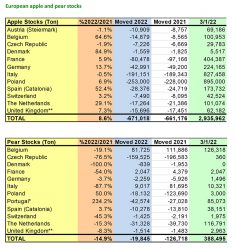
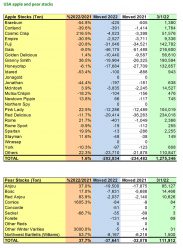
WAPA, the World Apple and Pear Association, released the apple and pear stock figures from 1 March 2022. The figures show that in Europe apple stocks increased by 8.6 % compared to 2021 to reach 2,935,962 T, while pear stocks decreased by 14.9 % to 388,495 T. In the USA, apple stocks as of 1 March 2022 stood at 1,275,346 T (+ 1.6 % compared to 2021), while pear stocks reached 111,912 T (37.7 % above 2021).
WAPA, the World Apple and Pear Association, collects every month the stock figures for apples and pears from Europe and the United States. WAPA can reveal that European apple stocks stood at 2,935,962 T as of 1 March 2022, which is 8.6 % above the figure of 2021. This was mainly driven by the increases concerning Red Jonaprince (54 % up from 2021), Jonagold (+ 27.9 %), Golden Delicious (+ 23.3 %), and Gala (+ 18.4 %), and despite the decrease in some major varieties, including Granny Smith (- 20 %) and Cripps Pink (- 14.9 %). On the other hand, pear stocks stood at 388,495 T on 1 March 2022, 14.9 % below the volume of 2021. The decrease in the Italian varieties (Abate Fetel – 97.8 % and Kaiser – 95.2 %) was partially mitigated by the stark increase in Portugal’s Rocha pears (+ 59,614 T compared to March 2021).
In the USA, apple stocks in March stood at 1,275,346 T (+ 1.6 % compared to 2021). The decrease among several large varieties, such as Fuji (- 20.8 %), Red Delicious (- 11.7 %), and Gala (- 9 %) was compensated by the 216.5 % increase in Cosmic Crisp apples, which reached 51.576 T, and the 36.5 % increase in the Granny Smith variety. Pears stocks in the USA stood at 111,912 T, which is 37.7 % above last year.
European apple and pear stocks (Photo: WAPA)
USA apple and pear stocks (Photo: WAPA)
Quadrupling of storage capacity at German production facility
BENEO, one of the leading manufacturers of functional ingredients, has announced a quadrupling of the storage capacity at its Offstein facility in Germany, to improve its efficiency and strengthen the company’s business contingency resilience still further. The new high-bay warehouse, which opened in February, allows for increased storage of BENEO’s crystalline functional carbohydrates Isomalt, Palatinose™ and galenIQ™. With a EUR 7.7 million investment in this fully automated facility, BENEO continues to further improve its supply chain robustness and reduces transport.
The new 25-metre-high warehouse has a storage capacity of more than 8.500 Euro pallets, and is located close to both the packaging and shipment operations at the production site in Offstein. Together with external warehouses worldwide, the addition of storage capacity in Offstein further supports BENEO’s multi-storage strategy for improved business contingency. Furthermore, transport ways are reduced as a larger proportion of functional carbohydrates is now stored on-site than in external warehouses.
In their crystalline form BENEO’s functional carbohydrates store well in humidity and temperature monitored facilities, such as the new warehouse. The fully automated high-bay facility allows for a higher proportion of direct loading and is freeing up personnel from the storage and retrieval process to be used more efficiently in other onsite activities.
Tim Berger (Photo: Eckes-Granini Group)
The past business year was a year of contrasts for the Eckes-Granini Group GmbH a year full of contrasts. The second pandemic year pandemic year and customer conflicts in the food retail sector once again presented the company with challenges, while 2021 also marked the start of the largest transformation in the company’s history. Sales revenue decreased moderately from 873 million euros in fiscal 2020 to 856 million euros (- 1.9 %), while sales volumes also declined, falling by 38 million litres to 805 million litres (- 4.5 %). Germany and France were particularly affected by the decline in sales volumes. Here, differing views on price adjustments led in part to the discontinuation of supply relationships with partners in the food retail sector. As a result, Eckes-Granini posted EBIT of 57.2 million euros (previous year: 71.0 million euros). The decline of 13.8 million euros is attributable to the effects of the pandemic, customer conflicts in the food retail sector and significantly higher costs for raw and packaging materials compared to the previous year. Tim Berger, CEO of Eckes-Granini Group GmbH, looks back on the business year as follows: “Despite considerable challenges posed by Corona, lower sales volumes and massive cost inflation, we succeeded in gaining market share – especially in the Nordic and Baltic countries – and strengthening our position during the past business year. Overall, our sales grew in nine out of ten countries. We also performed well in our international business in European countries and outside Europe.”
Eckes-Granini remains market leader
While the market for fruit juices, nectars and fruit beverages (FJND) was still able to benefit from food stockpiling in 2020, it declined in both value (- 2.1 %) and volume (- 4.4 %) in the second pandemic year. In particular, there was less demand for ambient, non-refrigerated fruit drinks sold via retailers. Accordingly, the 2021 segment recorded a decline of 3.7 % in sales and 5.2 % in volume sales, thus performing somewhat weaker than the market as a whole. In this generally weaker market environment, Eckes-Granini recorded a 0.7 % decline in market share in terms of value (market share 12.2 %) and a 0.8 % decline in volume (market share 11.3 %). The good news is that brands continue to gain market share. The e-commerce segment also continues to grow strongly but is not included in these figures. Eckes-Granini was able to make significant gains here, growing by + 35 %.
Full focus on innovation, digitization, and sustainability
In the area of product innovations, the company got off to a flying start with the market launch of hohes C Super Shots in Germany and Joker Shots in France. The popular hohes C Super Shots are currently leading the two-digit growth of the shot category in Germany (+ 31.1 %). Since the past business year, the Eckes- Granini Group has also been investing heavily in new distribution channels and cooperative ventures, and growth and the acquisition of new customers in e-commerce are developing particularly promisingly.
The Eckes-Granini Group also scored points in sustainability in 2021. With the publication of the first Group-wide sustainability report and the implementation of numerous measures, Eckes-Granini took important steps toward a more sustainable orientation of its business activities last year. To reduce emissions in line with the latest climate science criteria and achieve its ambitious targets, Eckes-Granini has been working with the independent Science Based Targets initiative (SBTi) since 2021.
Successfully heading for the future with a strong growth strategy
2021 marked the launch of the Eckes-Granini Group’s Strategy 2025 and thus the largest transformation in the company’s history. “The transformation in the FJND market will continue and requires new ways of thinking and working – also from us as ‘category thought leaders’,” says Tim Berger. “At the same time, our goals are clearly defined: In 2025, we want to generate one billion euros in net sales and achieve a market share of 15 % in Europe. We successfully laid the foundation for these ambitious goals in 2021 and are now building on them. In the past fiscal year, we succeeded in maintaining our market leadership position despite numer ous challenges and a difficult market environment, growing locally and driving for- ward key innovations. We have thus made a solid and motivated start to 2022.”
About the Eckes-Granini Group Eckes-Granini is the leading supplier of fruit juices and fruit beverages in Euro-pa. For the inde- pendent family-owned company headquartered in Nieder-Olm, Germany (Rhineland-Palatinate), the focus is on committed and competent employees, strong brands in the areas of juices, fruit beverages and smoothies, and a long-term strategic orientation with sustainable value creation. Today, Eckes-Granini operates mainly in Europe with its own national companies and strategic partners and generates annual sales of 856 million euros with a total of 1697 employees. The com- pany’s foundation is formed by the internationally renowned premium brands granini and Pago to- gether with strong national and regional brands for juices such as hohes C, Joker and God Morgon. Consumers in 80 countries worldwide and especially in Europe know and appreciate our fruit juices and the variety of fruit drinks.
The weather has been favouring the development of the 2022/23 orange crop. In general, frequent rainfall (since mid-October 2021) is helping the oranges to grow bigger and, thus, agents expect productivity to recover from the two previous seasons, when the volume harvested was low.
According to Cepea collaborators, the general scenario has been more favourable this year. Although the first blooming was late in some orchards (in mid-September in irrigated orchards and in October in dry land, after the return or rains), the number of flowers was considered positive, complemented by other blooming in the following months. Besides, the fruits set rate was high, favoured by rains followed by sunny days most of the time.
It is important to highlight that the damages caused by the long drought in the last two years (and frosts in some areas last Winter) were not completely offset, however, orange trees are currently more vigorous, leading agents to believe that productivity will be higher this season. Still, agents have distinct estimates about the harvest: some, who are more pessimistic, expect 300 million boxes to be harvested, while others, more optimistic, believe it will hit 350 million boxes. However, most of them expect something between 300 and 350 million boxes.
The only available estimates were released by the USDA in December, indicating the crop in São Paulo and the Triângulo Mineiro to total 305 million boxes (15.5 % higher than that in 2021/22). Agents are waiting for Fundecitrus’s estimates, to be released in May.
It is worth to mention that, despite the production increase, orange supply is expected to be tight in the 2022/23 season, due to the high demand from processors to replenish juice stocks – which are forecast at 127 thousand tons by the end of the 2021/22 season, in June 2022, according to estimates from CitrusBR. Still according to CitrusBR, this volume will not be enough to meet the world demand until the new season steps up.
In that scenario, even if the volume produced is near the expected by the more optimistic, there should not be an orange surplus, which justifies the high prices bid by processors for 2022/23.
This scenario may also limit supply in the in natura market along the season, however, this would not ensure higher prices, since the purchase power of many consumers in Brazil is weak because of the current high inflation and the national economic scenario.
Kombucha brand Aqua ViTea introduces Aqua Seltzers, a better-for-you bubbly beverage packed with probiotics for immune and gut health in the U.S. Like all of Aqua ViTea’s beverages, the new Aqua Seltzers are USDA Organic, GMO-free, gluten-free, vegan, and always low in calories and sugar.
As the leading East Coast manufacturer of Kombucha, Aqua ViTea has made it their mission for more than 15 years to educate and introduce consumers to the many health benefits of Kombucha through supremely unique product innovations. Aqua Seltzer is disrupting the bubbly beverage category with a light body, approachable and inventive taste, and vibrant packaging. Aqua Seltzer comes in four dynamic and refreshing flavours: Grapefruit + Thyme, Raspberry + Lime, Cucumber + Mint, and Pomegranate + Cherry. Each shelf-stable can is packed with five billion live probiotics and powerful antioxidants and enzymes. With only 15 calories and 1 gram of sugar, it’s the perfect healthy and functional seltzer to sip on all summer long.
“As one of the first commercial Kombucha brands, we keep our finger on the pulse of what consumers need from functional beverages while remaining true to our core value that food can be used as medicine,” said Jeff Weaber, Founder of Aqua ViTea. “A crowded market no doubt, Aqua Seltzer shines as a replacement to sugary beverages with beneficial living food properties that can help consumers achieve overall wellness from the inside out.”
Aqua ViTea is authentically crafted with naturally occurring probiotics, blending ancient Kombucha fermentation traditions with modern brewing techniques to produce refreshing beverages that are verified non-alcohol compliant and rich with clean ingredients. To date, Aqua ViTea has composted 26K pounds of tea for local agriculture and 75K pounds of wastewater for renewable energy. Additionally, up to 35 % of the fills at Aqua ViTea’s Kombucha fountains utilize reusable glass.
Also new in April, Aqua ViTea announced distribution expansion with the launch of an e-commerce vertical on its website making it easy for customers in the U.S. to purchase and receive their favourite beverages from the brand.
About Aqua ViTea Founder Jeff Weaber started homebrewing Aqua ViTea from his farmhouse basement in Vermont in 2005. Today, the company employs a team of thirty full-time employees at its Middlebury-based facility and has become the East Coast’s largest Kombucha manufacturer. Aqua ViTea is a sustainably driven Kombucha brand, focused on providing delicious and authentic better-for-you beverages. Aqua ViTea artfully blends ancient brewing traditions with modern techniques to create a healthier drink option, packed with natural probiotics, enzymes, and antioxidants. Each beverage flaunts a label exploding in colours and storytelling that invite you to sip on the refreshing flavours, like Blueberry Social, Elderberry, and Pineapple Lemonade among others, or enjoy one of the special CBD concoctions, like Chaga Chai. Its offerings extend to Aqua Seltzer and the hard kombucha category, dubbed AfterGlow, featuring noteworthy flavours like Ginger & Blueberry, Citrus Rush, Cherry Sour, and Apricot Dream. Aqua ViTea is offered at retailers like Whole Foods and Bristol Farms in the U.S.
Kerry, one of the world’s leading taste and nutrition companies, has announced it has completed the acquisition of U.S.-based Natreon, Inc., a leading supplier of branded Ayurvedic botanical ingredients.
Natreon supplies branded and scientifically studied and tested Ayurvedic extracts to the dietary supplement and functional food and beverage industries across the globe. The acquisition significantly expands Kerry’s leadership position and ProActive Health portfolio of science-backed branded ingredients, furthering the company’s technology growth. The branded ingredients in Natreon’s portfolio are protected by a wide range of U.S. and foreign patents and supported by a total of 52 clinical studies which support the efficacy of their health benefits. Natreon’s portfolio consists of the following:
Sensoril® – Ashwagandha extract for cognitive health benefits including stress, anxiety, and sleep.
PrimaVie® – Shilajit extract for sports nutrition and healthy aging.
Capros® – Amla extract for cardiovascular support.
Crominex® – Chromium complex for diabetes.
Ayuflex® – Terminalia chebula extract for bone and joint health benefits.
Ayuric® – Terminalia bellirica extract for uric acid health.
The ingredients will be integrated into Kerry’s ProActive Health portfolio and leveraged by Kerry’s broad customer base. The ingredients will be supported by Kerry’s global application and R&D network, including continued investment in the science and clinical evidence supporting the brands.
Kerry has been building a leading position in science-backed functional ingredients within its ProActive Health portfolio for the past several years, most recently with the acquisition of Spain-based company Biosearch Life in 2021.
The Sunshine Coast’s reputation as a food and beverage hub is being cemented by the Morrison Government with $ 33.4 million for an Aussie-first manufacturing precinct at Sunshine Coast Airport.
Minister for Industry, Energy and Emissions Reduction Angus Taylor announced support for the $ 112.8 million Turbine Collaborative Food and Beverage Manufacturing Precinct under the Collaboration Stream of the Morrison Government’s $ 1.3 billion Modern Manufacturing Initiative.
The precinct will be home to local food and beverage companies that will be able to utilise shared warehousing and logistics, an education and training centre, as well as a collaborative high-tech manufacturing facility.
It will bring together beverage company Lyre’s Spirit Co, the Queensland Drinks Accelerator and ingredients company Doehler Australia, with the Food and Agribusiness Network and University of the Sunshine Coast.
By having all the facilities under one roof, it will help drive the competitiveness of local companies by collaborating together and building further capability. Once complete, it will be Australia’s leading industry-based food and beverage research and commercialisation facility.
By teaming up with the University of the Sunshine Coast, the precinct’s first-of-its-kind embedded training centre will also help the next generation take the next step to their future roles in areas such food science, transport & logistics, and hospitality.
It’s expected the project will see 131 new jobs during construction and support 687 once operational with $ 200 million in economic benefits.
Minister Taylor said the Sunshine Coast is home to incredibly innovative manufacturers especially when it comes to amazing food and beverage products.
“Food and beverage manufacturing is the largest manufacturing sector for the Australian economy. One in four people employed in manufacturing are employed in our food and beverage sector and it contributes $ 27.5 billion to our economy,” Minister Taylor said.
“This funding will support some of the most innovative producers leverage technology to increase their production, while meeting growing export demand and creating new local jobs across the region and beyond through this world-class airport precinct.
“Not only does it remove barriers to businesses getting started, it will also help companies build their capabilities together and drive growth in the food and beverage sector on a scale not yet seen in Australia.”
Specialty chemicals company LANXESS will globally implement a variable pricing surcharge for its Lewatit ion exchange resins and Bayoxide iron oxide adsorbers which will be applied with immediate effect. The existing fixed surcharge will be adjusted based on the most relevant input costs on a monthly basis. In April/May 2022 the adder will be at around EUR 0.9/l or the equivalent amount in national currency. Customers will be contacted individually.
This step became necessary since the already tense cost situation has worsened even further due to the war in the Ukraine. The markets worldwide are experiencing an unprecedented volatility and prices for energy, raw materials and transportation increased at unexpected and unpredictable magnitudes.
The LANXESS Liquid Purification Technologies business unit is one of the world’s leading global solution providers for water treatment and liquid purification. Ion exchange resins and iron oxide adsorbers are used in numerous industries and applications to purify water and other liquid media effectively.
Naturally grown mini-mangos are fragrant, sweet, and are edible with the skin
Goldenberry Farms™ has begun shipping the initial boxes of Sweet Sugar Mangos™, an ultra-sweet and miniature mango variety, trademarked by the company. These naturally grown tree mangos easily fit in the palm of your hand and are unique due to their ability to be eaten with their skin, giving it the nickname of “lunchbox mango.”
The Sweet Sugar Mango has a red, fragrant flesh with a sweet juicy taste and a brix level of 22. Unlike some other exotic mangos, Sweet Sugar Mangos™ do not have a fibrous taste. These miniature mangos are grown naturally, non-GMO, and have a peak harvest season of April through September.
Sweet Sugar Mangos™ are exclusively grown commercially in the Magdalena Region of Colombia, close to Santa Marta on the Caribbean Coast. The tropical environment and unique locale create an ideal microclimate for this specialty fruit. The small fruit is highlighted for its extreme popularity in the region.
Sweet Sugar Mangos™ are offered commercially in 2 kilo (4.5 pound) cases, which hold between 18 – 24 mangos each. Specially branded retail kits and mini boxes are available to merchandise the Sugar Mangos™ in store.
Goldenberry Farms™ expects to offer up to 6,000 cases weekly of Sugar Mangos™ and Sweet Sugar Mangos™. The fruit is available to customers globally, and pending the final permissions for entering the USA market, which is expected for this season.
Sugar Mangos™ and Sweet Sugar Mangos™ are exclusive trademarks of Goldenberry Farms, LLC, and are available to be used under license by qualified growers, distributors, and importers.
Elopak advances its growth strategy with key acquisition of Naturepak Beverage Packaging Co Ltd, the leading gable top fresh liquid carton and packaging systems supplier in the MENA region
Elopak ASA has completed its acquisition of Naturepak Beverage from Naturepak Limited, a wholly owned subsidiary of Gulf Industrial Group, and Evergreen Packaging International LLC, a wholly owned subsidiary of Pactiv Evergreen Inc.
The acquisition of Naturepak, the leading gable top fresh liquid carton and packaging systems supplier in the MENA region, sees the addition of local production facilities in Morocco and Saudi Arabia to Elopak’s extensive existing global network, which already encompasses customers across 70 countries. At the same time, it boosts annual production capacity by more than 2.5 billion cartons, supporting the company’s ambition to meet the growing demand for sustainable packaging solutions.
The acquisition will also provide access to a strategic customer base in the fresh beverage carton segment in key growth markets, many of whom are global blue chip FMCG players and strong regional champions.
The acquisition marks a key milestone in Elopak’s growth strategy. Having listed on the Oslo stock exchange in 2021, the company is seeking to capitalize on its strong track record, growing geographical footprint and investment in sustainability-focused innovations to target organic growth of 2 – 3 % per annum. It is pursuing new business opportunities across both traditional and non-traditional segments, as well as driving the plastic to carton conversion.
Commenting on the acquisition Elopak CEO Thomas Körmendi stated, “We are delighted to have acquired such a high-quality asset in MENA. This move greatly enhances our position in the Middle East and African markets, enabling us to realize our ambitions of this growth region, as well as further strengthening our global footprint.”
“Going forward we are excited to share our sustainable packaging solutions with Naturepak Beverage’s client base and work hand-in-hand with them to find ways to reduce their carbon footprint and empower consumers to make environmentally conscious choices,” he continued.
“As we strengthen our presence in the region, we continue to bring new products to market that provide natural and convenient alternatives to plastic bottles that fit within a low carbon circular economy. We are ready to leverage our expertise, market-leading technology and skills to grow our presence in the region across products, segments and markets,” Körmendi explained.
Koa is disrupting transparency in the cocoa industry. The Swiss-Ghanaian start-up is launching a system, using blockchain technology, that proves transactions and higher income for cocoa farmers. In an international collaboration with the companies seedtrace (Germany) and MTN Group (South Africa), Koa has implemented a new, tamper-proof and scalable transparency system that records payments made to cocoa smallholders. Mobile money payments are verified in real-time and are irreversibly stored on a blockchain. Transactions are made publicly available, differentiating themselves from existing certification labels, providing consumers with direct proof that farmers receive the full payment.
Over the last decades, supply chain scandals and cocoa farmer poverty have continued to rock the cocoa industry, leading to increased consumer demand and political efforts to improve transparency and accountability within the cocoa industry. Yet, consumers struggle to put their trust in brands and their initiatives. While products carry certification labels, the inevitable question remains: How can I be sure that farmers receive the money that they’re entitled to?
Koa, the Swiss-Ghanaian start-up making use of cocoa food waste, has set sail to disrupt transparency standards and to enable consumers to obtain assurance. “We want to get rid of long, non-transparent supply chains,” emphasises Anian Schreiber, Managing Director and Co-Founder at Koa. “Instead of claiming good practices, we put our cards on the table to let the consumers witness each transaction to farmers.” The start-up is known for upcycling the white pulp that surrounds the cocoa beans, thereby significantly increasing the income of Ghanaian smallholders, while offering a solution to reduce farmer poverty. Koa is working with over 2,200 cocoa farmers and will add an additional 10,000 farmers to its value chain in the next two years.
Removing the room for errors and opaque marketing messages
To develop the pioneering transparency system, Koa collaborated with Berlin-based seedtrace, a SaaS start-up on a mission to make supply chain transparency the norm. Existing certification labels often validate transactions through non-transparent, error-prone control procedures, with farmers regularly only receiving a portion of the funds claimed to be earmarked for them. To combat this, seedtrace created a system that removes the room for error and enables customers to monitor the extra income paid to farmers. “We verify each transaction and store it on an open, low-emission blockchain. Together with Koa, we thereby set new standards assuring that the information is verified, cannot be manipulated and is accessible in real-time for all stakeholders,” explains Ana Selina Haberbosch, CEO at seedtrace.
Blockchain enables full transparency
The new system is unique as it connects blockchain with mobile money transactions. “Instead of having a person enter information on the blockchain, it links the data from mobile money transactions. This combination allows us to verify additional farmer income, deliver full proof and increase trust among stakeholders,” says Francis Appiagyei-Poku, Finance and Administration Director at Koa. To make this possible, Koa and seedtrace have partnered with MTN Group, Africa’s largest telecommunications operator, who’s mobile money transaction data serves as secure inputs for the blockchain provided by US company Topl. 360-degree transparency is achieved by implementing clear, transparent, and compliant data management processes that protects individual data and keep farmers informed of data use.
Oberweis first to integrate the system
Leading the way towards full transparency is Jeff Oberweis, the renowned pastry chef from Luxembourg, who sends consumers on a journey from cocoa farmers to the final product. A QR code on the packaging of the product containing Koa ingredients leads consumers to the seedtrace platform where they can see the additional farmer income. “In 2022, we want to have proof that people are paid fairly and that we work on an equal footing throughout the value chain. Koa’s integration of the blockchain guarantees total transparency and allows us to set an example to the industry,” emphasises Jeff Oberweis.
What is blockchain? Blockchain technology is at its very core a database, distributed across many servers in a network. The biggest benefits of using blockchain for supply chain management are transparency and traceability. Essentially, blockchain allows organizations to store information about transactions and their impact in an immutable and transparent way, ensuring that information about upstream events arrives downstream unaltered. Since the companies Koa and seedtrace are using a public blockchain and every actor has their own copy of the chain, it cannot be tampered with, which increases the transparency and trust- worthiness of the provided information. Since Koa pays farmers with mobile money (real money) through the mobile payment provider MTN, the tracing partner seedtrace can verify every individual transaction. Once triggered by Koa, seedtrace verifies through MTN whether the transaction arrived with the right person and the right amount before storing the data immutably on the blockchain.
QminC from Tera Food & Beverage Co., Ltd., Thailand’s leader in health beverages with revolutionary nano-liposome technology and zero preservatives, has unveiled 2 herbal-based health and functional drink flavours ‘QminC Ginger with Honey’ and ‘QminC Finger Root with Honey’.
Thanthit Yuenyongtechahiran, President of Tera Food & Beverage Co., Ltd., said, “The launch of concentrated ginger extract drink with honey under QminC brand is creating a phenomenon for the health and functional drink industry. It is the first time that a concentrated ginger drink is made available in a ready-to-drink bottle in Thailand. We are responding to the high demand of the health-conscious in the global market and to the trend of natural functional drinks, which is likely to have remarkable and rapid growth every year”.
QminC also plans to make a strong overseas presence in CLMV as well as the United States, China, Singapore, South Korea, Kuwait, and the United Arab Emirates and is ready to go fully online to give consumers extra convenience in response to the current trend of people boosting immunity and reducing inflammation while keeping a social distance.
The first flavour QminC Ginger with Honey contains 1,000 mg. of USDA-approved ginger extract imported from the United States. It also has 100 mg. of beta-glucan which provides immunity for the body and prevents infection from microbes making it widely recognised for being anti-inflammatory as well as vitamins C, D, E, and Zinc with the spicy flavour of ginger and natural sweetness of honey to give a perfectly great taste.
QminC Finger Root with Honey has 1,000 mg. of finger root extract, the famous herb in Thailand with pinostrobin, which has been recognised in studies by many institutions for its anti-viral and anti-bacterial properties. It also contains beta-glucan, vitamins C, D, A, and Zinc. With QminC’s manufacturing innovation (nano-liposome technology), it tastes great with an aroma and leaves no bitter taste or odour typical of finger-root beverages.
The two latest QminC’s drinks are now available in Thailand in a 150 ml bottle and retail for 25 Baht (0.7 USD). The drinks offer a low energy density of only 15 kilocalories.
Energy and raw material prices were already on very high level but surged even further after the beginning of the war in Ukraine. Those increases combined with availability issues have serious financial impacts on the flexible packaging supply chain. All main substrates used for flexible packaging such as plastics, paper and aluminium are concerned but also adhesives, lacquers and inks. The industry is confronted with the high energy prices in their direct operations manufacturing flexible packaging and logistics.
Even though the cost share for logistics is less than in other packaging sectors due to the low product to packaging ratio of flexible packaging and very efficient transportation (usually on reels) the absolute increase is very significant. Reports from forwarder associations even show the risk of reduction of available logistic capacities as companies will have to give up their operational business due to high diesel prices.
“The level of cost increases due this situation for manufacturers of the flexible packaging industry cannot yet be assessed completely but we are convinced that the peak is not reached yet,” commented Guido Aufdemkamp, Executive Director of Flexible Packaging Europe the situation.
“Main difficulties for our membership are the high uncertainty of serious pricing to their customers as many suppliers to the industry change their rates even after fixed delivery confirmation. Non-acceptance of such increases is often penalised by non-delivery or non-availability of the next order. Compared to the supplier and customer industry our sector is in a certain sandwich position. Furthermore, liquidity issues are of growing concern in particular for small- and medium-sized companies. That is combined with insufficient credit insurance lines due to high raw material prices.”
Almost half of the Fast-Moving Consumer Goods (FMCG) in Europe, excluding beverages, are packed with flexible packaging.
Louis Dreyfus Company B.V. (LDC) reported strong consolidated financial results for the year ended December 31, 2021, successfully fulfilling its key role to keep essential agricultural supply chains moving safely, reliably and responsibly in a context of continued global challenges.
Net sales amounted to USD 49.6 billion, up 47.7 % compared to 2020, while Segment Operating Results rose 17.6 % year-on-year to USD 1,834 million, as the company once again leveraged its global footprint and market intelligence to mitigate risk, deliver for customers and capture profitable origination and sales opportunities. This performance drove EBITDA to USD 1,623 million, up 22.6 % compared to the same period in 2020.
“2021 was a very special year for LDC, in which we celebrated 170 years of history and opened a new chapter for the company, welcoming ADQ into our shareholder group as a strategic partner in the pursuit of our long-term plans and strategy,” said Margarita Louis-Dreyfus, Chairperson of the Supervisory Board. “It was also another challenging year for our teams and partners around the world, to whom I am deeply grateful for their exceptional commitment, which made business continuity and success possible even in a complex and rapidly changing context.”
With overall resilient demand for the main products commercialized by the Group in 2021, both its business segments contributed to LDC’s strong operating results, which reached USD 1,191 million for the Value Chain Segment (compared to USD 1,003 million in 2020) and USD 643 million for the Merchandizing Segment (up from USD 556 million in the previous year). All business platforms successfully navigated uncertain market conditions, securing profitable flows to meet demand, implementing successful hedging strategies and capitalizing on recovery from Covid-19 impacts in certain sectors, owing to easing sanitary measures.
“In another year marked by the ongoing pandemic, freight shortages and port congestions, as well as climate challenges, LDC once again navigated a complex environment to deliver for customers, while making important strides in our strategic and sustainability roadmaps,” said Michael Gelchie, LDC’s Chief Executive Officer. “Our clear vision and agile mindset have underpinned our success over 170 years, and continue to do so today as we pursue our growth ambitions, always with the safety and wellbeing of all those who work for and with us as a top priority.”
As part of its commitment to helping address increasingly urgent climate and other global sustainability challenges, LDC set up a dedicated Carbon Solutions Platform in 2021 to accelerate the Group’s decarbonization journey. This reflects the sectoral commitment, signed at the COP26 United Nations Climate Change Conference, for accelerated action on deforestation and emissions, supporting the global drive toward a net zero economy.
“Our progress in 2021 further reinforced LDC’s leading position as a key industry participant for the future, while ensuring the future we shape is fair and sustainable, in line with our company purpose,” said Michael Gelchie. “Looking ahead, in light of new geopolitical tensions and macroeconomic shifts emerging in 2022, our role to provide essential products to the world’s population is more important than ever. It remains our priority to fulfill this role safely, reliably and responsibly, working hand in hand with our teams and business partners across the globe, to whom we are extremely grateful for their collaboration and steadfast support.”
Please download the full LDC’s digital 2021 annual report as pdf-file under: www.ldc.com
Coca-Cola Europacific Partners France (CCEP France) has announced an investment of EUR 30 million in its Dunkirk site, to fund a new production line that will increase the site’s capacity. The site already employs 400 people and bottles 10 different beverage brands. The investment will create at least 10 new jobs.
The Dunkirk site is the newest and largest CCEP site in France with lines producing all types of packs and sizes, and aseptic production which is used to manufacture still drinks – such as juices, teas and sports drinks. The site produces more than 600 million litres of beverages each year.
Since 2018, CCEP France has invested more than EUR 100 million to transform the Dunkirk site.
The Dunkirk site is committed to responsible growth and is taking measures to improve its carbon footprint, in line with CCEP’s net zero 2040 ambition and GHG emissions reduction target. For example, the site has set up an innovative device to replace plastic packaging on batches of cans with cardboard packaging, and 100 % of the waste created at the site is recycled or recovered.
The site also runs the Coca-Cola ‘Passport to Employment’ programme which benefits 400 young people from the Hauts-de-France region each year, and over 25,000 in France since its inception in 2003.
CCEP has been operating in France for more than 100 years, producing 90 % of the beverages in its portfolio locally and has invested EUR 350 million from 2009 to 2019 to strengthen its manufacturing capacity in the country.
Tahiti lime prices faded in São Paulo State in the first fortnight of March. According to Cepea collaborators, the current hot weather in Brazil has been favoring consumption, however, supply is high, due to the peak of harvest. Thus, quotations were pressed down.
However, many farmers reported that supply is beginning to decrease. The harvesting, which has been in full swing since mid-January, is expected to slow down until the end of March.
During the peak of harvest in 2022 (January – March), the quotations for tahiti lime have been lower than that in the same period of 2021. From the beginning of the year until March 10th, the average price for this variety closed at BRL 21.92/box, harvested, 1.8 % down from that in the first quarter of 2021, in nominal terms. Only in January/22 prices were higher than that in Jan/21.
The lower volume to be harvested in the coming weeks is expected to limit processing. By the end of the first fortnight, four plants were operating in SP, paying from BRL 18 to BRL 20.00 per 27-kilo box, harvested and delivered to processors.
EXPORTS – Brazilian exports of lemon and lime have been high this year. According to Secex, in the first two months of 2022, Brazil shipped to all destinations 22 thousand tons of lemons and limes, 17.1 % up from that in the same period last year, only lower than that in the first bimester of 2020. Revenue total USD 17.3 million, 11.9 % up in the same comparison. Despite higher volume and revenue, the average price (in dollar) paid for the fruit is lower than that from the same period of 2021.
In February, exports performance was a record for the month, favored by high supply in SP and higher quality of the fruits (because of recent rainfall). According to Secex, Brazil shipped 11.8 thousand tons of lemon and lime in February, 13.4 % up from that in Feb/21. Revenue totaled USD 9.2 million, 9.5 % up, in the same comparison.
The company will build new storage tanks for not-from-concentrate orange juice, supporting increased commercialization to European markets
Louis Dreyfus Company (LDC), a leading global merchant and processor of agricultural goods, announced the construction of new orange juice storage tanks in the city of Matão, located in Brazil’s largest citrus producing region, in the state of São Paulo. The project aims to increase the company’s production and storage capacity for not-from-concentrate (NFC) orange juice, a product with high added value for the consumer market.
The new investment in Matão, where LDC operates since 1988, will bring NFC storage capacity at the site to 30 million liters, and annual juice production capacity to 300 million liters.
“Increasing production and storage capacity for NFC will allow us to meet growing consumer demand for this high value-added product, especially in Europe, while reinforcing our position among the top three global processors and merchandizers of orange juice,” said Juan José Blanchard, Head of the LDC’s Juice Platform.
This project is the second phase in LDC’s plans to expand commercialization of NFC in Europe, North America and Asia. In 2020, the company announced a new, dedicated fleet for juice transportation that reduces fuel consumption by 40 % and sulfur emission levels by 85 % per ton of product. LDC also increased storage capacity by more than 50 %, and blending capacity by more than 20 %, at its port terminal and processing facility in Ghent, Belgium.
Brazil is the world’s largest exporter of orange juice, a business in which LDC has been active for over 30 years. The company’s operations in the country are fully integrated, comprising more than 25,000 hectares of sustainably grown citrus groves – strategically located in Brazil’s citrus belt – as well as three citrus juice processing plants and an export terminal in the Port of Santos (São Paulo state).
“This project also reinforces the company’s commitment to long-term investment in Brazil, a key origination market for over 80 years,” added Jorge Costa, Global Operations Director for LDC’s Juice Platform.
The new storage tanks are expected to be operational by the end of 2023.
About Louis Dreyfus Company Louis Dreyfus Company is a leading merchant and processor of agricultural goods, founded in 1851. We leverage our global reach and extensive asset network to serve our customers and consumers around the world, delivering the right products to the right location, at the right time – safely, reliably and responsibly. Our activities span the entire value chain, from farm to fork, across a broad range of business lines (platforms) including Grains & Oilseeds, Coffee, Cotton, Juice, Rice, Sugar, Freight, Carbon Solutions and Global Markets. We help feed and clothe some 500 million people every year by originating, processing and transporting approximately 80 million tons of products. Structured as a matrix organization of six geographical regions and nine platforms, Louis Dreyfus Company is active in over 100 countries and employs approximately 17,000 people globally.
In times of instability, crisis and major global events, how do we make sense of trends which are likely to influence the beverage market?
While it is too early to predict the full impact of the conflict in Ukraine, when considering the trends within the beverage industry, it is important to take the macro drivers influencing the global economy into consideration.
Even before the latest current events, the global economy continues to be in a state of flux with recovery moving at varying speeds across regions and nations because of the pandemic.
In a report published in 2021, PwC reported that by the end of 2021, early 2022, they expect the global economy to revert to its pre-pandemic level of output. Noting however, that the recovery will be uneven across sectors, countries, and income levels.
As 2022 gets well underway, and the world pivots from pandemic to recovery, consumer behaviour and purchasing power remain highly dependent on economic realities, and perhaps now more than ever, understanding some of the key factors impacting the economic landscape is crucial for business strategy.
In its report „5 economic factors influencing the global beverage market“ Treatt takes a closer look at:
Economic recovery post Covid-19
Public debt levels
Globalisation
Higher value-add activities
Generation Z
Please download the full report as pdf-file under: www.treatt.com
Functional beverage company, LIFEAID debuts refreshing new flavour FOCUSAID Watermelon Mint to add to its growing family of functional performance beverages.
LIFEAID, The Performance Beverage Company, brought the first flavour variation of one of its most popular blends, FOCUSAID, to market in the US. Getting the sustained and clean energy you need is easier when drinking a product free from chemical sweeteners, such as sucralose, and fillers, such as taurine. FOCUSAID delivers the natural flavours of bright crisp watermelon coupled with the cooling effect of mint.
Nootropics are brain-boosting vitamins and supplements, whose recent inclusion in the functional beverage space continue to grow in popularity in the market. As one of the leading nootropic beverages on the market, FOCUSAID Watermelon Mint, remains sodium and artificial sweetener free as well as vegan, non-gmo and gluten-free.
“FOCUSAID was one of the first nootropic beverages to hit the wider retail market and has remained a staple in our portfolio with retailers and online consumers. It only made sense to do a line extension to a fan-favourite with an additional refreshing crisp flavour,” says LIFEAID Co-Founder and President Aaron Hinde.
FOCUSAID Watermelon Mint is packed with brain-boosting super nootropics and 100 mg of clean crash-free caffeine from green tea and yerba maté. Whether you need a little focus before you kick off the day, or an afternoon energy boost, FOCUSAID Watermelon Mint will be your go to choice! Naturally sweetened with raw, cold-filtered agave, and never with any artificial colours or gut-wrecking artificial sweeteners, FOCUSAID Watermelon Mint has the premium nutrients and vitamins to keep you focused and on point.
FOCUSAID Watermelon Mint will be available to purchase online at lifeaidbevco.com and at select retailers such as Harris Teeter, Albertsons, and Circle K in the US.
Provisional consolidated EBIT 2021|22 prior to war-related extraordinary items forecast to be around EUR 95.5 million
The AGRANA Group previously anticipated EBIT in the 2021/22 financial year (1 March 2021 to 28 February 2022) to amount to at least EUR 86.6 million (guidance: a significant increase of at least 10 % compared to the prior year). On the basis of provisional, unaudited figures, the Group would generate EBIT prior to extraordinary items associated with the Ukraine war of around EUR 95.5 million (EBIT 2020/21: EUR 78.7 million). Group revenue will amount to around EUR 2.9 billion (2020/21: EUR 2,547.0 million).
The outbreak of the war in Ukraine on 24 February 2022 represents a relevant event for AGRANA as at the balance sheet date of 28 February 2022. Based on the current status of internal impairment testing, Management currently anticipates a largely non-cash impact on EBIT related to asset and goodwill impairments in a range of EUR 65 million to EUR 85 million. The consolidated audit performed by the appointed auditors is presently ongoing at the level of AGRANA Beteiligungs-AG. It is therefore not possible at this point in time to exactly define the actual scope of the impairments necessary.
The 2021/22 annual report will be published as planned on 13 May 2022.
You need to load content from reCAPTCHA to submit the form. Please note that doing so will share data with third-party providers.
You are currently viewing a placeholder content from Turnstile. To access the actual content, click the button below. Please note that doing so will share data with third-party providers.