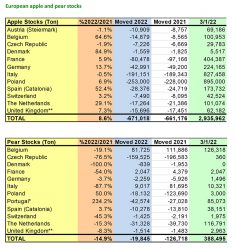
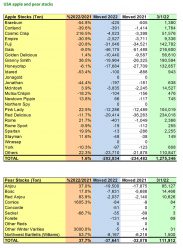
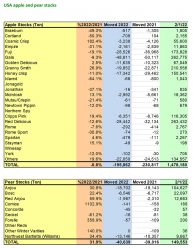
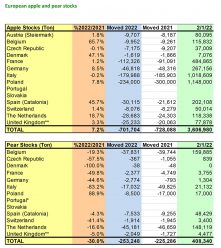
WAPA, the World Apple and Pear Association, released the apple and pear stock figures from 1 March 2022. The figures show that in Europe apple stocks increased by 8.6 % compared to 2021 to reach 2,935,962 T, while pear stocks decreased by 14.9 % to 388,495 T. In the USA, apple stocks as of 1 March 2022 stood at 1,275,346 T (+ 1.6 % compared to 2021), while pear stocks reached 111,912 T (37.7 % above 2021).
WAPA, the World Apple and Pear Association, collects every month the stock figures for apples and pears from Europe and the United States. WAPA can reveal that European apple stocks stood at 2,935,962 T as of 1 March 2022, which is 8.6 % above the figure of 2021. This was mainly driven by the increases concerning Red Jonaprince (54 % up from 2021), Jonagold (+ 27.9 %), Golden Delicious (+ 23.3 %), and Gala (+ 18.4 %), and despite the decrease in some major varieties, including Granny Smith (- 20 %) and Cripps Pink (- 14.9 %). On the other hand, pear stocks stood at 388,495 T on 1 March 2022, 14.9 % below the volume of 2021. The decrease in the Italian varieties (Abate Fetel – 97.8 % and Kaiser – 95.2 %) was partially mitigated by the stark increase in Portugal’s Rocha pears (+ 59,614 T compared to March 2021).
In the USA, apple stocks in March stood at 1,275,346 T (+ 1.6 % compared to 2021). The decrease among several large varieties, such as Fuji (- 20.8 %), Red Delicious (- 11.7 %), and Gala (- 9 %) was compensated by the 216.5 % increase in Cosmic Crisp apples, which reached 51.576 T, and the 36.5 % increase in the Granny Smith variety. Pears stocks in the USA stood at 111,912 T, which is 37.7 % above last year.
European apple and pear stocks (Photo: WAPA)
USA apple and pear stocks (Photo: WAPA)
Quadrupling of storage capacity at German production facility
BENEO, one of the leading manufacturers of functional ingredients, has announced a quadrupling of the storage capacity at its Offstein facility in Germany, to improve its efficiency and strengthen the company’s business contingency resilience still further. The new high-bay warehouse, which opened in February, allows for increased storage of BENEO’s crystalline functional carbohydrates Isomalt, Palatinose™ and galenIQ™. With a EUR 7.7 million investment in this fully automated facility, BENEO continues to further improve its supply chain robustness and reduces transport.
The new 25-metre-high warehouse has a storage capacity of more than 8.500 Euro pallets, and is located close to both the packaging and shipment operations at the production site in Offstein. Together with external warehouses worldwide, the addition of storage capacity in Offstein further supports BENEO’s multi-storage strategy for improved business contingency. Furthermore, transport ways are reduced as a larger proportion of functional carbohydrates is now stored on-site than in external warehouses.
In their crystalline form BENEO’s functional carbohydrates store well in humidity and temperature monitored facilities, such as the new warehouse. The fully automated high-bay facility allows for a higher proportion of direct loading and is freeing up personnel from the storage and retrieval process to be used more efficiently in other onsite activities.
Tim Berger (Photo: Eckes-Granini Group)
The past business year was a year of contrasts for the Eckes-Granini Group GmbH a year full of contrasts. The second pandemic year pandemic year and customer conflicts in the food retail sector once again presented the company with challenges, while 2021 also marked the start of the largest transformation in the company’s history. Sales revenue decreased moderately from 873 million euros in fiscal 2020 to 856 million euros (- 1.9 %), while sales volumes also declined, falling by 38 million litres to 805 million litres (- 4.5 %). Germany and France were particularly affected by the decline in sales volumes. Here, differing views on price adjustments led in part to the discontinuation of supply relationships with partners in the food retail sector. As a result, Eckes-Granini posted EBIT of 57.2 million euros (previous year: 71.0 million euros). The decline of 13.8 million euros is attributable to the effects of the pandemic, customer conflicts in the food retail sector and significantly higher costs for raw and packaging materials compared to the previous year. Tim Berger, CEO of Eckes-Granini Group GmbH, looks back on the business year as follows: “Despite considerable challenges posed by Corona, lower sales volumes and massive cost inflation, we succeeded in gaining market share – especially in the Nordic and Baltic countries – and strengthening our position during the past business year. Overall, our sales grew in nine out of ten countries. We also performed well in our international business in European countries and outside Europe.”
Eckes-Granini remains market leader
While the market for fruit juices, nectars and fruit beverages (FJND) was still able to benefit from food stockpiling in 2020, it declined in both value (- 2.1 %) and volume (- 4.4 %) in the second pandemic year. In particular, there was less demand for ambient, non-refrigerated fruit drinks sold via retailers. Accordingly, the 2021 segment recorded a decline of 3.7 % in sales and 5.2 % in volume sales, thus performing somewhat weaker than the market as a whole. In this generally weaker market environment, Eckes-Granini recorded a 0.7 % decline in market share in terms of value (market share 12.2 %) and a 0.8 % decline in volume (market share 11.3 %). The good news is that brands continue to gain market share. The e-commerce segment also continues to grow strongly but is not included in these figures. Eckes-Granini was able to make significant gains here, growing by + 35 %.
Full focus on innovation, digitization, and sustainability
In the area of product innovations, the company got off to a flying start with the market launch of hohes C Super Shots in Germany and Joker Shots in France. The popular hohes C Super Shots are currently leading the two-digit growth of the shot category in Germany (+ 31.1 %). Since the past business year, the Eckes- Granini Group has also been investing heavily in new distribution channels and cooperative ventures, and growth and the acquisition of new customers in e-commerce are developing particularly promisingly.
The Eckes-Granini Group also scored points in sustainability in 2021. With the publication of the first Group-wide sustainability report and the implementation of numerous measures, Eckes-Granini took important steps toward a more sustainable orientation of its business activities last year. To reduce emissions in line with the latest climate science criteria and achieve its ambitious targets, Eckes-Granini has been working with the independent Science Based Targets initiative (SBTi) since 2021.
Successfully heading for the future with a strong growth strategy
2021 marked the launch of the Eckes-Granini Group’s Strategy 2025 and thus the largest transformation in the company’s history. “The transformation in the FJND market will continue and requires new ways of thinking and working – also from us as ‘category thought leaders’,” says Tim Berger. “At the same time, our goals are clearly defined: In 2025, we want to generate one billion euros in net sales and achieve a market share of 15 % in Europe. We successfully laid the foundation for these ambitious goals in 2021 and are now building on them. In the past fiscal year, we succeeded in maintaining our market leadership position despite numer ous challenges and a difficult market environment, growing locally and driving for- ward key innovations. We have thus made a solid and motivated start to 2022.”
About the Eckes-Granini Group Eckes-Granini is the leading supplier of fruit juices and fruit beverages in Euro-pa. For the inde- pendent family-owned company headquartered in Nieder-Olm, Germany (Rhineland-Palatinate), the focus is on committed and competent employees, strong brands in the areas of juices, fruit beverages and smoothies, and a long-term strategic orientation with sustainable value creation. Today, Eckes-Granini operates mainly in Europe with its own national companies and strategic partners and generates annual sales of 856 million euros with a total of 1697 employees. The com- pany’s foundation is formed by the internationally renowned premium brands granini and Pago to- gether with strong national and regional brands for juices such as hohes C, Joker and God Morgon. Consumers in 80 countries worldwide and especially in Europe know and appreciate our fruit juices and the variety of fruit drinks.
The weather has been favouring the development of the 2022/23 orange crop. In general, frequent rainfall (since mid-October 2021) is helping the oranges to grow bigger and, thus, agents expect productivity to recover from the two previous seasons, when the volume harvested was low.
According to Cepea collaborators, the general scenario has been more favourable this year. Although the first blooming was late in some orchards (in mid-September in irrigated orchards and in October in dry land, after the return or rains), the number of flowers was considered positive, complemented by other blooming in the following months. Besides, the fruits set rate was high, favoured by rains followed by sunny days most of the time.
It is important to highlight that the damages caused by the long drought in the last two years (and frosts in some areas last Winter) were not completely offset, however, orange trees are currently more vigorous, leading agents to believe that productivity will be higher this season. Still, agents have distinct estimates about the harvest: some, who are more pessimistic, expect 300 million boxes to be harvested, while others, more optimistic, believe it will hit 350 million boxes. However, most of them expect something between 300 and 350 million boxes.
The only available estimates were released by the USDA in December, indicating the crop in São Paulo and the Triângulo Mineiro to total 305 million boxes (15.5 % higher than that in 2021/22). Agents are waiting for Fundecitrus’s estimates, to be released in May.
It is worth to mention that, despite the production increase, orange supply is expected to be tight in the 2022/23 season, due to the high demand from processors to replenish juice stocks – which are forecast at 127 thousand tons by the end of the 2021/22 season, in June 2022, according to estimates from CitrusBR. Still according to CitrusBR, this volume will not be enough to meet the world demand until the new season steps up.
In that scenario, even if the volume produced is near the expected by the more optimistic, there should not be an orange surplus, which justifies the high prices bid by processors for 2022/23.
This scenario may also limit supply in the in natura market along the season, however, this would not ensure higher prices, since the purchase power of many consumers in Brazil is weak because of the current high inflation and the national economic scenario.
Kombucha brand Aqua ViTea introduces Aqua Seltzers, a better-for-you bubbly beverage packed with probiotics for immune and gut health in the U.S. Like all of Aqua ViTea’s beverages, the new Aqua Seltzers are USDA Organic, GMO-free, gluten-free, vegan, and always low in calories and sugar.
As the leading East Coast manufacturer of Kombucha, Aqua ViTea has made it their mission for more than 15 years to educate and introduce consumers to the many health benefits of Kombucha through supremely unique product innovations. Aqua Seltzer is disrupting the bubbly beverage category with a light body, approachable and inventive taste, and vibrant packaging. Aqua Seltzer comes in four dynamic and refreshing flavours: Grapefruit + Thyme, Raspberry + Lime, Cucumber + Mint, and Pomegranate + Cherry. Each shelf-stable can is packed with five billion live probiotics and powerful antioxidants and enzymes. With only 15 calories and 1 gram of sugar, it’s the perfect healthy and functional seltzer to sip on all summer long.
“As one of the first commercial Kombucha brands, we keep our finger on the pulse of what consumers need from functional beverages while remaining true to our core value that food can be used as medicine,” said Jeff Weaber, Founder of Aqua ViTea. “A crowded market no doubt, Aqua Seltzer shines as a replacement to sugary beverages with beneficial living food properties that can help consumers achieve overall wellness from the inside out.”
Aqua ViTea is authentically crafted with naturally occurring probiotics, blending ancient Kombucha fermentation traditions with modern brewing techniques to produce refreshing beverages that are verified non-alcohol compliant and rich with clean ingredients. To date, Aqua ViTea has composted 26K pounds of tea for local agriculture and 75K pounds of wastewater for renewable energy. Additionally, up to 35 % of the fills at Aqua ViTea’s Kombucha fountains utilize reusable glass.
Also new in April, Aqua ViTea announced distribution expansion with the launch of an e-commerce vertical on its website making it easy for customers in the U.S. to purchase and receive their favourite beverages from the brand.
About Aqua ViTea Founder Jeff Weaber started homebrewing Aqua ViTea from his farmhouse basement in Vermont in 2005. Today, the company employs a team of thirty full-time employees at its Middlebury-based facility and has become the East Coast’s largest Kombucha manufacturer. Aqua ViTea is a sustainably driven Kombucha brand, focused on providing delicious and authentic better-for-you beverages. Aqua ViTea artfully blends ancient brewing traditions with modern techniques to create a healthier drink option, packed with natural probiotics, enzymes, and antioxidants. Each beverage flaunts a label exploding in colours and storytelling that invite you to sip on the refreshing flavours, like Blueberry Social, Elderberry, and Pineapple Lemonade among others, or enjoy one of the special CBD concoctions, like Chaga Chai. Its offerings extend to Aqua Seltzer and the hard kombucha category, dubbed AfterGlow, featuring noteworthy flavours like Ginger & Blueberry, Citrus Rush, Cherry Sour, and Apricot Dream. Aqua ViTea is offered at retailers like Whole Foods and Bristol Farms in the U.S.
Kerry, one of the world’s leading taste and nutrition companies, has announced it has completed the acquisition of U.S.-based Natreon, Inc., a leading supplier of branded Ayurvedic botanical ingredients.
Natreon supplies branded and scientifically studied and tested Ayurvedic extracts to the dietary supplement and functional food and beverage industries across the globe. The acquisition significantly expands Kerry’s leadership position and ProActive Health portfolio of science-backed branded ingredients, furthering the company’s technology growth. The branded ingredients in Natreon’s portfolio are protected by a wide range of U.S. and foreign patents and supported by a total of 52 clinical studies which support the efficacy of their health benefits. Natreon’s portfolio consists of the following:
Sensoril® – Ashwagandha extract for cognitive health benefits including stress, anxiety, and sleep.
PrimaVie® – Shilajit extract for sports nutrition and healthy aging.
Capros® – Amla extract for cardiovascular support.
Crominex® – Chromium complex for diabetes.
Ayuflex® – Terminalia chebula extract for bone and joint health benefits.
Ayuric® – Terminalia bellirica extract for uric acid health.
The ingredients will be integrated into Kerry’s ProActive Health portfolio and leveraged by Kerry’s broad customer base. The ingredients will be supported by Kerry’s global application and R&D network, including continued investment in the science and clinical evidence supporting the brands.
Kerry has been building a leading position in science-backed functional ingredients within its ProActive Health portfolio for the past several years, most recently with the acquisition of Spain-based company Biosearch Life in 2021.
The Sunshine Coast’s reputation as a food and beverage hub is being cemented by the Morrison Government with $ 33.4 million for an Aussie-first manufacturing precinct at Sunshine Coast Airport.
Minister for Industry, Energy and Emissions Reduction Angus Taylor announced support for the $ 112.8 million Turbine Collaborative Food and Beverage Manufacturing Precinct under the Collaboration Stream of the Morrison Government’s $ 1.3 billion Modern Manufacturing Initiative.
The precinct will be home to local food and beverage companies that will be able to utilise shared warehousing and logistics, an education and training centre, as well as a collaborative high-tech manufacturing facility.
It will bring together beverage company Lyre’s Spirit Co, the Queensland Drinks Accelerator and ingredients company Doehler Australia, with the Food and Agribusiness Network and University of the Sunshine Coast.
By having all the facilities under one roof, it will help drive the competitiveness of local companies by collaborating together and building further capability. Once complete, it will be Australia’s leading industry-based food and beverage research and commercialisation facility.
By teaming up with the University of the Sunshine Coast, the precinct’s first-of-its-kind embedded training centre will also help the next generation take the next step to their future roles in areas such food science, transport & logistics, and hospitality.
It’s expected the project will see 131 new jobs during construction and support 687 once operational with $ 200 million in economic benefits.
Minister Taylor said the Sunshine Coast is home to incredibly innovative manufacturers especially when it comes to amazing food and beverage products.
“Food and beverage manufacturing is the largest manufacturing sector for the Australian economy. One in four people employed in manufacturing are employed in our food and beverage sector and it contributes $ 27.5 billion to our economy,” Minister Taylor said.
“This funding will support some of the most innovative producers leverage technology to increase their production, while meeting growing export demand and creating new local jobs across the region and beyond through this world-class airport precinct.
“Not only does it remove barriers to businesses getting started, it will also help companies build their capabilities together and drive growth in the food and beverage sector on a scale not yet seen in Australia.”
Specialty chemicals company LANXESS will globally implement a variable pricing surcharge for its Lewatit ion exchange resins and Bayoxide iron oxide adsorbers which will be applied with immediate effect. The existing fixed surcharge will be adjusted based on the most relevant input costs on a monthly basis. In April/May 2022 the adder will be at around EUR 0.9/l or the equivalent amount in national currency. Customers will be contacted individually.
This step became necessary since the already tense cost situation has worsened even further due to the war in the Ukraine. The markets worldwide are experiencing an unprecedented volatility and prices for energy, raw materials and transportation increased at unexpected and unpredictable magnitudes.
The LANXESS Liquid Purification Technologies business unit is one of the world’s leading global solution providers for water treatment and liquid purification. Ion exchange resins and iron oxide adsorbers are used in numerous industries and applications to purify water and other liquid media effectively.
Naturally grown mini-mangos are fragrant, sweet, and are edible with the skin
Goldenberry Farms™ has begun shipping the initial boxes of Sweet Sugar Mangos™, an ultra-sweet and miniature mango variety, trademarked by the company. These naturally grown tree mangos easily fit in the palm of your hand and are unique due to their ability to be eaten with their skin, giving it the nickname of “lunchbox mango.”
The Sweet Sugar Mango has a red, fragrant flesh with a sweet juicy taste and a brix level of 22. Unlike some other exotic mangos, Sweet Sugar Mangos™ do not have a fibrous taste. These miniature mangos are grown naturally, non-GMO, and have a peak harvest season of April through September.
Sweet Sugar Mangos™ are exclusively grown commercially in the Magdalena Region of Colombia, close to Santa Marta on the Caribbean Coast. The tropical environment and unique locale create an ideal microclimate for this specialty fruit. The small fruit is highlighted for its extreme popularity in the region.
Sweet Sugar Mangos™ are offered commercially in 2 kilo (4.5 pound) cases, which hold between 18 – 24 mangos each. Specially branded retail kits and mini boxes are available to merchandise the Sugar Mangos™ in store.
Goldenberry Farms™ expects to offer up to 6,000 cases weekly of Sugar Mangos™ and Sweet Sugar Mangos™. The fruit is available to customers globally, and pending the final permissions for entering the USA market, which is expected for this season.
Sugar Mangos™ and Sweet Sugar Mangos™ are exclusive trademarks of Goldenberry Farms, LLC, and are available to be used under license by qualified growers, distributors, and importers.
Elopak advances its growth strategy with key acquisition of Naturepak Beverage Packaging Co Ltd, the leading gable top fresh liquid carton and packaging systems supplier in the MENA region
Elopak ASA has completed its acquisition of Naturepak Beverage from Naturepak Limited, a wholly owned subsidiary of Gulf Industrial Group, and Evergreen Packaging International LLC, a wholly owned subsidiary of Pactiv Evergreen Inc.
The acquisition of Naturepak, the leading gable top fresh liquid carton and packaging systems supplier in the MENA region, sees the addition of local production facilities in Morocco and Saudi Arabia to Elopak’s extensive existing global network, which already encompasses customers across 70 countries. At the same time, it boosts annual production capacity by more than 2.5 billion cartons, supporting the company’s ambition to meet the growing demand for sustainable packaging solutions.
The acquisition will also provide access to a strategic customer base in the fresh beverage carton segment in key growth markets, many of whom are global blue chip FMCG players and strong regional champions.
The acquisition marks a key milestone in Elopak’s growth strategy. Having listed on the Oslo stock exchange in 2021, the company is seeking to capitalize on its strong track record, growing geographical footprint and investment in sustainability-focused innovations to target organic growth of 2 – 3 % per annum. It is pursuing new business opportunities across both traditional and non-traditional segments, as well as driving the plastic to carton conversion.
Commenting on the acquisition Elopak CEO Thomas Körmendi stated, “We are delighted to have acquired such a high-quality asset in MENA. This move greatly enhances our position in the Middle East and African markets, enabling us to realize our ambitions of this growth region, as well as further strengthening our global footprint.”
“Going forward we are excited to share our sustainable packaging solutions with Naturepak Beverage’s client base and work hand-in-hand with them to find ways to reduce their carbon footprint and empower consumers to make environmentally conscious choices,” he continued.
“As we strengthen our presence in the region, we continue to bring new products to market that provide natural and convenient alternatives to plastic bottles that fit within a low carbon circular economy. We are ready to leverage our expertise, market-leading technology and skills to grow our presence in the region across products, segments and markets,” Körmendi explained.
Koa is disrupting transparency in the cocoa industry. The Swiss-Ghanaian start-up is launching a system, using blockchain technology, that proves transactions and higher income for cocoa farmers. In an international collaboration with the companies seedtrace (Germany) and MTN Group (South Africa), Koa has implemented a new, tamper-proof and scalable transparency system that records payments made to cocoa smallholders. Mobile money payments are verified in real-time and are irreversibly stored on a blockchain. Transactions are made publicly available, differentiating themselves from existing certification labels, providing consumers with direct proof that farmers receive the full payment.
Over the last decades, supply chain scandals and cocoa farmer poverty have continued to rock the cocoa industry, leading to increased consumer demand and political efforts to improve transparency and accountability within the cocoa industry. Yet, consumers struggle to put their trust in brands and their initiatives. While products carry certification labels, the inevitable question remains: How can I be sure that farmers receive the money that they’re entitled to?
Koa, the Swiss-Ghanaian start-up making use of cocoa food waste, has set sail to disrupt transparency standards and to enable consumers to obtain assurance. “We want to get rid of long, non-transparent supply chains,” emphasises Anian Schreiber, Managing Director and Co-Founder at Koa. “Instead of claiming good practices, we put our cards on the table to let the consumers witness each transaction to farmers.” The start-up is known for upcycling the white pulp that surrounds the cocoa beans, thereby significantly increasing the income of Ghanaian smallholders, while offering a solution to reduce farmer poverty. Koa is working with over 2,200 cocoa farmers and will add an additional 10,000 farmers to its value chain in the next two years.
Removing the room for errors and opaque marketing messages
To develop the pioneering transparency system, Koa collaborated with Berlin-based seedtrace, a SaaS start-up on a mission to make supply chain transparency the norm. Existing certification labels often validate transactions through non-transparent, error-prone control procedures, with farmers regularly only receiving a portion of the funds claimed to be earmarked for them. To combat this, seedtrace created a system that removes the room for error and enables customers to monitor the extra income paid to farmers. “We verify each transaction and store it on an open, low-emission blockchain. Together with Koa, we thereby set new standards assuring that the information is verified, cannot be manipulated and is accessible in real-time for all stakeholders,” explains Ana Selina Haberbosch, CEO at seedtrace.
Blockchain enables full transparency
The new system is unique as it connects blockchain with mobile money transactions. “Instead of having a person enter information on the blockchain, it links the data from mobile money transactions. This combination allows us to verify additional farmer income, deliver full proof and increase trust among stakeholders,” says Francis Appiagyei-Poku, Finance and Administration Director at Koa. To make this possible, Koa and seedtrace have partnered with MTN Group, Africa’s largest telecommunications operator, who’s mobile money transaction data serves as secure inputs for the blockchain provided by US company Topl. 360-degree transparency is achieved by implementing clear, transparent, and compliant data management processes that protects individual data and keep farmers informed of data use.
Oberweis first to integrate the system
Leading the way towards full transparency is Jeff Oberweis, the renowned pastry chef from Luxembourg, who sends consumers on a journey from cocoa farmers to the final product. A QR code on the packaging of the product containing Koa ingredients leads consumers to the seedtrace platform where they can see the additional farmer income. “In 2022, we want to have proof that people are paid fairly and that we work on an equal footing throughout the value chain. Koa’s integration of the blockchain guarantees total transparency and allows us to set an example to the industry,” emphasises Jeff Oberweis.
What is blockchain? Blockchain technology is at its very core a database, distributed across many servers in a network. The biggest benefits of using blockchain for supply chain management are transparency and traceability. Essentially, blockchain allows organizations to store information about transactions and their impact in an immutable and transparent way, ensuring that information about upstream events arrives downstream unaltered. Since the companies Koa and seedtrace are using a public blockchain and every actor has their own copy of the chain, it cannot be tampered with, which increases the transparency and trust- worthiness of the provided information. Since Koa pays farmers with mobile money (real money) through the mobile payment provider MTN, the tracing partner seedtrace can verify every individual transaction. Once triggered by Koa, seedtrace verifies through MTN whether the transaction arrived with the right person and the right amount before storing the data immutably on the blockchain.
QminC from Tera Food & Beverage Co., Ltd., Thailand’s leader in health beverages with revolutionary nano-liposome technology and zero preservatives, has unveiled 2 herbal-based health and functional drink flavours ‘QminC Ginger with Honey’ and ‘QminC Finger Root with Honey’.
Thanthit Yuenyongtechahiran, President of Tera Food & Beverage Co., Ltd., said, “The launch of concentrated ginger extract drink with honey under QminC brand is creating a phenomenon for the health and functional drink industry. It is the first time that a concentrated ginger drink is made available in a ready-to-drink bottle in Thailand. We are responding to the high demand of the health-conscious in the global market and to the trend of natural functional drinks, which is likely to have remarkable and rapid growth every year”.
QminC also plans to make a strong overseas presence in CLMV as well as the United States, China, Singapore, South Korea, Kuwait, and the United Arab Emirates and is ready to go fully online to give consumers extra convenience in response to the current trend of people boosting immunity and reducing inflammation while keeping a social distance.
The first flavour QminC Ginger with Honey contains 1,000 mg. of USDA-approved ginger extract imported from the United States. It also has 100 mg. of beta-glucan which provides immunity for the body and prevents infection from microbes making it widely recognised for being anti-inflammatory as well as vitamins C, D, E, and Zinc with the spicy flavour of ginger and natural sweetness of honey to give a perfectly great taste.
QminC Finger Root with Honey has 1,000 mg. of finger root extract, the famous herb in Thailand with pinostrobin, which has been recognised in studies by many institutions for its anti-viral and anti-bacterial properties. It also contains beta-glucan, vitamins C, D, A, and Zinc. With QminC’s manufacturing innovation (nano-liposome technology), it tastes great with an aroma and leaves no bitter taste or odour typical of finger-root beverages.
The two latest QminC’s drinks are now available in Thailand in a 150 ml bottle and retail for 25 Baht (0.7 USD). The drinks offer a low energy density of only 15 kilocalories.
Energy and raw material prices were already on very high level but surged even further after the beginning of the war in Ukraine. Those increases combined with availability issues have serious financial impacts on the flexible packaging supply chain. All main substrates used for flexible packaging such as plastics, paper and aluminium are concerned but also adhesives, lacquers and inks. The industry is confronted with the high energy prices in their direct operations manufacturing flexible packaging and logistics.
Even though the cost share for logistics is less than in other packaging sectors due to the low product to packaging ratio of flexible packaging and very efficient transportation (usually on reels) the absolute increase is very significant. Reports from forwarder associations even show the risk of reduction of available logistic capacities as companies will have to give up their operational business due to high diesel prices.
“The level of cost increases due this situation for manufacturers of the flexible packaging industry cannot yet be assessed completely but we are convinced that the peak is not reached yet,” commented Guido Aufdemkamp, Executive Director of Flexible Packaging Europe the situation.
“Main difficulties for our membership are the high uncertainty of serious pricing to their customers as many suppliers to the industry change their rates even after fixed delivery confirmation. Non-acceptance of such increases is often penalised by non-delivery or non-availability of the next order. Compared to the supplier and customer industry our sector is in a certain sandwich position. Furthermore, liquidity issues are of growing concern in particular for small- and medium-sized companies. That is combined with insufficient credit insurance lines due to high raw material prices.”
Almost half of the Fast-Moving Consumer Goods (FMCG) in Europe, excluding beverages, are packed with flexible packaging.
Louis Dreyfus Company B.V. (LDC) reported strong consolidated financial results for the year ended December 31, 2021, successfully fulfilling its key role to keep essential agricultural supply chains moving safely, reliably and responsibly in a context of continued global challenges.
Net sales amounted to USD 49.6 billion, up 47.7 % compared to 2020, while Segment Operating Results rose 17.6 % year-on-year to USD 1,834 million, as the company once again leveraged its global footprint and market intelligence to mitigate risk, deliver for customers and capture profitable origination and sales opportunities. This performance drove EBITDA to USD 1,623 million, up 22.6 % compared to the same period in 2020.
“2021 was a very special year for LDC, in which we celebrated 170 years of history and opened a new chapter for the company, welcoming ADQ into our shareholder group as a strategic partner in the pursuit of our long-term plans and strategy,” said Margarita Louis-Dreyfus, Chairperson of the Supervisory Board. “It was also another challenging year for our teams and partners around the world, to whom I am deeply grateful for their exceptional commitment, which made business continuity and success possible even in a complex and rapidly changing context.”
With overall resilient demand for the main products commercialized by the Group in 2021, both its business segments contributed to LDC’s strong operating results, which reached USD 1,191 million for the Value Chain Segment (compared to USD 1,003 million in 2020) and USD 643 million for the Merchandizing Segment (up from USD 556 million in the previous year). All business platforms successfully navigated uncertain market conditions, securing profitable flows to meet demand, implementing successful hedging strategies and capitalizing on recovery from Covid-19 impacts in certain sectors, owing to easing sanitary measures.
“In another year marked by the ongoing pandemic, freight shortages and port congestions, as well as climate challenges, LDC once again navigated a complex environment to deliver for customers, while making important strides in our strategic and sustainability roadmaps,” said Michael Gelchie, LDC’s Chief Executive Officer. “Our clear vision and agile mindset have underpinned our success over 170 years, and continue to do so today as we pursue our growth ambitions, always with the safety and wellbeing of all those who work for and with us as a top priority.”
As part of its commitment to helping address increasingly urgent climate and other global sustainability challenges, LDC set up a dedicated Carbon Solutions Platform in 2021 to accelerate the Group’s decarbonization journey. This reflects the sectoral commitment, signed at the COP26 United Nations Climate Change Conference, for accelerated action on deforestation and emissions, supporting the global drive toward a net zero economy.
“Our progress in 2021 further reinforced LDC’s leading position as a key industry participant for the future, while ensuring the future we shape is fair and sustainable, in line with our company purpose,” said Michael Gelchie. “Looking ahead, in light of new geopolitical tensions and macroeconomic shifts emerging in 2022, our role to provide essential products to the world’s population is more important than ever. It remains our priority to fulfill this role safely, reliably and responsibly, working hand in hand with our teams and business partners across the globe, to whom we are extremely grateful for their collaboration and steadfast support.”
Please download the full LDC’s digital 2021 annual report as pdf-file under: www.ldc.com
Coca-Cola Europacific Partners France (CCEP France) has announced an investment of EUR 30 million in its Dunkirk site, to fund a new production line that will increase the site’s capacity. The site already employs 400 people and bottles 10 different beverage brands. The investment will create at least 10 new jobs.
The Dunkirk site is the newest and largest CCEP site in France with lines producing all types of packs and sizes, and aseptic production which is used to manufacture still drinks – such as juices, teas and sports drinks. The site produces more than 600 million litres of beverages each year.
Since 2018, CCEP France has invested more than EUR 100 million to transform the Dunkirk site.
The Dunkirk site is committed to responsible growth and is taking measures to improve its carbon footprint, in line with CCEP’s net zero 2040 ambition and GHG emissions reduction target. For example, the site has set up an innovative device to replace plastic packaging on batches of cans with cardboard packaging, and 100 % of the waste created at the site is recycled or recovered.
The site also runs the Coca-Cola ‘Passport to Employment’ programme which benefits 400 young people from the Hauts-de-France region each year, and over 25,000 in France since its inception in 2003.
CCEP has been operating in France for more than 100 years, producing 90 % of the beverages in its portfolio locally and has invested EUR 350 million from 2009 to 2019 to strengthen its manufacturing capacity in the country.
Tahiti lime prices faded in São Paulo State in the first fortnight of March. According to Cepea collaborators, the current hot weather in Brazil has been favoring consumption, however, supply is high, due to the peak of harvest. Thus, quotations were pressed down.
However, many farmers reported that supply is beginning to decrease. The harvesting, which has been in full swing since mid-January, is expected to slow down until the end of March.
During the peak of harvest in 2022 (January – March), the quotations for tahiti lime have been lower than that in the same period of 2021. From the beginning of the year until March 10th, the average price for this variety closed at BRL 21.92/box, harvested, 1.8 % down from that in the first quarter of 2021, in nominal terms. Only in January/22 prices were higher than that in Jan/21.
The lower volume to be harvested in the coming weeks is expected to limit processing. By the end of the first fortnight, four plants were operating in SP, paying from BRL 18 to BRL 20.00 per 27-kilo box, harvested and delivered to processors.
EXPORTS – Brazilian exports of lemon and lime have been high this year. According to Secex, in the first two months of 2022, Brazil shipped to all destinations 22 thousand tons of lemons and limes, 17.1 % up from that in the same period last year, only lower than that in the first bimester of 2020. Revenue total USD 17.3 million, 11.9 % up in the same comparison. Despite higher volume and revenue, the average price (in dollar) paid for the fruit is lower than that from the same period of 2021.
In February, exports performance was a record for the month, favored by high supply in SP and higher quality of the fruits (because of recent rainfall). According to Secex, Brazil shipped 11.8 thousand tons of lemon and lime in February, 13.4 % up from that in Feb/21. Revenue totaled USD 9.2 million, 9.5 % up, in the same comparison.
The company will build new storage tanks for not-from-concentrate orange juice, supporting increased commercialization to European markets
Louis Dreyfus Company (LDC), a leading global merchant and processor of agricultural goods, announced the construction of new orange juice storage tanks in the city of Matão, located in Brazil’s largest citrus producing region, in the state of São Paulo. The project aims to increase the company’s production and storage capacity for not-from-concentrate (NFC) orange juice, a product with high added value for the consumer market.
The new investment in Matão, where LDC operates since 1988, will bring NFC storage capacity at the site to 30 million liters, and annual juice production capacity to 300 million liters.
“Increasing production and storage capacity for NFC will allow us to meet growing consumer demand for this high value-added product, especially in Europe, while reinforcing our position among the top three global processors and merchandizers of orange juice,” said Juan José Blanchard, Head of the LDC’s Juice Platform.
This project is the second phase in LDC’s plans to expand commercialization of NFC in Europe, North America and Asia. In 2020, the company announced a new, dedicated fleet for juice transportation that reduces fuel consumption by 40 % and sulfur emission levels by 85 % per ton of product. LDC also increased storage capacity by more than 50 %, and blending capacity by more than 20 %, at its port terminal and processing facility in Ghent, Belgium.
Brazil is the world’s largest exporter of orange juice, a business in which LDC has been active for over 30 years. The company’s operations in the country are fully integrated, comprising more than 25,000 hectares of sustainably grown citrus groves – strategically located in Brazil’s citrus belt – as well as three citrus juice processing plants and an export terminal in the Port of Santos (São Paulo state).
“This project also reinforces the company’s commitment to long-term investment in Brazil, a key origination market for over 80 years,” added Jorge Costa, Global Operations Director for LDC’s Juice Platform.
The new storage tanks are expected to be operational by the end of 2023.
About Louis Dreyfus Company Louis Dreyfus Company is a leading merchant and processor of agricultural goods, founded in 1851. We leverage our global reach and extensive asset network to serve our customers and consumers around the world, delivering the right products to the right location, at the right time – safely, reliably and responsibly. Our activities span the entire value chain, from farm to fork, across a broad range of business lines (platforms) including Grains & Oilseeds, Coffee, Cotton, Juice, Rice, Sugar, Freight, Carbon Solutions and Global Markets. We help feed and clothe some 500 million people every year by originating, processing and transporting approximately 80 million tons of products. Structured as a matrix organization of six geographical regions and nine platforms, Louis Dreyfus Company is active in over 100 countries and employs approximately 17,000 people globally.
In times of instability, crisis and major global events, how do we make sense of trends which are likely to influence the beverage market?
While it is too early to predict the full impact of the conflict in Ukraine, when considering the trends within the beverage industry, it is important to take the macro drivers influencing the global economy into consideration.
Even before the latest current events, the global economy continues to be in a state of flux with recovery moving at varying speeds across regions and nations because of the pandemic.
In a report published in 2021, PwC reported that by the end of 2021, early 2022, they expect the global economy to revert to its pre-pandemic level of output. Noting however, that the recovery will be uneven across sectors, countries, and income levels.
As 2022 gets well underway, and the world pivots from pandemic to recovery, consumer behaviour and purchasing power remain highly dependent on economic realities, and perhaps now more than ever, understanding some of the key factors impacting the economic landscape is crucial for business strategy.
In its report „5 economic factors influencing the global beverage market“ Treatt takes a closer look at:
Economic recovery post Covid-19
Public debt levels
Globalisation
Higher value-add activities
Generation Z
Please download the full report as pdf-file under: www.treatt.com
Functional beverage company, LIFEAID debuts refreshing new flavour FOCUSAID Watermelon Mint to add to its growing family of functional performance beverages.
LIFEAID, The Performance Beverage Company, brought the first flavour variation of one of its most popular blends, FOCUSAID, to market in the US. Getting the sustained and clean energy you need is easier when drinking a product free from chemical sweeteners, such as sucralose, and fillers, such as taurine. FOCUSAID delivers the natural flavours of bright crisp watermelon coupled with the cooling effect of mint.
Nootropics are brain-boosting vitamins and supplements, whose recent inclusion in the functional beverage space continue to grow in popularity in the market. As one of the leading nootropic beverages on the market, FOCUSAID Watermelon Mint, remains sodium and artificial sweetener free as well as vegan, non-gmo and gluten-free.
“FOCUSAID was one of the first nootropic beverages to hit the wider retail market and has remained a staple in our portfolio with retailers and online consumers. It only made sense to do a line extension to a fan-favourite with an additional refreshing crisp flavour,” says LIFEAID Co-Founder and President Aaron Hinde.
FOCUSAID Watermelon Mint is packed with brain-boosting super nootropics and 100 mg of clean crash-free caffeine from green tea and yerba maté. Whether you need a little focus before you kick off the day, or an afternoon energy boost, FOCUSAID Watermelon Mint will be your go to choice! Naturally sweetened with raw, cold-filtered agave, and never with any artificial colours or gut-wrecking artificial sweeteners, FOCUSAID Watermelon Mint has the premium nutrients and vitamins to keep you focused and on point.
FOCUSAID Watermelon Mint will be available to purchase online at lifeaidbevco.com and at select retailers such as Harris Teeter, Albertsons, and Circle K in the US.
Provisional consolidated EBIT 2021|22 prior to war-related extraordinary items forecast to be around EUR 95.5 million
The AGRANA Group previously anticipated EBIT in the 2021/22 financial year (1 March 2021 to 28 February 2022) to amount to at least EUR 86.6 million (guidance: a significant increase of at least 10 % compared to the prior year). On the basis of provisional, unaudited figures, the Group would generate EBIT prior to extraordinary items associated with the Ukraine war of around EUR 95.5 million (EBIT 2020/21: EUR 78.7 million). Group revenue will amount to around EUR 2.9 billion (2020/21: EUR 2,547.0 million).
The outbreak of the war in Ukraine on 24 February 2022 represents a relevant event for AGRANA as at the balance sheet date of 28 February 2022. Based on the current status of internal impairment testing, Management currently anticipates a largely non-cash impact on EBIT related to asset and goodwill impairments in a range of EUR 65 million to EUR 85 million. The consolidated audit performed by the appointed auditors is presently ongoing at the level of AGRANA Beteiligungs-AG. It is therefore not possible at this point in time to exactly define the actual scope of the impairments necessary.
The 2021/22 annual report will be published as planned on 13 May 2022.
The Flavors & Fragrances (F&F) business unit of specialty chemicals company LANXESS is increasing prices worldwide for its entire portfolio of preservatives, benzoates, intermediates, aroma chemicals and multifunctionals with immediate effect. Customers will be contacted individually regarding the specifics of the measure as it applies to their products or regions.
The reasons for the adjustments are, in particular, unprecedented challenges with a significant impact on logistics and production. Fragile supply chains, dramatically increased raw material and energy costs – not least as a result of the war in Ukraine with oil and gas prices at record levels – bring significant consequences for the entire supply chain.
Offerings from F&F are primarily used to provide flavour, fragrance, shelf life and essential performance characteristics in a wide variety of consumer products, such as food and beverages.
Omya, a leading global producer of industrial minerals and a worldwide distributor of specialty chemicals, announced the acquisition of Prima Inter-Chem Sdn Bhd, a diversified distributor of Ingredients and Specialty Chemicals in Malaysia and Indonesia.
Omya has acquired the distributor Prima Inter-Chem in Malaysia and Indonesia. With this move, Omya boosts and develops its ingredient and specialty chemicals distribution capability in these countries for the food, pharmaceutical, animal feed and industrial markets. In addition it establishes a platform for growth for the wider region.
Fooditive, a pioneer in developing plant-based ingredients, is gearing up for a game-changer in the industry: a Novel Food licence from the European Food Safety Authority (EFSA) for its sweetener. The Dutch company has developed from a concept to a company worth of 26 million euros in 2022 and is making significant progress. Founded on the belief that sustainability is more than a trend, Fooditive provides innovative and natural ingredients to food and beverage manufacturers.
The company’s unique process allows them to develop a remarkable sweetener, made from side streams of apples and pears. The production process has been enhanced and evolved from batch to continuous fermentation, to be able to deliver on the high demand from the food industry by producing up to 30 tonnes of sweetener per week. For this purpose, 83 tonnes of apples and pears are being upcycled, raw material that is considered as side streams, third-grade by juice manufacturers or simply the “ugly fruit”.
The sweetener – the first of Fooditive’s cutting-edge products – sparked a sugar-free, plant-based revolution. The company hopes to make a ground-breaking step towards establishing the sweetener in the market by forming a successful collaboration with a production partner in the Netherlands.
Fooditive has already been offering the sweetener for research and development purposes to players in the food industry to determine which applications their sweetener performs best in. After three years’ worth of learning and development, feedback, and support from the food industry, the company will submit the sweetener as 5-D-Keto-Fructose in the process of applying for Novel Food certification from the European Food Safety Authority.
Global competitor
Following the recent study by ReportLinker, Fooditive is the only start-up and Dutch company that is considered as one of the global competitors for food sweeteners in the industry competing alongside with several of the leading ingredient market vendors. Fooditive provides an innovative sweetener to companies, for different product applications where it can deliver not only the sweet taste but also the functions of sugar.
The sweetener is developed from the extraction of fructose through fermentation and its conversion to 5-D-Keto-Fructose through bio-refining techniques. Fooditive has accomplished this through its innovative approach to offer solutions by valorizing side-streams and starting from different raw materials, including cherries and bananas, to transform them into valuable, healthy ingredients.
Exciting journey
The Fooditive team is aware that the road ahead will be long and challenging. However, they know that completing its goal of securing EFSA approval for such a unique ingredient comes with a slew of benefits. Investors, venture capitalists, food attorneys, and consultants are invited to join the company’s journey on this effort to deliver this game-changer to the market.
International research into sustainable packaging carried out by global packaging, product, and material test and inspection company Industrial Physics has found that almost half of the 255 global packaging professionals (49 %) surveyed said meeting testing standards was one the biggest challenges they faced in wider adoption of sustainable packaging materials.
The research goes on to reveal that almost three quarters of those surveyed (71 %) reported that they found quality control processes ‘significantly’ or ‘somewhat more difficult’ with sustainable packaging materials.
69 % of respondents cited ‘cost’ as the main supply chain challenge they face in the move to sustainable packaging. Global supply obstacles caused by the pandemic made sourcing more difficult and legacy issues remain, meaning numerous suppliers are often needed rather than one trusted provider. This places additional pressure on quality control processes and greater need for packaging integrity testing.
Jim Neville, CEO at Industrial Physics, said: “Insights from our global network of technical experts provide manufacturers guidance to create innovative and sustainable packaging while ensuring the integrity of their brands and products by proper testing and inspection.”
He added: “Our research highlighted manufacturers face a range of risks. However, these risks can be identified and mitigated by partnering with a packaging testing and integrity solutions partner.”
The Sustainable Packaging Research Survey also revealed that respondents think that new standards (52.5 %) and new legislation/regulatory requirements (41.6 %) will have the most impact on sustainable packaging innovation over the next five years.
These findings come as no surprise to Industrial Physics, as Greg Wright, Global Vice President of Sales & Marketing, explains: “Sustainable packaging involves using completely new materials where there may not be test methods already established. Processes are constantly evolving and our expertise in packaging, product and material integrity testing means we can guide manufacturers through the transition to more sustainable packaging.”
The Survey found that most companies are actively seeking sustainable packaging solutions but, in doing so, they experience a range of additional challenges. These include optimizing material performance to protect goods (53 %), passing increased material costs onto the consumer (50 %), and ability to meet safety and testing standards (49 %).
“Our customers are trying to find the right standards and how to test for those standards,” says Joshua Miller a Product Manager at Industrial Physics. “We can really help customers shape their testing, such as giving them a better way to test a product that gives them better data and still meets internal standards.”
The research offers an insight into the future of sustainable packaging and explores adaptations that manufacturers, and the industry as a whole, will need to make in order to deliver innovation and implementation around sustainable packaging materials.
Sean Kohl, Global Line Product Director for Industrial Physics, adds: “This is what testing is for and why manufacturers must test. It all centers around the idea of being able to confirm that the physical properties, whether it be strength, puncture resistance, life prediction, recyclability, or whatever can meet the performance and durability standards.”
Findings show that paper, paperboard and fiberboard plant-based biodegradable flexible packaging, along with synthetic biodegradable packaging, are the most common materials being used to replace less sustainable alternatives like plastic, paper and foil packaging.
“A lot of new materials mean that we are dealing with limited established test methods,” says Nico Frankhuizen, Manager of Product Management at Industrial Physics. “So, if a customer comes to us thinking they may need a certain type of equipment or test, we may end up advising them that a different tool might be better.”
Results of the in-depth research involved organizations around the world, ranging in size to over £1bn turnover, and follows on the back of Extended Producer Responsibility (EPR) and other legislation in UK, Europe and USA that imposes a tax on plastic packaging items manufactured, imported or imported filled, containing less than 30 % recycled plastic.
Industrial Physics offers a range of packaging, product, and material integrity testing solutions to food and beverage, flexible packaging, medical, pharmaceutical, and coatings markets. The company adopts a collaborative approach with customers to help them work through the challenges of moving to sustainable packaging.
As the battle for superfruit supremacy rages on a new product is set to return the title to the true superfruit. A product that offers an entirely new way to experience a fruit with more nutritional benefits and social mission that provides generational change.
Introducing bevCacao — a radical new beverage loaded with goodness and social responsibility. Armed with the ethos “Good for you. Good for them,” bevCacao stands behind its one-two punch of nutrition and community support.
First, what’s in it for the consumer: Cacao provides three times the antioxidants of pomegranate. Twice as many as acai. Jam-packed with prize-fighting flavanols to deliver a knockout blow to toxins and free radicals. Vegan-friendly immune system support with no added sugars to boot.
Grown in uber nutrient-rich, unfertilised soil along the equator, cacao fruit comes from small family farms. Unlike other fruits, cacao doesn’t grow on branches. It grows on the trunk, meaning farmers must carefully cut the fruit away without damaging the tree. No nutrients are fertilised away — everything says right there in the fruit.
Previously, cacao was only coveted for its seeds — yes, cacao seeds are the base of what becomes chocolate. Farmers would scoop out these seeds, but the pulp of the cacao fruit was a waste product dropped onto the plantation floor. And what a waste indeed, as the pulp makes up roughly 30 percent of the pod and holds much of the nutrients.
Beyond antioxidants, bevCacao is loaded with fiber, promotes a healthy gut and balanced mind-body connection, hydrates on a cellular level, and improves cardio health. Essential minerals like magnesium turn glucose into energy. It’s perfect for an electrolyte boost post-workout or to sip whenever users need a little boost to their day.
On top of everything, bevCacao is sustainably harvested and canned and represents a massive profit boost for farmers who cultivate it. By using this pulp in its juices, bevCacao is creating a life-changing new revenue stream for these hard-working farmers without adding much extra work.
Beyond nutritional value and social impact, another differentiator for bevCacao is the taste.
Given its close connection to cocoa, one might assume that bevCacao will have a chocolate flavour. But while cacao juice offers the same health benefits of chocolate, the taste will come as a surprise to many. Not a hint of chocolate is to be found. Instead, bevCacao is fruity, sweet, and tangy, like the tropics after a storm. Users get notes of banana, white peach, lychee, and a spritz of lemon.
bevCacao is available online at bevCacao.com, Amazon.com and Walmart.com.
Huhtamaki, a key global provider of sustainable packaging solutions, has signed a 12-year Virtual Power Purchase Agreement (VPPA) with a subsidiary of NextEra Energy Resources, LLC. NextEra Energy Resources is the world’s largest generator of renewable energy from the wind and sun. The 42-megawatt agreement for renewable energy covers approximately 30 % of Huhtamaki operations’ current electricity demands in the United States and Mexico, where the company has 18 manufacturing units.
“We believe in protecting food, people and the planet. This agreement marks an important milestone on our journey towards delivering on our ambitious 2030 sustainability agenda. The agreement builds on the European VPPA agreement announced late in 2021, which covers 80 % of our European electricity usage”, says Thomas Guest, Deputy CEO of Huhtamaki.
The renewable energy covered by the agreement will be sourced from a subsidiary of NextEra Energy Resources’ Inertia Wind Energy Center in the Electricity Reliability Council of Texas (ERCOT) North Zone, in Texas. The approximately 300-megawatt project is expected to be operational by the end of 2022 and to save more than 71,000 tons of CO2 emissions annually, equivalent to the average electricity usage of more than 12,000 homes in the United States.*
“We applaud Huhtamaki’s commitment to sustainability and are pleased to be able to support the company’s renewable energy goals. This will also create significant economic stimulus for the local community, creating good jobs and additional tax revenue”, says Matt Handel, Senior Vice President of Development for NextEra Energy Resources.
“We have already taken a series of pioneering steps on our journey to a sustainable future, with the intent to reach carbon-neutral production by 2030 while optimizing usage of resources, including energy, water, and waste. The VPPA enables us to make a significant leap forward in delivering on our ambitious sustainability agenda and Scope 2 emissions reduction target in line with our science-based targets. It also contributes to adding more green electricity into the U.S. energy mix”, says Thomasine Kamerling EVP Sustainability and Communications.
Huhtamaki’s science-based targets were validated and approved by the Science-Based Targets initiative in 2021. The company is committed to limiting the global temperature rise to well below 2°C in its operations and value chain. It will reduce its electricity greenhouse gas emissions by 27.5 % by 2030 and greenhouse gas emissions from its product end-of-life by 13.5 % also by the same timeframe. To achieve these targets, the company has to address its Scope 1, 2 and 3 emissions. Currently, a large portion of Huhtamaki’s Scope 2 emissions relate to purchased electricity and can thus be addressed with further adoption of renewable electricity.
The 2021-2022 Florida all orange forecast released by the USDA Agricultural Statistics Board is 41.2 million boxes, down
2.30 million boxes from the February forecast. If realized, this will be 22 percent less than last season’s final production. The forecast consists of 18.2 million boxes of non-Valencia oranges (early, mid-season, and Navel varieties) and 23.0 million boxes of Valencia oranges. A 9-year regression has been used for comparison purposes. All references to “average”, “minimum”, and “maximum” refer to the previous 10 seasons, excluding the 2017-2018 season, which was affected by Hurricane Irma. Average fruit per tree includes both regular and first late bloom …
Please download the full citrus crop production forecast: www.nass.usda.gov
In November 2021, Symrise began a three-year research and development collaboration with French company Antofénol based in Plestan, Brittany. The company’s focus are natural solutions for replacing conventional agroextracts obtained by innovative, sustainable eco-extraction using microwave, ultrasound and vacuum technologies. The partners want to work together to develop environmentally friendly products. They will focus primarily on cosmetic ingredients and scents as well as the extraction of valuable compounds from side streams of the Flavor & Nutrition division.
The partners will contribute their specific skill sets and experiences to the collaboration in order to develop jointly unique products. Antofénol’s particular strengths lie in the microwave, ultrasound and vacuum extraction techniques, feasible even in combined mode, of natural raw materials. The technologies provide a number of advantages: They can adapt well to various raw materials, they use fast and effective energy transfer, and they save time compared with conventional processes. Antofénol’s high competency in the selection, sourcing and valuation of natural raw materials is also adding to this. In return, Symrise contributes its expertise in research and product development to the partnership, as well as its knowledge of the market, customers, and consumer demands. Of the Holzminden group, the cosmetic ingredients and scent divisions – both anchored in the Scent & Care segment – and France based Diana Nova from the Flavor & Nutrition segment participate in the collaboration.
The collaboration started to target the continuous increase in customer and consumer demands for naturalness, environmentally friendly and resources preserving manufacturing conditions. Sustainable and natural products from up-cycling of renewable side streams with good traceability play a decisive role in Symrise’s commercial success. The partnership strengthens the Holzminden Group’s position with regard to natural products in the Scent & Care segment and opens up new application areas in the Flavor & Nutrition segment.
In late February, the large-sized processors in São Paulo made their first purchase proposals for the oranges from the 2022/23 crop. Of the three companies in the state, two of them are interested in closing deals, bidding from BRL 30 – BRL 32.00 per 40.8-kilo box, harvested and delivered. The third processing plant was only renewing existing contracts. However, the number of deals closed is still low, since farmers expect prices to rise higher, due to both firm demand from the industry and, largely, higher production costs.
Indeed, data recently released by CitrusBR show that the volume of orange juice stocked by the end of the current season (in June 2022) will not be enough to supply the international market until the middle of next season. According to CitrusBR, ending stocks of Frozen Concentrate Orange Juice (FCOJ) Equivalent in the 2021/22 season are expected to total 126.574 thousand tons – possibly ranging between 115 and 135 thousand tons. It is important to mention that previous estimates (from September 2021) pointed to stocks between 170 and 190 thousand tons, but bad weather conditions (drought and frosts) reduced processing and hampered fruits development and ripening (influencing industrial yield).
If CitrusBR’s forecasts are confirmed, the volume stocked is expected to be much lower than the strategic level, of 250 thousand tons, scenario that may be observed at least until the end of the 2022/23 season (in June 2023) if the number of oranges produced is not high.
Cepea calculations show that, for stocks to surpass the strategic level by the end of next season, the number of boxes harvested in the citrus belt in São Paulo and the Triângulo Mineiro needs to be over 340 million – and of this total, 300 million need to be allocated to the industry. For these results were considered sales of a million tons (slightly lower than the average) and the average industrial yield of the past five crops.
Although it seems juice supply in Brazil will be tight for at least one more season, agents from processors have not reported any significant valuations for the commodity yet. This would be the major reason why bids for the new season have not been higher. On Feb. 23, the May contract at ICE Futures closed at USD 1,993/ton, 2 % down from that on December 30. However, it is important to mention that values at ICE Futures do not reflect real sales prices of processing plants.
One of the facts that may be constraining juice valuations abroad is the fear of bottling plants as for the negative effects of higher prices in Brazil. In the major destinations for the Brazilian orange juice, the United States and the European Union, demand for the product has been fading for some years, majorly because of the wide variety of other beverages, such as flavoured water, energy drinks and other types of juice, for instance.
Proactive health concerns are at the forefront of purchasing decisions across all generations, according to Kerry, one of the world’s leading taste and nutrition companies.
Kerry research shows that consumers in all age groups are interested in food and beverages with functional benefits – with demand for immune support, joint health and digestive health particularly high.1
The insights are contained in the company’s new eBook, ‘Functional Health Benefits for Every Generation’, which highlights growing proactivity around nutrition and the expansion in markets for products targeting specific life stages and other demographic categories, such as gender.
It explores the needs of three groups in particular:
Millennial parents: Millennials, who are now parents to around half of children in the US, are particularly likely to carry out extensive research ahead of purchases.
Young actives: Focus areas for Generation Z consumers and younger millennials include athletic performance, education and work. They have a holistic approach to wellness and are interested in benefits such as improved sleep.
Older adults: As consumers enter their 40s and 50s their focus shifts, with greater emphasis on physical and cognitive health.
The research also found that demographic factors affect demand for benefits in particular applications. For example, for consumers in the older millennial category and upwards, tea and coffee are popular platforms for immune support.2
John Quilter, Kerry’s VP of ProActive Health, said: “Across all age ranges, consumers are now looking for functional benefits from their favorite food and beverages. However, it’s also true that different groups often have different needs, so an understanding of the importance of demographic factors like age and activity level can help manufacturers create on-trend products. For example, manufacturers should use functional ingredients that are supported by research as well as appealing to children’s tastes to win over millennial parents.”
The eBook also highlights the range of value that Kerry offers its customers through collaborative go-to-market support. This includes proprietary market insights, access to a team of more than 1000 scientists, nutritionists, product formulation experts and marketers around the world. It features case studies where partners have formulated with ingredients from the ProActive Health portfolio to create innovative functional products.
1Kerry Global Consumer Survey, Digestive, Immune and Joint Health, 2021 2Kerry Global Consumer Survey, Digestive, Immune and Joint Health, 2021
Kayco Beyond announces the debut of Wonder Lemon™, a first-of-its-kind, 100 % organic cold-pressed juice with zero added sugar. Wonder Lemon will have its first debut at Natural Products Expo West 2022 in Anaheim, California, US. With the demand for organic juices on the rise, Wonder Lemon offers the bonus of fresh and delicious citrus flavour, along with the health and wellness benefits of lemon.
Kayco is a family-owned business with humble beginnings in Upstate New York. Starting only with bottles of the now-iconic Kedem Grape Juice in 1948, Kayco worked diligently to create high-quality, affordable products that meet the most rigorous kosher standards. Now producing thousands of products, distributed in over 30 countries around the world, Kayco remains committed to the standards that defined the company nearly 75 years ago and originally made it one of the most recognized and adored brands in the specialty food business.
Wonder Lemon is the latest product to be released under Kayco’s traditionally high standards. Wonder Lemon is crafted with a blend of 100 % cold-pressed fruits and vegetables with zero added sugar and a delightful reduction of the acidity of the citrus. Cold-pressed juice, as opposed to other forms of fruit juices, is made with a hydraulic press, which allows for maximum extraction of the fruit or vegetable’s juices and nutrients. Especially in the wake of the COVID-19 pandemic, consumers have been growingly conscious of health and wellness, often seeking out food and drinks to help boost the immune system. As such, cold-pressed juices have gained a lot of popularity as a healthy and guilt-free treat. Lemon juice is an especially great choice for health-conscious consumers, as lemons are rich in vitamins A and C, as well as calcium, potassium, and beta-carotene, making them helpful for immunity, fatigue, and mood. Wonder Lemon is a delicious and refreshing way for consumers to get all of these health benefits.
Wonder Lemon is available in three refreshing and delightful flavours: Lemon Ginger, Lemon Mint, and Lemon Basil Jalapeño. Each of the lemon blend flavours are made with only five to six ingredients, with less than 110 calories per bottle and made up of 100 % natural fruits and vegetables. With the pairing of tart lemons with other dynamic flavours, Wonder Lemon juices are sweet and thirst-quenching, and customers can feel confident in knowing that they contain no added sugar, artificial flavours, preservatives, additives, or artificial colouring. Wonder Lemon is great for children and adults alike and can even be great for mixing with other beverages for some extra flavour and nutrients.
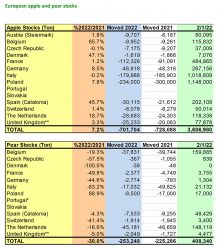
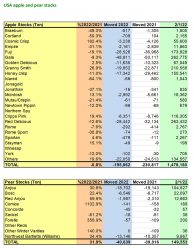
WAPA, the World Apple and Pear Association, released today the apple and pear stock figures from 1 February 2022. The figures show that in Europe apple stocks increased by 7.2 % compared to 2021 to reach 3,606,980 T, while pear stocks decreased by 30 % to 408,340 T. In the USA, apple stocks as of 1 February 2022 stood at 1,478,180 T (- 0.8 % compared to 2021), while pear stocks reached 149,553 T (31.9 % above 2021).
WAPA, the World Apple and Pear Association, collects every month the stock figures for apples and pears from Europe and the United States. WAPA can reveal that European apple stocks stood at 3,606,980 T as of 1 February 2022, which is 7.2 % above the figure of 2021. This was mainly driven by the increases concerning Red Jonaprince (35.9 % up from 2021), Golden Delicious (+ 22.5 %), Gala (+ 19.9 %), and Jonagold (+ 17.2 %), while several varieties decreased, including Cripps Pink (- 17.3 %) and Granny Smith (- 13.2 %). On the other hand, pear stocks stood at 408,340 on 1 January 2022, 30 % below the volume of 2021, mostly because of the large decrease in Italy (- 83.2 %).
In the USA, apple stocks in January stood at 1,478,180 T (down 0.8 % compared to 2021). The overall stability is due to the fact that Granny Smith’s 26.9 % increase over 2021 compensated for the decrease among several large varieties, such as Fuji (- 19.1 %), Red Delicious (- 12.6 %), and Gala (- 9.3 %). Pears stocks in the USA stood at 149,553 T, which is 31.9 % above last year.
(Photo: WAPA)(Photo: WAPA)
Beviale Moscow, the first holistic trade fair for the Russian beverage market, is being suspended indefinitely in light of current events. It will not take place, as planned, from March 29 to 31, 2022, in Pavilion 57 of the VDNH event center in Moscow.
In its sixth edition, Beviale Moscow was well on its way to building on previous successes. Around 100 exhibitors had registered for Beviale Moscow 2022 and some 5,000 visitors were expected, around two-thirds of them from Russia.
Trade fairs have always stood for the peaceful exchange of goods, services and ideas between different nations. Conversely, peace is a basic prerequisite for trade fairs to take place in the respective countries. Due to the armed conflict and the resulting sanctions, it is currently not possible to hold Beviale Moscow. It is therefore suspended for an indefinite period.
Symrise AG outstandingly capitalized on the economic recovery in 2021 and successfully continued the profitable growth course. The Group once again significantly increased sales and earnings. Symrise grew Group sales in reporting currency by 8.7 % to € 3,826 million (2020: € 3,520 million). Without taking into account portfolio and currency effects, organic growth amounted to 9.6 %. Earnings before interest, taxes, depreciation and amortization (EBITDA) at € 814 million were significantly above the prior-year figure of € 742 million. The Group maintained profitability at a high level with an EBITDA margin of 21.3 % (2020: 21.1 %). Against the backdrop of the positive development, the Executive Board and the Supervisory Board of Symrise AG propose a dividend increase for the 12th year in succession. Shareholders are to participate in the success of the company with a dividend of € 1.02 for the fiscal year 2021.
Dr. Heinz Jürgen Bertram (Photo: Symrise)
“2021 was a successful year all round for Symrise. We made good use of the tailwind generated by the global economic recovery and we aligned our sails accordingly. As a consequence, we very successfully continued our course of profitable growth. Additionally, we were also able to realize trailblazing purchases and investments. This allowed us to strategically diversify our know-how and our portfolio, further increase our appeal to customers and differentiate our profile in the market. Since September, Symrise has also been a member of the DAX, Germany’s leading index. As a result, our share has continued to gain a higher profile and enhanced appeal, particularly on the international capital markets. Part of our capital market philosophy is for our shareholders to participate in the successful development of Symrise AG. The Executive Board and Supervisory Board therefore propose the twelfth dividend increase in succession in the amount of € 1.02 for the year 2021,” said Dr. Heinz Jürgen Bertram, CEO of Symrise AG. “For the current fiscal year, we confirm our long-term target to achieve an average increase in sales of between 5 and 7 % (CAGR) and to exceed market growth. Furthermore, we are once again targeting high profitability for 2022 with an EBITDA margin of around 21 %, in spite of the increasing raw materials costs and energy prices.”
Economic recovery drives demand and leads to strong sales growth
The impacts of the coronavirus pandemic significantly diminished in large parts of the world over the course of the year. The behavior of consumers normalized and demand surged. Symrise increased sales in reporting currency by 8.7 % to € 3,826 million (2020: € 3,520 million). Organic sales growth amounted to 9.6 %. Symrise not only exceeded the average growth of the relevant market but also the most recent sales forecast issued in November 2021 of around 9 %. Regarding the regions, Latin America once again recorded the strongest organic growth of 13.5 %, followed by Asia/Pacific with 10.3 %. The regions EAME and North America also delivered very good growth with 8.8 % and 8.5 % respectively.
Significant increase in EBITDA and net income
In fiscal year 2021, Symrise increased earnings before interest, taxes, depreciation and amortization (EBITDA) to an outstanding € 814 million. The Company exceeded the prior-year level by 9.6 % (2020: € 742 million) in spite of the increased raw materials costs and costs of strategic growth initiatives amounting to € 174 million.
The group-wide EBITDA margin rose in the second year of the pandemic to 21.3 % and therefore exceeded the prior-year level (2020: 21.1 %).
Symrise increased net income by € 68 million to € 375 million (2020: € 307 million). Earnings per share rose to € 2.74 (2020: € 2.27). In view of this positive development, the Executive Board and the Supervisory Board will propose to the annual general meeting on 3 May 2022 a dividend increase to € 1.02 per share for the fiscal year 2021 (2020: € 0.97).
Net debt with 2.4 in targeted margin range
As of 31 December 2021, net debt including pension and leasing liabilities decreased to € 1,964 million (2020: € 2,029 million). This corresponds to a ratio of net debt to EBITDA of 2.4.
The business free cash flow amounted to € 486 million (2020: € 564 million).In spite of the increase in earnings, it was defined above all by higher investments, an increase in inventories (strategic stockpiling in order to mitigate the risks due to delays in international supply chains) and a high level of trade receivables as a consequence of the strong growth in sales.
In a year-on-year comparison, the equity ratio rose from 39.8 % to 49.0 %. Symrise thus has a very solid foundation for continued sustainable growth of its business in the future.
Taste, Nutrition & Health segment
In April 2021, Symrise merged the former two segments Flavor and Nutrition into a new segment and renamed it Taste, Nutrition & Health to reflect the purposefully implemented portfolio expansion. It is intended to align the expanded activities even more closely with customer needs and hence make know-how, technologies and product knowledge a shared asset. Over the course of the year, Symrise strengthened the activities through the acquisition of the Canadian manufacturer Giraffe Foods and invested in a stake of the Swedish animal health company Swedencare. The core business no longer includes the food color application areas which have been sold to Oterra as well as the Drinkstar Velcorin activities. The distribution model with Lanxess was terminated effective 1 January 2022.
Taste, Nutrition & Health increased sales by 8.5 % to € 2,335 million (2020: € 2,151 million). Organic growth even amounted to 10.6 %. The change in behavior in out-of-home leisure activities and the increasing trend of on-the-go consumption resulted in a particular high demand for beverage applications. Furthermore, the segment benefited from very dynamic growth rates in the Pet Food segment.
Taste, Nutrition & Health increased EBITDA to € 531 million (2020: € 471 million). The EBITDA margin at 22.7 % was at an outstanding level and significantly exceeded the prior-year value (2020: 21.9 %).
Symrise confirms long-term growth and profitability targets
According to experts estimates, the global economy will slow down slightly in the current fiscal year after the strong recovery in 2021. Symrise is excellently positioned with its robust business model, the diversified application portfolio and its broadly based regional presence and customer base. The Company therefore confirms its long-term growth and profitability goals. Symrise continues to target above market growth and increase average annual sales by 5 to 7 % (CAGR). This objective also applies to the current financial year 2022, in spite of increasing raw material costs.
Symrise is committed to organic and inorganic growth, which includes the acquisition of the Dutch company Schaffelaarbos in January 2022 and the Chinese Wing Pet Food in February 2022. Furthermore, Symrise will maintain strict cost consciousness and continue the holistic sustainability management in all its divisions.
Profitability is projected to remain at a high level in 2022 with an EBITDA margin of around 21 %. Over the medium term until the end of fiscal year 2025, Symrise has a target of achieving an EBITDA margin in the corridor of 20 to 23 %.
Elopak is deeply concerned by the tragic developments in Ukraine and stands with all those who are suffering at this time. Elopak has wholeheartedly condemned the unprovoked attack by the Government of Russia and supports the resulting economic sanctions implemented by the EU and other actors.
This war has an enormous human cost. As a result of the ongoing and escalating conflict, Elopak is today announcing the suspension of all activities in Russia with immediate effect and until further notice. Elopak’s plant in Fastiv, Ukraine, has already been temporarily closed as we work to protect the safety of our colleagues and their families.
We will continue to pay the salaries of our 336 employees directly affected until further notice. As part of the vital food supply chain, Elopak continues to monitor and evaluate the situation. We are assessing how best we can adapt our operations to support continued access to essential goods across the Eastern European Region.
Our overriding priority remains the personal safety and security of our employees in Ukraine. We are in constant touch with our co-workers in Kyiv and Fastiv and have established a steering group that is working to support them and their loved ones.
The decision is not expected to impact Elopak’s operations outside of Russia, Belarus and Ukraine.
A new study by Oregon State University scientists outlines a key advance in turning apple waste into an environmentally friendly packaging material that could serve as an alternative to plastic.
Recycled newspaper has traditionally been the main ingredient of so-called molded pulp packaging products, which have become increasingly popular because they are compostable. But the supply of recycled newspaper is in decline, creating a market for substitute materials.
Yanyun Zhao, an Oregon State professor who leads a research team focusing on sustainable food packaging and processing, has studied apple pomace and other byproducts from processing fruit and vegetable juice and winemaking as an alternative for recycled newspaper in molded pulp manufacturing. She and the team received a patent for this research.
“Right now, apple pomace is typically just composted or used for animal feed,” said Zhao, whose research aims to reduce food loss and waste across the food supply chain. “We thought why not turn it into an environmentally friendly product that meets an industry need.”
Zhao envisions apple pomace being the main ingredient for molded pulp packing products such as take-out containers, flower pots, beverage cartons and bottles and clamshell packaging used for fruits and vegetables.
She is focused on apple pomace, in part, because it is readily available in the Pacific Northwest. When apples are processed for juice about 70 – 75 % of the apple goes into the juice, leaving the remaining 25 – 30 % as pomace.
One of the key problems to solve in creating pomace and paper-based packaging is improving water resistance so that it could withstand high moisture, liquid food or non-food items and products stored under high humidity conditions.
In a just-published paper in Food and Bioproducts Processing, the team sought to create eco-friendly, bio-based, compostable and cost-effective solutions that would improve the hydrophobicity, or water resistance, of the apple pomace-based molded pulp products.
They used two strategies: incorporating polymers and compounds with characteristics to improve water resistance into the pulp formulation and applying superhydrophobic coatings on the product surface. The polymers and compounds studied include lignin, chitosan and glycerol.
Lignin is a polymer that forms key structural materials in the support tissues of most plants. Rhubarb pomace, which is particularly lignin rich, was used in this study.
Chitosan is a bio-based polymer commonly used in the papermaking industry. A previous study from Zhao’s team found that chitosan reduced water absorption of cellulose nanofiber (CNF) films significantly through adsorption of chitosan onto CNF fibers via hydrogen bonds.
Finally, glycerol is an organic compound often added to a material to make it softer and more flexible. Previous studies had shown that at low levels glycerol decreased water absorption.
The researchers determined the optimal amounts of those polymers and compounds while also adding a small amount of cardboard fiber for stability of the molded pulp packaging products.
Zhao’s team has a long history of studying food coatings as a barrier to water and gases. The team had previously created a two-step preparation of superhydrophobic coating that is heat, cold and water resistant. They applied a simplified, one-step coating on the surface of the apple pomace-based product to enhance water resistance.
They concluded that the study demonstrated the feasibility of using fruit pomace as a new source of fiber in producing molded pulp packaging and effective approaches to enhancing water resistance in those packaging materials.
Co-authors of the paper are Clara Lang, Jooyeoun Jung and Taoran Wang, all of whom are former or current members of the Sustainable Food Packaging and Processing team in the Department of Food Science and Technology in Oregon State’s College of Agricultural Sciences.
The research was supported by the Oregon Department of Agriculture Specialty Crop Block Grant Program. Kerr Concentrates, Inc. of Salem and Hood River Juice Company of Hood River provided fruit pomace for the research.
About the OSU College of Agricultural Sciences: Through its world-class research on agriculture and food systems, natural resource management, rural economic development and human health, the College provides solutions to Oregon’s most pressing challenges and contributes to a sustainable environment and a prosperous future for Oregonians.
On the occasion of its Annual General Meeting, the World Apple and Pear Association (WAPA) has released the Southern Hemisphere apple and pear crop forecast for the upcoming season. According to the forecast, which consolidates the data from Argentina, Australia, Brazil, Chile, New Zealand, and South Africa, apple and pear production is estimated to decrease by 7 % and 6 % respectively in 2022 compared to the previous year.
On 24 February 2022, on the occasion of its Annual General Meeting, the World Apple and Pear Association (WAPA) has released its 2022 apple and pear crop estimate for the Southern Hemisphere. This report has been compiled with the support of ASOEX (Chile), CAFI (Argentina), ABPM (Brazil), Hortgro (South Africa), APAL (Australia) and New Zealand Apples and Pears, and therefore provides consolidated data from the six leading Southern Hemisphere countries. WAPA’s Secretary General Philippe Binard commented “This forecast is released for the global apples and pears sector on the background of many uncertainties, including the geopolitical tension, the increasing costs for production, the impact of the rise of logistic costs and limited container availability, labour shortage and the increasing concerns of declining consumption due to economic situation”
The 2022 Southern Hemisphere apple crop forecast suggests a decrease of 7 % to a total of 4.864.000 T compared to last year (5.217.000 T), mainly due to the 30 % decrease in Brazil and the 11 % decrease in Argentina. Australia and Chile are also forecasted to decrease their production by 3 % and 2 % respectively. New Zealand and South Africa are the only countries where apple production is expected to increase (15 % and 4 % respectively). Chile is expected to remain the largest Southern Hemisphere apple producer in 2022 (1.455.000 T), followed by South Africa (1.163.000 T), Brazil (900.000 T), New Zealand (590.000 T), Argentina (445.000 T), and Australia (311.000 T). With 1.706.000 T, Gala remains by far the most popular variety, although its production is expected to decrease by 7 % compared to 2021. Despite the decrease in production, exports are forecasted to remain stable overall at 1.744.762 T, with the larger volumes exported by New Zealand (+ 17 %) and South Africa (+ 6 %) compensating for the 65 % decrease in Brazilian apple exports.
Regarding pears, the Southern Hemisphere growers predict a 6 % decrease of the crop, which will drop to 1.229.000 T. This is mainly due to the 13 % decrease in Argentina, the 11 % decrease in Chile, and the 6 % decrease in Australia. New Zealand and South Africa, on the other hand, are expected to increase their production by 31 % and 5 % respectively. Argentina remains the largest producer in the Southern Hemisphere (522.000 T), followed by South Africa (492.000 T), Chile (122.000 T), Australia (81.000 T), and New Zealand (11.000 T). Packham’s Triumph remains the most produced variety (444.000 T, despite a 4 % decrease compared to 2021), followed by Williams’ bon chrétien pears (306.000 T). Export figures are expected to decrease by 6 % compared to 2021 to a total of 641.207 T, mainly because of a 14 % decrease in Argentinian exports.
In the Northern Hemisphere, the stocks in the USA stood at 1.478.180 T (- 1 % compared to last year) for apples and 149.553 T for pears (+ 32 % compared to last year) on the 1st of February. In Europe, apple and pear stocks stood at 3.606.980 T (7 % up from last year) and 408.340 T (30 % down from last year). Philippe Binard commented: “Season developments clearly demonstrate the impact of logistics and costs on international trade also for Northern Hemisphere suppliers, with the USA concentrating sales for apples and pears in North America. European markets continue to be affected by the Belarus embargo, while the recent developments in Ukraine will also impact sales to all the destinations in Eastern Europe, including Russia, for all global apples and pears suppliers. It is important to continue building efforts to stimulate the consumption”. WAPA’s Annual General Meeting also hosted a discussion on CO2 emissions and how apple and pear production can reach carbon neutrality or even have a positive contribution to the environment. WAPA will continue to cooperate on this topic with its members in a dedicated working group based on the input and expertise of the University of Bolzano (Italy).
Finally, the Annual General Meeting also confirmed that Prognosfruit will return as an in-person event in the first half of August 2022 in Belgrade (Serbia). The exact date of the event will soon be announced.
The team behind Schilling Cider, a leading cider producer in the Pacific Northwest in the US, announced the launch of Vida Maté, a new line of low-calorie, non-alcoholic yerba maté beverages that seek to transform the caffeine experience. Crafted to elevate the traditional South American “super beverage” with the craft quality of the Pacific Northwest, Vida Maté is made with real fruit juice and a proprietary blend of adaptogens. The result is a refreshing, delicious alternative to sugary coffee drinks and artificially flavoured caffeine-in-a-can. With operations based in Seattle and Portland, the Schilling team is excited to debut this new plant-powered pick-me-up, made exclusively with naturally occurring caffeine.
Vida Maté fits the gluten-free and vegan-friendly lifestyle, offering a boost in vitality and focus through a functional blend of adaptogens: Vitamin B12 for a power boost, L-Theanine for focus, and GABA for stress relief combine to ensure a clean, jitter-free delivery of caffeine with no unpleasant crashes.
Launching with three flavours – Lemon Mint, Mango Lime, and Blackberry Lemonade – Vida Maté is available in 16 oz. cans at thousands of grocery, convenience, and natural food stores across the Pacific Northwest, since March 1, 2022.
“Innovating in healthful, refreshing beverages is our calling,” says Colin Schilling, CEO and co-Founder of Schilling Cider. “This starts with the same quality and techniques we bring to crafting our fresh-pressed apple cider. It’s exciting to push those boundaries into the yerba maté segment. Consumers are demanding delicious, healthier options made right here in their backyard, and we can’t wait to share Vida Maté with our community.”
While other canned yerba maté drinks depend on a formula that involves non-yerba maté derived and synthetically produced caffeine, Vida Maté’s caffeine occurs naturally and comes 100 % from yerba maté. And because Vida Maté is made from real fruit juice, it’s not overly sweet and it’s lower in calories and sugar.
The team at Schilling has long enjoyed traditional yerba maté drinks, before launching their own. Yerba maté is a plant indigenous to South America. The leaves and twigs are dried, dried over a fire, and then steeped in hot water for an invigorating tea.
WAPA, the World Apple and Pear Association, released the apple and pear stock figures from 1 February 2022. The figures show that in Europe apple stocks increased by 7.2 % compared to 2021 to reach 3,606,980 T, while pear stocks decreased by 30 % to 408,340 T. In the USA, apple stocks as of 1 February 2022 stood at 1,478,180 T (- 0.8 % compared to 2021), while pear stocks reached 149,553 T (31.9 % above 2021).
WAPA, the World Apple and Pear Association, collects every month the stock figures for apples and pears from Europe and the United States. WAPA can reveal that European apple stocks stood at 3,606,980 T as of 1 February 2022, which is 7.2 % above the figure of 2021. This was mainly driven by the increases concerning Red Jonaprince (35.9 % up from 2021), Golden Delicious (+ 22.5 %), Gala (+ 19.9 %), and Jonagold (+ 17.2 %), while several varieties decreased, including Cripps Pink (- 17.3 %) and Granny Smith (- 13.2 %). On the other hand, pear stocks stood at 408,340 on 1 January 2022, 30 % below the volume of 2021, mostly because of the large decrease in Italy (- 83.2 %).
In the USA, apple stocks in January stood at 1,478,180 T (down 0.8 % compared to 2021). The overall stability is due to the fact that Granny Smith’s 26.9 % increase over 2021 compensated for the decrease among several large varieties, such as Fuji (- 19.1 %), Red Delicious (- 12.6 %), and Gala (- 9.3 %). Pears stocks in the USA stood at 149,553 T, which is 31.9 % above last year.
(Photo: WAPA)
(Photo: WAPA)
Investment to grow critical infrastructure of leading global beverage solutions provider
Refresco Group B.V., one of the largest independent beverage contract manufacturers in the world, and KKR, a leading global investment firm, announced that KKR has signed a definitive agreement to acquire a majority stake in Refresco, with Refresco’s existing investors, PAI Partners and British Columbia Investment Management Corporation (“BCI”), maintaining a significant minority position. Terms of the transaction, which is subject to closing conditions, were not disclosed.
Founded in 1999, Refresco is a global independent beverage solutions provider for retailers and branded beverage companies with pan-regional coverage in Europe and North America through its network of bottling, warehousing, logistics and other operational assets. The Company’s production platform includes over 70 majority-owned manufacturing sites in Europe, the U.S., Canada and Mexico, providing customers with close proximity and a reliable service across geographies. Refresco has built long-standing relationships with its customers by partnering to support material planning, procurement, manufacturing, warehousing, fulfillment, and distribution.
KKR will support Refresco as it expands its global and strategically located footprint to better serve existing and new customers through a range of formats and channels. The Company will build on its ability to manufacture high quality products that meet the growing demand for sustainable beverage solutions, with a focus on sustainable sourcing, responsible production and environmentally friendly operations.
“We are very pleased to welcome KKR, one of the world’s most prominent investment firms, as our new majority owner. We are proud that PAI and BCI will continue as shareholders, which is a testament to our successful value creation,” said Hans Roelofs, CEO of Refresco. “To support further growth, we have explored the various alternatives available to us and believe that the investment by KKR is an incredibly positive development for the Company. Like our existing shareholders, KKR is supportive of our strategy and will bring operational expertise, access to capital and a well-established network to support us in our growth, innovation and M&A strategy. Our focus of growing alongside our customers, combined with expanding into new categories and geographies, remains unchanged. I look forward to this new chapter, and for all our employees and customers to capitalize on the opportunities ahead of us.”
“Refresco has established itself as an industry leader supporting the global beverage industry with a blue-chip global customer base, an experienced and highly regarded management team, and an impressive network of assets that provides compelling value to customers. The Company also has a strong commitment to sustainability, which is an important differentiator for its customers,” said James Cunningham, Partner at KKR. “We look forward to leveraging our operational expertise from across the KKR platform to support the Company’s continued growth and further advance the sustainability of its value chain.”
“We are proud to have been instrumental in Refresco’s growth since we initiated our investment with BCI in 2018,” said Frédéric Stévenin, Managing Partner of PAI Partners. “We are even more excited about the prospect of continuing to stay a part of Refresco’s strong growth trajectory alongside KKR. We are convinced of Refresco’s unique value-add capabilities, its growth initiatives and a proven M&A track record, and we look forward to the next phase of this journey.”
“As an institutional investor with a long-term perspective, supporting strong management teams and market leading companies is core to our private equity program. We are in full agreement with Frédéric’s comments and are very happy to continue this partnership with management, PAI and KKR,” said Julian Remedios, Senior Managing Director, Private Equity, BCI.
KKR is making this investment primarily through its Global Infrastructure strategy, which was established in 2008. Since that time, KKR has been one of the most active infrastructure investors around the world with a team of more than 70 dedicated investment professionals. The firm currently oversees approximately $ 40 billion in infrastructure assets and has made over 60 infrastructure investments across a range of sub-sectors and geographies.
About KKR KKR is a leading global investment firm that offers alternative asset management as well as capital markets and insurance solutions. KKR aims to generate attractive investment returns by following a patient and disciplined investment approach, employing world-class people, and supporting growth in its portfolio companies and communities. KKR sponsors investment funds that invest in private equity, credit and real assets and has strategic partners that manage hedge funds. KKR’s insurance subsidiaries offer retirement, life and reinsurance products under the management of Global Atlantic Financial Group. References to KKR’s investments may include the activities of its sponsored funds and insurance subsidiaries.
Elopak and Nippon Paper Industries sign Memorandum of Understanding (MoU) to strengthen partnership and advance collaborative efforts in the field of liquid-paper packaging.
Elopak ASA and Nippon Paper Industries Co., Ltd have signed a comprehensive Memorandum of Understanding (MoU). The agreement covers further collaboration between the two companies, looking at how potential business can be jointly developed and organised given their respective expertise, assets and networks.
Nippon Paper Industries, the largest liquid packaging player in Japan, is concentrating efforts in the field of paper packaging with the goal of contributing to the enrichment of people’s lives and the development of culture under the slogan of “Pioneering the future together with trees.” Based on the slogan “What can be done with paper,” Nippon Paper pursues the potential of paper packaging born from wood, a renewable resource, and offers a variety of proposals.
Elopak, a leading global supplier of carton packaging and filling equipment, offers sustainable packaging solutions that provide a natural and convenient alternative to plastic bottles. The MoU aligns with Elopak’s ambitions to meet the rising demand for sustainable packaging solutions by pursuing a growth strategy centered on investment in innovation; the pursuit of new business opportunities in existing and new markets across both fresh and aseptic markets; and driving the plastic to carton conversion.
The two companies have worked closely together for many years. In March 2016 they signed a product licensing agreement that allows Nippon Paper to manufacture and sell certain Pure-Pak® cartons in Japan. When Elopak listed on the Oslo Stock Exchange in June 2021, Nippon Paper entered into a cornerstone agreement to acquire shares equivalent to 5.0 % of the share capital.
Under the MoU a Steering Committee will be established, tasked with selecting and implementing collaborative themes that leverage the strengths of both companies, while increasing competitiveness and expanding sales of paper packaging to accelerate the move toward a low carbon circular economy.
Collaboration between Nippon and Elopak is built on the companies’ shared commitment to sustainability and innovation. Both companies are members of the United Nations Global Compact and incorporate the UN’s Sustainable Development Goals (SDGs) into their development strategies. They also have a shared dedication to sustainable forest management and improved recycling of their paper products.
Commenting on the MoU Elopak CEO Thomas Körmendi stated, “We are delighted to be exploring the opportunities that exist for Elopak and Nippon to collaborate further. Building on our strong track record of working together to deliver for customers, we are excited by the opportunity to leverage our relative strengths and areas of expertise to drive the adoption of sustainable packaging solutions.”
Commenting on the MoU Nippon Managing Executive Officer and General Manager of Paper-Pak Sales Division Yasuhito Obayashi noted, “We are really excited by this opportunity to grow our strong relationship with Elopak and are looking forward to collaborative value creation based on both companies’ deep expertise and strength that delivers sustainable packaging solutions to market.”
Bright, modern, and colourful design captures the brand’s mission to make soda both a fun and smart choice with ingredients that benefit the brain-gut connection and offer functional benefits with every sip
HERE Originals reintroduces its groundbreaking prebiotic soda, VINA in the US. Reformulated with an essential, proprietary blend of prebiotics, trace minerals, plant fibers and organic ingredients, VINA is expertly crafted to directly benefit the brain-gut connection. On a mission to recalibrate the soda category and functional cold box with a smarter choice, VINA unveils a line-up of flavours that taste great, are delightfully effervescent and expertly formulated to be both fun and smart to drink.
The revamped brand identity and packaging design follows a period of strategic repositioning of VINA’s functional benefits centered on the brain-gut connection. As functional soda becomes a fast-growing subcategory of the greater functional beverage space, the demand for healthier soda alternatives has rapidly increased. VINA’s unique formula that prioritizes brain and gut performance will invigorate consumer demand and add incremental value to this exciting new category with multifunctional benefits to both mind and body.
“Historically, soda hasn’t been considered a healthy choice, packed with sugars and toxins, despite the fun nature of the flavourful beverage. We saw a need to preserve what we all love about soda while completely reconstructing it to be both a naturally delicious and smart choice,” said Founder and CEO, Alex Matthews. “We challenged ourselves to cram what we call ‘The Smarts’ (plant fiber, trace minerals, prebiotics) into our formula for unprecedented functionality and of course, quality taste.”
Connected by millions of nerves and chemicals called neurotransmitters, the brain and gut are a package deal. Operating in a symbiotic relationship, when one is in distress, the other suffers. And, when one is balanced and thriving, the other reaps the rewards. VINA’s formula and ingredient selection are designed to address not one or the other in isolation, but both for optimal wellness.
According to VINA’s Chief Smarts Officer and mind-body expert, Dr. Cynthia Kerson, “The neurotransmitters bidirectionally linked between the brain and gut impact the very core of emotional wellbeing. Stress and anxiety in the mind caused by anything from external factors to deficiencies from essential nutrients can make its way down to the gut and lead to issues ranging from mild discomfort to GI tract issues. Alternatively, serotonin (the stuff that keeps our spirits high) is largely produced in the gut by millions of microbes in a healthy digestive ecosystem. VINA is ‘smart’ because it’s both multifaceted and hyperfunctional as it addresses mind-body wellness at its very core.”
VINA aims to delight both the pop purist and the functional beverage drinker with both taste and nutritional benefits. Crisp, fruity and crafted with an undertone of citrus to keep things balanced and bright, VINA comes in five flavours: Ginger Fizz, Cherry Pop, Grapefruit, Lime Lemon and Pomegranate. All blends are 5 g of sugar or less, 25 calories or less, certified USDA Organic, gluten-free, vegan and made with all natural ingredients.
VINA is the second beverage line out of HERE Originals, following De La Calle, a spin on the Mexican fermented pineapple beverage Tepache that won Best New Products and Best Packaging Design from BevNet’s Best of 2021 Awards.
VINA Prebiotic Soda is available in the US via drinkvina.com. Purchase one case of 12 cans (12 fluid ounces) for $33.99 MSRP or a monthly subscription for $28.89 per case, a 15 % discount.
Royal DSM, a global purpose-led science-based company, reveals its new integrated Food & Beverage operating structure which unifies three areas of DSM’s nutrition business – Food Specialties, Hydrocolloids and part of its Nutritional Products group – to closely align with emerging customer and market needs. The new business group combines the company’s full range of food and beverage ingredients, expertise and science-based solutions that improve the taste and texture of foods, as well as support healthier lives and a healthier planet. The new Food & Beverage organization will focus on helping consumers ‘enjoy it all’ without having to choose between taste, texture and health. This differentiating message will be the cornerstone of a new campaign.
The global food and beverage market is set to continue its upward trajectory as the world’s population grows, placing new pressures on producers in an already competitive space to innovate and get to market quickly. At the same time, the industry is converging with the health and wellness space, and increasingly aligning with consumer expectations for delicious products that support their health alongside environmental and social aspirations. DSM’s strategy aims to support this market advancement through the creation of one Food & Beverage business group that encompasses the ingredients, global and local expertise and solutions provided by its previously distinct Food Specialties, Hydrocolloids and Nutritional Products business areas.
This simplified structure represents the activation of DSM’s announcement in September 2021 that the company will become a fully-focused Health, Nutrition & Bioscience company. By establishing a ‘one-stop-shop’ of ingredients, solutions and end-to-end capabilities, DSM will help food and beverage manufacturers worldwide fast-track product development and achieve efficient production. As a leading provider of vitamins, minerals and other micronutrients, an innovator in enzyme solutions, and a frontrunner in dairy cultures, DSM has unrivalled nutritional science expertise and deep application knowledge which is paired with prominent advocacy for healthier and more sustainable food systems. This is supported by a number of recent acquisitions – including DSM’s acquisition of First Choice Ingredients, a leading supplier of dairy-based savory flavorings – which have enabled DSM to further elevate its taste, texture and health offering for customers. DSM is therefore uniquely placed to help manufacturers overcome the friction that must be navigated to deliver delicious, nutritious and sustainable food and beverage products, so customers and consumers can ‘enjoy it all’.
As an advocate and leader in enabling a healthier and more sustainable food system, DSM’s solutions help boost process efficiencies, reduce food loss and waste and lower the environmental impact of production and consumption – while also enhancing food’s nutritional profile. As part of this, DSM is taking strategic steps in developing specialty proteins that are produced within planetary boundaries, including CanolaPRO®, and supporting producers to be at the forefront of this protein diversification towards a healthier future. DSM’s recent acquisition of Vestkorn Milling, a supplier of pea- and bean-derived proteins, starches and dietary fibers, will also complement and further accelerate this growth. These efforts are part of DSM’s commitment to reach 150 million people with plant-based protein foods by 2030, in alignment with our recently announced series of quantifiable food system commitments.
All Oranges 43.5 Million Boxes
The 2021-2022 Florida all orange forecast released by the USDA Agricultural Statistics Board is 43.5 million boxes, down 2 percent from the January forecast. If realized, this will be 18 percent less than last season’s final production. The forecast consists of 17.5 million boxes of non-Valencia oranges (early, mid-season, and Navel varieties) and 26.0 million boxes of Valencia oranges. A 9-year regression has been used for comparison purposes. All references to “average”, “minimum”, and “maximum” refer to the previous 10 seasons, excluding the 2017-2018 season, which was affected by Hurricane Irma. Average fruit per tree includes both regular and first late bloom …
Please download the full citrus crop production forecast: www.nass.usda.gov
Leading branded soft drinks business, Britvic is joining forces with University of Cambridge-backed tech company Xampla in a GBP 1 million packaging innovation partnership.
After 15 years of Cambridge research, Xampla has developed the world’s first plant protein material for commercial use. This revolutionary material uses pea protein to make microscopic capsules that protect vitamins within liquid, stopping them from being broken down by sunlight.
Xampla’s work has seen the company secure GBP 1 million in funding from the UK Government’s innovation agency, Innovate UK, to scale up the technology and material processing.
The innovation is critical to delivering drinks fortified with vitamins in clear plastic bottles. Clear plastic bottles are considered a positive by consumers, with Britvic’s research showing that people are 40 % more likely to recycle clear bottles over coloured ones. However, the downside of clear bottles is that they let more UV rays in, losing the necessary protection for vitamin D.
Simon Hombersley, CEO of Xampla, said: “We are delighted to be partnering with Britvic to deliver innovation that will revolutionise the drinks industry and it is extremely exciting to see what our material can do at scale. Xampla works with businesses to help solve their biggest problems while also enabling customers to meet their sustainability goals.
“Britvic has a proud history of fortifying its products with vitamins and seeking sustainability in its packaging. Our partnership is about helping to do both even more effectively. We can’t wait to get started.”
Last year, major Britvic brands Fruit Shoot and 7UP made the shift to clear bottles to drive up recycling rates and Britvic has started to add vitamins B, C and D to Robinsons Fruit & Barley.
Meanwhile, leading Irish squash brand MiWadi 0 % Sugar contains vitamins B, D and zinc and children’s favourite Fruit Shoot has been fortified with multivitamins since 2016. Added vitamins C and D help support the immune system and the growth of strong bones, while B vitamins contribute to energy release.
Sarah Webster, Director of Sustainable Business at Britvic, said: “Our work with Xampla supports our Healthier People, Healthier Planet strategy.
“By agreeing this GBP 1 million partnership with each other, we have shown the power of collaboration between established players and cutting-edge innovators to deliver Healthier People and Healthier Planet.
“Xampla technology has the makings of a ‘win-win’, enabling delivery of greater nutritional value in the drinks people love, while ensuring that more products can come to market in clear, recyclable bottles.”
Britvic has a long history of fortifying drinks with vitamins. The FTSE 250 company started life in 1845 as The British Vitamin Product Company, with a mission to provide customers with an affordable source of nutrition. The company is committed to a programme to reduce unnecessary plastic and is working with Xampla through an Innovate UK-backed grant to develop new formats for delivery of soft drinks and nutrients within drinks.
News of the Britvic partnership follows a successful Xampla world first product launch with meal kit manufacturer Gousto last year, where Xampla created an edible film to be used as wrapping for stock cubes. The trial kits – for making an Indian Spiced Carrot & Lentil soup recipe – sold out within one hour of going on sale.
About Xampla Xampla is a spin-out from the University of Cambridge. Its Supramolecular Engineered Protein has been developed over the past 15 years. It has created the world’s first plant protein material for commercial use. Its material performs like synthetic polymers, but decomposes naturally and fully without harming the environment. Xampla is the first UK University spin-out to be awarded B Corp status.
Following its recent re-entry into the high pressure processing (HPP) market, Quintus Technologies is opening a state-of- the-art Application Center in Columbus, OH (U.S.). Under the leadership of Ngoc Phan, globally recognized as one of the world’s most experienced HPP application experts, the Center will assist food and beverage processors with the development of the preservative-free, ‘good-for-you’ products demanded by today’s consumers.
“Despite thousands of commercial HPP products currently available around the globe, one source of continued frustration to more food companies is the time involved in the realization of their new HPP products market rollouts,” observes Ed Williams, General Manager – Americas, Quintus Technologies. “A key objective of our new Application Center is to reduce those delays by putting our internal and external HPP expertise to work.”
The Center’s menu of services spans the entire HPP development process, from optimized product formulations and packaging to in-house pathogen validation, shelf-life studies, and assistance with HACCP implementation and regulatory compliance. In both scope and pace, evaluation and support offerings are geared to accelerate the speed at which processors bring new HPP products to market.
The new Application Center, part of a 5,200-sf demonstration suite, features a commercial size Quintus QIF 150L HPP modular system. Reflecting the company’s leadership role in high pressure for nearly three-quarters of a century, the press incorporates new mechanical and digital solutions such as an integrated pumping system, frequency-controlled motor drives, new smart-press functionality, and AI algorithm-based condition monitoring, all advances that improve efficiency and productivity.
The facility is also equipped with a test kitchen, microbiology laboratory, analytical laboratory, vacuum packaging machine, walk-in cooler, and freezer.
Application Center services are available to any food or beverage company wanting to advance the commercial growth of HPP foods. Processors interested in investing directly in a Quintus Technologies food system receive additional benefits through Quintus® Care, a comprehensive program of application know-how and best-in-class aftermarket technical support, designed for industry 4.0 and factory-of-the-future connectivity.
“We are very excited about the opportunities to help the food industry address global sustainability challenges such as food waste, product recalls, and related foodborne illnesses through the HPP technology we pioneered,” says Jan Söderström, CEO and President of Quintus Technologies. “We look forward to welcoming processors to our Application Center open house planned for late April 2022.”
Top 4 megatrends shaping global beverages in the year ahead
TREATT take a look at the top 4 megatrends set to shape the future of the beverage industry, sharing the latest global data and insights.
For each megatrend TREATT get closer to the key drivers affecting consumer behaviour, what this means for beverages across the world and helps to answer your questions around consumer trends.
The megatrends are:
1. Health and wellbeing
Health and wellbeing has morphed from a trend to a way of life but remains a key motivator of consumer behaviour globally. From the silent generation to Gen Z, all are embracing both a preventative and curative approach to health in a holistic and more personalised way than ever before. Across the CPG landscape TREATT is witnessing a rapid evolution of this megatrend.
2. Sustainability and ethics
The health of the planet is now the top consumer concern. There is a mounting awareness and concern surrounding the scale, complexity, and interdependence of shared social and environmental challenges globally. As the pandemic continues to highlight global inequalities, sustainability and ethical consumption concerns will only increase in significance and further impact consumer purchasing behaviours.
3. Sensory and indulgence
Consumers are seeking enjoyment beyond tangible products themselves. They are becoming more “experience-driven” and are willing to pay more for an enhanced brand experience. It is therefore becoming increasingly important for brands to perform at an experiential level, and offer varied, novel, and complex sensations for optimal enjoyment.
4. Digital lifestyles
Shopping and consumption patterns continue to evolve at a rapid pace in our digital world. In a hyper-connected, technology-enabled society, consumers seamlessly integrate the use of multiple technologies into their lives an d buying behaviour.
Orange prices increased in the Brazilian in natura market in the first fortnight of February. According to Cepea collaborators, frequent rains in the citrus belt (São Paulo State) favoured the quality (majorly the size) of oranges, making them suitable for sale in the in natura segment and allowing farmers to raise asking prices. Besides, rainfall also hampered the harvesting, limiting supply. In that scenario, values remained firm.
Usually, orange availability is not high in February – a month that may even be considered offseason –, however, as the 2021/22 season is late, supply is currently higher. Still, there is not an orange surplus in the domestic market, since processing at industries has been faster than usual this month.
So far, the number of early varieties to be harvested is not high – activities are expected to step up only from March onwards. However, supply may be constrained by the low flower set in the first blooming. Thus, the oranges currently available in the in natura market are mostly late varieties and pear oranges out of the ideal period.
TAHITI LIME – The production of tahiti lime is also being favoured by rains, however, farmers reported difficulties to harvest the fruits, which underpinned prices in the first fortnight of February, although it is currently the peak of harvest for tahiti lime in Brazil.
Despite the recent valuations for oranges and tahiti lime, Cepea collaborators have reported that the current economic scenario in Brazil is still constraining higher price rises. With high unemployment and inflation rates and lower income, the purchase power of many consumers is weak.
ESTIMATES – Although rains have favoured the quality of part of the fruits in orchards, they have not been enough to reverse all the damages caused by the drought to the oranges from the 2021/22 season.
According to data from Fundecitrus released on Feb. 10, the orange output (São Paulo + Triângulo Mineiro) in the 2021/22 season is still estimated at 264.14 million boxes of 40.8 kilograms, the same as that estimated in December, but 10 % below that forecast at the beginning of the season.
According to Somar/Climatempo (weather forecast agency), rainfall in SP between May/21 and Jan/22 was 25 % below the average for the period. In the Triângulo Mineiro, rains were 5 % higher than the average. Thus, orange growth was hampered, and the average fruit weight decreased. However, it is important to consider that the oranges harvested in February and in March 2022 are expected to be slightly larger, since they have been favoured by recent rains.
The volume harvested is still enough to replenish ending stocks at the processing plants in SP. According to CitrusBR, by the end of the 2021/22 season (in June 2022), the volume of Frozen Concentrate Orange Juice (Equivalent) stocked is expected to total 170 – 190 thousand tons, lower than the strategic level (250 thousand tons). It is important to consider that new estimates are supposed to be released until the end of February.
In this scenario, the harvest in 2022/23 needs to be large enough to raise stocks at least to the strategic level and thus prevent a world shortage of orange juice. Cepea calculations show that the orange output next season needs to total, at least, 330 million boxes in order to raise juice stocks to 250 thousand tons.
PROGRESS OF THE 2021/22 HARVESTING – According to Fundecitrus’ report, 82 % of the orange orchards had been harvested by mid-January/22, similar to that in the same period last season (81 %).
One of the circular economy agriculture leaders Alvinesa Natural Ingredients has announced the acquisition of Cades Penedes, a leading Catalonian manufacturer of grape-derived sustainable ingredients. The company is based in Penedes, one of Spain’s best wine-producing regions and among the most ancient viticultural areas in Europe.
Alvinesa Natural Ingredients upcycles and transforms plant-based coproducts into valuable natural ingredients that promote healthy living. Alvinesa sells an extensive range of natural ingredients made from wine grape pomace for use in the food, beverage, nutrition, animal nutrition and wine-making industries. The acquisition of Cades Penedes provides Alvinesa access to an excellent source of grape-based raw material that is organic produced and contains higher than average levels of polyphenols (micronutrients with antioxidant activity). These ingredient characteristics are in high demand from dietary supplement, food and beverage consumer product-makers.
Alvinesa controls a sustainable, traceable, and waste prevention supply chain. Cades Penedes will provide important supply chain diversification for Alvinesa, complementing the grape coproducts currently sourced from Spain’s abundant Castilla-La Mancha wine region. With its excellent “terroir” and conducive climate, the Penedes region produces wine grapes of outstanding quality that require little to no use of pesticides. Penedes is better-known for its Cava (sparkling wine) production and while white grape varieties predominate, the region also produces some highly regarded oak-aged red wines. Cades Penedes has supply agreements with bodegas (wineries) across the region, and its manufacturing facility will increase Alvinesa’s production capacity by up to 20 %. This will reinforce Alvinesa’s industry-leading ability to scale production to meet the growth requirements of customers.
South-Central Florida experienced a bout of extremely cold weather during the last few days of January, resulting in frost and icing throughout many Floridian orange groves. In the immediate aftermath of this event, farmers initially reported that the damage to their groves was minimal. However, more recent estimations paint a clearer picture of the frost’s effects, with certain grove locations recording temperatures as low as ~20 degrees Fahrenheit lasting for upwards of two days. Such sustained conditions of frost have not been observed in Florida for over five years. Temperatures below 30 degrees often lead to bloom damage on citrus trees, which can drastically affect the quality of their subsequent harvests.
Fruit droppage rates also appear to be a major issue for many Florida citrus growers post-freeze. As temperatures drop for sustained periods of time, the juices contained within citrus fruits become frozen, resulting in premature fruits dropping from their branches. This can happen in as little as 6 hours after exposure to substantial freezing temperatures; Florida’s freeze lasted for two days. As such, it will be difficult for farmers to fully assess the damage dealt to their groves until temperatures warm up to regularity once again. Other conditions expected to affect citrus trees in the region are wood injury and external fruit damage, both of which will reduce harvest levels.
Florida has already weathered a challenging orange season up to this point, with fruit estimates falling from 47 million boxes to just 44.5 million midway through January. These shifting numbers represented a 13 % reduction in harvest size when compared to Florida’s previous orange season, and it seems as though the difference between the two will only continue to grow from the effects of the freeze.
The global orange market is quite volatile currently, with prices rising on a regular basis due to an ongoing drought in Mexico and a difficult growing season for Brazil (frost has also been an issue there). As such, it seems likely that orange oil and its derivatives will continue to rise in price as availability of new materials reduces.
You need to load content from reCAPTCHA to submit the form. Please note that doing so will share data with third-party providers.
You are currently viewing a placeholder content from Turnstile. To access the actual content, click the button below. Please note that doing so will share data with third-party providers.