The 2023 – 2024 orange crop forecast for the São Paulo and West-Southwest Minas Gerais citrus beltby Fundecitrus in cooperation with Markestrat and full professors at FEA-RP/USP and FCAV/Unesp, is 309.34 million boxes (40.8 kg). Total orange production includes:
56.11 million boxes of the Hamlin, Westin and Rubi varieties;
18.22 million boxes of the Valencia Americana, Seleta, Pineapple and Alvorada;
98.95 million boxes of the Pera Rio variety;
105.23 million boxes of the Valencia and Valencia Folha Murcha varieties;
30.83 million boxes of the Natal variety.
Approximately 27.02 million boxes are expected to be produced in the Triângulo Mineiro region.
The projected volume is lower only by 1.55 percent as compared to the previous crop, which totaled 314.21 million boxes. That minor difference maintains the production at the same level as in the previous crop season and within the average range for the last ten years, as shown in Graph 1. As compared to the average volume produced in the last decade, the current crop shows a slight increase of 1.04 percent …
Natalie’s Orchid Island Juice Company announced today they have introduced two new juice blends: Tomato Reishi, Himalayan Salt, and Black Pepper Juice and Tangerine, Pineapple, Aloe Juice. Both blends are available to order on the Natalie’s Juices website and on grocery shelves in the US.
With Natalie’s Tomato Reishi Juice, Natalie’s is regenerating a generational favourite. This tomato juice is a source of clean hydration that is radical in flavour and low in calories. Mindfully handcrafted with an infusion of coveted holistic ingredients including adaptogens and spices for a robust and delectable sip, this juice is made from only 5 ingredients. Rich in Reishi – known to support the immune system, reduce stress, and improve sleep – this blend is vitality on the vine.
Natalie’s Tangerine, Pineapple, Aloe, Sweet Basil Juice is a vibrant oasis of unrivaled freshness. Handcrafted from only five ingredients, this blend was created to support the mind and body with a natural boost. Prepare to glow from the inside out with this unparalleled combination of vitamin-c-rich oranges and tangerines, paired with immune- supporting pineapples and aloe vera, and a touch of sweet basil.
“At Natalie’s, it is our passion and purpose to produce juices that exceed our customers’ expectations both in quality and value. Our Tomato Reishi blend is an authentic approach to a nostalgic favourite. Made from fresh pressed, wholesome tomatoes, this juice invigorates the consumer’s palette and redefines the standard perception of tomato juice flavour profile,” says Marygrace Sexton, founder and CEO of Natalie’s Juices. “This juice is a living elixir for the epicurious – drink as is or add your boozy accomplice.”
“Producing world-class quality products is what we do best,” says Natalie Sexton, Vice President of Marketing at Natalie’s Juice Company. “Our new blends are designed to support the entire wellness eco-system and provide our consumers with a drinking experience where nostalgia meets authentic freshness.”
The orange output in the citrus belt in southeastern Brazil (São Paulo and the Triângulo Mineiro) in the 2023/24 season is estimated at 309.34 million boxes of 40.8 kg each, according to data from Fundecitrus (Citrus Defense Fund) released on May 10th. This volume is 1.5 % lower than that harvested last season.
According to Fundecitrus, the major reasons for the lower harvest are rains above the historical average (although they have favoured both the vigor of trees and fruits growth, rains raised flower rotten), the negative biennial cycle (except for northern SP, where productivity was lower last season), lower blooming for some late varieties (whose harvesting was delayed and/or production was high in 2022/23) and the higher incidence of greening, which is expected to raise the rate of fruit fall. On the other hand, high moisture may favour fruits weight, which may be the highest since 2017/18.
As for productivity, the average forecast for the citrus belt is at 918 boxes per hectare, a slight 0.6 % up from that in the 2022/23 season.
Although the harvest expected in the citrus belt is within the average of the last 10 years, the needs of juice processors in SP for oranges is very high. Inventories are low, and the number of oranges to be available is not expected to be enough for stocks to recover.
Indeed, according to a report from CitrusBR released this month, the volume of juice stocked by the processors in SP in Dec/22 was 14.5 % lower than that in the same period of 2021. If this percentage continues stable until the end of the 2022/23 season (on June 30, 2023), ending stocks may total 122.3 thousand tons (juice equivalent), very low – maybe even insufficient – to meet the markets’ demand until the new season steps up.
Doehler and Ixora’s global partnership is committed to transforming natural taste modulation, broadening Doehler’s capabilities in natural ingredients and integrated solutions, further complemented by an upcoming cutting-edge hub in North Brunswick to accelerate agile flavour innovation and meet the needs of US customers.
Doehler, the global food and beverage ingredient company, has announced a strategic partnership with Ixora Scientific to discover and commercialise natural taste modulators derived from botanicals and cooperate around natural ingredients systems and integrated solutions for the global food and beverage industry.
Ixora Scientific is a San Diego-based start-up focusing on the research and development of novel taste modulators. With a fast-forward approach, within 18 months the Ixora team has developed a strong pipeline of modulators, using plants as starting material. The product portfolio is composed of a sweet taste modulator that strengthens sweet taste intensity, delivering sugar mouthfeel and early onset; outstanding maskers for astringent, bitter, sour, and plant protein off-tastes; and boosters for creaminess, alcohol spiciness, carbonation perception, and vanilla profile. The company is currently focusing on patent applications and regulatory approval.
As part of its commitment to innovation, health wellness, and sustainability, Doehler has established a long-term strategic partnership with Ixora, which will act as its research discovery partner for the next generation of taste modulators. Doehler brings its over 185 years of experience in the ingredients industry and its well-established thought leadership in the German and European flavours market to the US with a modern and visionary approach.
To further extend this partnership, Doehler will soon be inaugurating a technological and cutting-edge new office and lab customer facility in North Brunswick, acting as the Ixora east coast collaboratory hub and focusing on the development and validation of thousand product applications. Dedicated and experienced flavourists will be on hand to help scale up Ixora solutions and work as experts in flavour forensics. The North Brunswick hub will add to the other Doehler locations in the US, Pine Brook (NJ), Cartersville (GA), Chicago (IL), and Los Angeles (CA).
Orange supply has been low in Brazil since early 2023. In April, the pear oranges available in the market were the ones that ripen out of the usual period. However, the ones that were harvested earlier are not well accepted by consumers in the table market, since they did not reach the ideal maturation stage.
Despite low supply, pear orange prices weakened, due to the arrival of early varieties, such as hamlin, westin and rubi, to the market. Last month, the average price for pear oranges closed at BRL 46.87 per 40.8-kg box (on tree), 3.08 % lower than that from March but still 11.56 % higher than that in April last year, in nominal terms.
As the availability of pear oranges is low, many farmers – majorly in northern SP – tried to anticipate the harvesting of early varieties, aiming to take advantage of the current firm prices and make cash flow during the inter-harvest.
Ponkan tangerine
The prices for ponkan tangerine dropped last month too. While in March, supply was low, in April, the harvesting stepped up. Still, availability was not that high. The average price for ponkan tangerine closed at BRL 64.07 per 27-kg box (on tree) in April, 8.56 % lower than that in March but 40.6 % up from that in April/22, in nominal terms.
Tahiti lime
Opposite to the scenarios observed in the markets of oranges and ponkan tangerine, for tahiti lime, prices are on the rise, boosted by low supply – as the peak of harvest took place in the first bimester of 2023, supply in lower now.
Tetra Pak® has been named as a European Climate Leader 2023 by the Financial Times, in recognition of the company’s progress in reducing greenhouse gas (GHG) emissions and its robust commitments to climate action.
Of the thousands assessed by the Financial Times and Statista, only the leading 500 companies with the greatest reduction in their GHG emissions intensity made it to the final list.
Each company in the list has been assigned an individual score, which is calculated using information on the company’s volume of emissions, level of disclosure on these emissions and its reduction of emissions as a percentage.
Tetra Pak was ranked amongst the top 20 % of the 500 companies listed, achieving a 54.3 % absolute reduction of the Scope 1 and 2 emissions over a five-year period1. The ranking also recognises Tetra Pak’s efforts across the value chain (Scope 3), highlighting ist regular inclusion amongst CDP A-listed businesses and its net-zero targets as approved by Science Based Targets initiative (SBTi) along a 1.5° pathway.
1CDP data 2016-2021
As Chinese consumers are more focused on healthier beverages compared to their US counterparts, the country is witnessing a significant rise in consumer low-calorie soft drinks. Low-calorie soft drinks volumes increased at a triple-digit rate in China between 2019-2022, while the volumes grew by only 10 % in the US, finds GlobalData, a leading data and analytics company.
Global Data forecasts that in China, the volumes of low-calorie beverages will record a positive growth rate of 11.3 % in 2023, while in the US, it will be 2.2 %, albeit the US soft drinks market is much more mature and developed. The low-calorie market share in the soft drinks sector was 17 % in the US in 2022, while it was 2.4 % in China.
Dragos Dumitrachi, Consumer Analyst at GlobalData, comments: The carbonates category is the biggest winner regarding the growth of low-calorie beverages. Major brands such as Coca-Cola and Pepsi are continuing to invest in low-calorie variants and the trend is picking up globally. In China, low-calorie volumes are forecast to increase by 13.1 % in 2023, while the US will record a minimal 1.5 % rise in volume. “Since 2019, boosted by the COVID-19 pandemic, the health trend in the soft drinks sector has accelerated across the globe. In 2022, the world saw China and the US clash on multiple fronts. In the soft drinks consumer market, a similar opposing evolution scenario is taking place between the two countries.”
The carbonates category is the biggest winner regarding the growth of low-calorie beverages. Major brands such as Coca-Cola and Pepsi are continuing to invest in low-calorie variants and the trend is picking up globally. In China, low-calorie volumes are forecast to increase by 13.1 % in 2023, while the US will record a minimal 1.5 % rise in volume.
According to a recent GlobalData consumer survey*, when asked which feature consumers are actively looking for when making a purchase, a significantly higher proportion of Chinese consumers (49 %) said it is essential for the product to be good for physical fitness/health, while in the US, only 29 % find it essential.
Dumitrachi concludes: “This data shows that since the outbreak of the pandemic, whilst both markets show a high level of innovation towards low-calorie launches, Chinese consumers are more concerned about making informed health decisions within the beverage space in comparison to US consumers. Manufacturers in China and the US are set to increase the number of launches to capitalise on this trend throughout 2023.”
*GlobalData Q3 2022 Consumer Survey – China consisted of 532 respondents
A new hard iced tea, bound to delight tea lovers everywhere in the US, is entering the market! Made with real brewed Lipton tea, natural fruit flavours and a triple-filtered, premium malt base, Lipton Hard Iced Tea takes America’s favourite tea and reimagines it as a 5 % ABV non-carbonated product. This great tasting and refreshing hard iced tea is launching in four just-sweet-enough flavours that are inspired by Lipton tea fan favourites: Lemon, Peach, Half & Half and Strawberry.
About the flavours
All four flavours are made with real brewed Lipton tea:
Lemon: Tart lemon flavour and smooth Lipton iced tea combine in this classic 5 % ABV flavour.
Peach: Juicy peach flavour makes this fruity, 5 % ABV hard iced tea stand out in the crowd.
Strawberry: A balanced blend of ripe strawberry flavour, 5 % ABV and smooth Lipton iced tea for sunshine-ready sipping.
Half & Half: Lipton iced tea meets the just-sweet-enough flavour of lemonade in this refreshing 5 % ABV hard iced tea blend.
The climate impact of food is important to Europeans. Three out of five consumers consider climate impact when buying food according to a new survey by Yara.
Yara International announced the findings in a new European survey on sustainable food conducted by leading international market research company IPSOS on behalf of Yara. The report provides an overview of consumer purchasing habits and sustainable food preferences.
“The report shows that Europeans are highly motivated to buy sustainable food to reduce their climate impact. This should be a wake-up call to the entire food industry,” says Birgitte Holter, VP of Green Fertilisers at Yara. “While three out of five Europeans find the climate impact important when buying food, a majority feel it is not easy enough to understand available information about the climate emission to be able to make sustainable choices. More than three out of four consumers would prefer to be able to read the carbon footprint on the food item,” Holter says.
The world’s food production accounts for more than a quarter of global greenhouse gas emissions. This new report shows that 58 % of Europeans consider the climate impact important when buying food and beverages. In addition, 51 % of Europeans are willing to pay more for fossil free food items, meaning food produced without fossil sources. However, most people feel that it is not easy to know which food is climate friendly, as 76 % of Europeans would like the carbon footprint to be visible on the food label.
“Decarbonisation of food is possible and that is why we are developing green fertilisers made from water and air using renewable energy, to support farmers and food companies in reducing their climate impact of their food. These voluntary choices must be supported by adequate policies. The EU’s Sustainable Food System initiative, planned for the end of 2023, should therefore create a set of incentives for food systems’ actors to go beyond the minimum requirements and favor low-carbon footprint solutions such as green fertilisers,” says Holter.
In Porsgrunn, Norway, Yara is building the first production plant to run on renewable energy. From here, Yara will produce green fertilisers made without the use of fossil energy or fossil sources. This will result in crops with an up to 30 % lower carbon footprint and up to 20 % carbon footprint reduction in the food produced, making them a powerful solution to grow a decarbonised and fossil free food future. The first green fertilisers are planned to enter production in the second half of 2023.
The market demand for food made without fossil energy sources is high. More than half of Europeans (51 %) said they are willing to pay more for climate friendly food. A clear majority of Europeans (74 %) say food companies need to work to reduce the emissions from their food production.
Key findings in this survey:
58 % of Europeans consider the climate impact important when buying food and beverage items
69 % of Europeans would choose a climate friendlier food item versus a cheaper option. (26 % would choose a fossil free food item, 43 % would choose a low-carbon item)
51 % of Europeans say they are willing to pay more for food made without fossil fuel sources
31 % of Europeans already make sustainable choices when it comes to their buying habits
More than three out of four (76 %) Europeans want to see the carbon footprint of food items on the label
Nearly three out of four Europeans (74 %) believe food companies should work to reduce emissions in their food production
About the survey The survey on the need for sustainable food was commissioned by Yara International and conducted by IPSOS. The panel consisted of 12,000 consumer respondents in France, Germany, the United Kingdom, Ireland, Italy, Spain, Poland, Romania, Turkey, Norway, Sweden and Denmark (1,000 respondents in each country). The data was collected from online interviews during the period of December 1 – 14, 2022.
As per Fact.MR, a provider of market research and competitive intelligence, the global emulsion stabiliser for beverages market is anticipated to increase at a CAGR of 4.8 % from 2023 to 2033. The market is valued at USD 1.5 billion in 2023 and is thus expected to reach USD 2.4 billion by 2033-end.
Pectin has various health advantages such as lowering cholesterol, shortening the length of reflux episodes, and preventing diarrhea. As a result, pectin emulsifier demand for beverages is increasing substantially on a global level.
The market is anticipated to expand rapidly as consumers become more aware of the advantages of beverage emulsion. Rising demand for novel beverage products across a variety of industries, including food service, retail, and others, is the key driver of the market. Sales of emulsion stabilisers for beverages are increasing as customers demand beverages with more unique textures and flavours.
“Rapid increase in consumption of ready-to-drink healthy beverages”
More than ever, people are turning to easily accessible nutritious food and beverages due to hectic lifestyles, busy schedules, and a lack of time to enjoy them. The need for emulsion for beverages is increasing as producers offer ready-to-drink beverages with more nutrition, taste, colour, and flavour.
Major businesses in the food and beverage industry are concentrating on providing ready-to-drink healthy beverages to meet consumer demand.
The variety of convenience food products has expanded as a result of technological advancements in the packaging sector. Growing customer preference for ready-to-drink beverages has significantly contributed to market expansion.
Competitive landscape
Leading companies are focusing on new developments and introducing diverse product offerings. They are engaged in R&D operations to produce unique formulations that are more beneficial to end users following safety regulations to reduce environmental impact.
Major market participants are concentrating on quality control of value-added products to meet the requirements of end users. They are placing a lot of emphasis on product standards, collaborations, pricing trends, and supply chain management to grow their market position.
As discerning consumers seek product transparency, F&B manufacturers are inclined towards suppliers and distributors that follow clean label guidelines. Aware of these market dynamics, key market players are entering new ventures of clean-label production wherein clean-labeled offerings have become means to enhance brand image and attract health-conscious consumers.
Following the successful launch of Robinsons Benefit Drops last year, the UK’s number one squash brand1 is releasing a full benefits-led range of wellness-focused premium squash, named Robinsons with Benefits. The range features three flavours in a 750 ml format, with each containing a different functional benefit through added vitamins and no added sugar, while still retaining that great Robinsons taste. The range is rolling out in the grocery channel now, and available to the convenience channel in June. Almost two-thirds of shoppers say they are interested in beverages with a broad range of functional, better-for-you benefits2, and the new range will provide a convenient and tasty solution to meet shoppers’ needs for tastier, healthier drinks at home.
The new Robinsons with Benefits range consists of:
Robinsons Vitality Peach, Mango & Passion Fruit, boosted with vitamins B3 and D which helps to reduce tiredness and fatigue.
Robinsons Immunity Orange & Guava flavoured, boosted with vitamins C & D to support the immune system.
Robinsons Boost Raspberry, Strawberry & Acai, boosted with vitamin B6 to help recharge consumers’ batteries.
Ben Parker, Retail Commercial Director at Britvic said: “At a time when over half of consumers have revealed that they want to see healthier soft drinks in retailers’ ranges3, it’s the perfect time for us to expand the Robinsons range further to tap into this growing demand. The latest addition to our popular portfolio will build on the success of last year’s launch of Robinsons Benefit Drops, and aims to make it even easier for young people to enjoy benefit-led squash wherever they may be, at home or on the go.
“This launch follows our recent rebrand of the entire Robinsons range, and aims to offer consumers another premium squash for different occasions, sitting alongside our premium Fruit Creations range. The expansion also aims to help consumers make tastier, healthier choices in line with our long-term Healthier People strategy.
Functional benefits are important to almost three quarters of consumers4, and 68 % of shoppers prefer to get their vitamins from their diet, rather than health supplements5. The rollout of Robinsons with Benefits aims to meet this demand, as well as ensuring that customers have a healthier squash option that still tastes great.
The full Robinsons with Benefits range is available in the grocery channel now, and will be rolling out across the convenience channel from June, and will be supported by in-store and online activations throughout the summer, as well as form part of Robinsons’ Get Thirsty marketing campaign.
1NielsenIQ RMS, Total Squash, Britvic Defined, Total Coverage, Robinsons, Value Sales, 52w.e 25.3.22 2The Hartman Group Functional Food & Beverage Supplement 2022. 3Mintel Carbonated Soft Drinks 2022 4FMCG Gurus: The Rising Cost of Living 2022 5Kantar Profiles/Mintel, Vitamins & Supplements August 2022
The leading global trade fair for food and beverages taps into the extensive know-how of Europe’s leading initiative for food innovations
EIT Food, the world’s largest and most dynamic initiative for food innovations is the new partner of Anuga. In line with the key theme of Anuga, “Sustainable Growth”, the aim of the long-term, strategic partnership is to promote the dialogue and the interdisciplinary cooperation to achieve a sustainable food system. Together the leading global trade fair for food and beverages and EIT Food will create a platform for innovative ideas and new sustainable developments in the food industry. To this end, they are bringing the most important players from the industry and fields of politics and business together at Anuga in Cologne from 7 to 11 October 2023.
“We are delighted to have the experts of EIT Food and its network on board in the scope of this new, strategic partnership. New ways towards an improved, global food system will be highlighted in the course of different event formats and subsequently there will be an opportunity to engage in a direct exchange with an international trade audience and the trade media,” explained Bastian Mingers, Vice President Food.
Dr. Andy Zynga, CEO of EIT Food, adds: “EIT Food is very pleased to work more closely with Anuga, in addition to the partnership with Anuga HORIZON. The goal of the food community is clear: only together will we build an innovative and resilient food system, which is integral in driving greater food security and a healthier planet. This requires new ideas, solutions and collaboration within the industry, for which Anuga offers a fantastic opportunity.”
The key contents of the partnership are among others:
a professional exchange and knowledge transfer
the joint development of the conference and event programme of Anuga with panel discussions, workshops and speakers
joint press events in the run-up to and during Anuga
SBF GB&I, producer of Ribena, unveils a research project to reduce greenhouse gas emissions from the growing of blackcurrants through regenerative farming practices.
The ambitious project launching today in collaboration with the University of East Anglia, SBF GB&I, Suntory Holdings Limited and Soil Ecology Laboratory will take place across much of the 60 hectares of blackcurrant production at Gorgate Farm in Norfolk, UK, which has been growing blackcurrants for Ribena since the 1950s.
As part of Suntory Group’s overall ambition to support crop resilience and reduce carbon emissions from its supply chain, this project aims to reduce scope 3 greenhouse gas emissions from blackcurrant production and improve soil health so that it can support plant resilience and increase the amount of carbon it can sequester.
The project will focus on minimising external inputs while improving soil health, plant nutrition and environmental protection through:
Sap sampling to better understand and optimise blackcurrant plant nutrition – the theory being macro and micro-nutrient imbalances affect plant resilience and attack by pests and diseases
Utilisation of novel and organic inputs (both fertiliser and crop protection) to replace conventional inputs
Creation of diverse alleyway swards to feed the soil and increase carbon
Improvements to soil health and carbon sequestration through the utilisation of compost extracts to restore soil microbiology
The pilot project will launch in April 2023, backed by investment from Suntory Holdings Limited for at least three years. However, it is hoped that the principles and learnings developed will lead to a step change in sustainable production not just in blackcurrant but for many other crops well into the future. Creating a blueprint that could support other growers as they start their regenerative agriculture journey.
The project will use the widely adopted Cool Farm Tool to quantify the on-farm greenhouse gas emissions and soil carbon sequestration. This will ensure accurate and consistent carbon reporting. The wider results it is hoped will be reported via peer-reviewed scientific papers charting the project’s findings.
One of the fastest-growing sparkling water brands in the US creates the perfect Spiked Lemonade – without the added sugar or synthetic sweeteners.
Spindrift launched Spiked Strawberry Lemonade – the 21+ adult version of their fan-favourite sparkling lemonade. Spindrift Spiked is made with real fruit – and no synthetic sweeteners or additives – Spiked Strawberry Lemonade guarantees all the nostalgia of your favourite lemonade without any of the added sugar.
“Sparkling water at its core is unsweetened, clean, refreshing, and easy to understand. Hard seltzer and hard lemonade have migrated away from the promise of sparkling water and become sugary and artificial-tasting,” said Bill Creelman, CEO and founder of Spindrift. “With the launch of Spiked Strawberry Lemonade, Spindrift is doubling down on our belief that Hard Sparkling Water should be delicious without the added sugar.”
Each can is filled with real, juicy, jammy strawberries, a hint of lemon and lime juice, sparkling water, and alcohol from fermented cane sugar. Whether straight from the can or poured into a cold glass, for deliciousness that you can taste, Spiked Strawberry Lemonade is the perfect beverage to kick off the warmer weather.
With a superior, clean alcoholic base, Spiked Strawberry Lemonade has only 85 calories per can and is the perfect option for those looking for a cocktail that’s packed with flavour and an intentionally low ABV – 4 %. Like the rest of Spindrift’s Spiked line, Spiked Strawberry Lemonade uses a 10-day fermentation process to maximise ABV without additives and an ultra-filtration process that purifies at the molecular level.
Spindrift Spiked Strawberry Lemonade will first be available in late April in both an 8-pack, and within Spindrift’s Staycation 12-pack along with Pineapple, Mango, and Lime in select markets in 21 states in the US. Spindrift donates 1 % of its Spiked sales as part of its commitment to 1 % For The Planet.
Lotus Beverage Alliance offers highly customised beverage manufacturing products to promote growth in the craft beverage industry
Lotus Beverage Alliance, a collective of experienced craft beverage equipment manufacturing companies, announced that it has officially launched as a company. Six leading American craft beverage equipment suppliers have merged in a USD 100 million deal to create Lotus Beverage Alliance. The combined capabilities of Lotus Beverage Alliance will enable beverage manufacturers of all sizes to access the most comprehensive array of products spanning every step of production for craft beer, wine, hard cider, spirits, cold brew coffee, ready-to-drink cocktails, kombucha, CBD/THC-infused drinks, and sake beverages.
The six merged companies, Alpha Brewing Operations, GW Kent, Twin Monkeys, Stout Tanks and Kettles, Brewmation, and Automated Extractions, are leaders in craft beverage equipment manufacturing and offer essential infrastructure and technology for diversifying the craft beverage industry. The five founders of the six companies will remain in senior leadership positions at Lotus: Matt Rennerfeldt, John Watt, Kevin Weaver, Josh Van Riper, and Randy Reichwage. John Ansbro, an industry veteran with more than 30 years of experience in equipment manufacturing, has been named Chief Executive Officer for Lotus. Ansbro has held senior executive positions at Alfa Laval, Johnson Controls, and the GEA Group.
“Lotus has everything craft beverage creators need to produce the amazing artisanal products they love, for people who love them,” said John Ansbro, CEO of Lotus Beverage Alliance. “Our team’s proven industry experience includes a deep bench of experts helping to optimise the production of handcrafted beverages for consumers to enjoy.”
Lotus Beverage Alliance brings these leading equipment makers under one roof to become the only end-to-end provider dedicated to crafting possibilities for beverage makers, from nationally-distributed beverage purveyors to the everyday craft enthusiast. Lotus Beverage Alliance produces 1,500+ top-shelf products, including turn-key brewhouse production equipment, 304 stainless steel conical fermenters, brew kettles, IBC totes, multi-capacity tanks, mash tuns, brite tanks, canning systems, automation and control systems, packaging, thermal processes and sanitation equipment, raw ingredient supply, parts, and more.
In another industry first, Lotus introduced a proprietary financing program that offers customers affordable financing options, removing cost barriers for startups and smaller beverage producers. Credit approvals typically take less than 24 hours to provide clients with maximum flexibility.
“What a bold vision to pull together such well-respected leaders of each of their respective craft beverage supplier channel segments. The result of this merger for craft beverage makers is sure to be exponential growth and continued beverage innovation,” said Banjo Bandolas, Director of Advertising and Sales at ProBrewer.com. “Lotus appears to be a first-mover by creating a one-stop-shop for craft brewers and companies moving into ‘beyond beer’ products. I look forward to seeing where it evolves.”
Beverage makers who select Lotus Beverage Alliance as their trusted equipment partner can expect:
Responsive and expert customer service
A one-stop-shop supply chain for all production needs
Ready-to-ship production parts and equipment
High-performance equipment with extended life cycles
Seamless equipment integration with several third-party brands
Opportunities for reduced operating costs and downtime through automation
Greater uptimes and efficiencies in production processes
Post-purchase technical and operations support
Proprietary purchase financing program with typical approval in 24 hours
Lotus Beverage Alliance offers extensive support for startups and scale-ups, including:
Brewing and Distilling
Quick Ship Equipment and Parts
Packaging
Automation and Controls
Extraction Processing
Beverage Production Support
Following the six-way merger, the Lotus Beverage Alliance ownership structure includes the founders from all six businesses. Additionally, Lotus has implemented an employee ownership program, at no cost to the employees. Employee ownership has been extended to every single employee throughout the organisation. Research has shown that broad-based employee ownership programs improve worker retention, reduce income disparity, and result in higher margins, as well as improved growth and operating efficiencies across various aspects of a business. Lotus collaborated with Ownership Works in this employee ownership program’s creation. The Lotus merger was facilitated by Ronin Equity Partners, a New York-based investment firm with a long-term growth focus. Ronin is also an investor in Lotus.
About Lotus Beverage Alliance: Lotus Beverage Alliance is a collective group of experienced companies with extensive knowledge and professional insight into the craft beverage industry. The organisation was formed to bring excitement and resources to craft brewing companies by providing an advanced and comprehensive product line, knowledgeable technical guidance, immediate equipment and parts availability, and an excellent customer service team.
Elopak, a leading global supplier of carton packaging and filling equipment, published its 2022 Sustainability Report. Successes outlined in the report include a 20 % reduction in scope 1 and 2 greenhouse gas emissions since 2020, marking significant progress towards the company’s target of a 42 % reduction by 2030. Value chain emissions (scope 3) have also been reduced by 7 % since 2020. In 2022, Elopak set ambitious targets for reaching net zero emissions by 2050, approved by the Science Based Targets initiative (SBTi).
The 2022 report was compiled in accordance with the Global Reporting Initiative (GRI) framework, ensuring a transparent and accountable assessment of the past year. It covers Elopak’s key material topics within the sustainability themes of people, planet, and profit to give a full evaluation of the company’s sustainability performance and map out future ambitions. Chief among these are plans to reduce emissions across the company’s value chain by 90 % by 2050.
Speaking on the launch of the report, Elopak’s Sustainability Director Marianne Groven said, “I am pleased that we are continuing to make great progress across several aspects ranging from employee engagement to our offering of bio-circular cartons. The approval of our net zero targets by the SBTi marks a significant milestone for 2022.”
A global pioneer in carton-based packaging, Elopak has long championed product innovation as an effective tool in boosting sustainability. In 2022 Elopak rolled out the Pure-Pak® eSense: an aseptic carton made without an aluminium layer. This results in a 50 % lower carbon footprint compared to a conventional aseptic carton and helps simplify the recycling process.
In 2022, Elopak successfully boosted the sales of its most sustainable products, increasing the proportion of fully renewable cartons for fresh milk in Europe from 18 % of sales in 2021 to 30 %. Elopak has sourced 100 % of the fibers for its cartons from controlled sources in line with the standards set by the FSC™ since 2014.
Since listing on the Oslo Stock Exchange in 2021, Elopak has pursued a strategy of sustainability-driven growth, including geographic expansion to bring its sustainable packaging solutions to more markets and customers. In 2022 this involved the acquisition of Naturepak Beverage Ltd in the Middle East; the opening of a subsidiary, GLS Elopak, in India; and a licensing agreement with Nippon Paper to distribute Pure-Pak® cartons in Oceania.
Throughout 2022, Elopak maintained its high level of commitment towards its employees, striving to promote a culture to leverage critical competencies, core values and behavior of the organisation. Despite the suffering brought by the war in Ukraine, Elopak was proud to stand by its employees in Fastiv and Kyiv and support the supply chain of essential products such as milk and baby formula within the country. In July 2022, Elopak began the process of exiting the Russian market, finalising a sale to local management in March 2023.
More broadly, Elopak has conducted a human rights risk assessment across all of its operations and business partners in line with requirements set out in Norway’s Transparency Act. In 2022, 93 % of employees took part in code of conduct training, which includes provisions on upholding human rights. The company has also rolled out its new six Golden Safety Rules, which are partially responsible for a 19 % drop in work-related injuries since 2021.
Commenting on the publication of the report, CEO Thomas Körmendi said, “Through a year marked by changing climates related to the geo-political situation, environmental concern and market fluctuations, I am very proud of the resilience Elopak has shown. We have remained as focused and dedicated as ever towards our ultimate goal of delivering sustainable packaging solutions that leave customers’ products unchanged and our world unharmed.”
On 20th of April 2023, Krones has signed an agreement to acquire 90 % of Ampco Pumps Company LLC. Based in Wisconsin, USA, Ampco Pumps is supplying sanitary pumps and applied products like mixing and blending equipment to the food, beverage, dairy processing, personal care and pharmaceuticals markets. The company has more than 70 year history in the pump market and is a key player for sanitary pumps in the US food and beverage market.
In the 2022 fiscal year, Ampco Pumps generated with a workforce of more than 130 employees revenue of approx. USD 50 million and a high EBITDA margin. The transaction will increase the profitability margin of the “Process Technology” segment as well as the group margin of Krones. Current Ampco management will remain and will continue to hold 10 % of the shares of Ampco. Krones has an option to buy the 10 % of the shares in the future.
The acquisition of Ampco Pumps is a major step in expanding the components business of Krones Processing. With Ampco Pumps and Evoguard Valve Technology Krones has now a broad portfolio of all key components for the processing technology market. In addition, the businesses of the two companies complement each other perfectly in regional terms.
The transaction is subject to approval under the relevant antitrust legislation. Krones expects the transaction to be completed (closing) within the first half of 2023. As of the closing date, Krones will consolidate the figures of Ampco Pumps in the “Process Technology” segment.
Volvo Trucks North America announced Coca-Cola Canada Bottling Limited is acquiring six Volvo VNR Electric trucks, as part of a pilot program to service their iconic ‘Red Fleet’ customer delivery routes throughout the Greater Montreal Area. The six trucks are the first Class 8 battery-electric trucks in the beverage distributor’s fleet of 650 heavy-duty vehicles to service customers throughout the region. Coke Canada Bottling is the first Canadian food and beverage manufacturer to use zero-tailpipe emission trucks and all six Volvo VNR Electric trucks will be delivered throughout 2023.
As part of Coke Canada Bottling’s Toward a Better Future Together environmental sustainability action plan, the 6×4 Volvo VNR Electric trucks will contribute to the company’s goal of reducing carbon emissions from direct sources and supplied energy by 46.2 % by 2030. Coke Canada Bottling is taking action on fuel efficiencies in their fleet through electrification and the usage of alternative fuel sources. It currently has several light-duty electric service vehicles in the Greater Montreal Area and uses B20 biofuels on all trucks newer than 2012. To date, these initiatives have led to a savings of more than 1500 tonnes of C02.
Volvo Trucks hosted a Demo Day on April 13 at Coke Canada Bottling’s Montreal distribution center for delivery drivers to test drive the new battery-electric trucks. Participants learned ways to optimise the Volvo VNR Electric’s range, such as leveraging regenerative braking benefits to add power back to the battery.
The battery-electric fleet features a six-battery configuration that can cover up to 440 km (275 miles) on a single charge, as the trucks make several daily round trips of 150 km (93 miles) from the company’s distribution center in Montreal to customer locations.
To support charging its battery-electric fleet, Coke Canada Bottling is also installing three 150 kW DC chargers with nine dispensers at its Montreal distribution center. The charging infrastructure is anticipated to be complete in June 2023.
Coke Canada Bottling utilised federal and provincial incentives (Écocamionnage and the iMHZEV programs) for Heavy-Duty Zero-Emission Vehicles funding to offset the cost of the six Volvo VNR Electric trucks.
As per a new Fact.MR analysis, the global bottled tea market is forecasted to expand at a CAGR of 4.5 % from 2023 to 2033. The market is valued at USD 50 billion in 2023 and is thus expected to reach a size of USD 78 billion by the end of 2033.
Black tea is also well known as a source of antioxidants that aid in the body’s elimination of free radicals. It doesn’t have any sodium, fat, sugar, carbonation, or added sweetness. It is almost calorie-free. It supports maintaining a proper fluid balance and improves general health.
The camellia sinensis plant is used to produce all varieties of tea products, including green, black, oolong, and white, as per the National Institutes of Health.
“Rising adoption of flavoured bottled tea by Millennials”
Millennials choose tea in bottles over freshly brewed tea produced at home. The growing adoption of flavoured bottled tea by young consumers is boosting market expansion. Global demand for bottled iced tea beverages has been aided by Generation Z.
Decreased stress, antioxidants, and hydration are a few of the advantages of drinking bottled iced tea. As a result, people are adopting this beverage and supporting market growth. Also, the antioxidants in iced tea have the power to purify the body, eliminate toxins that have built up, and improve health.
“Increasing demand for discrete flavours of bottled tea in North America”
North America accounts for 60 % share of the global market due to rising customer desire for ready-to-drink beverages and consumer-driven product innovations.
Increasing demand for discrete flavours of bottled tea and the availability of premium tea brands are the elements supporting market expansion in the region.
Competitive landscape
Leading companies are attempting to boost their market presence by utilising novel ingredients & flavour combinations and maintaining quality control. Key bottled tea manufacturers are implementing strategies such as new developments, enhancing product standards, and launching new products following safety regulations to lower the environmental impact. They are focusing on authenticity and packaging, pricing trends, and improving supply chain management.
For instance,
Tiesta Tea, a Chicago-based loose-leaf tea company, launched a new line of functional cold-brew bottled tea in targeted grocery stores in the U.S.
Buddha Teas, a California-based brand ventured into Latin America, Mexico, with its bottled tea and beverages, cannabidiol blends, and RTD matcha beverages.
DanonWave-owned Brand Stok launched a new range of cold brew beverages, including Stok Yerba Mate Cold Brew Teas, which are ready-to-drink bottled tea ranges.
Arcadia Beverage launched Zumora, a new clean-label beverage line, including bottled tea.
These insights are based on a report on Bottled Tea Market by Fact.MR.
Orange production for the 2022-2023 crop season totaled 314.21 million boxes1
The 2022-2023 orange crop for the São Paulo and West-Southwest Minas Gerais citrus belt, published on April 10, 2023 by Fundecitrus – performed in cooperation with Markestrat, FEA-RP/USP and FCAV/Unesp2 – is 314.21 million boxes of 40.8 kg each (90 lbs), divided as follows …
1Hamlin, Westin, Rubi, Valencia Americana, Seleta, Pineapple, Alvorada, Pera Rio, Valencia, Valencia Folha Murcha and Natal. 2Department of math and science, FCAV/Unesp Jaboticabal Campus.
Arla Foods Ingredients will serve up innovative concepts for high-protein ready-to-drink (RTD) tea and coffee at Vitafoods Europe (May 9th to 11th).
The market for functional RTD teas and coffees is predicted to grow 6 – 7 % by 2026,* creating opportunities for both sports nutrition manufacturers and mainstream health brands. To support them, Arla Foods Ingredients has created two inspirational new RTD concepts:
A cold brew coffee that works as either a morning caffeine boost or a pre-workout energiser. High in protein, calcium and caffeine, but low in sugar and fat, it will appeal to the 58 % of consumers who choose functional food and beverages that increase their energy levels.*
A refreshing RTD tea, designed as the perfect mid-afternoon pick-me-up. Flavoured with yuzu and high in protein and calcium, it’s tea but with an invigorating new twist, and is ideal for the 57 % of consumers who choose products that support strong and healthy bones.*
Both concepts owe their high protein and calcium content to Lacprodan MicelPure®, a micellar casein isolate produced using gentle membrane filtration technology. As well as allowing on-pack nutrition claims, its benefits include a mild milky taste and low viscosity throughout a product’s shelf life. During production, Lacprodan MicelPure® offers outstanding heat stability, unlocking a range of processing, packaging and flavour options.
Troels Nørgaard Laursen, Director for Health & Performance at Arla Foods Ingredients, said: “Consumers are increasingly seeking out beverages that are novel and convenient and also offer a nutritional boost. RTD teas and coffees with functional benefits are riding a major wave right now, and these concepts demonstrate how they can deliver an on-trend combination of protein, calcium and caffeine.”
Arla Foods Ingredients will exhibit at Vitafoods Europe on Stand G30. Other concepts on show will include a multi-textured bar with protein in every layer, a special edition of which has been created for Vitafoods, and Rehydrate & Restore – a clear refreshing RTD beverage solution which combines protein with electrolytes.
*Innova Market Insights
Ardagh Metal Packaging (AMP) announced the acquisition of a majority share in innovative digital can printers NOMOQ, in a move that extends AMP’s industry-leading support of newcomers to the beverage market.
The Switzerland-based start-up, founded in 2021, promises beautifully printed cans with short lead times and “NO Minimum Order Quantity” – hence the name. Their extreme versatility and customer-centric proposition allows beverage companies of every size to flex their creativity and produce stunning packs with almost limitless colour options and photorealistic graphics.
NOMOQ is the latest super-agile innovator to be welcomed under the AMP umbrella. AMP’s acquisition in 2021 of Quebec-based Hart Print saw AMP enhance its digital print offering to emerging customers in the North American market, and with AMP’s investment in a majority stake in NOMOQ, it provides the platform to roll out access to the same cutting-edge print technology to all of its European customers. As well as supporting fast-growing market entrants, NOMOQ’s superb flexibility also enables larger producers to trial new products, implement short-term event-based marketing campaigns, or run special editions with no obstacles on batch size.
Cans have outstanding consumer appeal, being convenient, lightweight, shatterproof, and infinitely recyclable. With a higher proportion of new European beverages now launched in cans, drinks producers are increasingly recognising their exceptional potential for brand-building thanks to the sheer range of customisation options. NOMOQ’s passion is making cans into stand-out “works of art”, through a graphical capacity that encompasses millions of colours and shades, and several eye-catching finishes: matte, glossy or selective gloss.
Better Juice and GEA report successful pilot trials on clear juices, concentrates for leading fruit juice producers
FoodTech start-up Better Juice, Ltd. announces its highly successful completion of a series of pilot trials for reducing simple sugars in natural berry and other fruit juices. In partnership with GEA Group, one of the largest suppliers for food processing technology, Better Juice hosted several prominent forest fruit juice manufacturers from the EU, the U.S., Australia, and Brazil to give their personal brands a sugar-reduction makeover using their groundbreaking sugar-reduction technology.
The trials were conducted at the pilot unit established last year in GEA’s innovation center in Ahaus, Germany. Accommodating the GEA Better Juice Sugar Converter Skid, the site is equipped with continuous flow columns containing Better Juice’s sugar-reducing beads. During the trials, the team was able to reduce the simple sugar content by 30 % and 50 % across a range of forest fruit juices, including strawberry, cherry, and blueberry, while preserving their characteristic flavours and textures.
“Forest fruit juices contain 10 % or more sugar, with berry and cherry juices comprised of 10 % – 20 % sucrose and the remainder fructose and glucose,” explains Eran Blachinsky, co-founder and Co-CEO of Better Juice. “Our technology reduces the loads of all three of these simple sugars. This will allow more people to enjoy berry-based juices.”
Forming Better Juice’s proprietary sugar-reduction beads are non-GMO microorganisms that naturally convert the juice’s composition of sucrose, glucose, and fructose into prebiotic oligosaccharides and other non-digestible fibers, while retaining their natural complement of vital nutrients.
“By implementing a ‘plug-and-play’ approach, we were able to produce fruit drinks with the same nutritional value and mouthfeel as the original products, with only a slightly toned-down sweetness,” reports Gali Yarom, Better Juice co-founder and Co-CEO. “The feedback was most promising, with several companies expressing a strong interest in continuing to work with us to bring these products to market. We are currently in advanced discussions with several major US-based fruit juice companies to install our technology in their juice production systems. We project sugar-reduced forest fruit juices will reach the shelves early next year.”
The treatment process proved successful for both clear NFC (not from concentrate) juices and dense concentrates as well as pulp-retained juices. A significant number of juice manufacturers worldwide use concentrates to reduce shipping costs by evaporating the water and adding it back in at the destination during bottling.
Forest fruit juices are naturally abundant in pulp, which is why many juice companies strive to retain these fiber-rich fruit solids in their products. Better Juice’s technology has been designed to handle pulp and ensure it remains in the juice, eliminating the need for filtering. This not only helps to preserve the nutritional benefits of the fruit, but also delivers a satisfying texture that consumers love.
“Since the opening of the pilot facility last year, we have hosted dozens of companies from all over the world to test their juice brands on our technology as well as on other fruit-based products, such as jams,” adds Michael Harenkamp, Sales Support Engineer for Non-Alcoholic Beverages for GEA. “We are excited by the emerging demand for naturally sugar-reduced juices in the marketplace. Some of the participants are major global players who have expressed genuine enthusiasm about our combined solution and the prospect of giving their products a new competitive edge with lowered-sugar fruit juices that are still as nutritious and refreshingly delicious.”
Leading soft drinks business, Britvic, is announcing a further £13 million investment into a fifth canning line at its Rugby factory.
Based on the Glebe Farm Industrial Estate, the investment is expected to create up to 20 new jobs across engineering and manufacturing, as well as providing Britvic’s apprentices with an opportunity to take up full-time positions in the business.
The announcement is part of c.£40 million worth of investment into the factory over the past two years and takes the site into the top five largest soft drinks manufacturing sites in Europe.
Paul Graham, Britvic Managing Director in Great Britain, commented: “This investment is another example of our commitment to our people, product and planet goals.
“Developing our state-of-the-art supply chain means that we can increase the production capacity of peoples’ favourite brands, create more jobs and improve efficiency helping to reduce waste. We look forward to seeing the new canning line in action!”
These investments follow Britvic’s broader c.£250m business continuity plan investment in its British supply chain, which was completed in November 2019 and reflects the Group’s ongoing commitment to the continuous improvement of its operations.
The new set-up will see capacity increase by 14 %, producing 80,000 recyclable 330 ml cans per hour of some of the UK’s favourite brands including Tango and Pepsi MAX. The first cans are expected to hit shelves in the next few weeks.
The announcement follows the £27 million canning line investment in the factory in 2021 and £19 million to upgrade Britvic’s national distribution centre last year.
AR® Organic, a line of organic Complete Hydration™ beverages offering a blend of vitamins, antioxidants and electrolytes, announced it unveiled the newest additions to its portfolio. Strawberry Lemonade, the latest flavour of their functional hydration and wellness beverages, brings a refreshingly sweet and mildly tart addition to the core Complete Hydration™ beverage line. The brand is also extending its mission of delivering immunity-boosting hydration for consumers on-the-go with ROAR® Plus, a naturally flavoured vitamin and electrolyte drink mix available on QVC and online. These two innovations come on the heels of the brand’s latest USD 6 million capital raise alongside new distribution in Publix Super Markets, contributing to ROAR®’s momentum as it heads into the end of Q1 and the rest of the year.
According to recent research, ready-to-mix drinks and naturally flavoured powders are expected to continue to grow as more consumers are looking for easy-to-use, accessible options for their busy lifestyles (Grand View Research 2022). Capitalising on these trends, ROAR® Plus marks the brand’s introduction to the hydration powders space as it looks to provide consumers with immunity-boosting benefits on-the-go. Similar to their line of Complete Hydration™ beverages, ROAR® Plus is packed with a blend of antioxidants, vitamins and electrolytes, and is also boosted with 1,000 mg of vitamin C, as well as added zinc, elderberry and green tea polyphenols, with only 2 g of sugar and 20 calories per single-serve stick. ROAR® Plus comes in two flavours:
Berry Lemonade – fruity and tangy, anytime thirst-quencher that perfectly balances sweet and tart flavours
Strawberry Watermelon – bursting with juicy, vibrant strawberry and watermelon flavours that are equally refreshing and replenishing
“We are incredibly excited about the Powders launch as it gives us the opportunity to expand into a trending category and allows us to provide another hydration solution to ROAR® consumers,” said Bill Lange, President at ROAR® Organic. “We are on a mission to support hydration and wellness by offering multiple benefits in one bottle, and now also in powder form. Hydration is key for many aspects in our daily lives, and now that more people are out of the house and on-the-go, we want to make sure they feel good about what they’re putting in their bodies, whether packing for a flight or packing their gym bag.”
For consumers obsessed with ROAR®’s core Complete Hydration™ beverage line, the new Strawberry Lemonade flavour is packed with electrolytes, vitamins and antioxidants for the “whole package.” This smooth, multi-functional flavour makes it easy for consumers to live a healthy, effortless lifestyle, with each bottle providing 100 % daily value of vitamins C, B5, B6 and B12 and an excellent source of antioxidants from vitamins A, C and E, with only 20 calories and 2 g of sugar per bottle.
ROAR® Organic beverages are USDA Certified Organic, non-GMO, vegan and keto-friendly and can be found in natural and traditional grocers in the US, including Whole Foods Markets, Kroger, Sprouts, Publix, Wegmans, Safeway, Albertsons and more, plus online at www.roarorganic.com and on Amazon, while ROAR® Plus can be found on QVC, and online at www.roarorganic.com and on Amazon.
The 2022/23 orange season in the citrus belt (São Paulo State and the Triângulo Mineiro) is ending, while the oranges from next season are still green. Thus, the volume of oranges being processed at the plants in SP has been low. Considering large-sized plants, only three of them were processing oranges in March. In the same period last year, the scenario was the same, while in 2021, only one plant was in operation, which confirms that industrial activity is still high for this time of the year.
However, one of these plants is forecast to end activities in April, since orange availability is low. So far, the prices paid by the industry in the spot market have been around BRL 38.00 per 40.8-kg box (harvested and delivered). Considering the oranges from the new season (2023/24), bids have been higher, at BRL 40/box, however, the farmers consulted by Cepea reported some deals at BRL 42/box.
Most of the oranges from the 23/24 season has been sold. Thus, the number of fruits available in the spot market in 2023/24 will be low. However, processors’ needs are high, since their juice inventories are low.
As for the oranges not purchased yet, agents from processors reported that farmers are not rushing to sell them, since quotations have been firm in the table market, which may lead them to send the ripen fruits to this segment. These fruits may also be sent to small-sized plants that produce whole juice, which continue to process fruits and are paying up to BRL 45/box. However, for the production of whole juice, quality requirements are usually higher.
Orange processing in the 2023/24 season is forecast to begin in mid-May at large-sized processors. However, only from June onwards the volume is expected to increase.
Mondi, a global leader in sustainable packaging and paper, has won the coveted PPI Award in the Product Innovation category for its Hug&Hold packaging solution. The Fastmarkets Forest Products PPI Awards are the only global awards dedicated to recognising the achievements of companies, mills and individuals in the pulp and paper sector.
Hug&Hold is a paper packaging solution designed and developed to wrap and transport PET beverage bottles, replacing plastic shrink wrap. It is a recyclable 100% paper-based solution, comprising a kraft paper sleeve and a corrugated clip to secure the bottles and offer a comfortable handle for transportation.
The Product Innovation Award is presented to companies that demonstrate how a newly developed product solves an existing need or problem. Hug&Hold is perfect for FMCG brands and beverage producers, who want more sustainable packaging solutions that appeal to consumers and meet their product protection needs.
A sustainable, functional and fully automated alternative to plastic shrink wrap means that brand owners can safely switch to the recyclable paper-based packaging solution, without any risk to their product or logistics. With Hug&Hold, Mondi is the first to manufacture and market a complete concept, providing a strong and stable solution that is made from renewable and fully recyclable materials, suitable for existing paper waste streams throughout Europe.
Tarik Aniba, Sales & Marketing Director Corrugated Solutions at Mondi, says: “We are committed to making the most sustainable packaging solutions for our customers and we are very proud to see our innovations being recognised by our peers.”
Silvia Hanzelova, Sales Director Specialty Kraft Paper at Mondi, says: “Leveraging Mondi’s team of kraft paper and corrugated specialists, we were able to develop a fully paper-based solution with minimal material usage. Following thorough testing, Hug&Hold has been confirmed in terms of runnability and viability.”
The award ceremony took place in the city of Prague, Czechia, on 8 March 2023. Find out more about Hug&Hold, the responsible way to deliver your beverages.
The climate impact of food is important to Europeans. Three out of five consumers consider climate impact when buying food according to a new survey by Yara.
Yara International announced the findings in a new European survey on sustainable food conducted by leading international market research company IPSOS on behalf of Yara. The report provides an overview of consumer purchasing habits and sustainable food preferences.
“The report shows that Europeans are highly motivated to buy sustainable food to reduce their climate impact. This should be a wake-up call to the entire food industry,” says Birgitte Holter, VP of Green Fertilisers at Yara. “While three out of five Europeans find the climate impact important when buying food, a majority feel it is not easy enough to understand available information about the climate emission to be able to make sustainable choices. More than three out of four consumers would prefer to be able to read the carbon footprint on the food item,” Holter says.
The world’s food production accounts for more than a quarter of global greenhouse gas emissions. This new report shows that 58 % of Europeans consider the climate impact important when buying food and beverages. In addition, 51 % of Europeans are willing to pay more for fossil free food items, meaning food produced without fossil sources. However, most people feel that it is not easy to know which food is climate friendly, as 76 % of Europeans would like the carbon footprint to be visible on the food label.
“Decarbonisation of food is possible and that is why we are developing green fertilisers made from water and air using renewable energy, to support farmers and food companies in reducing their climate impact of their food. These voluntary choices must be supported by adequate policies. The EU’s Sustainable Food System initiative, planned for the end of 2023, should therefore create a set of incentives for food systems’ actors to go beyond the minimum requirements and favor low-carbon footprint solutions such as green fertilisers,” says Holter.
In Porsgrunn, Norway, Yara is building the first production plant to run on renewable energy. From here, Yara will produce green fertilisers made without the use of fossil energy or fossil sources. This will result in crops with an up to 30 % lower carbon footprint and up to 20 % carbon footprint reduction in the food produced, making them a powerful solution to grow a decarbonised and fossil free food future. The first green fertilisers are planned to enter production in the second half of 2023.
The market demand for food made without fossil energy sources is high. More than half of Europeans (51 %) said they are willing to pay more for climate friendly food. A clear majority of Europeans (74 %) say food companies need to work to reduce the emissions from their food production.
Key findings in this survey:
58 % of Europeans consider the climate impact important when buying food and beverage items
69 % of Europeans would choose a climate friendlier food item versus a cheaper option. (26 % would choose a fossil free food item, 43 % would choose a low-carbon item)
51 % of Europeans say they are willing to pay more for food made without fossil fuel sources
31 % of Europeans already make sustainable choices when it comes to their buying habits
More than three out of four (76 %) Europeans want to see the carbon footprint of food items on the label
Nearly three out of four Europeans (74 %) believe food companies should work to reduce emissions in their food production
About the survey The survey on the need for sustainable food was commissioned by Yara International and conducted by IPSOS. The panel consisted of 12,000 consumer respondents in France, Germany, the United Kingdom, Ireland, Italy, Spain, Poland, Romania, Turkey, Norway, Sweden and Denmark (1,000 respondents in each country). The data was collected from online interviews during the period of December 1 – 14, 2022.
According to the scientific study conducted by Professor Christian Fischer of the Free University of Bolzano, the company contributes to a 10% reduction in harvest losses in the apple sector.
An estimated 22 % of fruit and vegetables are lost every year during or immediately after harvest. Much of global food waste therefore occurs at the beginning of the value chain, long before products reach the market.
Through its activities, VOG Products contributes to reducing this phenomenon, thanks to its business model, to efficient planning and the significant technological investments made in recent years. The South Tyrolean producer organisation is one of the largest in the sector in Europe and processes about 70 – 80 % of the Italian industrial apple harvest (20 % of the Trentino-South Tyrol harvest).
The validity of the anti-waste model adopted by VOG Products is demonstrated by a recent scientific study conducted by Christian Fischer, Professor of Agricultural and Food Economics at the Free University of Bolzano, which was also presented at the 2022 International Horticultural Congress in Angers (France).
In the study, titled “The apple processing cooperative VOG Products as a role model for minimising post-harvest crop losses – an empirical case study from South Tyrol, Italy”, Professor Fischer demonstrates how VOG Products significantly contributes to reducing harvest and post-harvest losses in the apple production chain. While internationally apple wastage averages 20 % of the harvest volume, with VOG Products food loss in Italian apples drops to 6 – 10 % (depending on the year).
“Food waste is not inevitable,” comments Christoph Tappeiner, CEO of VOG Products. “With good organisation and investment in innovation along the supply chain, product losses can be significantly reduced, providing a triple win for producers, consumers and the environment.”
The FAO specifically refers to food loss as “the waste of edible food in the production, post- harvest and processing stages of the food chain”. Besides the wastage of the food itself, food loss also entails environmental costs in the form of loss of land, water, factors of production and labour, and leads to greenhouse gas emissions that contribute to global warming.
For VOG Products, food loss already starts with the company’s mission statement: apples destined for industrial processing are those with minor quality defects (too big, too small or not enough colour) or do not meet the quality standards of fresh fruit, and therefore cannot be sold on the table apples market.
“VOG Products is an international model for minimising harvest and post-harvest losses in the apple supply chain,” remarks Prof. Fischer. “VOG Products also generates significant added value for members in the region by giving them a fair and sustainable payout price.”
Growers who deliver their apples to VOG Products’ members (VOG, VIP, La Trentina and 18 cooperatives) receive an average of 4,000 euro per head or 1,400 euro per hectare for their apples for processing. The producer organisation also creates jobs for around 210 employees. The industrial fruit enhancement strategy pursued in recent years strengthens the region’s high-quality image of table apples, based on a win-win approach that rewards all operators along the supply chain. Generating value for the economy, people and the planet.
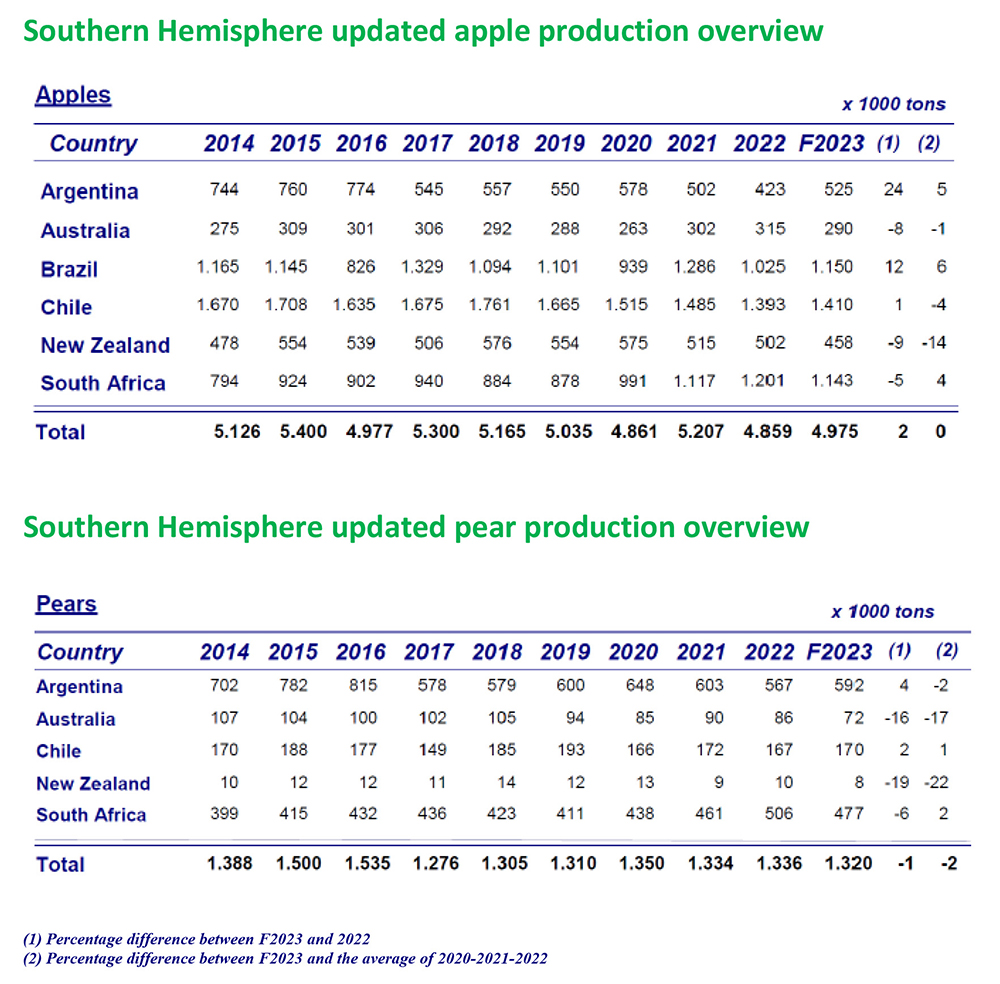
Following the intense weather events that affected several countries in the Southern Hemisphere, the World Apple and Pear Association (WAPA) has released an update of the Southern Hemisphere apple and pear crop forecast that was originally presented during the Association’s latest Annual General Meeting in Berlin’s Fruit Logistica. According to the revised forecast, which consolidates the data from Argentina, Australia, Brazil, Chile, New Zealand, and South Africa, apple production is set to increase by 2,38 % to reach 4.974.990 T, while pear production is expected to decrease by 1,25 % to a total of 1.319.601 T.
During its latest Annual General Meeting in Berlin’s Fruit Logistica, the World Apple and Pear Association (WAPA) presented the Southern Hemisphere apple and pear crop forecast for the upcoming season. The yearly report is compiled with the support of ASOEX (Chile), CAFI (Argentina), ABPM (Brazil), Hortgro (South Africa), APAL (Australia), and New Zealand Apples and Pears, and therefore provides consolidated data from the six leading Southern Hemisphere countries. The initial forecast for the 2023 season, which estimated a 6 % and 1 % increase for apples and pears respectively compared to 2022, has been revised in light of the intense weather events that affected several countries in the Southern Hemisphere. New Zealand’s and South Africa’s apple crop forecasts have been revised downward by 77.902 T and 77.276 T respectively. New Zealand’s pear crop estimates have also been slightly decreased compared to the initial forecast (- 323 T), as well as South Africa’s (- 28.726 T).
Regarding apples, the updated Southern Hemisphere 2023 crop forecast suggests an increase of 2 % to a total of 4.974.990 T compared to last year (4.859.026 T). A smaller apple crop is expected in New Zealand, (457.675 T, – 9 % compared to 2022), Australia (- 8 % compared to 2022, to a total of 290.000 T), and South Africa (1.142.880 T, down 5 %). Chile remains the largest producer (1.409.633 T, in line with 2022), now followed by Brazil (1.150.000 T, + 12 %). Argentina’s apple production should reach 525.000 T (+ 24 % compared to 2022). Exports are also expected to decrease (- 3 % compared to 2022) to a total of 1.556.668 T. Chile remains the largest exporter (604.000 T) followed by South Africa (509.158 T), whose exports are forecasted to decrease by 10 %. Exports from New Zealand (286.823 T) and Australia (2.687 T) are also expected to decrease by 15 % and 1 % respectively. Brazil’s (70.000 T) and Argentina’s exports (84.000 T), on the other hand, are expected to recover from the low 2022 figures. With 1.843.130 T, Gala remains by far the most popular variety, with its production expected to increase by 4 % compared to 2022.
Regarding pears, the Southern Hemisphere growers predict a slight decrease of the crop (- 1 %), which will drop to 1.319.601 T. While Argentina and Chile are expected to increase their production by 4 % and 2 % respectively, South Africa’s (- 6 %), Australia’s (- 16 %), and New Zealand’s (- 19 %) production levels are all expected to decrease. Argentina remains the largest producer in the Southern Hemisphere (592.000 T), followed by South Africa (477.419 T), Chile (170.000 T), Australia (72.016 T), and New Zealand (8.120 T). Packham’s Triumph remains the most produced variety (481.049 T, in line with 2022), followed by Williams’ bon chrétien pears (332.447 T). Export figures are expected to be stable (670.054 T), with a 12 % increase in Argentinian exports and a 13 % decrease in exports from South Africa.
(Photo: WAPA)
Lipton Ice Tea, the number one ready-to-drink tea brand1, is relaunching its range in a modernised design with a packaging makeover for all flavours. The packaging refresh is also accompanied by a reduction in sugar across the core range of Peach, Lemon, and Green Mint & Lime. The reduction will help the brand continue to appeal to the growing number of shoppers on the lookout for lower sugar options without any compromise on taste.
Half of shoppers say they are actively reducing the amount of sugar they consume2, which makes it the perfect time for Lipton’s relaunch. The new and improved drinks will maintain Lipton’s refreshing fruity taste and offer shoppers a lower sugar alternative, without compromising on great flavour.
As the leading brand in ready-to-drink tea3, Lipton Ice Tea’s value grew + 27 % in 20224 with further opportunities to grow as it taps into the 50 % of shoppers who choose food and drink products with reduced or no sugar content5. As a soft drinks segment, ready-to-drink tea represents a trade up opportunity for retailers, holding a price point of £2.43 per litre on average, versus the wider soft drinks’ £1.34 per litre6. This represents a premium option for consumers, and allows retailers to offer a full range of soft drinks which caters to multiple tastes and wallets.
The relaunched range will roll out across all channels from March 2023.
The new Lipton Ice Tea recipes are the latest lower sugar offering from Britvic, with continued innovation and reformulation programmes enabling the company to offer consumers healthier choices as part of ist Healthier People sustainability strategy. In 2022, this meant 96 % of its innovation launches were low or no calorie drinks – with an average of around 14 calories per serve across its Great Britain portfolio.
1NielsenIQ RMS, Total Coverage GB, Ready-To-Drink Ice Tea value sales, Britvic Defined 5Y, 31st Dec 2022 2Mintel – Attitudes towards Sugar and Sweeteners – UK – 2021 3NielsenIQ RMS, Total Coverage GB, Ready-To-Drink Ice Tea value sales, Britvic Defined 5Y, 31st Dec 2022 4NielsenIQ RMS, Total Coverage, RTD Ice Tea value sales, Britvic Defined, MAT we 31.12.2022 5Mintel – Attitudes towards Sugar and Sweeteners – UK – 2021 6NielsenIQ RMS – Total Coverage, Total Soft Drinks Britvic Defined, Average Price Point MAT we 31.12.2022
Pepsi is unveiling a new logo and visual identity system, the first update of the iconic Pepsi globe logo in 14 years. Pepsi will roll out the new look in North America this fall in time for the brand’s 125th anniversary, and globally in 2024, marking the brand’s next era with an eye toward the future. The new design evolves the Pepsi brand to represent its most unapologetic and enjoyable qualities, and will span across all physical and digital touchpoints, including packaging, fountain and cooler equipment, fleet, fashion and dining. Pepsi plays a critical role in achieving the PepsiCo positive sustainable packaging targets and in the U.S., as of 2022, Pepsi has begun to convert all 20oz bottles of Pepsi, including Pepsi Zero Sugar to 100 % recycled PET. The new logo and visual identity pays homage to the brand’s rich heritage while taking a big leap toward the future.
The Association for the Cannabinoid Industry’s novel foods applications (RP126 and RP127) have been validated by the Food Standards Agency (FSA).
The ACI received formal notification from the FSA that both its applications for the authorisation of CBD isolate and distillate ‘fall within the scope of the novel foods regime’ as set out in Regulation (EU) 2015/2283 (as retained) and fulfil the requirements set out in Article 10(2) of that Regulation.
These applications are now regarded as valid, and will now move on to the risk assessment stage to be assessed further.
ACI member applications account for 30 % of the products currently permitted to remain on the market under the novel foods authorisation process.
These applications relate to 320 brands on sale in Britain.
In 2022, the ACI submitted a complete toxicological package and related bioavailability data to the FSA to support the consortium of member applications.
This included the dose range finding study and the OECD408 rodent toxicity study to determine a No Observable Adverse Effect Level (NOAEL), to cover the safety implications of not only CBD, but also the minor cannabinoids and other plant matrices present in these plant-derived products.
Two years on from the novel food application submission deadline, this week’s FSA update comes a year after the food safety body published its first public list of ingestible CBD products deemed temporarily compliant, pending the submission of toxicology data, its risk assessment and acceptance to progress to the validation stage.
Steve Moore, ACI co-founder and strategic counsel, said: “This is a key milestone for the sector and the ACI. The new consumer cannabinoid sector has been set as an important regulatory challenge. Today’s outcome suggests that by collaborating, they are both progressing towards market authorisation for thousands of products but also delivering the safety data the authorities have been crying out for.”
Paul Birch, ACI co-founder, said: “This outcome was only achievable due to the expertise of our regulatory and scientific team led by Dr Parveen Bhatarah and Dr Paul Duffy who have provided exemplary insight and advice throughout this process.”
Provisional, unaudited operating profit of EUR 158 million
The preparation of the consolidated financial statements of the AGRANA Group for the period to 28 February 2023 reveals a provisional, unaudited operating profit of EUR 158 million, which is therefore significantly higher than the Company’s own guidance (“up to + 50 % compared to prior year”).
The provisional consolidated earnings before interest and tax (EBIT)* for the 2022/23 financial year (1 March 2022 to 28 February 2023) amount to EUR 88 million (2021/22: € 24.7 million). EBIT takes into account impairment charges taken against assets and goodwill in the amount of EUR 91 million which were recognised in the half-year financial statements (prior year: net exceptional items expense of EUR 70 million). Group revenue will amount to EUR 3.6 billion (2021/22: EUR 2.9 billion).
AGRANA’s Management Board currently forecasts a very significant improvement in EBIT during the ongoing 2023/24 financial year (more than + 50 %). The assumption is that consolidated revenue will increase significantly (by more than + 10 % and up to + 50 %). Key uncertainties however remain the war in Ukraine and its consequences.
The 2022|23 annual results and the 2022/23 annual report will be published as scheduled on 17 May 2023.
*After exceptional items and share of results of equity-accounted joint ventures
The Brazilian exports of orange juice are on the rise in the current season (2022/23). According to data from Secex (Foreign Trade Secretariat), between July/22 and Feb/23, Brazil exported 776.3 thousand tons of Frozen Concentrate Orange Juice (FCOJ) Equivalent, 14 % more than that shipped in the same period of the previous season. Revenue totaled USD 1.5 billion, 34 % higher, in the same comparison.
The higher increase in the revenue than in the volume exported highlights the higher average price paid for the commodity exported by Brazil. Data from Secex show that the quotations for the national FCOJ Equivalent rose 22 % between the last and the current seasons, and for Not-From-Concentrate juice, 7 %.
Exports to the European Union, the number one destination for the Brazilian orange juice, have decreased 2 % this season, while revenue has increased 16 % because of the recent valuations.
To the United States, exports are on the rise. In the current season, 240 thousand tons of the product have been shipped to this destination, a staggering 82 % up from that last season. Revenue more than doubled (+ 110 %), totaling USD 478.7 million. With shipments to the EU being stable and the increase to the USA, the share of the Brazilian juice in the total imported by the USA rose from 19 % in 2021/22 to 31 % in 2022/23.
It is important to mention that America’s high demand for the Brazilian juice is linked to the fact that the 2022/23 orange season in Florida has been compromised by the high incidence of greening and natural disasters, such as hurricanes and frosts.
The increasing trend of consuming organic food products along with healthy eating habits, especially among the young generation, is driving the demand for smoothies. According to the latest data provided by Fact.MR, a market research and competitive intelligence provider, the global smoothies market is estimated to reach a value of USD 52.5 billion by the end of 2033, expanding at a CAGR of 6.8 % during the forecast period (2023 to 2033).
Smoothies refer to thick beverages that are made by blending assorted vegetables, fruits, and other ingredients such as sweeteners, ice cubes, yogurt, seeds, milk, and herbal and nutritional supplements. They are rich in nutrients, including fibers and vitamins, and are easy to prepare and store for consumption. More people nowadays are also including green leafy vegetables such as lettuce, collard greens, spinach, and kale due to the increasing trend of green smoothies. These green smoothies are consumed to improve digestion, boost immunity, and minimise unhealthy food cravings.
Nutritional deficiencies and malnourishment have been affecting a large part of the population across several countries. However, over the years, due to improving economic conditions, these issues have been largely replaced with chronic diseases such as epilepsy and heart attacks, diabetes, obesity, strokes, and arthritis, especially in developed nations.
According to CDC (Centers for Disease Control and Prevention), chronic diseases are one of the prominent health problems in the United States.
More people are becoming health conscious and are adopting healthier lifestyles by making alterations to their everyday diets. There has been a remarkable shift from carbohydrate-laden food products to healthy protein-enriched meals and snacks, in terms of demand. Furthermore, functional foods and beverages such as smoothies are also consumed by many people to meet their routine nutritional requirements.
Long working hours and hectic lifestyles are stimulating the demand for on-the-go-meal options, which, in turn, is strengthening the growth opportunities for market players. Key manufacturers are focusing on new product launches and strategic initiatives to drive market growth over the coming years.
Vegetables and fruits are used as major raw ingredients in the production of smoothies. Fluctuations in the prices of raw materials due to climatic changes can directly impact the cost of the final product. This is expected to restrain market growth to some extent.
Key Takeaways from Market Study
The global smoothies market is anticipated to reach a value of USD 52.5 billion by the end of 2033.
Demand for smoothies is forecasted to increase at a CAGR of 6.8 % during the forecast period from 2023 to 2033.
The global market for smoothies is valued at USD 27.2 billion in 2023.
The fruit-based segment is expected to account for more than 50 % market share by the end of 2033.
Sales of smoothies in Germany are projected to increase at a CAGR of 4.8 % from 2023 to 2033.
Demand for smoothies in Canada is set to expand at a CAGR of 5.5 % through 2033.
Expert flavorists will enhance sweet and culinary capabilities with cutting-edge modulation technologies
IFF a global leader in solutions for food and beverages, health, biosciences, and scent has increased its innovation capabilities with two new state-of-the-art flavour labs at its facility in Northern Europe. The sweet and culinary flavour creation labs are the latest addition to the company’s expansive campus that has been in operation since 1964, spanning more than 312,150 square feet in Brabrand, Denmark.
The innovation hub is home to more than 400 employees engaged in research, application development, ingredient and flavour creation. The expanded facility will enable local and regional manufacturers to work in close partnership with a new team of flavourists who will introduce the latest modulation technologies and develop solutions for the beverage, bakery, dairy, snacks, culinary, bars and confectionery end markets. Working with an extensive library of proprietary flavor ingredients they will create exciting and unique flavour experiences for consumers, especially in areas such as masking, sweetness and umami.
“This expanded facility is a testament to our continued investment in innovation to meet evolving consumer expectations,” said Jan Bechtel, regional president of Nourish Europe, IFF. “We will continue to build on our deep expertise and scientific knowledge and invest in tools and products to bring what matters most to consumers in the market: creating the next generation of delicious, healthy and experiential food and beverages.”
Expert flavourists will have access to IFF’s latest research innovations, particularly in plant-based and biotechnology, along with resources like pilot plant manufacturing, ingredient expertise and evaluation studios, creating the perfect environment for end-to-end product design.
“We’re thrilled to launch these flavour labs,” said Laurens Reiber, creative director, Nourish Europe, IFF. “Brabrand is already a massive innovation center, and its location helps us better understand local market preferences and deliver trending global flavours. Now we’re investing further to boost our speed-to-market capabilities and to bring greater value to our partners.”
Following the completion of the Culinary Design Center last summer in Denmark, the opening of the new flavour labs is the company’s latest investment in R&D to develop winning solutions that meet customer and market needs with speed, agility and creativity.
vitaminwater® announced the addition of two new flavours – ‘with love’ and ‘forever you’ – to its zero sugar lineup, plus an innovative reformulation for all six zero sugar flavours. The new zero sugar reformulation offers our latest sweetener formula that includes monk fruit and stevia in addition to added vitamins and nutrients. The products are now available in the US at mass retailers, grocery stores and convenience stores.
The new flavours serve as an extension of vitaminwater’s promise to ‘nourish every you.’ Inspired by the notion that multiple sides of “you” have needs, vitaminwater encourages individuals to nourish each and every one. Whether your body, your emotions, or your complexities, vitaminwater has something in its suite of products to celebrate your multifaceted self.
Joining vitaminwater’s zero-sugar rainbow of flavours, ‘with love’ and ‘forever you’ provide new nutrition that can add positivity for each of your “yous”:
‘with love’ is delightfully infused with raspberry and dark chocolate for a unique taste. The nutrient-enhanced water beverage features a liquid boost of magnesium (85 mg) to help support heart health and 100 % antioxidant vitamin C alongside vitamin A (25 %) and vitamin E (30 %).
‘forever you’ contains tropical coconut lime flavours with white curcumin (18 mg) alongside 100 % antioxidant vitamin C, vitamin A (25 %) and vitamin E (30 %). Both drinks are a great source of vitamin b3, vitamin b5, vitamin b6, and vitamin b12.
The pollution of water and soil by waste is one of the biggest problems for our environment. Indonesia is the second-biggest contributor of plastic waste in the world, producing over 5 million tons of plastic waste per year with around 3 million tons disposed to the waters around the country. One of the main reasons is that many small islands have no waste collection and no municipal disposal system for household and other waste. Due to a lack of knowledge about the dangers involved, people dump their waste in landfills, burn it or dispose of it in the sea.
With the Recycle for Good program, SIG and the SIG Way Beyond Good Foundation want to change people’s behavior and promote a mindful use of natural resources. The program is designed to encourage the public to drop off recyclable waste such as beverage cartons, glass, plastic or cooking oil at a collection point and thus return it to the cycle. In return, they receive food vouchers or coupons for other goods and services that they can exchange at Recycle for Good partners. The materials are sorted on site and recycled by a recycling partner.
SIG Way Beyond Good Foundation envisions a future where good nutrition and clean water are available to everyone and natural habitats are preserved for the future generation.
With the experience of SO+MA, a Brazilian social startup that has been working with SIG since 2018 to promote the circular economy through a reward system, the foundation developed its global Recycle for Good program. Indonesia launched the program as the first country in Southeast Asia on March 3, 2023, at Cibubur Junction in East Jakarta, where a Recycle for Good drop point is located. Later, the program will be replicated.
LRQA, a leading global assurance partner, has warned that food and beverage organisations must not lose focus on their sustainability targets amid claims of ‘greenhushing’ expected to rise this year.
Greenhushing is the term given to organisations who are hesitant to share progress on sustainability goals to avoid external scrutiny. It is expected to rise up the agenda for some organisations, as scrutiny increases on sustainability statements.
For example, it was recently reported that the EU plans to crack down on inflated claims around products’ environmental credentials through the introduction of ‘proportionate’ penalties. With accusations of greenwashing being likely to increase as punishments are formalised, LRQA is encouraging organisations to relieve any concerns about sharing updates by adopting independent verification to inform progress against sustainability goals.
Heather Moore (Photo: LRQA)
Heather Moore, Technical Director for Sustainability at LRQA, said: “While greenhushing may seem like a viable option to avoid any potential external scrutiny, it could have a detrimental impact on our collective progress towards a more sustainable future. Organisations have a big role to play in achieving global sustainability targets. As such, they need to feel confident when speaking about progress, so they can share their wins and losses and learn from each other. Third party verification is one way to regain confidence when communicating progress, as it helps to prove the improvements being made.”
According to LRQA, the role of independent verification and certification frameworks will be key to demonstrate more transparent and accurate sustainability commitments, in turn reducing the risk of being criticised for a lack of progress or misrepresenting data. ISO 14064, for instance, is a standard for greenhouse gas accounting and verification for organisations looking to quantify and reduce emissions, helping companies hit projected greenhouse gas reduction targets.
Together with verification from independent third parties, following such standards can help ease the pressure facing organisations and avoid the need to adopt greenhushing processes, as Heather Moore explains: “Greenhushing may be on the agenda for some organisations this year, but it could have a detrimental impact on long-term global sustainability targets. The best way to safeguard sustainability objectives is through independent third-party verification, as it ensures that companies can accurately keep on track to meet their goals. That way, organisations can be safe in the knowledge they are on the best path to success, creating greater transparency and trust with key stakeholders throughout.”
Firmenich introduces Orange NextGen replacers and extenders, its natural alternative to FTNF (From The Named Fruit) orange oils, achieving identical orange flavours at significant economic benefit to customers and enabling sustained supply.
The global orange oil market has been under severe pressure and volatility in recent years due to crop shortages, poor fruit quality, climate-related challenges, and transportation instability. To address these supply disruptions and meet the growing demand for orange citrus oils, Firmenich has developed a range of natural, high-performing Orange WONF (With Other Natural Flavours) solutions, achieving taste profiles identical to orange oils.
“A fundamental part of our commitment to being our client’s unrivaled Citrus Partner means providing great taste and consistent quality, together with supply stability,” said Sonia Botta, Firmenich’s Global Citrus VP. “This is especially relevant in light of the continuing supply challenges facing the orange oil market. By leveraging our strong in-house citrus capabilities, advanced analytical expertise and deep understanding of natural molecules, our experienced Citrus Flavorists have masterfully created Orange NextGen replacers and extenders, allowing us to provide equivalent taste at cost competitiveness.”
For use in a wide variety of applications including waters, juices, alcoholic beverages, sweet goods and savory products, Firmenich’s Orange NextGen is designed to replace or extend orange oils, helping customers avoid product disruptions and delivering the same great flavour their consumers have grown to love.
Happi Glow and Happi Nightcap boast minor cannabinoids paired with functional mushrooms
Cannabis-infused seltzer brand Happi is pioneering a new path in the cannabis beverage space with Happi Glow and Happi Nightcap. These groundbreaking functional beverages are perfect for day and night, respectively. Created with a unique blend of minor cannabinoids and non-psychedelic lion’s mane and reishi mushrooms, these formulas are the first of their kind, with Happi filing a patent application covering the formulation for the products.
Happi Glow is available in a citrusy, bright Blood Orange Ginger flavour. Each can has 5 mg of THC, 5 mg of CBD, 3 mg of CBG, and 2 mg of CBN. Perfect for daytime, Happi Glow boasts the benefit of lion’s mane mushroom, which can help promote calm and focus to keep you clear-headed.
Happi Nightcap is available in Turkish Apple Tea, featuring notes of crisp apple and warm spices. Each can has 5 mg of THC and 5 mg of CBN. Ideal for evening, Happi Nightcap brings together soothing reishi mushrooms with a blend of minor cannabinoids to help you settle into a peaceful slumber so you wake up refreshed.
Each formula is vegan, gluten-free, and made with simple, all-natural ingredients. In addition to Glow and Nightcap, the brand also features two original flavours: Lemon Elderflower and Raspberry Honeysuckle.
Happi Glow and Nightcap are now available at select retailers in Minnesota (US) and online.
SISTO Armaturen S.A., a member of the KSB Group, inaugurated a newly built technology centre in Echternach, Luxembourg, on 27 February 2023. The SISTO TechCenter includes testing facilities specifically tailored to the needs of the pharmaceutical industry and biotechnology. Furthermore, this building also features modern office space for the technical departments.
The testing facilities also include a custom-built test stand for sterile process valves. This allows practical testing of valves for sterile processes. Here, developers are able to simulate all the necessary cleaning (CIP) and sterilisation (SIP) processes under original conditions. All common cleaning products (CIP), ultra-pure steam (SIP), compressed air, and vacuum are used, as well as cold and hot water. The tests can be performed according to ASME BPE standards or according to individual specifications of the end user.
In addition to further function and endurance test stands for diaphragm valves and accessories, a variety of facilities for materials testing and testing of mechatronic assemblies are also available. A vacuum chamber with leak detector is available for leak tests using helium in accordance with ISO 15848-1 or German Technical Guidelines on Air Quality Control (TA Luft).
The building covers an area of 350 square metres and has two floors. As part of its sustainability policy, SISTO Armaturen S.A. has designed the building to be climate-neutral. On completion, the building will require neither heating nor cooling. The inauguration of the multi-million euro building took place on 27 February in the presence of Franz Fayot, the Luxembourg Minister of the Economy.
All oranges 16.1 million boxes
The 2022-2023 Florida all orange forecast released by the USDA Agricultural Statistics Board is 16.1 million boxes, increased 100,000 boxes from the February forecast. If realised, this will be 61 percent less than last season’s final production. The forecast consists of 6.10 million boxes of non-Valencia oranges (early, mid-season, and Navel varieties) and 10.0 million boxes of Valencia oranges. A 9-year regression has been used for comparison purposes. All references to “average”, “minimum”, and “maximum” refer to the previous 10 seasons, excluding the 2017-2018 season, which was affected by Hurricane Irma. Average fruit per tree includes both regular and first late bloom. …
Please download the full citrus crop production forecast: www.nass.usda.gov
FoodTech venture fund Sparkalis has taken a minority stake in Fooditive, a next-gen food technology business specialising in sustainable plant-based ingredients. Fooditive’s innovations include an upcycled calorie-free natural sweetener with the taste and functionality of sugar, which is derived from apple and pear side streams.
Following the investment, Sparkalis Managing Director Filip Arnaut has joined Fooditive’s advisory board. There are now 11 foodtech experts sitting on the board. They will provide advice and insights to support Fooditive’s mission to create plant-based ingredients that are healthier for consumers, better for the planet and kinder to animals.
Fooditive, based in the Netherlands, has risen to prominence for successfully harnessing its precision fermentation technology to produce groundbreaking innovations such as vegan casein and bee-free honey. It also recently became the first food industry signatory to the Washington Compact, a new agreement on conducting business operations in outer space.
About Fooditive BV Based in Rotterdam, The Netherlands, Fooditive is a plant-based ingredient manufacturer committed to making healthy food available for all with its 100% natural ingredients. Since it was established in 2018, Fooditive has used its unique fermentation process to create a world-renowned sweetener, made from side-streams of apples and pears. The sweetener’s unique approach provides not only taste but also functionality and a sustainable impact. As the world begins to recognize the value in veganism and sustainability, Fooditive has also recently launched a new plant-based protein that can be used in the food industry to replace dairy in food and beverage applications.
About Sparkalis Sparkalis is an independent corporate venture fund, and a sister company of PURATOS, the global leader in the B2B bakery, patisserie and chocolate sectors. Sparkalis’s mission is to work with start-up founders, innovative and business-driven entrepreneurs to transform exciting ideas into successful business realities. Sparkalis is committed to investing in innovative solutions to create, with future partners, a healthier and better ‘food print’ for today’s and tomorrow’s generations around the world.
The processing of the oranges from the 2022/23 crop is beginning to slow down in Brazil, but it is still higher than the usual for this time of the year. In February, five plants – of the large-sized processors – were operating, the same as that last year but much more than that in 2020 and in 2021, when only a single plant was processing oranges.
According to Cepea collaborators, last year, the orange harvest was delayed, which explained the higher volume being processed in February. However, in the 2022/23 season, late processing is due to rains, which are hampering crop activities – although workers manage to get into the groves to harvest oranges, transportation is being difficulted.
The end of processing is still uncertain. Agents from processors reported that planning has been postponed because of the difficulties in crop activities. So far, some plants are expected to continue to process oranges in March.
A frequent concern among agents from processors is the yield of the oranges being harvested, majorly in 2023. They reported that, with frequent rainfall, the quality of the fruits for juice production has decreased, raising the number of boxes needed to the produce a ton of concentrated juice – higher moisture raises water absorption by fruits.
As for prices in the spot market, they were up to BRL 38.00 per 40.8-kilo box (harvested and delivered to processor) in February, considering large-sized companies. At smaller-sized processors, the prices paid for pear and late oranges reached BRL 40.00/box.
For the new crop (2023/24), whose processing is expected to begin in May/June, bids from large-sized processors have been up to BRL 38.00/box. Agents from processors reported that, despite the increase compared to the first bids for the 2022/23 crop, farmers expected higher prices, and, thus, many of them postponed deals.
ORANGE JUICE – Despite the valuation of concentrated orange juice at ICE Futures in recent months, there have not been major reflexes on processors’ revenue. According to Cepea collaborators, most of the juice is being sold through contracts with fixed prices. Since Jan. 1st, the contract due in March has valued 19%%, closing at USD 3,543/ton on Feb. 23rd.
TAHITI LIME – Tahiti lime processing was high in February but is expected to slow down in March. The company that processes tahiti lime aims to receive lower volumes of the fruit in the coming weeks. In February, two plants were receiving tahiti lime, but from March onwards, only one of them is expected to keep activities going. The prices paid by large and small-sized processors for tahiti lime are between BRL 12 and BRL 14/box.
Made with 100% fruit juice1 to infuse fun into any part of the day – snack time, meal time, or dessert
(Photo: Dole)
Dole Packaged Foods, LLC, released its latest innovation: Dole® Wiggles™ Fruit Juice Gels. A wholesome take on the classic treat, Dole® Wiggles™ Fruit Juice Gels are crafted with 100 % fruit juice1 to bring a new level of fun to meal or snack time throughout the day – because only the fun fruit wiggles.
The new snacks come in three bright, fruit-forward flavours: strawberry, orange, and cherry. They’re not only good for you – they’re also convenient for busy families on the go. Unlike many processed and sugary gelatin snacks currently found on shelves, each Dole® Wiggles™ cup delivers an excellent source of Vitamin C with no added sugar2 and no artificial flavours. Dole® Wiggles™ cups contain no high fructose corn syrup, no artificial preservatives, and are non-GMO and gluten-free.
Dole® Wiggles™ Fruit Juice Gels are sold in packs of four individual 4.3oz cups for an MSRP of $2.99. Wiggles are available at select retailers in the US and online.
1With natural flavors and other ingredients. 2Not a low calorie food. See nutrition facts for sugar and calorie content.
The Danish aroma company, EvodiaBio, secured 6.4 million dollars in a recent capital raise. Their goal is to become a global industry leader in sustainable aroma production for the food and beverage industry.
EvodiaBio recently introduced a ground-breaking technology platform that uses precision fermentation to produce sustainable aromas for the food and beverage industry. Now, the ambitious company has secured 45 million Danish kroner in additional funding, equaling approximately USD 6.4 million.
EvodiaBio, founded just one-and-a-half-years ago, received 14 million kroner in financial support from the BioInnovation Institute, a Danish accelerator funded by the Novo Nordisk Foundation. The remaining 31 million kroner stem from several international industry players, including the German flavour house Symrise that steps in as strategic investor, and Nordic Foodtech VC is lead investor.
Jarne Elleholm, co-founder and chairman of EvodiaBio, sees the capital raise as a crucial step in reaching the company’s soaring ambitions. “Our vision is to create a sustainable, global company within the development, production, and commercialisation of natural aromatic substances and this funding is our opportunity to realise this vision. The funding was made possible by a strong support from the BioInnovation Institute and by the great progress we have made during our only one-and-a-half-year lifetime”, says Jarne Elleholm.
Non-alcoholic beer is the first segment that EvodiaBio will address, says Jarne Elleholm, as getting the taste of the beer right has been a major challenge for the brewing industry. The company’s newly developed aroma blend, called Yops, can improve the taste of non-alcoholic beer, and serves as a sustainable alternative to cultivated aroma hops. In the long term, the bio-industrial company will develop aromas for other beverages, perfume, and a range of other segments.
EvodiaBio’s monoterpenoid aromas are produced using yeast cells that secrete the individual aroma components and are then combined to mimic the aroma profiles of different hops. The result is a natural, pure, and sustainable product. The technology has been developed after years of research by the scientific co-founders, Prof. Sotirios Kampranis, Dr. Simon Dusséaux and Dr. Victor Forman. EvodiaBio’s approach surpasses all other methods and enables, for the first time, a cost-effective and sustainable biotechnological production of the volatile aroma molecules from hops. Using EvodiaBio’s solution, the brewer avoids depleting limited plant resources, while water and CO2 emissions are reduced by more than 90 percent.
Next step in EvodiaBio’s far-reaching plans is the establishment of the company’s own offices, laboratories, and pilot-production in Denmark. They are now preparing for the launch of Yops in 2023, where they also expect an increase in staff.
Kerry announced details on the consolidation of its distributor network across Europe. The company has chosen Azelis and Caldic as distribution partners for Kerry products* to selected customers in the European region.
The appointment of these two well-recognised and experienced distributors will extend the reach of Kerry’s portfolio in market, enabling the supply of more customers with Kerry’s industry-leading products and technologies.
Caldic will operate in South Europe, the United Kingdom, Ireland, the Nordics and Benelux while Azelis will have responsibility for Germany, Austria, Switzerland and Eastern Europe, within the food, beverage and meat sectors.
Kerry will continue to operate direct sales across the region to its established and target customer base.
*Kerry Dairy Ireland, condensed smoke, food service products, retail butchery in UK and Ireland, pharma products and supplements are not included.
SIG will construct its first aseptic carton plant in India, the world’s largest milk market, and one of the largest juice producing countries globally. The plant will be in Ahmedabad, in the state of Gujarat. SIG entered the Indian market in 2018 and has seen a rapid expansion of its business. The plant will supply its growing filler base, which now serves all leading dairy and non-carbonated soft drink players.
The investment will cover state-of-the art production capacity, for the printing and finishing of aseptic carton packs with high environmental standards. Construction will commence in Q1 2023, and commercial production is expected towards the end of 2024. Phase one of construction is expected to create around 300 jobs.
SIG will invest approximately EUR 60 million over the period 2023–2025, to reach production capacity of up to 4 billion packs per annum. Subsequent investments could increase capacity up to 10 billion packs per annum. Land and buildings will be financed through a long-term lease with an NPV of approximately EUR 30 million.
You need to load content from reCAPTCHA to submit the form. Please note that doing so will share data with third-party providers.
You are currently viewing a placeholder content from Turnstile. To access the actual content, click the button below. Please note that doing so will share data with third-party providers.