Persistent unfavorable weather conditions are expected to have a significant impact on citrus production in Marketing Year (MY) 2022/23. Post forecasts lemon production to decline by 10 percent from MY 2021/22 to 1.65 million metric tons (MMT). Orange production is projected to fall by 13 percent to 623,000 MT, and tangerine production is expected to decrease by 18 percent to 285,000 MT.
Lemon exports are expected to decline to 200,000 MT in MY 2022/23, due to lower production. Orange exports are projected to decrease slightly to 55,000 MT, and tangerine exports are estimated to decrease to 30,000 MT, both due to smaller production …
Please download the full citrus crop production forecast: www.nass.usda.gov
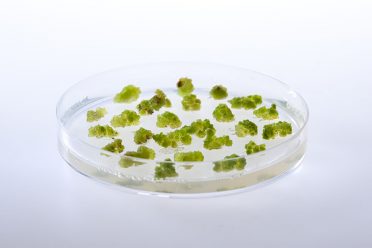
Scientists at Plant & Food Research are using their expertise in horticulture to explore the production of fruit without a tree, vine, or bush – instead using lab-grown plant cells. Initial trials have included working with cells from blueberries, apples, cherries, feijoas, peaches, nectarines and grapes.
Lab grown fruit (Photo: Plant & Food Research)
Cellular horticulture, agriculture and aquaculture, the production of plant, meat and seafood products in vitro, is at the cutting edge of food technology worldwide. By growing food from cells in the laboratory there are opportunities to use fewer resources and improve the environmental impact of food production.
Food by Design programme leader, Plant & Food Research scientist Dr Ben Schon says there’s a great deal of interest and development in controlled environment and cellular food production systems, with more than 80 companies worldwide looking to commercialise lab-grown meat and seafood.
“Cellular horticulture currently has a smaller profile than cellular agriculture and aquaculture, but we believe this is a really exciting area of science where we can utilise our expertise in plant biology and food science to explore what could become a significant food production system in the future.”
Ben Schon says the team is now 18 months into the five-year long Food by Design programme, which is funded through Plant & Food Research’s internal Growing Futures™ investment of the MBIE Strategic Science Investment Fund. The research has also gained support from New Zealand company Sprout Agritech, having recently being accepted into their accelerator program designed for agrifoodtech start-ups.
Dr Schon says initial trials have used cells harvested from blueberries, apples, cherries, feijoas, peaches, nectarines and grapes. Much like lab grown meats, the challenge is to create an end product that is nutritious and has a taste, texture and appearance that consumers are familiar with.
“In order to grow a piece of food that is desirable to eat, we will need more than just a collection of cells. So we are also investigating approaches that are likely to deliver a fresh food eating experience.”
“The aim isn’t to try and completely replicate a piece of fruit that’s grown in the traditional way, but rather create a new food with equally appealing properties.”
As well as exploring the viability of cellular horticulture as a future tool for food production, Dr Schon says the research also aims to provide better understanding of fruit cell behavior – these insights could help breed better fruit varieties that would also benefit the traditional growing methods being used by New Zealand’s horticultural sector.
This cellular horticulture research fits within Plant & Food Research’s Hua Ki Te Ao – Horticulture Goes Urban Growing Futures™ Direction, which is focused on developing new plants and growing systems that will bring food production closer to urban consumers.
“Globally, we are seeing rapid growth in both the vertical farming, controlled environment growing as well as cell-cultured meat spaces. It’s possible that cell-cultured plant foods could be a solution to urban population growth, with requirements for secure and safe food supply chains close to these urbanised markets,” says direction co-leader Dr Samantha Baldwin.
A survey carried out through independent auditing of each of the companies associated with CitrusBR and also consolidated by external auditing revealed that the total oranges processed in the Sao Paulo and Minas Gerais Citrus Belt in the 2022/23 season was estimated at 265,292,217 boxes of oranges of 40.8 kg of which 243,967,550 boxes were processed by CitrusBR members and close to 21.3 million boxes were processed by non-members.
With the final estimated juice yield on fruit of 280.58 boxes of oranges to produce one metric ton of FCOJ equivalent in aggregate for CitrusBR members and non-members, the final estimate for total orange juice production for the 2022/23 season was of 945,529 metric tons of FCOJ equivalent …
Curaleaf Holdings, Inc., a leading international provider of consumer cannabis products, announced the launch of Zero Proof, a new brand of THC drinkables in fast-acting, sessionable and easy-to-use formats. The brand’s inaugural product offering, Squeeze, is now available at all Curaleaf locations in Illinois, US and will be followed by additional SKUs in the coming months.
Zero Proof Squeeze follows Select’s popular THC-infused beverage enhancer, Select Squeeze, originally launched in March 2021. While similar in functionality and effect, Zero Proof Squeeze has been reformulated with natural sweetener to provide a significantly lighter taste and balanced flavour profile for enhanced mixability. The beverage complement offers a uniquely controllable and customisable experience with an easy-to-pour dispenser and compact design delivering 2.5 mg THC per dose for discreet enjoyment on the go.
Utilising nanotechnology, Zero Proof Squeeze provides a truer-to-flower experience with effects felt in as little as 15 – 30 minutes, significantly faster than traditional edibles. By turning cannabis oil into tiny water-soluble molecules, the THC compounds dissolve evenly into any beverage and are more rapidly and efficiently absorbed into the bloodstream. At launch, four delicious, low calorie and gluten-free flavours will be available including Dash of Cherry, Dash of Orange, Dash of Lime and Dash of Sweet.
“Zero Proof exemplifies our commitment to providing high-quality, consistent consumer products in familiar and approachable formats that model traditional consumer packaged goods,” said Matt Darin, CEO of Curaleaf. “Curaleaf has been on the forefront of creating sophisticated cannabis experiences which we believe will ultimately redefine the way people socialise. We’re proud to bring Zero Proof Squeeze to our patients and customers in Illinois first before expanding to additional markets.”
According a new Gallup poll, the rate of alcohol consumption in the U.S. continues to decline with 62 % of adults under age 35 reporting they drink alcohol, down 10 % from two decades ago. Zero Proof is the latest addition to Curaleaf’s brand portfolio that seeks to redefine how people socialise by delivering a fast-acting, sessionable alternative to alcohol.
Zero Proof Squeeze is now available at all Curaleaf dispensaries in Illinois as well as wholesale dispensaries across the US.
About Curaleaf Holdings Curaleaf Holdings, Inc. is a leading international provider of consumer products in cannabis with a mission to enhance lives by cultivating, sharing and celebrating the power of the plant. As a high-growth cannabis company known for quality, expertise and reliability, the Company and its brands, including Curaleaf, Select, and Grassroots provide industry-leading service, product selection and accessibility across the medical and adult-use markets. In the United States, Curaleaf currently operates in 19 states with 152 dispensaries and employs nearly 5,500 team members. Curaleaf International is the largest vertically integrated cannabis company in Europe with a unique supply and distribution network throughout the European market, bringing together pioneering science and research with cutting-edge cultivation, extraction and production. Curaleaf is listed on the Canadian Securities Exchange under the symbol CURA and trades on the OTCQX market under the symbol CURLF.
On August 28, 1898 in New Bern, North Carolina, pharmacist Caleb Bradham renamed “Brad’s Drink,” his popular non-alcoholic digestif, “Pepsi-Cola.” 125 years later, Pepsi has become one of the world’s most recognisable brands and today, it officially ushers in its next era while honoring its storied legacy, as the brand’s new logo begins to roll out in stores in the US.
In honor of its 125th birthday, Pepsi will celebrate its iconic history where it has lived at the center of pop culture – in sports, music, and entertainment – and look ahead to the brand’s next 125 years. On August 28 the brand started the party by offering free Pepsi to everyone across the US, and over the course of the 125 days leading up to New Year’s Eve, the brand will launch 125 various types of programming including immersive events, social content moments and giveaways. Each touchpoint and its corresponding programming will revisit and reimagine the impactful and culture-driving moments fans have cherished throughout the brand’s rich history just as the new Pepsi logo, which pays homage to past brand looks, comes to life for consumers wherever they shop, dine, play and scroll, ushering in the next era of culture-defining moments.
125 years of trailblazing
Pepsi has been and continues to be a driver of cultural impact and relevance for 125 years. From having the only female professional skywriter draw Pepsi in the clouds to creating iconic moments with some of the biggest pop stars on the planet to making the Super Bowl Halftime Show the most watched 12 minutes of music; from initiating the now iconic ‘Pepsi Challenge’ to trailblazing the idea of lifestyle marketing with music videos as commercials; from creating flavours like Pepsi Wild Cherry and groundbreaking innovations like Nitro Pepsi, time and again Pepsi has found itself on the cutting edge of pop culture, embracing what fans love about culture. And now, Pepsi will pull back the curtain on its history for 125 days, complete with an immersive experience consumers will have to see – and taste – to believe.
Sponsored Post – VOG Products, the South Tyrolean fruit processing company, not only processes increasing quantities of organic apples, but has also expanded its portfolio with Naturland-certified products. Of vital importance for customers is the regional origin of the raw materials that are sourced from the producer organisation’s members.
Supplies on the market for organic apples have changed enormously. In Trentino-South Tyrol, which is home to the largest producers of organic apples in Europe with the producer organisations and VOG Products’ members VIP and VOG, 56,944 tonnes of organic products were harvested in 2018. The figure in 2022, in contrast, was 92,412 tonnes.
Supplies on the market for organic apples have changed enormously. (Photo: VOG Products)
A trend that is also continuing in the organic quantities being delivered to VOG Products. In the 2022 financial year, this figure had already climbed to more than 32,000 tonnes. VOG Products processes and refines every third apple grown organically in Trentino-South Tyrol.
“We have been supporting this dynamic development for many years and are pursuing the objective of further expanding our leading position in the organic sector”, Christoph Tappeiner, CEO of VOG Products, explains. “We have been continually expanding our portfolio of organic products.”
VOG Products supplies high-quality products with the seal of the Bioland and Demeter organic farming associations and has also obtained the Bio Suisse certification. VOG Products has supplemented its organic range very recently with products certified according to Naturland standards. Naturland is the largest international association for organic farming in Germany and its guidelines go far beyond EU regulations. They also include targets for social responsibility and other key aspects of sustainability.
Play it safe with members’ products
What stands out about VOG Products is that organic raw materials are sourced from its own members in South Tyrol and Trentino. “Organic to us means ‘members’ products’, and this is recognised on the market. This gives our products a clear identity,” Tappeiner emphasises.
Full traceability back to the committed organic producers in the region – mostly small family farms – is coupled with strict controls along the entire supply chain. VOG Products guarantees safe, inspected and healthy food as well as continuous availability and security of supply year-round. This unique supply chain is presented by VOG Products under the name FROM Italian Alps (further information can be found at https://www.vog-products.it/en/from).
Customers’ demands in the baby food industry are particularly stringent. This continues to be one of the key customer segments for VOG Products in the organic sector. The semi-finished organic products are in demand among baby food manufacturers due to the strictly controlled supply chain as well as their high quality. The private label business of the food retail trade is gaining significance in the apple sauce sector, but organic also plays a major role for the apple juice industry.
Along with juices, concentrates and purées/pulp – also available in convenient small-sized packaging such as the “Bag-in-Box” – the South Tyrolean producer organisation also supplies organic-quality frozen fruits, cut and canned products and steamed fruits.
The tastemakers of the world will come together when Fi Europe returns to Frankfurt from 28-30 November
Food & beverage professionals are invited to step inside a microcosm of the ingredients world at this year’s Fi Europe. With 135 countries represented, over 25,000 visitors and 1,200 exhibitors are expected to come together under one roof, resulting in a rich, immersive opportunity to experience the energy of invention and profitable connection.
This year’s event blends real-world and digital interactions through the Fi Europe Event Platform, which will be open online pre- and post-show, extending the possibilities for exhibitors and visitors to discover new business opportunities, connect with the right people and be inspired by the latest industry trends and innovations. It also allows attendees to maximise their time in Frankfurt and prepare for the on-site event by planning a personalised agenda, bookmarking sessions they want to attend and reaching out to suppliers to set up meetings.
Fi Europe’s winning formula combines a bustling show floor with an insightful conference line-up. In the exhibition hall, attendees can access an unrivalled breadth of products spanning the entire food & beverage supply chain. The global exhibitor base includes many high-profile names such as Cargill, ABF Ingredients, Prinova, Brenntag and Lesaffre.
The Fi Europe Conference (28-29 November) and Future of Nutrition Summit (27 November) will provide exclusive, paid-for content that cannot be accessed elsewhere. It is focused on addressing current challenges and identifying immediate opportunities in the F&B industry. Its stellar speaker line-up includes Kalina Doykova, Senior Research Analyst at Euromonitor International, and Cyrille Filott, Global Strategist at Rabobank.
The Future of Nutrition Summit offers a deep dive into disruptive technologies and solutions that have the potential to reshape the industry. Delegates will hear from presenters such as Floor Buitelaar, Managing Partner at Bright Green Partners; Mario Ubiali, Founder & CEO of Thimus; and Christine Gould, Founder & CEO of Thought For Food. Free-to-attend content will be offered at the Innovation Hub and Sustainability Hub.
The growing importance of sustainability as an industry challenge will be reflected in the event highlighting issues such as sustainable sourcing, labels and transparency, regulatory compliance, ESG, gender equity, and more. As part of its ongoing commitment to sustainability, Informa has recently partnered with the international civil society organisation Solidaridad. Through the Sustainability Hub, visitors can find out how Solidaridad’s work in creating sustainable supply chains globally can help with ethical and sustainable ingredient sourcing.
In addition to the numerous informal and impromptu interactions that an industry gathering on this scale provides, there will be several organised networking opportunities. Data-driven matchmaking offers a scientific approach to making connections, and female professionals can look forward to inspiring others and being inspired at the popular Women’s Networking Breakfast.
As well as encouraging diversity in all forms, Fi Europe champions innovation and excellence through its award programmes. The Fi Innovation Awards celebrate individuals and businesses breaking new ground and making a difference in the industry. They culminate in an evening awards ceremony held on Tuesday, 28 November. The Startup Innovation Challenge offers a springboard for young companies with disruptive potential. Attendees can watch these startups pitch their concepts to a panel of investors, accelerators and influential industry players at the Innovation Hub on 28 November.
Commitment to reach net-zero greenhouse gas emissions by 2050
SIG received approval for its group-wide Net-Zero science-based target from the Science Based Targets initiative (SBTi). The company has committed to reach net-zero greenhouse gas (GHG) emissions across its value chain by 2050 – the most ambitious commitment available through the SBTi process. Of the 2,000+ companies globally with a public net-zero pledge, SIG is among the first 325 companies to have its target validated by the SBTi.
SIG has set a new series of near and long-term science-based emissions reduction targets with the SBTi, committing to reach net-zero – the point at which a balance is achieved between emissions produced and emissions taken from the atmosphere – by 2050. These targets are significantly more ambitious than the company’s previous GHG reduction targets, approved by the SBTi in 2018 and 2020. The move sees SIG look beyond its own operations and commit to the decarbonization of its full value chain in line with climate science.
SIG’s new near-term 2030 commitments (using 2020 as the baseline year) include:
42 % absolute reduction of scope 1 and 2 GHG emissions
100 % renewable electricity through 2030
51.6 % reduction of scope 3 GHG emissions per liter packed
SIG’s new long-term 2050 targets include:
90 % absolute reduction of scope 1 and 2 GHG emissions
97 % reduction of scope 3 GHG emissions per liter packed
Samuel Sigrist, CEO at SIG: “The approval of our Net-Zero pathway by the SBTi is a milestone achievement that showcases our dedication to decarbonizing our operations and value chain. Our new targets are considerably bolder than our previous GHG reduction targets and have been well received by our stakeholders. Decarbonizing our business will not be an easy task, but we’re excited to speed up our journey to net-zero as one of the first 325 companies that have received SBTi approval.”
Meeting the Paris Agreement goals and limiting global warming to 1.5 °C requires net-zero carbon emissions globally by 2050. The SBTi’s rigid approval process helps ensure that SIG is using a robust, clear, and scientific framework to contribute to global efforts to mitigate climate change impacts.
The main ways SIG is reducing its operational emissions (scope 1 and 2) are its 100 % renewable electricity commitment and outstanding on-site solar installation program, as well as exploring low carbon energy sources to lower direct emissions.
SIG’s products play a major role in reducing emissions across the value chain (scope 3), due to the amount and types of raw materials used. Going forward, the company’s priorities are to use less aluminum foil in its aseptic carton packs, work with suppliers to reduce emissions across the supply chain, further improve energy efficiency with new filling lines, and increase collection and recycling of used packaging.
Elopak reported strong financial performance for the second quarter of 2023
Highlights:
Revenues increased by 8 %, to EUR 278.0 million, driven by growth in EMEA and Americas
Organic growth was 6 %, or EUR 14.6 million, adjusted for currency translation effects and revenue from acquired businesses
Adjusted EBITDA was EUR 41.6 million, an improvement of EUR 15.1 million
Strong cash flow generation, leverage ratio reduced to 2.6x
Elopak will build a new plant in the USA to further leverage the high customer demand in the region
Commenting on Elopak’s performance, CEO Thomas Körmendi said:
“Building on our solid performance in past consecutive quarters, Q2 saw Elopak delivering strong profitable growth. Despite inflationary pressures, we remain on-track to achieving our strategic objectives. Our strong performance is allowing us to explore new market opportunities, including building a new state-of-the art factory in the US, and expanding our India operations.“
“Looking forward, we expect to deliver full year revenue growth well above our mid-term target. While we see softening of some raw material prices, the liquid paper market remains tight and higher board prices will have full effect in the second half of 2023. Additionally, the significant inflationary pressures on the broader cost base will impact our full year EBITDA margin. However, based on expected revenue growth, our second half EBITDA will be higher than last year. I am pleased to report this strong performance and remain eager and optimistic for continued sustainable packaging demand.”
The yearly WAPA report was published on the occasion of the Prognosfruit held in Trentino (Italy): Italian production levels are stable, France and Spain grow, while Poland and Germany suffer a slump.
The new challenges in the apple industry will headline the Interpoma 2024, the only trade fair in the entire world specialised in apples. The trade fair will run between 21 and 23 November 2024 at the Fiera Bolzano.
During the hiatus between the South Tyrolean trade fair, which takes place every two years – the last edition was held in November 2022 – apple enthusiasts can look forward to Prognosfruit 2023, the yearly, itinerant trade fair during which WAPA, the World Apple and Pear Association, publishes a report containing forecasts on the upcoming European apple harvest. Due to WAPA’s choice of location, this year’s Interpoma supported and promoted Prognosfruit as the event’s Technical Sponsor. This meant that every fairgoer received the second edition of Interpoma’s official magazine, the Ipoma Magazine, printed on 100 % apple paper and bursting with news on the industry. Gerhard Dichgans coordinates the magazine, which goes into detail across numerous topics. The second edition focused on topics such as “Rise and Fall of a Superstar: Why the Red Delicious has gone downhill”, “Precision agriculture and AI predictions in orchards”, “Love and Craft: How Japan raised the apple to the status of cultural asset”, “Juicy Dividends in Normandy: How apples not suited for raw consumption are transformed into cider and Calvados”.
The Prognosfruit 2023 was held in Trentino (Italy) and revealed that forecast European production will reach 11,411,000 tons, a 3.3 % drop compared to last year. The country dragging production down is Poland, the largest European apple producer overall, with a – 11.1 % drop YOY. If we turn to Italy, production levels are strong yet stable, helping it maintain its second position in Europe with an estimated 2,104,000 tons. If we dig deeper, South Tyrolean and Trentino production are on the rise, respectively at + 7 % and + 4 %. Moving to upcoming trends, France and Spain have proved to be quite lively markets: Forecasts for France speak of a harvest equaling 1,501,000 tons, + 7.9 % YOY on growth and + 9.5 % compared to the average of the last three years. Spain performs even better with its 536.000 tons, representing an astounding + 30.1 % YOY growth and + 14.8 % compared to the average of the last three years. However, what goes up, must come down: That fate has befallen Germany, as estimates speak of a harvest yielding 952,000 tons, i.e. – 11.2 % YOY and – 7.9 % compared to the last triennium.
These new trends and much, much more will be in the spotlight between 21 and 23 November 2024 in Bolzano during Interpoma and the satellite Interpoma Congress, where international apple experts gather to exchange ideas and updates about the industry.
Tahiti lime prices have been firm in the citrus-producing regions in São Paulo State since mid-June. However, in the first fortnight of August, quotations skyrocketed. Supply has decreased even more steeply, while demand is beginning to warm up – it is important to consider that this year’s winter has been warmer than the average.
Between August 1st and 15th, the average price for tahiti lime closed at BRL 76.70 per 27-kg box (harvested) a staggering 111.87 % up from that in July and 106.85 % above the average in the first fortnight of August of 2022, in nominal terms.
Some growers managed to sell the box for BRL 100.00 in the first half of August. With prices at high levels, many growers harvested all the fruits they were able to, in order to ensure a good revenue, offsetting at least part of the financial losses from the peak of harvest, when quotations were lower than BRL 10/box.
Cepea, collaborators believe that prices will continue high for some time, since supply in SP is only expected to resume rising after the return of rains, which usually occurs in September.
According to Cepea collaborators, in general, fruits quality (peel, amount of juice and size) is considered good, being higher in irrigated orchards – where fruits are growing bigger.
EXPORT – Domestic valuations have influenced the export value for the Brazilian tahiti lime. However, agents believe shipments will decrease soon, since sales in Brazil are expected to get good remuneration and thus reduce the attractiveness of the international market.
It is important to mention that this year’s shipments are currently at record levels, at 103.4 thousand tons (lemons and limes), 0.7 % higher than that from the same period last year, according to data from Secex (Foreign Trade Secretariat). Revenue is at USD 99.25 million, 4.4 % higher, in the same comparison.
Britvic plc announced the acquisition of the Extra Power energy drink brand in Brazil from GlobalBev. This marks an important extension of Britvic’s Brazilian operations, consistent with Britvic’s strategy to accelerate and expand its presence across Brazil.
With 42% market share in its core regions near Brasilia, Extra Power enables access to the fast-growing, high-margin energy category. In addition, the acquisition includes a modern, efficient warehouse in Brasilia that will enhance Britvic’s supply chain efficiency across its wider portfolio and route to market into Brazil’s Centre-West region. In the year to December 2022, the acquired portfolio generated R$118m of net sales, growing 26 % on the previous year.
Simon Litherland, Chief Executive Officer commented: “I am delighted by this acquisition, which enables us to enter the higher-margin energy category in Brazil. In line with our strategy to accelerate and expand our presence in the country, we will access a growing category, extend our regional presence and deliver efficiencies in our supply chain. I am confident this acquisition will accelerate our growth trajectory in one of our key markets and generate great value for our business.”
This acquisition gives Britvic a meaningful presence in Centre-West region (Distrito Federal & Goias), providing the opportunity to scale its existing brands into a region where the business has historically under-indexed, as well as bring the acquired brand into Britvic’s existing footprint.
Britvic first entered the Brazilian market in 2015 with the acquisition of Ebba, followed by the acquisition of Bela Ischia in 2017. Since then, Britvic has developed fruit favourites such as Maguary, Dafruta and Bela Ischia into strong national presences known for innovation.
The Maguary brand heritage dates back to 1953 and, similar to the European flavour concentrates brands, is consumed by families at home. This heritage and family awareness enabled Fruit Shoot to be launched in Brazil as Maguary Fruit Shoot – following the same principle Britvic has followed in Europe, where Robinsons and Teisseire are the halo brands. More recently the local team has expanded the brand’s presence further launching a plant-based chocolate drink. New category launches in recent years have included Puro Coco and Natural Tea, both of which are ready-to-drink formats in the coconut and iced tea categories. The expansion of the portfolio continued in 2020.
Dafruta Tropical was launched in the flavour concentrates category, utilising the technical know-how of the Robinsons formulation. This new range uses real fruit, has a range of flavours and is pre-sweetened, differentiating it from the traditional concentrates in Brazil which require sugar to be added by the consumer. More recently the portfolio has expanded with the launch of Britvic Mixers and the premium Mathieu Teisseire range of concentrates for cocktails.
The growth market for fruit drinks in Brazil is perfectly complemented by Britvic’s fruit growing and fruit processing company, Be Ingredient, providing natural ingredients for Britvic and the international market.
In the financial year 2022, Britvic generated £143m of revenue in Brazil.
The acquisition of Extra Power will be funded from existing internal resources and external debt facilities.
The acquisition will require regulatory clearance but is expected to be completed around the start of Britvic’s next financial year in October 2023.
Doehler, a global producer, marketer and provider of technology-driven natural ingredients, ingredient systems and integrated solutions for the food, beverage and lifescience & nutrition industry acquires Boon Flavors, located in Bangkok, Thailand, and strengthens its presence in Southeast Asia.
Doehler, a global producer, marketer and provider of technology-driven natural ingredients, ingredient systems and integrated solutions announces the acquisition of Boon Flavors, a renowned premium flavour house located in Bangkok, Thailand. As part of this acquisition, Boon Flavors will be known as Doehler Thailand going forward and be managed by its founder, Piya Boonnamkitsawad.
In 2018, Boon built a state-of-the-art flavour plant in Bangkok. Leveraging its proprietary technologies, the company has developed a great variety of local flavour tonalities that perfectly extends Doehler’s global taste portfolio. Boon will have access to all of Doehler’s cutting-edge taste technologies and, together with Doehler’s application labs in Indonesia and Thailand, global and local customers can expect to benefit from enhanced services and a more extensive product portfolio in the region.
Consumers are looking for exceptional sensory experiences in nutrition; superior taste, a perfect appearance and well-balanced mouthfeel play a significant role for consumers when choosing their products, ultimately guiding their preferences towards a better human nutrition.
Boon’s premium variety of local flavours, now integrated into Doehler’s global taste portfolio, contributes perfectly to this trend providing superior natural flavours to the food, beverage and lifescience & nutrition industry. This strategic acquisition further strengthens Doehler’s commitment to meeting the evolving needs of customers and consumers for excellent and remarkable tasty, healthy and sustainable solutions.
VOG Products, the South Tyrolean fruit processing company, not only processes increasing quantities of organic apples, but has also expanded its portfolio with Naturland-certified products. Of vital importance for customers is the regional origin of the raw materials that are sourced from the producer organisation’s members.
Supplies on the market for organic apples have changed enormously. In Trentino-South Tyrol, which is home to the largest producers of organic apples in Europe with the producer organisations and VOG Products’ members VIP and VOG, 56,944 tonnes of organic products were harvested in 2018. The figure in 2022, in contrast, was 92,412 tonnes.
A trend that is also continuing in the organic quantities being delivered to VOG Products. In the 2022 financial year, this figure had already climbed to more than 32,000 tonnes. VOG Products processes and refines every third apple grown organically in Trentino-South Tyrol.
VOG Products supplies high-quality products with the seal of the Bioland and Demeter organic farming associations and has also obtained the Bio Suisse certification. VOG Products has supplemented its organic range very recently with products certified according to Naturland standards. Naturland is the largest international association for organic farming in Germany and its guidelines go far beyond EU regulations. They also include targets for social responsibility and other key aspects of sustainability.
What stands out about VOG Products is that organic raw materials are sourced from its own members in South Tyrol and Trentino. Full traceability back to the committed organic producers in the region – mostly small family farms – is coupled with strict controls along the entire supply chain. VOG Products guarantees safe, inspected and healthy food as well as continuous availability and security of supply year-round. This unique supply chain is presented by VOG Products under the name FROM Italian Alps.
Customers’ demands in the baby food industry are particularly stringent. This continues to be one of the key customer segments for VOG Products in the organic sector. The semi-finished organic products are in demand among baby food manufacturers due to the strictly controlled supply chain as well as their high quality. The private label business of the food retail trade is gaining significance in the apple sauce sector, but organic also plays a major role for the apple juice industry.
Along with juices, concentrates and purées/pulp – also available in convenient small-sized packaging such as the “Bag-in-Box” – the South Tyrolean producer organisation also supplies organic-quality frozen fruits, cut and canned products and steamed fruits.
Nestlé has introduced a versatile and cost-effective sugar reduction technology that can be applied across different product categories, with benefits beyond sugar reduction. It can also be used to produce low lactose and skimmed milk-based products, while reducing total sugars.
Using an enzymatic process, it reduces intrinsic sugar in ingredients such as malt, milk, and fruit juices by up to 30 %, with a minimal impact on taste and texture. The sugar-reduced ingredients are then used in recipes for various products. There is no need to add sweeteners or bulking agents to replace the volume of the eliminated sugar.
When the patented sugar reduction method is applied to milk-based products, it also increases prebiotic fibers. First clinical studies have shown that these fibers can support the growth of multiple types of beneficial bacteria leading to a favourable microbiome composition in healthy adults.
Stefan Palzer, Nestlé Chief Technology Officer says, “Sugar reduction across our portfolio remains a top priority. This new technology is a true breakthrough, as we can reduce sugar without adding sweeteners while preserving a great taste, all at a minimal cost increase. In addition, our scientists discovered that the sugar reduction generates prebiotic fibers that support the microbiome, which is an additional benefit. We are now accelerating the global roll-out across formats and categories.”
The sugar reduction was first piloted in cocoa and malt-based ready-to-drink beverages in Southeast Asia and over the past year, Nestlé has already introduced it in factory lines for cocoa and malt-based powdered beverages such as Milo across several countries across Asia, Africa, and Latin America. Since 2021, the sugar reduction technology has been applied to over 200 000 tons of cocoa and malt-based beverages. The roll-out continues, and other product categories such as dairy powders will follow.
The development of novel technologies is part of Nestlé’s continuous efforts to improve the nutritional value of its products, while supporting responsible consumption as part of a balanced diet. The new sugar reduction technology complements a wide range of existing solutions which Nestlé has developed over the years in collaboration with external innovation partners and suppliers. This includes natural sweeteners, sweetness-enhancing or bitterness masking flavours, as well as natural bulking agents such as fibers, cereals and tailor-made dairy and cocoa powders.
Orange Juice
Global orange juice production for 2022/23 is estimated 9 percent lower to 1.5 million tons (65 degrees brix). Production is down due to reduced fruit available for processing in Brazil, the European Union, Mexico, and the United States. Consumption is mostly flat while exports are estimated down with the reduced available supplies …
Britvic is expanding its iconic range of mixers and juices with the launch of three new Cocktail Mixers that tap into the increasing demand for elevated serves that also deliver on great taste. The move will help bartenders prepare perfect drinks every time, with only the addition of the chosen spirit needed to mix up classic cocktails. The range features Mojito, Piña Colada and Strawberry Daiquiri mixers, and will be available from August 2023 exclusively for the hospitality channel.
Cocktails are worth an impressive £686m in hospitality, having risen by 132 % in the past year1, and represent a significant growth opportunity for outlets. The new Britvic Cocktail Mixers were chosen from the top five ‘go-to’ cocktails, as half of consumers say they prefer classic drinks that they know and trust2. Operators will be able to trade up from standard mixed drinks to popular cocktails on their menus, as the range will offer delicious cocktails that can be made with ease.
Adam Russell, director of foodservice & licensed at Britvic, comments: “3. In the current climate, people need even more reason to be tempted out of home, with 88 % of consumers saying they want bars and pubs to provide them with an experience they can’t get at home.4 Premium serves and cocktails have a big role to play here.”
“Despite the opportunity, we know that half of bar owners say they don’t offer cocktails in mainstream outlets because they take too long to make, there are too many ingredients to stock or there is a lack of staff skill or knowledge. Our Cocktail Mixers are designed to make cocktails an easier opportunity to tap into and are the perfect addition to help operators serve cocktails more quickly, efficiently and cost-effectively.”
Britvic Cocktail Mixers will be available to the licensed sector from August 2023. All three mixers come in at under 40 kcal per serve, are HFSS compliant and are suitable for vegans. At Britvic, we have a long history of helping people make healthier choices and our innovation pipeline continues to focus on low and no-sugar products which meet HFSS regulations, all while maintaining our commitment to never compromising on taste.
The launch will be supported by social media, merchandising, and point of sale. The range will be available via www.sensationaldrinks.com.
On August 1, 2023, Anton Paar acquired the German company Brabender GmbH & Co. KG, which will be integrated into the Anton Paar Group as Anton Paar TorqueTec GmbH. The effective, retroactive date of the acquisition is January 1, 2023. The company, based in Duisburg, Germany, offers measurement and process engineering solutions for the testing of various raw materials and for recipe and process development. It covers a wide range of applications – from food and feed to plastics and rubber, and even batteries and other special applications.
The signing of the acquisition agreement took place on August 1, 2023. The parties have agreed not to disclose the purchase price. A smooth integration of Brabender into the Anton Paar Group is planned. As before, products and services can be purchased directly via the Brabender website and sales organisation.
Development, growth, and position on the market
For Anton Paar, the acquisition of Brabender is a promising addition to the product portfolio, especially in the area of material characterisation – one of Anton Paar’s strongest growth markets.
“The decisive factor for Anton Paar’s decision to purchase Brabender was the know-how in the development and production of world-leading measuring instruments, which the company has built up since its foundation 100 years ago,” says Anton Paar CEO Dr. Friedrich Santner. “In line with its own long-term strategy, Anton Paar will sustainably expand and further strengthen Brabender’s sites in Duisburg and Hackensack (USA).”
Brabender’s approximately 200 employees will become part of Anton Paar. The acquisition represents a clear commitment to progress, according to Brabender Executive Director Dr. David Szczesny: “Being part of the Anton Paar Group opens up many opportunities for us – in research and development of our innovative products as well as in sales and service. For us, this is a great move that will definitely benefit our employees and customers.”
Pangea Natural Foods Inc., announced the launch of its latest product, 100 % locally sourced blueberry juice. This refreshing and nutritious beverage is made with exceptional quality and has a remarkable 8-month shelf life.
The blueberry juice is cold-pressed, resulting in a richer and more nutritious product. In addition, Pangea Natural Foods has partnered with a renowned leader in the field of high-pressure processing (HPP). This process allows for the elimination of harmful pathogens without the need for heat or artificial preservatives. As a result, consumers can enjoy Pangea Natural Foods blueberry juice knowing that it maintains its nutritional integrity while remaining safe for consumption.
Looking forward, Pangea Natural Foods continues to prioritise innovation and sustainability, striving to develop products that nourish both individuals and the planet.
About Pangea Natural Foods Inc. Pangea Natural Foods is a Vancouver (CAN) based natural foods company that manufactures and distributes high quality food products that are nutritious and free of GMO ingredients, fillers, antibiotics, hormones, and bioengineered ingredients. Pangea offers a broad range of great tasting, innovative food products that are sustainably sourced and “Powered by the Earth”. Pangea’s signature products include the Pangea Plant-Based Patties, Pangea Old Fashioned Ghee, Pangea Energy Gel and the Pangea Munchie Mix, which are available on the Company’s website and in over 500 leading national retail food stores including Loblaws, Save-on-Foods, Sobeys, IGA Marketplace, Fresh Street Market, Choices Markets, Whole Foods and on select Air Canada and WestJet flights. Pangea has partnered with world renowned food scientists to formulate its high-quality food products. All products are manufactured in-house at its state-of-the-art facility, and then packaged and distributed through Pangea’s retail and wholesale network and also on the website of the company.
There are new developments at BIOFACH, World Leading Lrade Trade Fair for Organic Food. In July 2023, Steffen Waris took on the role of Exhibition Director for the trade fair, reinforcing the team led by Danila Brunner, Executive Director Exhibitions. Brunner will continue to have overall responsibility for the combined BIOFACH and VIVANESS trade fair.
Steffen Waris has wide-ranging experience in trade fair and event management. For more than a decade, he held various roles at Mineralientage Munchen (the trade fair for minerals, fossils, gemstones, and jewellery in Munich). These included positions in marketing, leading the technical services, and event management. He will now give BIOFACH the benefit of his extensive expertise.
“After a brief excursion into the logistics segment, I am very pleased to be finally breathing in the trade fair atmosphere again. Bringing people together and helping them to network is what drives me. I also live and love team spirit, which is why the close contact to our customers, exhibitors, visitors, and media representatives is so hugely important to me,” says Waris.
“In Steffen Waris we have gained an experienced trade fair expert,” explains Brunner. “I am looking forward to working with him and our entire team as we continue to successfully develop BIOFACH and VIVANESS and create inspiring experiences for our customers.”
Waris made a conscious decision in favour of BIOFACH and the organic food sector. Not only does it match his personal values and expectations; it also aligns with his professional objectives. “BIOFACH offers an incredibly fascinating environment. The segment is facing some challenges due to both market forces and political decisions, and there is a lot of movement within it. It is an honour to be part of such an exciting and dynamic sector!”
Britvic, the FTSE 250 global soft drinks business, has partnered with Atrato Onsite Energy, a leading solar energy provider, to deliver clean energy to Britvic via an innovative 10-year Power Purchase Agreement (PPA).
Atrato’s new solar installation in Northamptonshire will generate energy exclusively for Britvic. It will have a total capacity of 28 MW and will be capable of generating 33.3 GWh pa of clean energy, the equivalent of powering 11,500 homes or planting 260,000 trees. The electricity generated will be enough to power 75 % of Britvic’s current operations in Great Britain, including its Beckton and Leeds factories, which can produce 2,000 recyclable bottles per minute for a portfolio of iconic brands including Tango, Pepsi and Robinsons.
As part of Britvic’s Healthier People, Healthier Planet sustainability mission to make a positive contribution to society, they are tackling their carbon footprint head on. Through innovation, utilising low carbon technology and energy sources, and establishing a more sustainable supply chain, Britvic is determined to play its part in securing a healthier future for the planet.
Britvic has committed to achieving net zero carbon emissions by 2050 and has led the industry as the first UK soft drinks company to have a 1.5 °C target verified by the Science Based Targets initiative. Britvic has demonstrated its commitment to this goal, having reduced its direct carbon emissions by 34 % since 2017 and generated 57 % of its energy needs from renewable sources in 2022, up from 28 % in 20181.
Progress has been achieved through significant investments across Britvic’s manufacturing base. For example, Britvic has installed five biomass boilers in Brazil, delivered multiple energy saving projects, is investing £ 4 million in a heat recovery system at Beckton, and they’ve recently announced a new Corporate Power Purchase Agreement in Ireland that will ensure that Ballygowan, Ireland’s iconic water brand, is produced using 100 % renewable electricity harnessed from local wind energy.
In this latest milestone, Britvic’s agreement with Atrato has provided the investment security needed to build the new solar farm in an old quarry in Northamptonshire. This will see 28 MW of new additional renewable energy capacity created as a result of the deal.
Atrato will supply Britvic with solar electricity that is commercialised on a pay as you generate basis but is delivered on a baseload basis that is consistent to the consumption needs of the company. This innovative and long-term PPA has underwritten the Atrato’s investment into this solar project.
Atrato has fully financed the solar installation, which is expected to be commissioned in early 2024. In only 19 months since IPO, Atrato has built a portfolio of 40 solar sites across the UK. Atrato is the green energy solution provider of choice for many UK companies with an impressive client list of blue-chip corporates including Tesco, Marks & Spencer, Anglian Water, Nissan and Amazon.
1Britvic Annual Report 2022, page 3
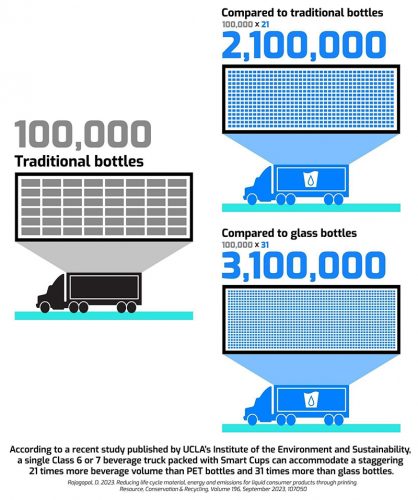
More Delivered, Less Trucks Needed! Smart Cups’ efficient technology means fewer transportation vehicles needed with greater volume of products delivered. (Photo: Smart Cups)
Smart Cups, a pioneering sustainability-driven technology company behind innovative ingredient printing announced the publication of a new research study in the esteemed journal Resource, Conservation & Recycling. The study, titled “Reducing life cycle material, energy and emissions for liquid consumer products through printing,” conducted by UCLA’s Institute of the Environment and Sustainability and authored by Professor Deepak Rajagopal, has brought to light the remarkable potential of Smart Cups Technology in transforming the consumer-packaged goods industry and contributing to a greener future.
“The technology that Smart Cups has pioneered has the potential to drastically reduce the environmental burden of beverages and several other liquid products through a reduction in total packaging and transportation across the product lifecycle,” said Professor Deepak Rajagopal. “The implications of this research extend beyond the consumer-packaged goods industry. Major companies, including industry giants like Pepsi, Coke, and Proctor and Gamble, could benefit from Smart Cups’ ground-breaking approach to delivering products more sustainably. Embracing this innovation can help such large corporations achieve sustainability goals and become leaders in eco-friendly practices”.
The study focuses on the profound environmental benefits of Smart Cups Technology which enables direct printing of consumer product ingredients onto surfaces, leading to substantial reductions in packaging materials, energy consumption, carbon emissions and overall environmental burdens. The study unveils the far-reaching implications for not just the beverage industry, but also the consumer-packaged goods industry as whole, promising to revolutionise distribution logistics and minimise environmental impact.
Key highlights from the study include:
The study’s findings show that a single Class 6 or 7 beverage truck packed with Smart Cups can accommodate a staggering 21 times more beverage volume than PET bottles and 31 times than glass bottles.
Smart Cups printed on PLA cups, when paired with tap water, result in 20 % less packaging materials than aluminum, 40 % less than plastic, and an impressive 90 % less than glass-based packaging.
This reduction in packaging translates into a 23 % to 48 % decrease in lifecycle primary energy and a 40 % to 57 % decrease in global warming potential. With biogenic carbon credit for landfilled PLA, the reductions reach an impressive 50 % to 70 %.
Smart Cups Technology is the first of its kind, revolutionising the delivery of liquid consumer products and minimising their environmental impact. This research not only amplifies the positive impact Smart Cups Technology can have on the world but also strengthens the validation of its significant benefits by reshaping the consumer products industry. By eliminating the need for bulky packaging materials, such as PET bottles or glass containers, Smart Cups optimise beverage payload, allowing for substantially higher volumes to be transported within the same truck weight limits. This breakthrough not only enhances logistical efficiency but also reduces the carbon footprint associated with transportation, as fewer trucks are required to transport the same amount of beverage.
The implications of this research extend far beyond the immediate benefits of increased payload capacity. By revolutionizing beverage transportation, Smart Cups are poised to transform the entire industry landscape, introducing a new era of sustainability and efficiency. With the potential to streamline distribution networks and reduce reliance on fossil fuels, Smart Cups offer a visionary solution to the pressing environmental challenges faced by the beverage sector.
The UCLA study underscores the profound impact of Smart Cups on beverage transportation, highlighting the unparalleled payload capacity that this innovative packaging technology provides. As industry leaders and consumers alike seek more sustainable and efficient solutions, Smart Cups stands at the forefront of a transformative movement. The researchers at UCLA are confident that their findings will inspire further exploration and adoption of Smart Cups within the beverage industry, ultimately leading to a greener, more efficient future.
Alvinesa Natural Ingredients has successfully acquired Genosa. This acquisition marks a significant milestone in Alvinesa’s growth strategy and strengthens its position as a key player in the upcycled natural ingredients market.
Alvinesa Natural Ingredients is a “circular economy” leader of sustainable plant-based ingredients. Alvinesa upcycles and transforms agricultural coproducts from wine industry into valuable natural ingredients for the Food, Beverage, Animal Health and Nutraceutical industries. With a rich heritage and years of expertise, Alvinesa has established itself as a trusted provider of high-quality natural ingredients to customers worldwide.
Alvinesa’s portfolio of natural ingredients is the result of years of research and development, driven by its belief in harnessing the power of nature to deliver valuable ingredients. Among its esteemed offerings is the flagship brand, Vintera™, which focuses on grape extract rich in polyphenols. The Vintera™ brand has gained recognition for its exceptional quality, food protection capabilities and the numerous health benefits associated with its polyphenol content. In addition, its portfolio includes natural colour, grape seed oil, natural flavour (wine concentrate) and natural tartaric acid.
Genosa stands as a global leader and trailblazing company in the production and commercialisation of upcycled natural hydroxytyrosol (Hytolive®) derived from olive fruit. Since its establishment in 2001, the company has made substantial investments in human expertise and financial resources, prioritizing the production of premium natural extracts and delivering added value to its valued customers.
A true pioneer, Genosa was the first to introduce high-purity natural hydroxytyrosol extracts derived from olive fruit. Their patented international process utilises only physical and mechanical methods, ensuring the utmost quality and environmental responsibility by abstaining from the use of solvents in the extraction of hydroxytyrosol.
This acquisition presents a unique opportunity for Alvinesa Natural Ingredients to further expand its ingredient range and leverage the synergies between both companies to drive innovation and customer value.
As part of the integration process, Alvinesa will be exploring ways to leverage Genosa’s expertise and technologies to enhance its existing product range.
The Brazilian orange crop for Marketing Year (MY) 2022/23 is forecast at 410.6 million 40.8-kg boxes (MBx) or 16.75 million metric tons (MMT), a slight decrease of 1.1 percent vis-à-vis the current season, with the resumption of the biennial crop cycle and consequently, a lower fruit load per tree. Meanwhile, orange weight at harvest is projected to increase 3.71 percent in relation previous crop, due to heavy rains throughout the citrus belt since October 2022. FCOJ 65 Brix equivalent production for MY 2022/23 is forecast at 1.125 million metric tons (MMT), a decrease of nine percent from the estimated orange juice production for MY 2021/22, which was revised upward to 1.135 MMT. A larger share will supply the U.S. market to compensate Florida’s juice production, which was damaged significantly by hurricane Ian. …
Spain’s authorities have certified the entirety of Nektium’s Rhodiolife® Rhodiola rosea inventory as CITES-compliant. The approval means the Las Palmas-based company now has permits in place to commercialise large volumes of Rhodiolife® for customers within the EU and worldwide, both directly and via its network of global distributors.
In February, CITES incorporated Rhodiola spp. into Appendix II, its list of endangered species that are subject to international trade controls. On 20 May, the EU added Rhodiola spp. to Annex B, its equivalent list of species subject to restrictions. Subsequent to this, Nektium applied for trade permits for its existing Rhodiolife® stocks. These were granted on 16 June.
Bruno Berheide, Nektium’s Commercial & Partnerships Director, said: “Our approved Rhodiolife® stocks are sufficiently abundant to meet market demand for the foreseeable future. This is a major boost for the Rhodiola rosea category, which continues to thrive. At the same time, we are continuing to communicate regularly with our suppliers to guarantee compliant raw material from future harvests to ensure long-term continuity of supply.”
CITES is the Convention on International Trade in Endangered Species of Flora and Fauna. Although a voluntary organisation, its decisions are considered binding for the 184 countries that are members.
Rhodiola rosea is one of nature’s most potent adaptogens, offering a range of scientifically proven cognitive health and sports performance benefits. The popularity of the plant, which grows wild in the remote Altai mountains in south and central Asia, has put pressure on supplies, leading to over-harvesting. Historically, Nektium has relied on wild Rhodiola rosea roots harvested using sustainable practices. But the company recently pioneered the large-scale cultivation of Rhodiola rosea at levels sufficient to satisfy market demand.
The Prognosfruit Conference, Europe’s leading annual event of the apple and pear sector, is right around the corner. On 2-4 August 2023, the Italian region of Trentino (Italy) will welcome an estimated 300 delegates from Europe and beyond. Registration is still open for sector representatives interested in getting the latest updates on the preparations for the upcoming apple and pear season.
Prognosfruit, the leading annual event for the apple and pear sector, will take place in Trentino, Italy, from the 2nd to the 4th of August 2023. Prognosfruit 2023 is organised by WAPA in cooperation this year with APOT (Associazione Produttori Ortofrutticoli Trentini). After more than 20 years, the Italian region of Trentino is ready to welcome back a delegation of 300 leaders from the apple and pear sector from Europe and beyond. Registration is open on the Prognosfruit website until 25 July 2023, along with all the information to book accommodation in Trento.
The complete programme of Prognosfruit 2023 is available on the Prognosfruit website. The three-day event will gather the most important representatives of the sector to learn about the upcoming European apple and pear production and latest market trends, covering as well as the EU neighbourhood and the USA, China, and India. Philippe Binard, Secretary General of WAPA commented: “Prognosfruit is a long-established event for the European apples and pears sector. It has been on the agenda of the sector for 48 years. Besides the session that will reveal the key features for the Northern Hemisphere 2023/2024 apple and pear production forecast and corresponding market analysis, we are pleased this year to complement the programme with insightful new sessions on the demand side with an organic market outlook and a retail panel on adapting to consumer’s expectation. Mr Binard added “Despite on-going challenges of rising costs impacting both the sector and consumers and unpredictable climatic events, the first indicators for both apples and pears look very promising and will lead to interesting exchange during the conference in the middle of one of the most important production places”. To facilitate the debate, simultaneous translation will be available in Italian, English, French, and German.
Intermarché, one of the most popular retail chains in France, demonstrates its relentless commitment to sustainability as it becomes the first in the country to use tethered SIG SwiftCap Linked closures on SIG’s carton packs. This pivotal move covers their entire private label juice portfolio of around 20 SKUs.
The fruit juice for the Paquito own brand distributed in Intermarché outlets is produced by Agromousquetaires, the agro-industrial entity of the Les Mousquetaires group.
Intermarché will also switch to a packaging material from the SIG Terra portfolio, which helps to reduce the use of fossil plastics. The SIG Terra portfolio is a set of more sustainable packaging solutions offering different structural options: without aluminum layer, with renewable materials from the forest, and/or recycled materials.
The polymers in SIG Terra packaging material support the transition to renewable polymers from the forest using a certified mass balance approach. SIG uses tall oil as a forest-based raw material for the production of the polymers. This is a by-product of the paper industry, thus avoiding the use of raw materials from agricultural crops. The polymers are certified according to the certification scheme ISCC PLUS. The ultra-thin aluminum foil used in the packaging material protects the contents from light and oxygen and is certified against ASI (Aluminium Stewardship Initiative) standards.
Intermarché, in its likeminded partnership with SIG, has achieved a first for the French juice market in helping to combat plastic waste leaking into the environment. The move to tethered caps comes well ahead of the EU’s Single-Use Plastics Directive deadline of July 2024 and will also be welcomed by both consumers and regulators. The tethered caps can be easily disposed of and recycled with the rest of the carton pack.
SIG’s tethered caps do not compromise on convenience for consumers, offering an easy pouring and drinking from the pack experience, via a robust double hinge solution. They are also compatible with existing SIG filling machines and closure applicators. This means no major investment is required, demonstrating the flexibility and adaptability needed to reassure customers that SIG’s packaging and filling solutions are a secure investment for the future.
The decision to launch Paquito and MERCI! brand juices with both innovations from SIG, fits perfectly with the company’s priority on responsible action. Intermarché’s socially responsible brand called Les Éleveurs vous disent MERCI! (The Farmers say Thank You!) is all about giving back. Its products offer consumers the opportunity to support farmers with better remuneration. MERCI! is also vehemently committed to the environment, society and animal welfare. MERCI! juices will come in SIG PremiumBloc 1,000 ml carton packs and Paquito in 750 ml and 1,000 ml.
The World Health Organization (WHO) and the UN Food and Agriculture Organization (FAO) have re-affirmed that aspartame is safe. UNESDA Soft Drinks Europe applauds the conclusions of the new, comprehensive safety review of aspartame by the WHO/ FAO Joint Expert Committee on Food Additives (JECFA), the world’s leading food safety body for additives.
Commenting on the release of the WHO/FAO JECFA review of aspartame, Nicholas Hodac, director general of UNESDA, stated:
“Once again, aspartame is assessed as safe by the world’s leading authority on food safety, based on a rigorous review of high-quality evidence. The WHO/FAO JECFA definitive conclusion is of great importance. It strengthens public confidence in the safety of aspartame and will help consumers make well-informed food and beverage choices.’’
Mr. Hodac added: ‘’This WHO/FAO conclusion is also key in further supporting our sector’s sugar reduction efforts. For decades, we have been reducing the average sugar content in our soft drinks, largely through the use of low- and no-calorie sweeteners, such as aspartame. To make further progress in encouraging consumers towards more balanced diets, the continued support of public health authorities on the use of aspartame and other sweeteners is essential.’’
Commenting on the opinion issued by the International Agency for Research on Cancer (IARC), Mr. Hodac said: “IARC is not a food safety body. It has classified aspartame, pickled vegetables and working at night as possibly carcinogenic. The fundamental aspect to consider is the potential risk on human health, which is what WHO/FAO JECFA has assessed with the conclusion that aspartame is safe.”
The WHO/FAO JECFA review of aspartame reiterates similar findings determining the safety of aspartame by over 90 food safety agencies around the world, including the European Food Safety Authority (EFSA) and the US Food and Drug Administration (FDA).
The Brazilian exports of orange juice increased in the 2022/23 season (July/22 – June/23), after fading for two consecutive seasons. According to data from Secex, Brazil exported 1.09 million tons of the product (Frozen Concentrate Orange Juice FCOJ Equivalent) in the 22/23 crop, 9 % up the volume shipped in the previous season. The revenue received from these shipments totaled USD 2.1 billion, a staggering 28 % up, in the same comparison.
Although the consumption of orange juice is not increasing in the major destinations of the Brazilian product – and despite the low national inventories –, the United States had higher import needs in the last years, due to the steep production decrease in Florida – mainly in the current season, 2022/23 –, which had been facing the effects of greening and was hit by hurricanes late last year.
According to Secex, the Brazilian exports of orange juice to the US have increased high this season, totaling 340.9 thousand tons, 69 % higher than the volume shipped in 2021/22. Revenue totaled USD 701.9 million, a staggering 93 % up, in the same comparison. As production is not expected to rise high in Florida in the short term, the US may continue with high imports needs, and Brazil is the number one supplier of orange juice in the world.
In a report released in June, Florida Citrus Department confirmed higher imports to the US: between Oct/22 and Apr/23, the country doubled the volume of FCOJ imported from Brazil compared to that in the previous season; of NFC (Not-From-Concentrate) orange juice, shipments rose 82 %.
EUROPEAN UNION – To the European Union, the number one destination of the Brazilian orange juice, exports totaled 569.6 thousand tons in the 2022/23 season, 8 % less than that shipped in the previous season. Revenue totaled USD 1.13 billion, 9 % up, in the same comparison.
MycoTechnology, a trailblazer in the field of mushroom research and ingredient innovation, has announced the landmark discovery of a natural sweet protein derived from honey truffle.
This first-of-its-kind discovery paves the way for the launch of honey truffle sweetener, a potentially game-changing alternative to sugar and artificial sweeteners that could reduce global sugar consumption and build towards a healthier future.
This breakthrough is the culmination of MycoTechnology’s extensive efforts to investigate the highly sought-after truffle and uncover the source of its sweet taste. The honey truffle has been consumed for centuries and valued for its uniquely delicious properties. In identifying and isolating the sweet protein, MycoTechnology continues to leverage its advanced technology to harness the versatility of fungi and address new food system challenges.
“Our honey truffle sweetener is derived from a protein, which brings an unprecedented level of excitement as proteins are widely recognised as the future of sweeteners,” said Alan Hahn, CEO of MycoTechnology. “This breakthrough ushers in a new era of clean label sweeteners, revolutionising the way we create foods and beverages without relying on traditional sugar or artificial sweeteners.”
A significant development in the sweetener sector, the news is already sparking enthusiasm, with several commercial partners expressing their interest in new collaborations. MycoTechnology is developing a proprietary platform designed to scale production, minimise manufacturing costs, and optimise yield. The result is a clean, intense natural sweetness with an expected cost-in-use competitive with sugar, and absence of aftertaste.
Doehler, a global producer, marketer and provider of technology-driven natural ingredients, ingredient systems and integrated solutions for the food, beverage and lifescience & nutrition industry strengthens its portfolio in red fruit and vegetable ingredients and extends its market presence in the USA and Asia with the acquisition of SVZ.
Doehler, a global producer, marketer and provider of technology-driven natural ingredients, ingredient systems and integrated solutions announces the acquisition of SVZ, subject to regulatory approval. This strengthens Doehler’s portfolio of natural red fruit and vegetable ingredients and its global market presence, expanding the operations in the USA and Japan.
SVZ is known for its high-quality purees, concentrates and ingredients of sustainably sourced vegetables and red berries. With production sites in the USA, Spain, Poland and Belgium, SVZ has established a strong global presence and successfully built a base of premium customers in the food, beverage and lifescience & nutrition industry. SVZ’s experience and operational excellence perfectly complements Doehler’s sourcing, production and supply chain capabilities. With this acquisition, customers will benefit from an even broader ingredient portfolio and larger raw material base.
Consumers’ interest in healthier nutrition creates a rising demand for ingredients that offer better nutritional value and superior sensory experiences from sustainable raw materials. SVZ’s portfolio contributes to this trend by offering a variety of low-calorie, high-fiber and nutrient-rich fruit and vegetable ingredients that enhances the overall nutritional content of food and beverages. SVZ’s products seamlessly integrate with Doehler’s portfolio of natural ingredients and ingredient systems.
About SVZ
SVZ supplies high quality fruit and vegetable ingredients to food and drink manufacturers around the world. Its long heritage in agricultural supply and accredited sustainability initiatives ensure a consistent, premium quality ingredient supply. With more than 100 years’ experience in the global fruit and vegetable agribusiness, SVZ represents quality leadership throughout the whole supply chain. Headquartered in Breda, SVZ has state-of-the-art production facilities in Belgium, Poland, Spain and the US, where it has built strong partnerships with local growers to ensure fruit and vegetables are cultivated, harvested and processed to the highest standards. Strategically positioned at the heart of the fruit and vegetable supply chain, SVZ is committed to enacting positive, sustainable change in the fruit and vegetable ingredient industry by Growing better, together.
The 2022-2023 Florida all orange forecast released by the USDA Agricultural Statistics Board is 15.9 million boxes. The total is comprised of 6.15 million boxes of non-Valencia oranges (early, mid-season, and Navel varieties), unchanged from the June forecast, and 9.70 million boxes of Valencia oranges, up 100,000 boxes from the June forecast. The forecast of all Florida grapefruit production is lowered 10,000 boxes to 1.81 million boxes. Of the total grapefruit forecast, 250,000 boxes are white, and 1.56 million boxes are the red varieties. The Florida all tangerine and tangelo forecast is now 480,000 boxes. …
Please download the full citrus crop production forecast: www.nass.usda.gov
Symrise AG has signed a minority investment agreement with Bonumose. The early-stage food ingredient manufacturer specialises in the affordable production of delicious, good-for-you rare monosaccharides (alternatives to sucrose) such as tagatose and allulose. With this strategic transaction, Symrise will accelerate growth in its sugar reduction initiatives. The area represents a high-priority focus for the North America region within the Taste, Nutrition & Health segment.
“This exciting investment forges a strategic partnership. It will enhance our flavour and taste balancing technologies with Bonumose’s innovative and economical tagatose and other alternative sweetening solutions. Combining our technologies, will enable us to offer our customers new pathways to sugar reduction and taste balancing solutions. In turn, this will allow them to reduce sugar while optimising the taste of better-for-you products for their consumers. This applies especially in the beverage and ice-cream categories. Health forms a growing focus category for Symrise. With the support of Bonumose’s enzymatic expertise, we can bring novel and disrupting ingredients to the marketplace together”, said Nick Russell, Senior Vice President – Business Incubation Group, Symrise AG.
Bonumose opened a new R&D facility and manufacturing plant earlier this year. The facility allows for quality, consistent, and economic production of their growing portfolio of sugar alternatives. Bonumose was founded in 2016 as a start-up. It continues to grow thanks to their patented enzymatic technology. This allows for the sustainable bulk production of healthy ingredients from globally-abundant plant material.
Ed Rogers, Bonumose Chief Executive Officer and Co-Founder, said: “We feel enthusiastic about the future and the growth that the investment and partnership with Symrise enables. Now, we are coupling our expertise in tagatose and other naturally-occurring sugar alternatives with the extensive Symrise flavour proficiency and expansive portfolio across multiple platforms in both human food and animal nutrition. This creates the opportunity to offer unique value to customers. The strength of Symrise as an augmented flavour house paired with Bonumose’s patented enzymatic technology will enable cutting edge solutions to sugar reduction.”
The two most important international trade fairs for the beverage and liquid food industry will join forces to strengthen their positions in the world market. drinktec from Munich (GER), the world’s leading trade fair for the beverage and liquid food industry, and Nuremberg’s (GER) BrauBeviale, the leading capital goods trade fair for the beverage industry in Europe, have joined forces to form the joint venture “YONTEX” as of 1 July 2023. The company is based in Nuremberg and CEO will be Rolf M. Keller, previously divisional director at NürnbergMesse. Both trade fairs will continue to operate as independent brands, retain their names, and keep their events at the respective locations in Munich and Nuremberg, but under the shared umbrella of YONTEX.
The merger of drinktec and BrauBeviale into one company is the largest merger of two trade fair flagships in Germany to date. Both trade fairs will be able to continue their individual growth unimpeded, widen their national and international reach in terms of customer contacts, and bundle their resources to the benefit of their exhibitors and visitors.
The new company YONTEX will present itself for the first time with the BrauBeviale to be held in Nuremberg from November 28 to 30, 2023. Both events will be held as before at their accustomed venues, both will retain their prestigious brand names and their well-known contact persons. Moreover, they will be held in the same cycles as before: drinktec will be held at the Munich Exhibition Centre every four years, the next event being in 2025, and BrauBeviale will still be held annually at the Nuremberg Exhibition Centre, as before, except for the “drinktec years”. In addition to Munich, drinktec is also held at two additional venues: an annual event in India (drink technology India) and a biennial event in China (CHINA BREW CHINA BEVERAGE).
A 19-person team of experienced trade fair professionals from drinktec and BrauBeviale, as well as some new trade fair professionals, will be the foundation of YONTEX in the future. This new team includes CEO Rolf M. Keller and Executive Vice President Petra Westphal, who had previously been a project manager for drinktec and its international exhibitions, Executive Director BrauBeviale Andrea Kalrait, Executive Director drinktec Cluster Markus Kosak and Executive Director Operations Moritz Müller.
Klaveness Digital announces its latest partnership with Citrosuco, a global leader in orange juice concentrate production, as the company adopts CargoValue to optimise supply chain operations. Citrosuco is the latest to join a growing community of industrial companies taking the lead in how they manage their seaborne supply chain.
In today’s highly competitive market, Citrosuco recognises the value of incorporating advanced technologies to support its standing in the global citrus industry. The company’s dedication to creating top-quality products and embracing environmentally responsible practices has encouraged its pursuit of innovative solutions for enhancing its supply chain.
With the adoption of CargoValue, Citrosuco can now efficiently plan and manage their entire shipping and inventory schedule in one solution with a single source of information, from planning to production, allowing the company to reduce risks and costs. Citrosuco currently has 5 marine terminals located in: Santos (BR), Wilmington (USA), Gent (Belgium), Toyohashi (Japan) and Newcastle (Australia), as well as 5 dedicated ships and 1 multi-cargo vessel.
According to Luiz Fernando Ragonha Jr, the Director of Supply Chain Planning at Citrosuco’s Santos Port Terminal, the adoption of CargoValue by Citrosuco reaffirms the company’s prominent position in the global citrus industry. By embracing this cutting-edge technology, Citrosuco demonstrates its unwavering commitment to keeping pace with the latest industry trends and advancements. The implementation of this solution not only enables Citrosuco to streamline its operations and decrease operating costs, but also plays a crucial role in reducing the company’s environmental impact. By identifying opportunities for more sustainable transportation and storage practices, Citrosuco actively contributes to its CO₂ emission reduction targets, thereby aligning itself with a more environmentally conscious future.
Greater efficiency, cost savings, and sustainability in the supply chain
“By incorporating CargoValue into their operations, Citrosuco demonstrates their forward-thinking approach and commitment to excellence,” said Aleksander Stensby, CEO at Klaveness Digital AS. “We’re excited to partner with Citrosuco to help them achieve greater efficiency, cost savings, and sustainability in their global supply chain.”
Rebellious Kids combines great taste with true function. No sugar, no calories, vitamins A, B12, C, D, E, Zinc, plus sea salt for natural electrolytes from the ocean.
Rebellious Beverage Company, the preeminent functional beverage company, launched its first ready-to-drink line of functional beverages, Rebellious Kids, in an 8-ounce bottle with sports cap, made with post-consumer recycled content. Rebellious Kids is an organic, plant-based plus minerals beverage, that delivers key nutritional support children need with no sugar. Rebellious Kids has 40 % of the daily value of vitamins B12, C, and D and 20 % of the daily value of vitamins A and E, plus zinc, and electrolytes.
“Our move into the healthy hydration space for children addresses an unmet need for parents who want refreshing drinks that they can feel good about serving their kids: no sugar, no calories, clean ingredients, that delivers key functional nutrition, and great taste,” said co-founder and CEO Doug DuMars. “We are re-invigorating a category that has basically been forgotten about. Rebellious Kids is a nutritional beverage solution with a holistic approach to foundational wellness supporting our next generation at home, at school, or during their activities.”
Rebellious Kids are available in 8oz bottles with 4 flavours kids love:
Scrappy Strawberry
Wild Wild Wildberry
Outrageous Orange
Wacky Watermelon
Rebellious Kids and Rebellious Infusions are intent on transforming the trend using a little monk fruit. Research from the CDC1 confirms that children and teens are drinking too much sugar from their beverages, two-thirds drink at least one sugary beverage per day. Since added sugar contributes to weight gain, heart disease, cavities and more, Rebellious can play an important role in overall health.
Available across more than 385 Sprouts Farmers Market stores in 23 states. Sprouts is one of the largest and fastest growing specialty retailers of fresh, natural, and organic food in the United States.
About Rebellious Beverage Company: Rebellious is a preeminent functional beverage company with nutritional beverages that have no sugar, no calories, no Crap! Segments include Rebellious Kids and Rebellious Infusions. The Infusion line consists of 10 flavours within pure function, pure performance, and caffeine free. Each portable packet has no more than 5 ingredients, contains L-theanine for brain health, and up to 200 mg of antioxidants for immune system support. Rebellious is the brainchild of former PepsiCo and Kraft Foods industry veteran, Doug DuMars, and his co-founder, Joe O’Connor. Sprouts is the first major push into traditional retail. Rebellious has consumers in all 50 states in the US, plus Australia, United Kingdom, Europe, Middle East, and India. Rebellious’ customers include professional sports teams, NCAA and high school athletic departments, and hotels.
Pat Cummins, captain of the Australian Test Cricket team and international sporting icon, has announced an exclusive partnership with the expanded Nexba business. As part of the collaboration, Pat will embrace his love for Kombucha and become a Nexba shareholder and brand ambassador in Goodness Group Global, the better-for-you company.
The multi-year partnership will see the 30 year old right arm fast bowler become a shareholder in Goodness Group Global, as well as a public face of the Nexba brand, and at the forefront of NEW brands to be built under the Goodness Group Global umbrella.
Nexba is a leading brand in ‘Naturally Sugar Free’ functional soft drinks that has removed more than 6 billion grams of sugar from global diets. This year, Nexba expanded to become Goodness Group Global with the goal of building a house of brands that ‘taste good & do good’ while creating positive change by removing sugar and artificial ingredients from consumption.
Pat’s relationship with Nexba and Goodness Group Global adds to his growing portfolio of off-field business interests which he’s looking to grow for his eventual life after cricket.
Nexba is a leading brand in ‘Naturally Sugar Free’ functional soft drinks and kombucha both in Australia & the UK. All of the Nexba drinks are powered by their Goodsweet® natural sweetener which emulates the taste of sugar without the nasties. Consumers, retailers & governments, locally and internationally, are increasingly focused on health & wellness with rejection of both sugar and artificial sweeteners.
The opportunity to own shares alongside Pat Cummins in Nexba and Goodness Group Global is available via a crowdfunded capital raise campaign on VentureCrowd. Budding investors better be quick, as it closes in less than a month!
On 25 May Freshfel Europe held its Annual Event 2023 in Brussels. The event brought together over 100 participants, including experts from the fresh produce sector, European Commission professionals, Members of the European Parliament and representatives from international organisations and associations. The Annual Event Public Conference focused on building a fresh image for fresh fruit and vegetables was preceded by Freshfel Europe’s Annual General Meeting, where the goals and ambitions for the Association in 2023 were set.
The Annual Event of Freshfel Europe 2023 took place on Thursday 25 May in central Brussels. The event was focused around the theme ‘A fresh face for fruit & vegetables. Rejuvenating fresh produce to stimulate healthy & sustainable consumption and featured top-level speakers from the European Commission, WRAP UK, Trianon Scientific Consulting, Planet Tracker and the OECD. The fresh produce industry is facing several challenges relating to climate change, misleading negative public depictions of products, and a steadily decreasing consumption rate. This year’s annual event focused on how the sector will position itself at the forefront of sustainable change, promoting accountability and responsibility to accurately showcase the many assets and benefits of fresh fruits and vegetables, portraying a ‘fresh face’ and the true qualities of the products.
Salvo Laudani, President of Freshfel Europe states: “We cannot continue to ignore this problem. Just a few years ago, during the pandemic, we were the heroes. Consumers knew we are a sustainable food alternative with high health benefits and low environmental impacts. Now, fruits and vegetables are more and more often being portrayed negatively, with misleading and untrue information on water use, quality and safety and affordability being disseminated in communication outlets.” One of the most common current misconceptions is that fruits and vegetables have become unaffordable, with prices driven up by the high inflation rates of the last year. However, as emphasised by Mr Laudani: “Estimations from Italy show that in 2022, monthly household expenditure increased by EUR 446, out of which grocery expenditure accounted for EUR 35 with 10 % being attributed to fruits and vegetables. That means that the inflation on fruits and vegetables only led to an increased cost of EUR 3,5 more per month, or 0,1 cents per day, for Italian households.”
Fresh produce is essential to the green transition and is central in European strategies such as the Green Deal, Farm to Fork, Fit for 55 and the EU Beating Cancer Plan. Speakers at the event highlighted the urgency to act now to reach these goals and stressed that although fruit and vegetables have the capacity and qualities of taking the lead in sustainability, there is still a lot more work to be done. Innovational efforts, new technologies and farming practices are still in their infancy, and greater attention must be paid to how to efficiently finance the efforts that need to be made for the sector to remain proactive.
While the meeting identified several areas where progress can be made, regulatory and financial hurdles remain. Philippe Binard, General Delegate of Freshfel Europe remarked: “Fruit and vegetables have a key role to play in the move towards a plant diet and sustainable food chains. Yet, policy changes are placing hurdles on the sector’s journey towards these objectives. Restrictions to the use of plant protection products, packaging, efficient labelling requirements and insufficient actions to stimulate innovation projects and consumption are impeding and delaying the move to fully sustainable fresh produce.
Before the Annual Event Public Conference, Freshfel Europe held its Annual General Meeting, during which the Freshfel Europe 2023 Activity Report, covering the Association’s activities in the period June 2022 to May 2023, was presented to the members. The Freshfel Europe 2023 Activity Report is available online here.
In June, the Swiss packaging solution provider SIG marked another milestone in its long history – 170 years of operation. Founded in 1853 and headquartered in Neuhausen, Switzerland, the company took the opportunity to look back on its impressive history of ingenuity and innovation, visit its present, and explore the exciting potential the future holds. Moreover, the event enabled customers and employees to experience firsthand what SIG stands for today and will stand for tomorrow: SIG – for better.
The first celebratory event on June 17th centered on residents from Neuhausen’s local community, who were invited to SIG’s industrial area and headquarters to explore the facility and enjoy a food festival.
On June 20th, customers from all over the world participated in an exclusive event that included a tour through the ages from SIG’s perspective and a celebratory dinner. The final event occurred two days later on June 22nd when SIG leaders arrived for an intensive two-day leadership meeting.
Samuel Sigrist, CEO, SIG: “Being in operation for 170 years is something to celebrate and it was an excellent opportunity for us to showcase the spirit of SIG to our global customers and employees. The events reinforced the fact that while SIG has evolved over time, one aspect of our company has always remained the same, our commitment to delivering better for customers, consumers, and the world.”
Today, SIG is a leading provider of sustainable, innovative, and versatile packaging solutions. The company works in partnership with customers to bring food products to consumers globally in a safe, sustainable, and affordable way. In 1906 its long journey in food packaging began with packaging chocolates.
The first beverage carton and filling machine was launched in Europe in 1930, while it was not until 1955 that Scholle, now part of SIG, invented the revolutionary bag-in-box format that transformed distribution of liquid storage.
In 1975, beverage carton provider PKL introduced its combibloc aseptic packaging and filling system. SIG acquired PKL in 1989, creating a pathway for growth in aseptic packaging. At the beginning of this century, SIG decided to focus entirely on its packaging business and has since become one of the industry’s lead players. Joining forces with Scholle IPN and Evergreen Asia in 2022 extended its range to now include fresh and aseptic carton, bag-in-box, and spouted pouches.
SIG today is a leading sustainable packaging solutions provider and the world’s only system supplier covering carton, spouted pouch, and bag-in-box. The company’s versatile technology and capacity for product innovation means customers benefit from a wide range of solutions across categories and channels, which address consumer, market, and planet needs with responsibility, flexibility, speed, and affordability.
The company is committed to working towards net positivity and has split its sustainability initiatives into four core areas: Climate+, Forest+, Resource+, and Food+. To date, this commitment has seen SIG leading its industry in responsible sourcing and sustainable innovations.
All this reflects the spirit of SIG’s brand promise, “For better”. The phrase inspires its innovation of sustainable solutions and pioneering technology, all to transform its customers’ businesses and the world for better.
In the first quarter of the 2023/24 financial year (the three months ended 31 May 2023), AGRANA, the fruit, starch and sugar company, achieved very significant growth of 23.1 % in operating profit (EBIT) to EUR 63.5 million. Revenue increased by 9.0 % to EUR 966.1 million. “We have made a successful start to the 2023/24 financial year and are especially pleased with the continuing healthy profit trend in the Sugar segment and the good performance in the Fruit segment, where structural measures to boost profitability of the fruit preparations business are already producing results. In the Starch segment, the expectation of a challenging financial year was proved correct in the first three months. EBIT declined significantly in this business segment, due especially to a lower ethanol performance driven by sales prices,” explains AGRANA CEO Markus Mühleisen.
Results in each business segment for the first quarter of 2023/24
Fruit segment
The Fruit segment’s revenue in the first quarter was EUR 401.1 million, up 11.2 % from one year earlier. The revenue expansion both in the fruit preparations and fruit juice concentrate businesses was the result of price changes. EBIT of the segment as a whole increased to EUR 24.4 million in the first three months of the financial year (Q1 prior year: EUR 19.9 million). The earnings result in fruit preparations was significantly above the year-ago level. The improvement was attributable mainly to a positive business performance in the Europe region. The fruit juice concentrate business as well further grew its earnings compared to the already very good year-earlier quarter. This was driven by improved contribution margins of apple juice concentrate made from the 2022 crop.
Starch segment
The Starch segment’s revenue of EUR 317.1 million in the first quarter was steady year-on-year (Q1 prior year: EUR 319.1 million), as lower sales volumes coincided with higher selling prices. Across most product categories, customers now are not fully utilising sales contracts that were concluded in fall and winter 2022 against the backdrop of the then-prevailing tight availability and resulting high market prices. Demand for native and modified food starches as well as saccharification products is more restrained, even in the normally stable food market. Many customers are facing weaker consumption and are increasingly running down their inventories. At EUR 22.1 million, EBIT in the Starch segment was down significantly from one year earlier (Q1 prior year: EUR 29.3 million). A key reason lay in the low-margin ethanol business, as a result of a considerable decline in Platts quotations.
Sugar segment
Revenue in the Sugar segment was EUR 247.9 million, up 20.0 % from the first quarter of the previous year. This growth was driven by a substantial increase in sugar selling prices. EBIT, at EUR 17.0 million, represented a marked improvement from the year-earlier period. The Sugar segment’s very good EBIT in the first quarter of 2023|24 reflected the significantly increased sugar sales prices in particular, as well as many reorganisation measures taken previously.
With a joint investment of around EUR 29 million by Tetra Pak and Stora Enso, a new recycling line for post-consumer beverage cartons is starting operations in Poland. The line has the potential to triple the annual recycling capacity of beverage cartons in the country – from 25,000 to 75,000 tonnes – and provides scope to absorb the entire volume of beverage cartons sold in Poland, as well as additional volumes from neighbouring countries, including the Czech Republic, Hungary, Slovakia, Latvia, Estonia and Lithuania.
Featuring an annual capacity of 50,000 tonnes, the state-of-the-art line at Stora Enso’s production unit in Ostrołęka (Poland) handles solely beverage carton material separation, detaching fibres from polymers and aluminium. The fibres are then recycled into cardboard materials, effectively contributing to material circularity by turning used paper-based packaging into new paper-based packaging materials. This new paper recycling facility is complemented by Czech company Plastigram Industries, that, together with Tetra Pak, is industrialising a solution to recycle polyAl1 into new products.
The new line is set to ramp up recycling of beverage cartons throughout Central and Eastern Europe, signaling the beverage carton industry’s willingness to support the circularity goals of the proposed EU Packaging and Packaging Waste Regulation (PPWR), and showcasing the pivotal role of recycling in helping the green transition of the food packaging sector. The industry has already invested approximately EUR 200 million to increase the capacity for beverage carton recycling in the EU and plans to invest a further EUR 120 million by 2027.2
1The non-fibre component of carton packages is known as polyAl, which designates the layers of polyolefins and aluminium being used as barrier against oxygen and humidity to protect the food content in aseptic carton packages. 2https://www.beveragecarton.eu/wp-content/uploads/2022/03/ACE-Impact-assessment-study-of-an-EU-wide-collection-for-recycling-target-of-beverage-cartons-Roland-Berger.pdf
Prinova research has revealed wide variations in the needs of sports nutrition consumers, with those who exercise less frequently more likely to prioritise goals such as weight management and immune health. The survey also shows that more casual sports nutrition consumers are more likely to value taste and texture.
Prinova, the leading provider of bespoke premixes and blends, surveyed 1277 European consumers of sports nutrition products. Although all were physically active, exercising at least twice a week, their preferred activities, goals, needs and purchasing habits varied significantly by activity level.
Respondents were presented with a list of 15 possible goals and asked to pick the five that were most important to them when using sports nutrition products. The three most common were energy (71 %), post-exercise recovery (51 %) and muscle growth (48 %).
However, the research suggests that the mainstreaming of the consumer base has increased the importance of goals not traditionally associated with the category. Consumers who exercised twice a week were almost twice as likely to prioritise immune health as those who exercised daily (20 % vs 11 %).
The less frequent exercisers were also significantly more likely to target weight management (24 % vs 16 %) and digestive health (11 % vs 7 %), and to list taste and texture as a purchase influencer (33 % compared to 22 %).
Tony Gay, Technical Sales Director, Nutrition, at Prinova Europe, said: “Sports nutrition has emerged from its niche of serious athletes, resulting in a more mainstream consumer base. This research suggests that people who exercise less regularly tend to have different goals from their more ‘hardcore’ counterparts and are more likely to have needs that overlap with other categories, such as immune health and weight management. The key takeaway is that there is no ‘typical’ sports nutrition consumer, and as the market becomes more fragmented, there will be growing demand for innovative bespoke and hybrid products targeting more than one goal.”
Prinova is a leading global supplier of ingredients and premix manufacturing solutions. Its branded products for sports nutrition include:
enduracarb® – a science-backed, slow-release ‘double sugar’ which outperforms other carbohydrate sources over prolonged periods of intense exercise
Aquamin – a range of plant-based, clean label, marine multimineral-complex products supported by more than 40 peer-reviewed scientific publications
EAAlpha™ – a patented, balanced blend of nine essential amino acids (EAAs) with arginine, providing an optimal ratio for muscle protein synthesis.
The survey of 1277 consumers in the UK, France, Germany Italy and Spain was carried out in April 2023. The full results will be published in a Prinova report.
Latest innovation offers added functionality for consumers with great-tasting formula
BODYARMOR Sports Nutrition announced the launch of its first-ever rapid rehydration beverage, BODYARMOR Flash I.V. Designed to deliver the latest in active hydration and functionality for consumers without compromising on taste, BODYARMOR Flash I.V. is scientifically formulated to ensure the perfect balance of carbohydrates and electrolytes for faster absorption and replenishment.
Developed with the same great-tasting, coconut water base as BODYARMOR Sports Drink, BODYARMOR Flash I.V. offers consumers the ability to refuel, replenish and recover with more electrolytes than the competition, added functionality with Zinc, Vitamins B and C to support a healthy immune system, and the same BODYARMOR promise of no artificial flavours, sweeteners, or dyes.
BODYARMOR Flash I.V. comes in a 20 oz, square bottle and contains over 2200 mg of electrolytes – more than traditional sports drinks – for rapid and sustained rehydration for quick recovery. BODYARMOR Flash I.V. will launch in four great-tasting flavours including Grape, Strawberry Kiwi, Orange, and Tropical Punch. New packaging for BODYARMOR Flash I.V. will feature vibrant flavour colours and highlight key functional benefits to create an eye-catching lineup at retail.
Launching in retail stores regionally this May, BODYARMOR Flash I.V. will be available in-stores nationwide and online via Amazon nationally in 2024. In support of BODYARMOR Sport Nutrition’s first new product offering in more than two years, the brand will feature BODYARMOR Flash I.V. in a variety of social media extensions, OOH media, retail activations, and sampling events in local markets across the US.
This year, within the context of the world’s most important packaging event, interpack, the spotlight was focused on Women in Packaging, a panel discussion featuring five industry female leaders. An audience of more than 150 people attended the panel on 8 May, demonstrating that this is a hot topic that will continue to be discussed even after the Düsseldorf trade fair has concluded.
Valentina Aureli, CEO of the Aetna Group together with her brother Enrico, was among the protagonists of the panel. She shared her view on women’s position in the world of packaging and spoke about her career path. In addition to her, other prominent professionals shared their stories at the event: Afsaneh Nabifar, Head of Market Development for Biopolymers at BASF; Australian Nadia Taylor, co-founder and director of TNA Solutions; Marjo Halonen, Vice President of Communications at Metsä Board Corporation in Finland; and Gabi Bauer, Head of Marketing and Communications at Uhlmann Pac-Systeme.
For the first time at interpack, this year’s format was organised with the support of the World Packaging Organization, WPO. Furthermore, it was created to inspire and disseminate the testimonies of women who have made their mark on the packaging industry. In fact, until recently, this sector was dominated mainly by men. However, it is now also being positively valued by many young women who wish to pursue careers in this area.
Valentina Aureli explained to the audience that she gained her experience in international high finance at Rothschild Banking. However, over the past two decades, she and her brother have guided Aetna Group towards steady global growth with the main brands Robopac and OCME. “It is important to be the same person both at home and at work, and to always put yourself out there”, commented the CEO, “but keeping in mind three fundamental coordinates, which have helped me overcome challenges in both my personal and professional lives. Be real, be whole and be innovative”. She stated emphatically: “Essentially, this means being oneself regardless of external influences, being whole by following one’s principles, and finally being innovative by employing not only rational, but emotional and social intelligence as well. All this is very valuable in working environments”.
At Aetna Group, talent development is the basis of a rich and stimulating work system, which knows no cultural or gender differences.
Valentina Aureli commented on the subject, stating: “I am fortunate to be able to say that our Group is filled with talented individuals, many of whom are women. We have several female managers on the front line in China, Mexico, Italy and America, even in sectors and departments in which women have traditionally been under-represented and where specific product knowledge is required. I am referring to engineering, sales engineering, after-sales, sales and spare parts. It is also noteworthy that there are women managers in more traditional roles, such as marketing, human resources, and administration. My choices to place women in certain key roles reflect their ability to coordinate and facilitate processes”.
This was a successful event and a source of inspiration for many young women, as well as a very sensitive topic within the Group. The latter had already proposed and organised it on several occasions through the Robopac USA subsidiary under the same title: the first time in October 2022 at Pack-Expo in Chicago, and then twice more this year in Duluth, home of the American HQ.
Sensegen, the pioneering biotechnology-based solution provider in taste, smell, and beauty, has launched its highly anticipated Exotic Flavours collection.
Sensegen has created a range of captivating flavours for food and beverages. The collection features six unique exotic true-to-fruit flavours: lychee, guava, papaya, yuzu, dragon fruit, and violet.
“We are thrilled to introduce the Exotic Flavours collection to the market, representing a significant milestone in our mission to redefine taste and consumer experiences,” said Natasha D’Souza, VP of Flavours and Consumer Experience at Sensegen.
“Our research has revealed that exotic flavours transcend vacation settings and have become a top preference for various occasions and drink preferences. By leveraging our bio-based solutions, we invite food and beverage companies to explore the immense potential of these flavours across different categories and create truly personalised experiences for their consumers,” said D’Souza.
According to Sensegen’s Sensory and Consumer Insights Center, 48 % of consumers identified exotics as a top flavour. Consumers are open to more adventurous flavours in social settings or when they feel exploratory. In alcoholic beverages, consumers consider unique, exotic, and natural flavours as the top three desired characteristics.
Sensegen will unveil the Exotic Flavours collection at IFT First in Chicago, July 17-19, 2023, at its creative partner Blue California’s booth S1670. In anticipation of the collection, IFT attendees will be the first to taste food and beverage prototypes made with the flavours and complimentary ingredients from Sensegen’s sugar reduction solutions partner Sweegen.
Shelf life of bottled natural fruit juice (BNFJ) provides relevant information on quality and authenticity for consumer protection. However, existing techniques for monitoring the shelf life of BNFJ are destructive and time-consuming. We report on using laser-induced autofluorescence (LIAF) spectroscopic technique in combination with multivariate analysis for shelf life monitoring of BNFJ. The LIAF spectra data were acquired for nine1 continuous days on three batches of BNFJ samples purchased from a certified retailer. Deconvolution of the LIAF spectra revealed underlying peaks representing constituents of the BNFJ. Principal component analysis (PCA) was able to monitor the trend in the changes of the BNFJ as it aged. Partial least square regression (PLSR) predicted the exact day from the production of the BNFJ accurately at 96.6 % and 98.8 % in the training and testing sets, respectively. We, therefore, propose the LIAF combined with multivariate analysis as a potential tool for nondestructive, rapid, and relatively inexpensive monitoring of the shelf life of BNFJ.
1H. W. Yeom, C. B. Streaker, Q. H. Zhang, and D. B. Min, “Effects of pulsed electric fields on the quality of orange juice and comparison with heat pasteurization,” Journal of Agricultural and Food Chemistry, vol. 48, no. 10, pp. 4597–4605, 2000.
Copyright 2023 Peter Osei-Wusu Adueming et al
CCL Industries, a world leader in specialty label, security and packaging solutions, announced it has signed a binding agreement to acquire Pouch Partners s.r.l. Italy (“Pouch Partners”) from Pouch Partners AG Switzerland, a company owned by Swiss headquartered Capri-Sun Group.
Pouch Partners, currently a provider of flexible laminates to the Capri Sun Group to make its iconic Capri Sun pouches, has been operating as a family owned business for the last 50 years and has been part of the Capri Sun Group since October 2017.
Guenther Birkner, President of CCL Label Food & Beverage, commented: “Pouches are a packaging format we’ve looked at for a long time as an adjacency to our label and sleeve decorating technologies with a similar modus operandi. Our common customers see them as an interesting alternative to rigid containers with labels. Pouch Partners has highly focused, deep know-how for these materials, a solid foundation to enter this market. If our investment is successful in Europe, there could be interest to develop the product line globally, alongside our decorative label portfolio”
Since several years there has been a lot of development and innovation in the packaging market with the goal to make packaging more reusable and recyclable to support a circular economy. One major trend has been to provide a refillable solution for the parent packaging. Typically the parent packaging is a more premium bottle or container and the pouches provide the refill option. The new business will then trade as CCL Specialty Pouches and become an integral part of CCL Label’s Food & Beverage division.
“There are opportunities to utilise this technology in the Food & Beverage and the Home & Personal Care spaces and interesting potential to design new, sustainable, barrier films at our sister company Innovia Films who are experts in material science and develop the packaging materials of the future. We see many of our global brand customers turn to alternative packaging solutions to substitute packaging that has a high carbon footprint, pouches provide a lightweight solution.” says Reinhard Streit, Vice President & Managing Director Food & Beverage Europe.
Pouches, made from flexible material, are designed to minimise the use of packaging materials. They are very light and reduce the ecological footprint during transportation and storage. They have an outstanding packaging-to-product ratio compared to rigid packaging types and the shape and the format can be adjusted to exactly fit the product volume resulting in material savings*. CCL is working with its sustainability partners along the whole value chain with organisations like CELAB, Plastic Recycler’s Europe and RecyClass to make sure the pouches can and will be recycled.
“After the development of our recyclable pouch for Capri Sun with the help of Pouch Partners, it was time to focus again on our core business: Beverages. Divesting the business to CCL, a large and successful player in packaging, makes a lot of sense for the future. We are excited to continue to partner with CCL, now as a strategic customer, and will for sure benefit from their deep expertise, R&D resource and worldwide presence”, said Roland Weening, CEO of the Capri Sun Group and Chairman of Pouch Partners AG.
*Source: Flexible Packaging Europe (FPE)
The UK’s favourite squash is launching a new packaging concept, Robinsons Ecopack – a highly concentrated squash in a plant-based carton. The Britvic brand continues to create innovative products that offer consumers more squash, with less plastic.
Launching exclusively in selected Tesco stores across the nation, the Robinsons Ecopack boasts a super concentrated liquid that contains 60 serves per 500 ml carton and is made from 89 % plant-based material. Robinsons’ new packaging innovation aims to reduce packaging waste with 85 % less plastic per serve, compared to a one litre bottle of Robinsons Double Concentrate. With a higher squash concentration compared to its single or double concentrate drinks, the carton is the equivalent of three single concentrate bottles and results in significantly less packaging per serve.
Fiona Graham, Innovation lead for Robinsons, said: “As a brand, Robinsons is continuously innovating and is committed to improving the environmental impact we have. Squash is already a sustainable product due to its concentrated format. Making Robinsons available in this new format allows consumers to feel confident in the knowledge that the pack they’ve chosen has more serves, but used less packaging per serve, and can be recycled once finished. All packaging types have their own unique benefits and challenges, and we know there is currently no one ‘silver bullet.’ That said, we believe that continuing to innovate with products such as Robinsons Ecopack will bring us one step closer to a solution and provide consumers with a range of options. The brand-new Robinsons Ecopack carton will be available via Tesco to begin with, and we are excited to learn what consumers think about the new format.”
Martin Shaw, Market Unit Manager at Elopak UK & Ireland, said: “We’re happy that Robinsons have chosen our Pure-Pak carton for their super strength squash product. Our renewable and recyclable carton packaging makes a great match with their products.”
The launch marks the latest activity for the brand, following a radical rebrand earlier this year and the launch of its new £4 million marketing campaign Get Thirsty. Robinsons Ecopack is one element of Britvic’s positive packaging strategy which seeks to reduce the need for unnecessary plastic, and make sure packaging doesn’t become waste.
Since 2017, Britvic has reduced the amount of virgin plastic it uses by more than 4,000 tonnes through packaging redesign, and it continues to increase the amount of recycled packaging and sustainably sourced materials it uses across its portfolio.
Last year, the company launched the Aqua Libra Flavour Tap – a sleek tap that reduces packaging waste by 99 %. The launch followed London Essence launching the Freshly Infused fount – offering premium tonic on dispense in 1,200 outlets across the UK and cutting packaging by 96 % when compared with traditionally packaged tonic water.
FEVE – the European Container Glass Federation elected its Presidency team for the 2023 – 2025 term of office at its Annual General Assembly on Thursday 15th June.
Martin Petersson, CEO Ardagh Glass Packaging – Europe: one of the world’s leading glass packaging manufacturers – has been elected President of the EU container glass federation.
Commenting on his appointment, Mr Petersson said: “I am honoured to take up this important role and look forward to contributing to FEVE’s work in collaboration with FEVE members, staff, and the national associations. We have challenging and exciting times ahead of us, but we are in a strong position to reach our sustainability goals and strengthen our industry’s Circular Economy model.
He added: “Glass is a material that has unique inherent sustainability benefits: it is a permanent material, endlessly recycled in a closed loop and it is inert, meaning that it protects the quality of products, it preserves their taste, and guarantees safety for consumers’ health. It is also uniquely versatile in adding value and premium positioning to products. However, all these qualities are often taken for granted in the marketplace. We need to be more proactive in defending and promoting glass.”
Martin Petersson succeeds Vitaliano Torno, O-I Glass President Business Operations & O-I Europe, who led the association for the previous two years. “Vitaliano did a great job in navigating the federation through recent years, marked by the global pandemic and unforeseeable market dynamics, but he also managed to maintain a united industry in shaping a common vision to face the major challenge of climate neutrality”, commented Petersson.
The FEVE members also elected Michel Giannuzzi, Chairman of the Board of Verallia, as Vice-President. Mr Giannuzzi commented: “Our industry is at a crucial crossroad on the path to the future. We should not be afraid to invest in the sustainability assets of our business model to secure our future as packaging leaders. I am looking forward to supporting Martin and the sector over the next two years in the drive to address climate change and the sustainability agenda.”
A pair of Quintus Technologies High Pressure Processing (HPP) systems will begin operation in Yiqing Food’s new beverage facility in Danjiangkou, Hubei province, China, later this year. Manufactured at Quintus’s state-of-the-art facility in Sweden, the presses are part of a customised turnkey solution provided by liquid packaging expert Jiangsu Newamstar Packaging Machinery Co., Ltd., with both presses scheduled for handover in Fourth Quarter 2023.
Focusing on integrated solutions for smart factories making liquid products, Newamstar selected the Quintus press model QIF 400L-6100, which features a very large vessel diameter of 18.5-inch (47 cm), for its high capacity, reliability, and lower per unit production cost. Each press will perform 10 cycles per hour to meet Yiqing Food’s target of 18,000 bottles of fresh juice per hour.
High Pressure Processing is the ground-breaking food safety technology that uses pressure instead of chemicals and heat to inactivate dangerous foodborne pathogens without compromising the quality or taste of the end product. HPP significantly extends refrigerated shelf life, producing preservative-free foods and beverages that retain their full nutritional benefits.
Yiqing Food, a state-owned food conglomerate, is one of the largest domestic soft drink producers in China. Its new modern and highly automated plant in Danjiangkou includes a premium juice production line that integrates high pressure processing of its upscale mandarin orange juice.
“The Chinese market is seeing a growing demand for HPP products, as processors seek to bolster food safety and brand protection while consumers grow increasingly concerned with healthy, nutritious eating,” says James He, Newamstar’s Chief Executive Officer. “Consumers appreciate the value of fresh, high-end fruit juices and teas that undergo the HPP process, such as Yiqing’s popular mandarin orange juice, which will be made in the Danjiangkou facility.”
The global leader in high pressure technology, Quintus has long been active in the Chinese market, supporting its customers with a well-established service operation across the APAC region. The company opened a China office in January 2018 to better serve its local customers.
The QIF 400L press family incorporates advanced features like frequency-controlled motor drives for energy conservation; “SmartPress” cloud-based press management software; fewer moving parts for reduced downtime; and easy access to all components requiring regular maintenance or inspection. The press’s wire-wound frame and cylinder design for safety and lighter weight reflect Quintus’s legacy as the HPP pioneer.
“These high-performing solutions illustrate how Quintus has maintained the lead in high pressure for almost 75 years,” Mr. He comments.“The QIF 400L presses are supported by a long legacy and meet Yiqing’s needs seamlessly. It is important for us to select the best quality equipment to meet our customers’ demanding specifications.”
“The new generation of Quintus HPP systems helps processors boost production efficiencies through high system availability and controlled service costs,” Jan Söderström, CEO and President of Quintus Technologies, points out. “We are pleased to embark on this new partnership with Newamstar and look forward to working with them as Yiquing Food continues on its growth trajectory,” he concludes.
You need to load content from reCAPTCHA to submit the form. Please note that doing so will share data with third-party providers.
You are currently viewing a placeholder content from Turnstile. To access the actual content, click the button below. Please note that doing so will share data with third-party providers.