The 2025-2026 Florida all orange forecast released by the USDA Agricultural Statistics Board is increased 200,000 boxes to 12.2 million boxes. If realised, this will be 1 percent less than last season’s revised production. The forecast consists of 4.70 million boxes of non-Valencia oranges (early, mid-season, and Navel varieties) and 7.50 million boxes of Valencia oranges. A 7-year regression was used for comparison purposes. All references to “average”, “minimum”, and “maximum” refer to the previous 10 seasons, excluding the 2017-2018 season, which was affected by Hurricane Irma, the 2022-2023 season which was affected by Hurricanes Ian and Nicole, and the 2024-2025 season which was affected by Hurricane Milton. Average fruit per tree includes both regular bloom and the first late bloom …
Döhler will present its portfolio of natural ingredients, ingredient systems and integrated solutions at Djazagro 2026, the leading trade fair for the food and beverage industry in Algeria and North Africa. The exhibition brings together key regional manufacturers, industry experts and decision-makers, offering a central platform for innovation exchange and partnership development.
North Africa’s food and beverage market is evolving rapidly, shaped by growing consumer demand for affordable products that combine great taste with a more natural and healthier positioning. This shift is driving clear formulation requirements, including sugar reduction, natural colours and flavours, fruit-based systems, robust shelf life and strict compliance with halal and food safety standards.
With its strong global footprint, advanced R&D capabilities and vertically integrated sourcing network, Döhler translates these market needs into scalable, market-ready solutions. Going beyond single ingredients, the company supports customers end-to-end – from market insights and concept development to formulation, scale-up and industrial production – enabling faster innovation cycles, reduced complexity and reliable product performance in highly competitive environments.
Focus at Djazagro 2026
At Djazagro, Döhler will showcase application concepts tailored to the Algerian market, combining Multi-Sensory Experiences with Nutritional Excellence while ensuring economic feasibility and process efficiency.
Key highlights include:
Juice drinks featuring reduced sugar formulations, locally adapted flavour profiles and functional positioning with fruit, botanicals, vitamins and fibres targeting immunity and digestive wellbeing.
Soft drink concepts including clean-label carbonated soft drinks as well as energy, hydration and gut health solutions, supported by natural flavours, colours and optimised sweetening systems.
Functional dairy drinks delivering nutritional and digestive benefits alongside indulgent taste profiles, complemented by bakery applications based on natural ingredient solutions.
All showcased concepts are built on integrated compounds and systems designed to support rapid product development and industrial scalability, allowing manufacturers to launch cleaner-label, lower-sugar and functionally enhanced products without significant process adjustments or cost increases.
According to the in-depth study published by Vyansa Intelligence, the Juice Market in the United States is projected to grow at a CAGR of around 1 % during 2026 – 2032. The market growth is primarily driven by sustained demand for natural and 100 % juice products, increasing health consciousness among consumers, and strong distribution through retail channels across the country.
United States juice market key takeaways
The United States Juice Market is estimated at around USD 24.97 billion in 2025 and is projected to reach approximately USD 26.78 billion by 2032, reflecting stable growth supported by consistent consumer demand and gradual product innovation.
By category, 100 % juice dominates the market with approximately 45 % share, driven by increasing consumer preference for natural, minimally processed beverages perceived as healthier alternatives to sugar-sweetened drinks.
By sales channel, the off-trade segment accounts for nearly 75 % of the market share, supported by strong presence of supermarkets, convenience stores, and growing online retail platforms.
More than 20 companies are actively engaged in the US juice market, indicating a competitive yet moderately consolidated landscape.
The top five companies collectively account for around 40 % of the market share, including Vita Coco Inc, Naked Juice Co, The Campbell’s Company, The Coca-Cola Company, and Tropicana Products Inc, among others.
Key factors driving the growth of juice market in the US
Rising demand for natural and 100 % juice products
The US juice market is primarily driven by a growing consumer shift toward beverages that offer perceived health and nutritional benefits. Increasing awareness of clean-label products, transparency in ingredient sourcing, and the avoidance of added sugars and artificial additives have significantly strengthened demand for 100 % juice. As a result, consumers are actively opting for products that are natural and minimally processed. In response to this evolving preference, manufacturers are expanding their portfolios with premium offerings, particularly not-from-concentrate juices, to align with the rising demand for quality and authenticity.
Strong retail distribution supporting off-trade sales
In addition to product preferences, the widespread availability of juice products across retail channels continues to play a crucial role in market growth. The dominance of off-trade channels, comprising supermarkets, hypermarkets, convenience stores, and online platforms, ensures high product accessibility and visibility. These channels offer a diverse range of options, competitive pricing, and convenient purchasing experiences, making them the primary point of sale for consumers. Furthermore, the rapid expansion of e-commerce and direct-to-consumer models is reinforcing retail-driven consumption, thereby strengthening the overall market landscape.
Product diversification and packaging innovation
Alongside distribution strength, continuous product innovation is further supporting market expansion. The US juice market is witnessing diversification across categories such as juice drinks, nectars, and fruit and vegetable blends, catering to a broader range of taste preferences and price segments. At the same time, companies are investing in advanced packaging solutions, including PET bottles, aseptic cartons, and portable on-the-go formats, to enhance convenience, extend shelf life, and improve product appeal. These innovations are enabling brands to remain competitive while addressing evolving consumer lifestyle needs.
Key challenge impacting the market growth
Mature market limiting high growth potential
Despite steady demand and ongoing innovation, the US juice market faces notable growth constraints due to its mature nature and high level of market penetration. Established consumption patterns limit opportunities for rapid expansion, while shifting consumer preferences toward low-sugar beverages, functional drinks, and alternatives such as flavoured water and plant-based beverages pose additional challenges. Moreover, increasing scrutiny regarding sugar content in beverages continues to impact traditional juice consumption. As a result, while the market remains stable, its overall growth trajectory is expected to be moderate in the coming years.
Transformative industry moves and functional innovation redefining the US juice landscape
The US juice market is witnessing a dynamic phase of transformation, driven by strategic investments, product innovation, and a growing focus on health-oriented beverages. In 2025, PepsiCo strengthened its position in the evolving beverage landscape by acquiring prebiotic soda brand Poppi for approximately USD 1.95 billion. This strategic move highlights a broader industry shift away from traditional high-sugar juice products toward functional, low-calorie, and gut-health-focused beverages, reflecting changing consumer preferences.
At the same time, legacy juice brands are re-entering the market with refreshed offerings. Odwalla, backed by Grupo Jumex, relaunched its portfolio in 2025 with a new range of smoothies and juices made from real fruit, free from added sugars and artificial ingredients. Packaged in glass bottles and Tetra Prisma cartons, these products are specifically designed to attract health-conscious consumers seeking clean-label and premium beverage options.
Further reinforcing this trend, Suja Organic expanded its product portfolio in 2024 by introducing ready-to-drink protein shakes. These beverages, formulated with plant-based protein sources such as pea, rice, and hemp, along with essential nutrients and functional ingredients like acacia fiber, mark the brand’s entry into the rapidly growing functional beverage segment. Collectively, these developments underscore a clear industry transition toward innovation, diversification, and alignment with evolving consumer health and wellness trends.
Market analysis by category and sales channel
By category, 100 % juice continues to lead the US juice market, accounting for approximately 45 % of the total share. This dominance is largely driven by its strong health perception, natural composition, and absence of added sugars or artificial ingredients, which align with evolving consumer preferences. Furthermore, its widespread availability across retail channels enhances accessibility and consumption. Within this segment, not-from-concentrate juices are gaining notable traction as consumers increasingly prioritise freshness, quality, and minimal processing. Meanwhile, juice drinks and nectars continue to appeal to price-sensitive consumers, offering affordable alternatives and a variety of flavours, thereby supporting overall market stability and sustained demand.
By sales channel, the off-trade segment dominates the US juice market, capturing approximately 75 % of the overall share. This leadership is primarily supported by the country’s extensive retail infrastructure, including supermarkets, hypermarkets, convenience stores, and rapidly expanding online platforms. These channels provide consumers with easy accessibility, diverse product offerings, and competitive pricing, making them the preferred point of purchase. Additionally, frequent promotions, discounts, and bulk purchasing options further enhance consumer engagement and drive repeat purchases. The continued growth of e-commerce and direct-to-consumer models is also strengthening retail sales, ensuring that off-trade remains the primary driver of juice consumption across the United States.
Major juice companies in the United States
Key companies contributing to competition and innovation in the market include:
Distribution agreement extended to include citrus pulp co-products made from pectin production in Tate & Lyle’s facility in Großenbrode, Germany
Tate & Lyle PLC, a global leader in ingredient solutions for healthier food and beverages, has extended its partnership with Van Triest CirQlar, part of ForFarmers, a leading animal feed business, to enhance the value creation and environmental impact of its co-products business. The partnership will also help Tate & Lyle to meet its commitment to beneficially use 100 % of its waste by 2030.
Under the extended agreement, Van Triest CirQlar, which specialises in the purchasing and sales of co-products, will manage the main aspects of citrus pulp co-product sales and distribution from Tate & Lyle’s pectin production facility in Großenbrode, Germany. Tate & Lyle’s pectin is a nature-based ingredient derived from citrus fruit peels, a co-product of the juice industry. Nutritious material left over from the production of pectin becomes a citrus pulp co-product, which is widely used as animal feed, and which Tate & Lyle currently supplies to livestock farmers in northern Germany.
Tate & Lyle’s Großenbrode facility, acquired in 2024, has supplied farmers in northern Germany with citrus pulp co-products for animal feed for over forty years, ensuring the beneficial use of a significant residual stream while generating additional value. Following the acquisition, strong cross-site cooperation quickly revealed synergies between Großenbrode and Tate & Lyle’s Koog aan de Zaan facility in the Netherlands, which has an existing distribution agreement in place with Van Triest CirQlar for several of its corn-based co-products. By aligning co-products operations and leveraging Van Triest CirQlar’s specialised market expertise and customer network, Tate & Lyle is further strengthening the commercial and operational performance of its co-products business.
This agreement ensures long-term market access and structured pricing for Großenbrode’s main capacity of citrus pulp co-product, reducing commercial risk and increasing planning reliability. By leveraging Van Triest CirQlar’s specialised market expertise, customer network and active market management, Tate & Lyle can optimise value realisation for its co-products while ensuring consistent offtake. This model strengthens circular value chains and allows Tate & Lyle to focus on its core food and drink ingredient customer offering.
Sönke Schweiger, Tate & Lyle Plant Director in Großenbrode, explained: “At our Großenbrode facility, we turn upcycled citrus peels into high value ingredients and give their co-products a second life – that’s circularity in action. With this expanded partnership, we can maximise the commercial and environmental value of our pectin production. By harmonising our co-products models across two sites drawing on external expertise, we can focus on delivering high quality, functional food and drink ingredients that support healthier diets while caring for our planet and making good use of its resources.”
Roel van Haeren, Managing Director Van Triest CirQlar Europe, explained: “This partnership aligns with our objective to lead in managed co product value chains and is an important step in further strengthening our relationship with Tate & Lyle. It is a strategic expansion of our activities in Germany and our citrus pulp position in this market. It’s exactly how Van Triest CirQlar grows – by professionalising co product streams and turning them into dependable, circular value.”
Growth in R&D investment remained stable across the OECD in 2024, accompanied by tightening public budgets for R&D and a growing emphasis on defence, according to the latest estimates published in the OECD Main Science and Technology Indicators.
Growth in inflation-adjusted expenditure on Research and Experimental Development (GERD) in the OECD area remained at 2.6 % in 2024, unchanged from 2023. R&D expenditure rose in the United States by 3.4 %, while growth in the European Union stood at 0.4 %. Germany, its largest economy, recorded a 0.4 % decline. In contrast, Japan, Korea and Türkiye reported growth rates of over 5 %.
The business sector continued to account for the largest share of OECD R&D expenditure with 73 % of total GERD, up from 67 % in 2010 but unchanged since 2023. Growth rates in R&D spending across different sectors have converged after more than a decade in which R&D growth in the business sector significantly outpaced other sectors. While R&D expenditure in government organisations has recently grown by over 3 %, this has not been sufficient to reverse its long-term decline in relative importance. Growth in higher education R&D stood at close to 2 %.
The United States and China reach the one-trillion-dollar R&D milestone in 2024
The United States and the People’s Republic of China (thereafter “China”) consolidated their position as the world’s largest economies in terms of R&D expenditure, widening the gap with others. R&D spending comparisons that account for differences in purchasing power parity (PPP) indicate that China’s GERD caught up with and even surpassed the United States in 2024, at USD 0.86 trillion in terms of PPP-adjusted dollars of 2020, the benchmark year for National Accounts. This implies that expressed in 2024 prices, both China and the United States reached the 1 USD trillion mark.
The latest estimates suggest that global R&D expenditure may have reached USD 3.8 trillion in 2024. OECD countries account for almost two-thirds (USD 2.3 trillion), with the United States contributing 1 USD trillion, the European Union USD 0.6 trillion, and the remaining USD 0.7 trillion accounted for by other OECD economies. According to the latest available estimates from OECD for 2024 and UNESCO (projections from 2023), non-OECD economies other than China, such as Brazil and India, would account for close to USD 0.4 trillion.
Understanding international comparisons of R&D expenditure based on purchasing power (PPP) and average annual exchange rates (EXR)
While PPP-based comparisons are generally preferred for international comparisons, given the volatility of currency markets and related factors, data users should note that available PPPs are designed for GDP and not R&D and may be significantly revised in future PPP benchmarking exercises. Comparisons between the United States and China in EXR-adjusted terms indicate that China’s R&D was about 50 % that of the United States in 2024, up from 44 % in 2014 and 8 % in 2004.
Using the 2020 base year PPPs as reference is equivalent to assuming that 4 yuan purchase the same volume of R&D inputs in China as 1 dollar in the United States, instead of 6 as implied by the exchange rate or 3.5 as per latest PPP estimate, would place China at approximately 90-95 % of US’s R&D in 2024 rather than 102 % with the 2024 PPP ratio. Comparisons between the United States and the European Union show that, in PPP-adjusted terms, EU R&D stood at 60 % of that of the United States, down from 70 % in 2014. In EXR-adjusted terms, the EU area stood at 43 %, down from 57% in 2014.
R&D intensity in the OECD area remains unchanged, China catches up
R&D intensity, a headline measure of R&D expenditure relative to GDP, remained at 2.7 % in 2024, unchanged since 2020. China’s R&D intensity has caught up with that of the OECD area in 2024, having previously surpassed the European Union, where R&D intensity has remained unchanged at 2.1 % since 2020. Among OECD countries, Israel and Korea continued to report the highest levels of R&D intensity, at 6.8 % and 5.1 % of GDP, respectively.
Government R&D budgets decline in 2024 and 2025 while reorienting from energy and the environment to defence
Revised data on Government Budget Allocations for R&D (GBARD) in the OECD area point to a larger than anticipated inflation-adjusted decline of 4.1 % in 2024, following a 0.7 % increase in 2023. Data on the socioeconomic objectives of government R&D budgets show reductions across most categories in 2024, with defence (+1.2 %) and support towards General University Funds (+2.1 %) as the main exceptions. Growth in defence R&D budgets was particularly marked in the EU27 (+11.5 %) and Japan (+17.9 %). Energy and environment-related GBARD fell by 8.0 % after significant growth in previous years.
While intended to provide a timely picture of government support intentions for R&D, most OECD countries have not yet submitted official and internationally comparable estimates of their government R&D budgets for 2025 as of March 2026. Among the nine countries that have, GBARD declined by over 5 % in real terms in 2025, including a 7.9 % decrease in the United States. A more complete assessment of 2025 GBARD trends will be available in September 2026.
Since its creation in 1959, CHANDON has been opening a world of possibilities by crafting sparkling wines in vineyards around the globe. From Argentina to California, via Brazil, Australia and China, the winery has become one of the world’s largest estates dedicated to bubbles. As pioneers, CHANDON constantly explore new ingredients, techniques and terroirs.
With the launch of the CHANDON Spritz collection, consumers are invited to discover a new trio of ready-to-serve sparkling cocktails, offering a range of flavours and intensity levels, from the subtle, delicately bitter Orange Peel & Spices at 11.5 % ABV, to the aromatic and zesty Berries & Hibiscus and Lemon & Verbena, both at 6 % ABV.
The collection is the result of a collaborative effort led by Ana Paula Bartolucci, Cellar master of CHANDON Argentina; Pauline Lhote, Director of oenology and vineyards of CHANDON California; and Inés de los Santos, mixologist and owner of Cochinchina, ranked #26 within the World’s 50 Best Bars 2025. Together, they combined their respective expertise to create the collection.
The three Spritz are crafted from musts and sparkling wines produced in Mendoza, a high-altitude terroir ideally suited to the freshness, ripeness and acidity required. By exploring mixology, we developed innovative recipes, testing 179 formulations over six years using fresh fruit, herbs and spices. The result: botanical macerations obtained through slow extraction of aromas, whether from organic lemons and oranges; Patagonia raspberries and blackcurrants; hibiscus; or lemon verbena. In addition, our two lower-alcohol recipes stand out to be crafted without any dealcoholising process.
Ana Paula Bartolucci explains: “We created new cocktails without using any dealcoholising process, thanks to a selection of Muscat grapes that are low in sugar and harvested early in the season. We then stopped the fermentation of the juices in our vats once the alcohol level reached 5.5 % and residual sugar 57 g/L. Blended with macerations of natural aromas, we achieve Spritz at 6 % ABV.”
CHANDON Spritz Orange Peel & Spices is available across Europe through leading wine merchants, bars, restaurants and outdoor terraces. In France, CHANDON Spritz Lemon & Verbena and Berries & Hibiscus will be available as a preview during the Roland-Garros Tournament, and via online retail websites.
€19.90 at wine merchants; €12–13/glass and €49–59/bottle in restaurants.
What do consumers want, and what foods and beverages drive growth? Market research gives us some answers. The current 2026 Top Ten Trends from Innova Market Insights once again show that foods and beverages that promote physical and mental wellness are very much in demand from consumers – especially if they offer the perfect taste. Foods adapted to the individual requirements of consumers are popular, as are affordable or sustainable offerings. With new ideas for high-sales food & drink concepts, Hydrosol helps manufacturers address the trends of tomorrow.
High protein remains the Top Trend
“Powerhouse Protein” for overall wellbeing is the most important trend for this year, according to Innova Market Insights. Consumers are looking for protein-rich products, ideally enriched with vitamins and minerals, that support mental fitness as well as gut health and the immune system. Healthy aging, weight management, and athletic performance are further important criteria. Hydrosol has developed multiple concepts to meet these expectations, including a stabilising system for meal replacement drinks. The system ensures stable emulsions with creamy mouthfeel and high satiation effect. The final product features high protein content and can also be declared as a source of fiber.
Wide range of delights
The many facets of indulgence are at the focus of the second Innova Top Trend: “Layers of Delight.” It is based on four pillars: comforting moments, mood enhancing, rich sensory enjoyment, healthier enjoyment. Familiar flavours are in demand as are new creations, and Hydrosol offers the right inspirations for both. For example, with one of the stabilising systems from the Stabisol series dairies can make a trendy matcha latte. The system provides high stability and a pleasant mouthfeel. It can be combined with plant proteins and offered in a range of flavours. Another advantage is that there is no sedimentation during storage.
Individual moments
Convenience is a common denominator in the expectations of different target groups that Innova addresses together in the Top Trend “Made for Moments”. Whether small portions for single households or family packs, consumers are looking for varied formats in snacks, fresh meals, and individual portions. The choice of new flavour sensations should be at least as varied. DIY ice cream in pouches is one example. The product is easy to make on a UHT line with the help of a new Stabimuls series compound. After filling into pouches it can be sold in stores in liquid form, or deep-frozen just before consumption, for example at a kiosk. Creative compositions in various flavours can be made to meet customer demand. Thus, these DIY ice creams give dairies access to a new category.
SEW-EURODRIVE and SAFELOG enter into a strategic partnership
SEW-EURODRIVE and SAFELOG announced a strategic partnership to jointly develop and establish a high-performance software system for controlling mobile and stationary processes in intralogistics. The collaboration combines the software expertise of SAFELOG, a specialist in software for controlling intralogistics processes, with the drive and automation expertise of SEW-EURODRIVE.
As part of the collaboration, SAFELOG will serve as the software provider and will further develop its existing system in a targeted manner to meet specific requirements. SEW-EURODRIVE will continue to focus on the development of mobile and, now, stationary robots, as well as other automation solutions that can be integrated into the software system in a modular and highly productive manner. In the future, SEW-EURODRIVE will be able to market this as a standalone product, as a bundle with drive technology, or as an integrated solution. Under the MAXOLUTION brand, the Bruchsal-based family-owned company will also implement complete projects as a system integrator.
“The goal of this partnership is to establish a software system on the market that sets new standards in the control of intralogistics processes – one that is flexible, scalable, and consistently tailored to user requirements”, emphasizes Dr. Hans Krattenmacher, Managing Director of Corporate Innovation Mechatronics at SEW-EURODRIVE. This allows both partners to focus on their strengths and benefit from a forward-looking, collaborative approach.
Michael Wolter, owner and Managing Director of SAFELOG, is also convinced of the added value of the collaboration: “We are combining our strengths to develop a state-of-the-art software system for the automation of the future. This allows us to offer customers perfect solutions today for goods-to-person applications as well as for classic logistics processes – with powerful mobile and stationary robotics.”
The solution is intended not only for use by customers but also, step by step, in SEW-EURODRIVE’s own plants to demonstrate its potential in real-world operation. “With this collaboration, we are taking a decisive step together toward a software-defined factory based on powerful mobile and stationary robots and powered by SEW-EURODRIVE’s MOVI-C automation module, regardless of the application”, adds Dr. Hans Krattenmacher.
At its meeting the Supervisory Board of Krones AG approved key personal decisions aimed at ensuring long-term continuity in the Company´s leadership.
The current Chairman of the Executive Board, Christoph Klenk, will step down from the Company’s Executive Board by mutual agreement with the Supervisory Board following the upcoming Annual General Meeting, effective June 10, 2026. The Supervisory Board today appointed Mr. Thomas Ricker, who has been a member of the Executive Board since 2012, as his successor with effect from June 11, 2026.
With effect from July 1, 2026, the Supervisory Board has also appointed two additional members to the Executive Board until June 30, 2029. Mr. Bülent Bayraktar will in future head Process and System Solutions. Mr. Reinhold Jung will in future be responsible for International Operations and Services. The contract of Executive Board member Markus Tischer, who will as CTO also take over the management of Machines and Lines for filling and packaging technology in the future, has been extended by further five years until De-cember 31, 2031.
PulPac continues to expand the possibilities of fiber-based packaging, now introducing a new generation of caps currently under development. The caps will be presented publicly for the first time at interpack 2026, demonstrating how fiber can move into one of the most widely used and technically demanding components in packaging.
(Photo: PulPac)
Caps and closures represent a significant opportunity within packaging, used across a wide range of applications and industries. Building on years of experience in Dry Molded Fiber, PulPac is now advancing fiber-based alternatives in this category, targeting one of the most widely used plastic components in everyday packaging and a key segment in the transition toward more material-aligned packaging systems. The new caps are designed to meet the functional and consumer expectations typically associated with plastic alternatives, while moving toward a fiber-based solution.
Early tests indicate promising performance across several key parameters, including thread engagement, opening and closing functionality, sealing architectures, and overall tactile experience. The caps also enable a high level of design flexibility, including the ability to differentiate the inside and outside of the cap, opening new possibilities for both function and brand expression.
The development is carried out together with PA Consulting and in close dialogue with industry stakeholders including PulPac’s designated machine partner for this segment, Optima. It also builds on ongoing work within the Bottle Collective initiative, where complete fiber-based bottle systems, including closures, are being explored and evaluated as integrated solutions, with participation from several global brand owners and packaging players.
Early versions of the caps have already been produced and tested in real-life environments as part of ongoing bottle and packaging evaluations. These activities reflect a growing interest from across the value chain to explore fiber-based alternatives for closures, as part of wider transitions toward packaging systems with improved material alignment and circularity.
Visitors to interpack will be able to explore both Dry Molded Fiber solutions available today and developments that will shape the packaging systems of tomorrow. The caps will be showcased in both PulPac’s and Optima’s booths.
With the focus on liquid-based food and beverage categories, the new Product Development Centre brings world-class pilot production capabilities and end-to-end innovation support closer to food and beverage manufacturers across the region
Tetra Pak has officially opened its latest Product Development Centre (PDC) in Rayong, Thailand, to support food and beverage manufacturers across Asia Pacific (APAC) in taking new products from concept to production.
Southeast Asia, as one of the fastest-growing sub-regions within APAC, is seeing strong momentum in food and beverage innovation, driven by urbanisation, rising middle-class consumption and demand for healthier, functional products. This has driven functional beverage market launches across the region to grow in double digits of around 15 % year-on-year.
To meet this momentum, Tetra Pak has strengthened its innovation ecosystem in APAC to help food and beverage manufacturers in the region accelerate product development and bring new ideas to market more efficiently. With its integrated capabilities and strategic positioning, the ecosystem is well-placed to support food and beverage producers across the APAC region.
Julia Luscher, Vice President, Marketing at Tetra Pak, comments: “Across Asia Pacific, we are seeing strong demand for higher-value, more differentiated food and beverage products. To compete regionally and globally, manufacturers need faster validation cycles, more efficient development, and the ability to scale with confidence. Tetra Pak Product Development Centre’s global network provides that platform, bringing together our capabilities in product innovation and processing excellence with a strong regional ecosystem for food innovation. This will help manufacturers accelerate product development and support more sustainable growth across the industry.
Spanning 40,000 sq. ft., the facility brings together two integrated areas: the Liquid Food Solutions and the Food Development Facility. Equipped with semi-industrial, end-to-end pilot plants for both aseptic and non-aseptic applications, the PDC supports six high-growth, liquid-based food and beverage categories spanning dairy, beverages (juice, nectars, still drinks, coffee, and tea), plant-based foods, ice cream, food applications including Tetra Recart® culinary and porridge dishes, and food supplements and nutrition.
Together, these capabilities enable food and beverage manufacturers to:
Validate recipes and processes before commercial roll-out, reducing risk and enhancing product quality.
Optimise investment in development by trialling sensitive or high-value ingredients under near-identical conditions to full-scale production.
Accelerate time-to-market through end-to-end support, from laboratory recipe development through pilot-scale trials to process optimisation.
Support regional product development by enabling manufacturers to test new ingredients, formulations and processes close to actual production, while gaining access to capabilities across Tetra Pak’s global network of Product Development Centres, each tailored to different food and beverage categories.
Gain confidence in product launches through sensory testing, nutritional analysis, shelf-life studies and consumer research conducted on-site.
The centre features dedicated laboratories and a team of food scientists, bioprocess engineers and process specialists, ensuring every customer trial is backed by rigorous science and industry expertise. Designed to serve manufacturers of all sizes, the PDC provides access to pilot production facilities, technical guidance and quality validation processes that would otherwise require significant capital investment.
This investment builds on Tetra Pak’s growing presence across the APAC region. From the expansion of its packaging material production plant in Binh Duong, Vietnam to building innovation capabilities in Rayong, Thailand, Tetra Pak is positioning itself at the centre of the region’s growth, serving its customers with full-scale reliability and innovative solutions.
Marcelo Perazzo, Managing Director Tetra Pak Malaysia, Singapore, Philippines & Indonesia (MSPI), “The PDC in Rayong is designed to support manufacturers across the region with hands-on product development, helping them bring to market innovations that are not only technically sound, but also relevant, differentiated and scalable in today’s competitive landscape. This reflects Tetra Pak’s commitment to enabling customers across Malaysia, Singapore, the Philippines and Indonesia to innovate with confidence, backed by our Product Development Centres’ global network.”
The Rayong PDC is now officially open, joining Tetra Pak’s global network of 12 Product Development Centres. The commercial trials for customers is expected to begin in Q2 2026.
Consumption of sugar sweetened beverages (SSBs) in Indonesia continues to rise, potentially causing the public to exceed safe daily sugar intake limits. In fact, excess sugar from beverages can increase the risk of various noncommunicable diseases such as obesity and diabetes.
This issue was highlighted by Dr Zuraidah Nasution, a lecturer in the Department of Community Nutrition at the Faculty of Medicine and Nutrition (FKGiz) at IPB University, during the IPB Podcast on the IPB TV YouTube channel.
“The recommended daily sugar intake limit is approximately 10 percent of daily energy needs. If the average energy requirement is 2.000 kilocalories, that amounts to about 50 grams of sugar, or the equivalent of four tablespoons,” she said.
Continuing to rise
Dr Zuraidah explained that various studies show that SSB consumption in Indonesia has risen sharply over the past two decades. In fact, Indonesia was once recorded as one of the countries with the highest consumption of sugar-sweetened beverages in the Asian region.
Data from the Ministry of Health shows that the average sugar consumed from sugar sweetened beverages alone can reach about 50 percent of the recommended daily limit.
“Just imagine, 50 percent of that comes from beverages alone. That doesn’t even include food or other processed products that also contain added sugar,” she said.
This situation, she noted, is exacerbated by the easy access to sugary drinks, ranging from packaged beverages to ready to drink options like sweet tea, boba, or trendy coffee drinks, which often do not clearly list their sugar content.
Healthy from an early age
According to Dr Zuraidah, the habit of consuming sugary drinks often forms during childhood and can carry over into adulthood. Therefore, parents play a crucial role in fostering healthier consumption habits.
She advises parents not to keep sugary drinks at home and to encourage children to read the nutritional information labels on packaging.
“Simply put, we can reduce the likelihood of children becoming dependent on sugary drinks. For example, by not stocking sugary drinks at home or encouraging children to choose beverages with lower sugar content,” she explained.
However, she emphasized that people shouldn’t completely avoid sugary drinks, but should manage their sugar intake wisely.
“It doesn’t mean we can’t have them at all, but we need to be in control. Limit the amount, keep track of your total daily sugar intake, and balance it with a healthy lifestyle, such as eating fruits and vegetables, engaging in physical activity, and getting enough rest,” she concluded.
De La Calle, the modern Mexican soda brand inspired by the street tradition of tepache, introduces Strawberry Citrus, a bold new flavour that signals the brand’s next chapter in fruit-forward refreshment.
Strawberry Citrus blends ripe, juicy strawberries with a bright mix of citrus for a crisp, refreshing soda crafted through fermentation. The flavour balances sweetness and acidity for a vibrant, crushable profile that feels both nostalgic and entirely modern. Inspired by Mexico’s everyday street life, Strawberry Citrus honours the tradition of tepache while confidently expanding it into the evolving soda category.
The launch marks a continued evolution for De La Calle as it leans further into expressive fruit flavour and vibrant design. Strawberry Citrus debuts alongside the brand’s new Frutas campaign, which celebrates bold fruit imagery, playful collages, and the cultural role of fruit in Mexican street life. Together, the flavour and campaign position De La Calle as a more flavour-led, visually dynamic modern Mexican soda brand.
Like all De La Calle sodas, Strawberry Citrus is USDA Organic and contains 6 g of fiber, 60 calories or less, and 9 g of sugar or less, with functional benefits including high Vitamin C. The brand continues to bridge better-for-you credentials with bold, craveable flavour.
Strawberry Citrus launches in the US with Target as a key retail partner and will also be available at additional retailers and online.
De La Calle’s modern Mexican soda offers a refreshing, low-sugar, and low-calorie alternative to traditional sodas. With eight times less sugar than conventional Mexican sodas like Jarritos and significantly less than mainstream options like Fanta and Mexican colas, De La Calle’s Tepache is a better-for-you, craft-fermented beverage available at an affordable price, starting at $ 2.49 per can.
Citrus farmers are concerned about rising production costs. The sharpest price increase in March was observed for oil-related products, such as nitrogen fertilisers and diesel oil, due to ongoing tensions between the United States and Iran. This situation has disrupted oil production and constrained the global trade flow, leading to higher maritime freight costs.
Phosphate fertiliser prices have also risen, while potassium fertiliser quotations have seen only minimal increases.
Data from the National Agency of Petroleum, Natural Gas and Biofuels (ANP) show that diesel oil prices increased 15.4 % up to mid-March. Considering that, at the moment, the main mechanical activity performed by citrus growers is spraying, this rise in diesel prices could account for a 5.8 % increase in costs for the crop just from spraying alone, disregarding other activities and freight. This situation is concerning, as profit margins are expected to be tight in the next orange harvest.
Therefore, geopolitical developments in the coming weeks are concerning, as they could impact crop investments.
Distribution agreement extended to include citrus pulp co-products made from pectin production in Tate & Lyle’s facility in Großenbrode, Germany
Tate & Lyle PLC, a global leader in ingredient solutions for healthier food and beverages, has extended its partnership with Van Triest CirQlar, part of ForFarmers, a leading animal feed business, to enhance the value creation and environmental impact of its co-products business. The partnership will also help Tate & Lyle to meet its commitment to beneficially use 100 % of its waste by 2030.
Under the extended agreement, Van Triest CirQlar, which specialises in the purchasing and sales of co-products, will manage the main aspects of citrus pulp co-product sales and distribution from Tate & Lyle’s pectin production facility in Großenbrode, Germany. Tate & Lyle’s pectin is a nature-based ingredient derived from citrus fruit peels, a co-product of the juice industry. Nutritious material left over from the production of pectin becomes a citrus pulp co-product, which is widely used as animal feed, and which Tate & Lyle currently supplies to livestock farmers in northern Germany.
Tate & Lyle’s Großenbrode facility, acquired in 2024, has supplied farmers in northern Germany with citrus pulp co-products for animal feed for over forty years, ensuring the beneficial use of a significant residual stream while generating additional value. Following the acquisition, strong cross-site cooperation quickly revealed synergies between Großenbrode and Tate & Lyle’s Koog aan de Zaan facility in the Netherlands, which has an existing distribution agreement in place with Van Triest CirQlar for several of its corn-based co-products. By aligning co-products operations and leveraging Van Triest CirQlar’s specialised market expertise and customer network, Tate & Lyle is further strengthening the commercial and operational performance of its co-products business.
This agreement ensures long-term market access and structured pricing for Großenbrode’s main capacity of citrus pulp co-product, reducing commercial risk and increasing planning reliability. By leveraging Van Triest CirQlar’s specialised market expertise, customer network and active market management, Tate & Lyle can optimise value realisation for its co-products while ensuring consistent offtake. This model strengthens circular value chains and allows Tate & Lyle to focus on its core food and drink ingredient customer offering.
Sönke Schweiger, Tate & Lyle Plant Director in Großenbrode, explained: “At our Großenbrode facility, we turn upcycled citrus peels into high value ingredients and give their co-products a second life – that’s circularity in action. With this expanded partnership, we can maximise the commercial and environmental value of our pectin production. By harmonising our co-products models across two sites drawing on external expertise, we can focus on delivering high quality, functional food and drink ingredients that support healthier diets while caring for our planet and making good use of its resources.”
Roel van Haeren, Managing Director Van Triest CirQlar Europe, explained: “This partnership aligns with our objective to lead in managed co‑product value chains and is an important step in further strengthening our relationship with Tate & Lyle. It is a strategic expansion of our activities in Germany and our citrus pulp position in this market. It’s exactly how Van Triest CirQlar grows – by professionalising co‑product streams and turning them into dependable, circular value.”
Global carton packaging company Elopak has published its 2025 Annual Report, revealing a 39 % reduction in absolute Scope 1 and 2 emissions against its 2020 baseline, as well as record revenues in excess of EUR 1.2 billion.
Commenting on the 2025 Annual Report, CEO Thomas Körmendi said: “2025 was another landmark year for Elopak. In a world affected by trade tensions, inflation, and conflict, we delivered strong financial results and remained a reliable partner to our customers. “We continued to execute our ‘Repackaging tomorrow’ strategy with focus and confidence: driving profitable growth; advancing low-carbon, fiber-based packaging; and meeting recycling requirements. “I would like to thank our employees, customers, suppliers, and partners for their commitment and trust. Together, we made 2025 another strong year for Elopak.”
PLANET: Strongest sustainability performance on record
The reduction in absolute Scope 1 and 2 emissions by 39 % against its 2020 baseline keeps Elopak firmly on track to achieve its SBTi-approved target of a 42 % reduction by 2030. Elopak continued to run on 100 % renewable electricity across its manufacturing operations.
Innovation continued to shape the development of Elopak’s product and technology portfolio. The company launched its first cartons made with recycled and renewable polymers, positioning the business ahead of incoming EU Packaging and Packaging Waste Regulation (PPWR) requirements. The Pure-Fill A60L, a next-generation aseptic filling machine, was also introduced during the year, bringing a flexible, modular design that enables fast changeovers across multiple carton sizes.
PROFIT: Revenues surpassed EUR 1.2 billion for the first time
In 2025 Elopak recorded revenues of EUR 1,206 million, a 4.2 % increase year-on-year, with an EBITDA of EUR 184.7 million and an EBITDA margin of 15.3 %.
The Americas business was a standout performer, delivering 18 % organic revenue growth anchored by the opening of Elopak’s first U.S. production plant in Little Rock, Arkansas. Meanwhile, in India, the Roll Fed business delivered 28 % organic revenue growth, with the first chilled Pure-Pak® cartons hitting the shelves.
PEOPLE: Scaling a high-performance culture
Elopak’s strong commitment to safety continued in 2025 with a decrease in the Total Recordable Injury (TRI) score to 4.0. A new senior mentoring system was rolled out to ensure knowledge transfer and cultural continuity as the organisation grows, and 100 % of employees completed Code of Conduct training. The first group from Elopak’s graduate programme were welcomed into the company during the year, as the total number or employees surpassed 3,000 worldwide.
SIG and Oobli have formed a strategic partnership to showcase integrated, reduced-sugar beverage concepts to market. By combining Oobli’s sweet protein technology with SIG’s advanced aseptic filling expertise and diverse packaging options, the collaboration aims to deliver long shelf-life beverages that taste delicious and don’t require refrigeration.
What this collaboration brings:
Proven combined capability: Oobli’s sweet protein technology enables significant sugar reduction without compromising taste, using plant-based proteins to deliver nutrition labels that align with consumer demand for healthier options.
Shelf-stable, preservative-free solutions: SIG’s aseptic packaging allows long shelf life at ambient temperatures, supporting broad distribution and reduced supply-chain constraints without the need for refrigeration.
Flexible formats and rapid development: SIG’s filling capabilities accommodate multiple packaging formats and volumes, backed by global innovation centers that provide access to equipment, expertise, and testing resources for product development.
Context and ecosystem
The partnership was formed at MISTA, the San Francisco–based global food innovation platform that connects companies across food, ingredients, and technology to address industry challenges. Both SIG and Oobli participate as active MISTA members, reinforcing their commitment to collaborative innovation in the beverage space.
The collaboration focuses on product concepts that demonstrate reduced sugar content, natural-protein-based sweetness, and shelf-stable formulation, while maintaining consumer appeal and brand integrity.
The partners are pursuing joint development projects, pilot runs, and consumer testing to validate performance, flavor, and shelf life across key markets.
About Oobli Oobli is the pioneering sweet protein technology platform company focused on delivering tastier, reduced-sugar solutions across food and beverages. Sweet proteins have no glycemic impact or effect on the gut microbiome. Produced via fermentation, Oobli sweet proteins are both cost-effective as a sweetener replacement and climate friendly, saving massive amounts of land, water and carbon compared to farmed sugarcane. Through proprietary protein technologies and collaborations with leading brands, Oobli aims to redefine sweetness while supporting healthier, accessible consumer choices.
The resilience of the global economy is being tested by the evolving conflict in the Middle East, which has generated new inflationary pressures while creating significant uncertainty, according to the OECD’s latest Interim Economic Outlook.
Global growth was steady heading into 2026, supported by the strength of technology-related production, lower effective tariffs on US imports and the momentum carried over from 2025. The energy supply shock following the onset of the conflict in the Middle East is expected to significantly weigh on global growth while putting new upward pressure on inflation.
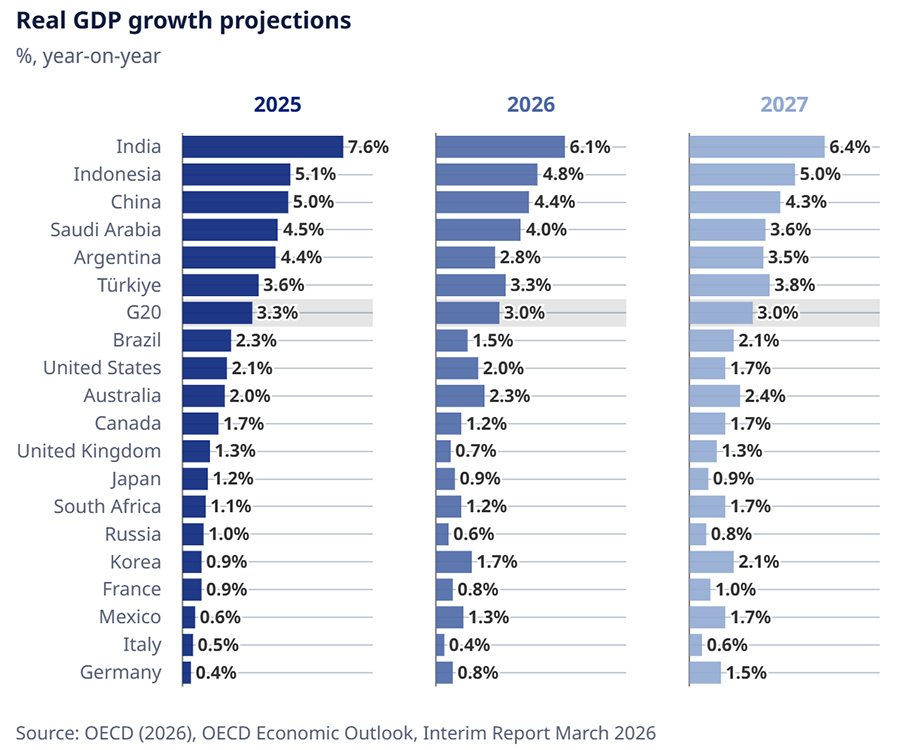
As a result of these developments, the Outlook projects global growth of 2.9 % in 2026 and 3.0 % in 2027. The evolution of the conflict in the Middle East is highly uncertain and poses considerable risks to these baseline projections. A more long-lasting disruption, with energy prices remaining elevated beyond mid-2026, would further reduce growth prospects.
GDP growth in the United States is projected at 2.0 % in 2026, before moderating to 1.7 % in 2027. In the euro area, growth is projected to be 0.8 % in 2026 and 1.2 % in 2027. China’s growth is projected to slow to 4.4 % in 2026 and 4.3 % in 2027.
Inflation pressures will persist for a longer period, with inflation now expected to be higher in 2026 than previously projected, reflecting the surge in global energy prices. Headline inflation in G20 countries is projected to be 4.0 % in 2026, easing to 2.7 % in 2027.
(Photo: OECD)
“The energy supply shock from the evolving conflict in the Middle East is testing the resilience of the global economy. We project global growth will remain robust, but it will be slower than the pre-conflict trajectory, with significantly higher inflation,” OECD Secretary-General Mathias Cormann said. “Any policy measures adopted to cushion the impact of the energy price shock should be targeted towards those most in need, temporary, and ensure incentives to save energy are preserved. Increasing renewable energy generation and energy efficiency can enhance economic security while boosting resilience to future price shocks.”
The Outlook highlights a range of risks. The expected decline in future energy prices is based on assumptions that current disruptions to supply will ease over time, and be limited in 2027. Longer-lasting closure of oil and gas production facilities in the region or persistent disruptions to exports through the Strait of Hormuz would likely have more significant adverse consequences on energy prices, inflation expectations and future growth.
The Outlook points out that higher energy and fertiliser prices could spur increases in food prices, particularly affecting vulnerable households. Higher energy prices could also increase the cost for European countries carrying out necessary annual replenishing of natural gas stocks. Financial markets may experience additional volatility while rising long-term sovereign yields increase fiscal risks.
Given these challenges, the Outlook highlights key priorities for policymakers. Central banks should remain vigilant and ensure expectations are well-anchored. Stronger efforts are needed to safeguard the sustainability of public finances. Any measures to cushion the economic impact of the energy shock will need to be targeted, temporary and take into account limited fiscal space facing most governments. Lowering trade barriers would boost output and reduce inflationary risks. Over the medium term, improving energy efficiency and reducing dependency on fossil fuel imports can lower exposure to future supply shocks.
Tetra Pak has won the Microsoft Intelligent Manufacturing Award (MIMA) 2026 in the Scale! category for its next-generation automation and digital portfolio, Tetra Pak® Factory OS™. The Scale! award recognises intelligent industrial solutions leading the way in the breadth of value chains, clients or internal processes they impact, across different levels of maturity.
Tetra Pak® Factory OS™ is a suite of modular, open and scalable smart factory technologies designed for food and beverage production. By unifying automation, data and analytics into a consistent, factorywide operating environment, it connects equipment regardless of age or supplier, transforming fragmented factory data into a unified, contextualised, real-time view.
The judges recognised Tetra Pak® Factory OS™ for its ability to help food and beverage producers expand output, introduce new products more quickly and reduce production costs in an increasingly challenging geopolitical and economic environment. As rising food prices and input costs place pressure on food producers, the platform enables food and beverage producers to improve efficiency and strengthen operational resilience while safeguarding product quality.
Deployable across sites with varying levels of digital maturity, Tetra Pak® Factory OS™ strengthens operational performance, accelerates digital transformation at scale and opens new growth opportunities by bringing coherence, repeatability and intelligence to endtoend factory operations. Built with security-by-design and layered defences to protect operations and data amid today’s heightened geopolitical cyber risk, it provides an AI-ready foundation that turns real-time data into contextualised insights for faster, smarter decisions.
The Microsoft Intelligent Manufacturing Award (MIMA) recognises innovative industrial solutions that drive measurable impact through intelligent manufacturing technologies. Granted by Microsoft and Roland Berger, the award followed a competitive evaluation process. Tetra Pak was shortlisted and presented its solution to an independent jury before being named winner in the Scale! category. Tetra Pak® Factory OS™ will be formally recognised at Hannover Messe on 22 April 2026.
A refreshing cold-pressed juice joins Suja’s Loves line, and a vibrant new wellness shot delivers prebiotics and probiotics to support gut health.
Suja Organic, a leader in organic cold-pressed juices and wellness shots in the US, announced the launch of two new innovations: Watermelon Love Cold-Pressed Juice, the newest addition to its fan-favourite Loves cold-pressed juice lineup, and Digestion Goldenberry Wellness Shot. Designed to meet ever-growing consumer interest in functional, organic beverages, both products highlight dynamic and thoughtfully selected ingredients that complement Suja’s existing portfolio.
Watermelon Love expands Suja’s Loves line-up – refreshing, cold-pressed juices known for craveable fruit flavours and functional ingredients. Alongside existing flavours Lemon Love, Ginger Love and Turmeric Love, Watermelon Love delivers a refreshing blend of watermelon, strawberry, dragonfruit and lemon with added probiotics. The 12-ounce cold-pressed juice contains 1 billion CFUs of probiotics per bottle, just 25 calories and no added sugar. An excellent source of antioxidant vitamin C, Watermelon Love offers a bright, sweet flavour profile that brings a bright new twist to the Loves family.
Joining Suja’s popular wellness shot lineup, Digestion Goldenberry is a bold new flavour featuring goldenberry, pear and ginger with probiotics and prebiotic fiber to support gut health. Lightly fruity with a subtle tartness, the shot is an excellent source of vitamin C. Goldenberry introduces a brand-new flavour to the wellness shot category and it is poised to be a hot new flavour trend, reinforcing Suja’s commitment to innovation within functional beverages.
Like all Suja Organic products, both new offerings are USDA Organic, Non-GMO Project Verified and made with plant-based ingredients. Suja’s cold-pressed juices and wellness shots are crafted using high-pressure processing (HPP) to help maintain quality and freshness.
Watermelon Love is available in the US at Kroger and Albertson’s, and Digestion Goldenberry is available in the US at Kroger.
Natalie’s Orchid Island Juice Company, part of the Perricone Farms family, announced the launch of its new Carrot Juice – a freshly handcrafted juice that joins the brand’s expanding lineup of premium, non-citrus offerings. The new carrot juice is now available in the US at all Wakefern/ShopRite locations across the Northeast and Mid-Atlantic.
Bottled in both 32 oz and 56 oz sizes, Natalie’s Carrot Juice is vegan, kosher, Non-GMO, and free from added sugars and artificial flavours. Crafted using a gourmet pasteurisation process, the juice preserves bright flavour and nutritional value while delivering the convenience and shelf stability trade partners and consumers expect.
“This launch is a direct result of listening to our retail partners and consumers,” said Ashley Sommer, VP of Marketing at Perricone Farms. “Customers told us they wanted a carrot juice with the ingredients and taste they trust from Natalie’s. Expanding beyond citrus into vegetable-forward offerings is a natural next step for the brand. And placing this product into Wakefern’s ShopRite doors makes it easy for shoppers to try and adopt it.”
Retail and foodservice buyers will find the product highly versatile: perfect for refreshing straight pours, mixer programs (mocktails and cocktails), and culinary applications ranging from glazes to soups and sauces. The juice’s clean profile also makes it an ideal ingredient for wellness programs and chef-driven menus that prioritize simple, traceable ingredients.
Natalie’s developed the carrot SKU in response to repeat retailer requests for a premium carrot juice that matches the brand’s high standards for sourcing and small-batch production. The new offering underscores the company’s strategic expansion into vegetable juices while maintaining the same farm-to-bottle care consumers expect.
Availability: Natalie’s 100 % Carrot Juice is currently available in the US at all Wakefern banners, including ShopRite, PriceRite, Brown, Village Supermarkets, Morton Williams and will appear in select additional grocery chains soon. The product is also available to purchase via natalies.com.
SIG announced a 24 % year-over-year sales growth in 2025 for its alu-layer-free aseptic cartons, that reduce the already low CO2 footprint of standard SIG packs even further. This milestone marks another leap forward in the company’s ambition to create a regenerative food packaging system.
The sustained growth proves the market’s appetite for low carbon, recycle-ready packaging. Notably, beverage producers can adopt full barrier aseptic cartons without aluminum, seamlessly compatible with existing SIG filling lines, allowing for swift sustainability upgrades with minimal operational adjustments and no extra capital expenditure.
SIG’s packs are among the most sustainable packaging solutions in each relevant market segment1 – and the company is innovating to reduce its environmental impact even further. The flagship SIG Terra portfolio exemplifies the company’s relentless pursuit of sustainable innovation. This includes pioneering packaging materials without aluminum layers, polymers linked to forest-based and recycled feedstocks2, and next-generation recycle-ready bag-in-box and spouted pouch solutions.
Since launching the SIG Terra portfolio, SIG has delivered enough SIG Terra solutions across its portfolio of aseptic cartons, bag-in-box, and spouted pouches to fill around 7 billion liters of food, including almost 2 billion liters in 2025 alone. Double-digit growth in alu-layer-free aseptic cartons was driven by an expanded SIG Terra product range in Europe and the global ramp-up of the SIG Terra Alu-free + Full barrier packaging material, marking a major milestone in sustainable innovation.
MJF Beverage Partnership shared that Dilmah Craft Iced Tea has been recognised with a distinction in the Golden Innovations FMCG & Retail competition.
The awards distinguish the most ambitious and innovative products in the FMCG industry – those that inspire the market and set new directions. The winners were chosen by genuine consumers, giving the awards the credibility of real-world brand recognition.
Distributed in Poland by Gourmet Foods Polska, Dilmah Craft Iced Tea in Lychee Black Tea flavour was recognised in the ‘Tea-Based Drinks’ category, confirming that the quality, authenticity and unique flavour of Dilmah Iced Tea are the perfect recipe for market success.
The soft sweetness of the regal lychee fruit, with its aromatic and succulent nature, is delicious paired with fragrant, black Ceylon tea. Popular for its refreshing taste, the lychee flavour market is experiencing significant growth, driven by consumer trends and demand for exotic, floral, and sweet-tart profiles in premium, health-conscious, and functional beverage products.
Delicious poured over ice, blended into cocktails, or enjoyed on-the-go, Dilmah Craft Iced Tea is refreshing, chilled, natural and delicious, containing all the goodness of Ceylon tea. It is made using single-origin Ceylon Tea leaves, handpicked in the tea gardens of Sri Lanka, then brewed and perfected on-site to maintain freshness, flavour and antioxidants.
Danone announced it has entered into a definitive agreement to acquire Huel, a leading player in complete, nutritionally balanced meal solutions.
In line with its Renew Danone strategy, the acquisition will enhance Danone’s presence in functional nutrition and extend its portfolio into the fast-growing Complete Nutrition space. Huel’s complementary range, spanning various food forms including ready-to-drink and powders, is supported by best-in-class digital execution, strong digital direct-to-consumer sales and a fan-base in the UK, Europe and the US.
Combining Huel with Danone’s scale, capabilities and global reach will accelerate growth, innovation and international expansion. Huel’s mission to make nutritionally complete, convenient, sustainable food, aligns closely with Danone’s purpose of bringing health through food to as many people as possible.
The transaction remains subject to customary closing conditions, including regulatory approvals.
Culture Pop Soda is officially bringing a fresh take to one of the most nostalgic drinks of all time: lemonade. Marking the brand’s first lemonade flavour, the functional beverage leader is introducing Sparkling Raspberry Lemonade. This debut represents a strategic pivot for the category, offering a sophisticated alternative to the traditional ultra-sweet profiles that have long defined it. Staying true to its mission of using simple ingredients that people recognise, Culture Pop delivers a slightly sweet, tart and complex flavour experience without refined sugars or the “weird” aftertaste of artificial and high-intensity sweeteners like stevia and monk fruit.
Unlike traditional lemonades that often rely on a syrupy-sweet profile, Culture Pop’s Sparkling Raspberry Lemonade offers a refreshing, nuanced taste. Sweetened only with organic fruit juices from concentrate, never refined sugar or artificial sweeteners and paired with organic herbs, spices and a live probiotic, the brand has crafted a drink that tastes real and skips the sugar crash. The result is a sophisticated carbonated lemonade designed for a modern palate, one that hits the not-too-sweet spot while supporting gut health through billions of live probiotics.
This new permanent flavour follows the brand’s “refreshingly real” blueprint, delivering vibrant raspberry flavour layered with tart lemon brightness and a crisp finish. Founded in 2020 by beverage industry veteran Tom First (co-founder of Nantucket Nectars), Culture Pop is on a mission to bring soda back to its roots: crafted, refreshing and made with simple ingredients you can feel good about.
Building on a successful strategic collaboration launched in 2025, Döhler Australia has signed an agreement to acquire Ezy Chef, a Melbourne-based provider of high-quality culinary solutions. The acquisition combines Ezy Chef’s advanced culinary development and strong customer partnerships with Döhler’s global innovation platform and comprehensive portfolio of natural ingredients, strengthening support for customers across Australia and New Zealand. Customers will benefit from enhanced local manufacturing capabilities and a broader portfolio, especially culinary solutions.
Strengthening culinary xxpertise and customer solutions
Ezy Chef has built a strong reputation for delivering high-quality food solutions and customised product development. In addition to its expertise in customised sauces and ready-to-eat formats, the company is also known for specialised texture-modified food solutions that support healthcare and aged care nutrition.
Through the acquisition, Döhler Australia will significantly expand its capabilities in savoury applications, ready-to-eat formats and customised culinary offerings – complementing its expertise in natural ingredients and all-in-one food and beverage solutions.
“This acquisition marks an important step in strengthening our presence in Australia and New Zealand,” said Peter Gates, Managing Director at Döhler ANZ. “Ezy Chef has built an excellent reputation for culinary expertise and close customer collaboration. By combining these strengths with Döhler’s global capabilities, we are creating new opportunities to innovate and deliver even greater value to our customers across the region.”
Expanding local manufacturing capabilities
The integration also strengthens Döhler’s manufacturing footprint in Australia. As part of the transition, planning will begin to consolidate the current Heidelberg operations into Ezy Chef’s Broadmeadows facility, creating a more efficient and scalable production environment designed to support future growth and customer demand.
Döhler is scheduled to formally assume ownership on 1 April 2026. Following completion, the teams will focus on integration activities and planned investments at the Broadmeadows facility, further enhancing manufacturing capabilities and supporting future innovation in savoury and culinary solutions. With manufacturing locations in both northern and southern Australia, the strengthened footprint will improve supply flexibility and enable closer collaboration with customers throughout the region.
Peer-reviewed study finds fibre may boost focus potentially involving the gut-microbiome
Tate & Lyle PLC, a global leader in ingredient solutions for healthier food and beverages, welcomes the publication of a new peer-reviewed study from the University of Illinois Urbana-Champaign, which sheds light on how soluble corn fibre may support cognitive function.
Through a randomised placebo-controlled crossover trial involving healthy middle-aged and older adults, researchers found that daily intake of soluble corn fibre significantly improved focus, while also boosting gut bacteria in ways that may support brain function.
Researchers set out to test whether soluble dietary fibre, already known to support gastrointestinal and physical health, could also improve cognitive performance by changing the gut microbiota, an emerging area of research. The study specifically evaluated the effects of soluble corn fibre on cognitive performance, gut microbiota composition, and the substances those bacteria produce, with the aim of identifying changes in the gut environment affecting cognitive function.
Over a four-week period, forty-two participants consumed soluble corn fibre daily and carried out tests to measure their memory and ability to focus attention. Researchers found that soluble corn fibre consumption led to selectively improved response times during tests compared with the control and increased the abundance of Parabacteroides. Parabacteroides are bacteria that have been linked to possible anti-inflammatory effects, gut barrier protection, and gut derived compounds that could be relevant to gut-brain communication and health outcomes [1].
Dr. David A. Alvarado, lead researcher, University of Illinois Urbana-Champaign, said: “Soluble fibre is well known for supporting gut and overall physical health, but we are still learning how specific fibres might influence the brain. In our study, consuming soluble corn fibre significantly improved how quickly participants responded during tests of attention and inhibitory control, without sacrificing accuracy. We also saw consistent shifts in the gut microbiota, including increases in Parabacteroides distasonis, a microbe that is well suited to break down this fibre. The extent of the cognitive improvement varied with the magnitude of change in Parabacteroides. These findings point to a gut microbiome signal that may partly help explain how soluble corn fibre supports aspects of brain-related performance.”
Dr. Clare Leonard, VP Nutrition and Health Sciences, Tate & Lyle, said: “There is so much potential for better health outcomes through targeted feeding of the gut microbiota. Fibre is the greatest underutilised resource in our diets. We are seeing studies linking the gut-heart axis, gut-brain axis, and so much more. What’s so wonderful is the solution isn’t an exclusive or expensive supplement but an affordable ingredient that consumers and the industry can easily build into everyday diets: soluble corn fibre. Increasing intakes could be a major unlock for public health.”
Abigail Storms, VP Sweeteners and Fibres, Tate & Lyle, said: ”The science of the gut–brain axis is advancing rapidly, and this study is a powerful example of how nutrition can support cognitive outcomes in ways consumers increasingly care about. Our market insights show strong demand for benefits like focus and stress support, but also a disconnect: people are seeking these outcomes while the industry is still in the early stages of clearly explaining how fibre, prebiotics, and probiotics really work. Evidence that soluble corn fibre can improve focus and positively shift gut bacteria helps bridge that gap, reinforces how everyday ingredients can play a meaningful role in wellbeing. With fibre intakes globally well below recommended levels, connecting this kind of science to consumer-friendly benefits is an important step toward motivating the higher fibre consumption we know is needed.”
The peer-reviewed study has been published in The Journal of Nutrition and was part-funded by Tate & Lyle. The soluble corn fibre used in the study was Tate & Lyle’s PROMITOR® Soluble Fibre.
The European Food Safety Authority (EFSA) releases positive feedback on the risk assessment for Givaudan’s Everzure® Galdieria, a vibrant natural alternative to the synthetic Brilliant Blue FCF (E133) colour.
Givaudan Sense Colour is announced that the European Food Safety Authority (EFSA) has shared its scientific opinion, declaring the safety of blue galdieria extract for use as a food colour additive. Next, Everzure® Galdieria will go to the European Commission to determine final authorisation.
Everzure® Galdieria, is a natural colour additive made from Galdieria sulphuraria. Developed in collaboration with French biotech company Fermentalg, this novel phycocyanin blue is fermented and extracted from microalgae using patented processes. It offers a similar shade to spirulina, with complete traceability. And its acid stability broadens the scope of application and use beyond where spirulina can be used.
“We welcome this long-awaited news that Galdieria has received positive feedback following a thorough and intensive assessment,” says Barry Foley, regulatory director for Givaudan Sense Colour. ”This milestone reflects Givaudan’s ongoing commitment to supporting the regulatory pathways that bring these natural alternatives to market. We conducted rigorous testing of galdieria blue extract in food and beverage applications to support this assessment and take us one step closer to approval of galdieria as a colour additive in the EU.”
Leveraging Fermentalg’s expertise in blue biotechnology and precision fermentation, Everzure® Galdieria is sustainably produced via the controlled fermentation of the microalgae Galdieria sulphuraria, followed by a gentle water extraction. The proprietary process ensures consistent quality, efficient resource use, and scalable production—hallmarks of its leadership in algae-based innovation.
“Once it is fully approved by the European Commission, manufacturers will finally be able to achieve vibrant blues, greens, and purples in acidic applications like beverages and confections that were previously unattainable with spirulina. And its close colour match to Brilliant Blue will allow customers to create novel and exciting food experiences without compromising on naturalness,” says Nathalie Pauleau, global product manager for Givaudan Sense Colour.
Everzure® Galdieria is currently approved for use and is available for sampling in the US.
The global fruit and vegetable supply chain will gather at Macfrut (21-23 April, Rimini Expo Centre). The 43rd edition is packed with new features: the Caribbean as the international partner, 800 top buyers, 10 Regions of Italy present and Sicily as the Partner Region, the global Mango and Avocado supply chain, Themed Exhibitions and around 100 events.
The global fruit and vegetable supply chain will gather at Macfrut, which will take place from Tuesday, 21 April to Thursday, 23 April 2026 at the Rimini Expo Centre. This three-day event brings together industry professionals to explore business opportunities and discover the latest innovations and trends in a key Italian agribusiness sector, accounting for around a third of the country’s agricultural production and worth approximately €19 billion, with the entire supply chain generating around €60 billion.
The 43rd edition will be packed with new features, all under the slogan „Make it Juicy“, offering a „juicier“, trendier and more innovative event: Mangoes and Avocados are the key products at an event that brings together the entire global supply chain; an international focus on Caribbean countries, with strong representation from other continents (especially Europe and Africa); over 800 international top buyers; Sicily as the Partner Region with the participation of 10 Regions of Italy; Themed Exhibitions on industry trends coordinated by a team of experts; around 100 events, including high-profile conferences on current industry-related issues, in collaboration with the Macfrut Scientific Technical Committee (the New CAP, International Conference on Assisted Evolution Techniques, news on Healthy Food products, Mediterranean Stone Fruit Symposium, among others); two 2,500-square-metre test fields showcasing the latest fruit and vegetable products; and a Start-up area featuring 25 innovative proposals from around the world.
Presentation of the 43rd edition of Macfrut
The 43rd edition of Macfrut was presented at the Italian Trade Agency (ITA) in Rome by Francesco Lollobrigida – Minister of Agriculture, Food Sovereignty and Forests, Matteo Zoppas – President of ITA-Italian Trade Agency, Patrizio Neri – President of Cesena Fiera, Paolo De Castro – President of the Macfrut Scientific Technical Committee, Livio Proietti – President of ISMEA (Institute of Services for the Agricultural Food Market), Luca Sammartino – Regional Councillor for Agriculture of the Sicilian Region, Ugo Ferrero – Head of Institutional Affairs at AICS (Italian Agency for Development Cooperation), and Rafael A. Lantigua Ciriaco – Ambassador of the Dominican Republic to Italy.
Fruit and vegetables, a strategic asset of Made in Italy: rising exports and consumption
Fruit and vegetables take centre stage at Macfrut. The sector is worth around €19 billion in Italy, accounting for 27% of the national agricultural production and, together with vegetable preserves, 18% of Italy’s agri-food exports (source: ISMEA).
Italian fruit and vegetable exports rose by 11.3% in 2025 (from January to November), reaching a total value of €7 billion (source: Italian Trade Agency). Essentially, around one-third of Italy’s products are exported worldwide. Italy is the third-largest exporter in Europe, following Spain and the Netherlands. Interestingly, the five main target markets for Italian fruit and vegetables are all experiencing significant growth: Germany (2.1 billion), France (722 million), Austria (476 million), Switzerland (397 million) and Spain (319 million).
According to data from Nomisma, Italy accounts for 17 % of the total value of fruit and vegetables produced in the EU, making it the second-largest producer of vegetables (including processing tomatoes) and the second-largest producer of fruit (including dried fruit) on the continent.
ISMEA data shows that vegetable sales are performing well in the fruit and vegetable sector. Total purchased volumes have increased by 2.6%, while expenditure on fruit has risen by 2.7 %.
Specifically, the fresh produce sector has shown significant growth in the vegetable category, with modest increases in the volume of fresh vegetables (+3.5 %) and potatoes (+5.1 %) sold. Purchases of fresh-cut vegetables remain stable (with expenditure increasing by 0.4 % and volumes decreasing by 0.1%), as are those of frozen vegetables (with expenditure increasing by 0.2 % and volumes remaining stable). The volume of tomato preserves has increased slightly (+1.4 %), while expenditure has remained stable and prices have fallen slightly.
With regard to fruit, although juice sales have decreased (-6.5 %), consumption of fresh produce has shifted towards red fruits and tropical fruits, as well as nuts. The sales volume of nuts has increased (+2.6 %), along with kiwifruit (+7.2 %), strawberries (+8.9 %), blueberries (+25.9 %), mangoes (+36.4 %), avocados (+47 %) and pomegranates (+25 %). The consumption of packaged organic fresh fruit is also on the rise, with respective increases in quantity and expenditure of 1.8 % and 7 %.
Macfrut, a global supply chain trade fair
The one trait that sets Macfrut apart is its international outlook, achieved through a year-round programme of presentations around the world and extensive incoming buyer activities organised in collaboration with the Italian Trade Agency. This edition has an international focus on Caribbean countries, which are one of the world’s most dynamic regions, with exports worth over $30 billion. The Dominican Republic is a key player in this focus area, with a stand that has doubled in size since last year (400 square metres), featuring producers and exporters of tropical fruit, as well as institutions and supply chain operators. Cuba, Costa Rica, Colombia and Ecuador will also be present. Representing South America, Chile and Argentina have confirmed their attendance, while Brazil and Peru will be making their debut at the trade fair with their own national stand and a delegation of producers, as well as some of the most dynamic companies in Latin America’s fruit and vegetable industry.
Once again, a significant number of African countries will participate, including 20 from Sub-Saharan Africa, who are primarily interested in acquiring the know-how and technologies for which Italy is world-renowned.
Thanks to the invaluable support of the Italian Trade Agency, more than 800 top buyers from all over the world will attend the trade fair, with a special focus on leading European fruit and vegetable importers, selected through targeted scouting by Macfrut.
Macfrut, the premier showcase for the Italian supply chain
What sets this edition apart is a collaborative process involving all industry stakeholders, which has resulted in a shared vision of Macfrut as the premier showcase for the Italian fruit and vegetable sector. It has earned this status thanks to its ability to bring together all the major players in production, technology and packaging, as well as the three main modern retail chains in the fresh produce segment (Conad, Coop Italia and VèGè Group), and leading companies from every link in the Italian supply chain, which is unique worldwide.
Many Regions of Italy will be in attendance, having chosen Macfrut as the platform for showcasing their exceptional products, including PDO and PGI products. As many as 10 Regions will have their own stand at Macfrut 2026, representing leading national fruit and vegetable companies: Basilicata, Calabria, Campania, Emilia-Romagna, Lazio, Piedmont, Apulia, Sardinia, Sicily and Umbria.
The 43rd edition of the trade fair will feature Sicily as the Partner Region. With over 263,000 hectares dedicated to the cultivation of fruit and vegetables (22% of the national total) and a production of 4.6 million tonnes (19% of Italy’s total fruit and vegetable production), Sicily is a jewel in the country’s crown. Its achievements include being the leading region for organic production, with around 47,000 hectares cultivated, equivalent to around a quarter of the national total. It ranks first in Italy in terms of production value, accounting for around €3 billion (16% of the national total), largely thanks to its excellent PDO and PGI products. Sicilian produce will be given centre stage at the three-day event, where it will be thoroughly discussed and presented to an international audience as part of a wide-ranging programme of activities.
Spotlight on avocados and mangoes
The key products of Macfrut 2026 will be in the spotlight at a global event, ‘Mango and Avocado Explosion’, which will bring together the entire supply chain, from production and marketing to the analysis of agronomic data, market trends, development opportunities and real-world case studies from leading global companies (Brazil, Colombia, the Netherlands, Egypt, India, Peru, Italy, Kenya and the Dominican Republic). This event is an opportunity to explore business opportunities, make new connections, enter into business agreements, and meet top buyers of two products that are gaining prominence in the global market and generating over $80 billion worth of business.
Themed Exhibitions
Themed Exhibitions, coordinated by leading sector experts, confirm Macfrut’s status as a ‘knowledge fair’. In addition to the exhibition and trade areas, each Themed Exhibition will feature a rich programme of conferences on strategic industry topics, offering a broad range of insights: Acqua Campus, dedicated to innovative water-saving systems; Plant Nursery, showcasing the latest nursery innovations (Workshop on Assisted Evolution Techniques, new varieties, rootstocks and genome); Biosolutions & Digital Technologies, dedicated to natural plant protection, nutrition and biostimulation products (international kiwi conference, technical round tables, incoming buyers); Berry Area, dedicated to the world of berries (new varieties and the relationship with large-scale retailers); Healthy Food Area, focusing on minimally processed health-promoting products (the organic product supply chain, fresh-cut produce, Mangoes and Avocados); Spices & Herbs Global Expo, dedicated to the world of medicinal plants, spices and herbal products (focus on the future of spices and medicinal herbs, Tisana Day and Herbal Factory); and Agrisolar, a dedicated showcase for agrivoltaic technologies. There will also be a Start-up area showcasing 25 innovative proposals from around the globe (Finland, Germany, Ghana, Poland, Uganda, the USA and Italy). Visitors to the Pre-Harvest area will have the opportunity to take a look at the latest innovations in fruit and vegetable cultivation in two test fields covering 2,500 square metres.
The three-day trade fair will host around 100 events, including high-profile conferences on current industry-related issues, organised in collaboration with the Macfrut Scientific Technical Committee. Scheduled events include: the New CAP, International Conference on Assisted Evolution Techniques, news on Healthy Food products, Mediterranean Stone Fruit Symposium, among others.
Macfrut 2026 – Rimini Expo Centre: Tuesday 21 and Wednesday 22 April (9.30 am – 6 pm), Thursday 23 April (9.30 am – 5 pm).
Tilray Brands, Inc., a leading global lifestyle and consumer packaged goods company at the forefront of the beverage, cannabis and wellness industries, announced the completion of the acquisition of BrewDog Brewing Australia Pty Ltd., including BrewDog’s Australian brewing and production facility in Brisbane, Queensland, along with a portfolio of owned and franchised BrewDog bars across Australia.
Irwin D. Simon, Chairman and Chief Executive Officer, Tilray Brands, stated, “The acquisition of BrewDog’s profitable Australian brewery operations and flagship bars represents another important milestone in advancing Tilray’s global beverage and consumer products strategy. Australia is a highly attractive craft beer market with a strong beer culture and serves as a strategic gateway to the rapidly growing Asia-Pacific region. Together with our recently announced acquisition of BrewDog’s profitable UK operations, this transaction further expands Tilray’s international brewing footprint and strengthens our scaled global beverage platform. BrewDog’s brewing capabilities, production infrastructure, and hospitality locations in Australia provide a strong operational base to invest in the brand’s next chapter, while also creating a strategic hub to introduce Tilray’s portfolio of leading U.S. beverage brands across the Asia-Pacific region.”
The acquisition includes two owned BrewDog bar locations in Brisbane — DogTap Brisbane and BrewDog Fortitude Valley, as well as three franchised BrewDog locations in Pentridge (Victoria), South Eveleigh (New South Wales), and Perth (Western Australia).
Rajnish Ohri, President, International, Tilray Brands, said, “We’re excited to welcome the BrewDog Australia team to Tilray Brands. They bring strong brewing expertise, experienced local leadership, and a deep connection to the Australian craft beer community. From an operational standpoint, this acquisition gives us a strong foundation in a key market and an important hub for our international beverage and consumer products business. Together with the BrewDog team, we will focus on growing the brand locally while leveraging our brewing, distribution, and commercial capabilities to expand BrewDog across Australia’s national retail chain footprint and introduce Tilray’s broader beverage portfolio across Australia and the Asia-Pacific region, including key markets such as Japan.”
This transaction strengthens Tilray’s global beverage and consumer products platform and advances our strategy to scale internationally. Australia provides a strategic hub to accelerate expansion across the Asia-Pacific region, allowing Tilray to capitalise on the growth of premium and craft beer while introducing its leading U.S. beverage brands into key markets throughout the region.
Premium cold-pressed juice and smoothie brand continues to innovate with on-trend sea moss gel ingredient, now in the wellness shot category
Arden’s Garden, a premium cold-pressed juice and wellness company in the US with 30-year roots in metro Atlanta, announced the launch of its newest wellness shot, Sea Moss Energy™. The new product expands on Arden’s Garden’s category-leading offering of sea moss gel products, including its best-selling Tropical Sea Moss Smoothie introduced in 2025.
Crafted with a combination of fruit juices and gel made from St Lucia Sea Moss, this low-calorie shot gives you the sustained energy and gut-friendly nutrients your body craves, naturally. Sea Moss Energy™ combines the familiar flavours of pineapple, passion fruit, and lemon with the mineral-rich nourishment of sea moss and smooth lift of green tea that doesn’t produce the crash of coffee. Each 2-ounce shot has just 40 calories and 106 milligrams of caffeine.
Arden’s Garden Sea Moss Energy™ retails for $2.99 per 2oz. shot and is available at all Publix locations.
About Arden’s Garden Arden’s Garden is a leader in cold-pressed juices, smoothies, functional shots, and better-for-you foods in the US. Founded in 1995 in Atlanta, Georgia by Arden Zinn, Arden’s Garden began with a vision to bring health and wellness to the Atlanta community through nutritious and accessible options. Over the last 30 years, what began with a single kitchen juicer has grown into a second-generation, woman-owned company with 19 brick-and-mortar neighborhood locations and an expanding retail presence across the Eastern United States and beyond. Rooted in juice and built with purpose, Arden’s Garden is proud to be a WBENC-certified business, Non-GMO Project Verified, and Kosher certified. Arden’s Garden products can be found in more than 3,000 retailers, corner cafés, and community markets including Publix, Whole Foods, Kroger, Roundy’s, Sprouts, and more.
Brazilian shipments of orange juice to the European Union increased in January, which raised expectations for further increases in following months. However, sales to the EU declined again in February, somewhat discouraging market participants. Although exports to the United States remain firm, demand from Europe still needs to increase to support shipments.
Up to the 2023/24 season, exports to all destinations typically surpassed 1 million tons. In the 2024/25 crop, however, shipments totaled 775.6 thousand tons, 22.7 % less than in 2023/24.
In the accumulated of the 2025/26 season (from July/25 to February/26), Brazilian shipments of concentrate orange juice (66° brix) were at 549.96 thousand tons, considering data converted into FCOJ, downing 3.8 % compared to that recorded in 2024/25. The income, in turn, was at USD 1.885 billion in the first eight months of the season, for a decrease of 27.1 % in the same comparison – data from Secex.
OJ exports to the European Union amounted 250.2 thousand tons from July/25 to February/26, decreasing 55.7 thousand tons in relation to that verified in the same period of the season before. In February alone, Brazil shipped 24.5 thousand tons to the EU, against 49.8 thousand tons in January. Brazil would have to export 35.5 thousand tons per month until the end of the season (over the next four months) to reach the volume shipped to the EU last crop (392.1 thousand tons).
Shipments to the United States amounted 256.1 thousand tons between July and February, 23 % more than that verified in the same period of the crop before.
Spokesperson: Winnie Muheling, Director of Marketing & Communications at Pro Carton
Winnie Muheling (Photo: ProCarton)
Global Recycling Day is an opportunity to recognise how recycling powers circularity in practice – closing the loop between production, consumption, and regeneration. The latest Pro Carton European Consumer Packaging Perceptions Survey, released this month, confirms that consumers increasingly view “ease of recycling” as the number one priority when it comes to sustainable packaging, and, by extension, of brand trust.
Our 2026 research found that more than one in three Europeans have switched brands due to packaging concerns (37 %), while ease of recycling has become the top packaging requirement for 64 % of Europeans. This clear signal shows how packaging has moved from being a functional protection to a driver of product value, perception, and loyalty.
What’s especially encouraging is that consumers are backing up their expectations with action. Almost six in ten Europeans (59 %) say they are recycling more household waste, while 62 % believe recycling is one of the most effective ways to combat climate change.
Fibre-based materials such as cartonboard have become a clear favourite and now command 87 % consumer trust when it comes to successful recycling – more than any other material – and 84 % of Europeans say they would prefer cartonboard over plastic when given the choice.
Even in a cost-of-living context, where affordability remains an important factor in purchasing decisions, sustainability and recyclability are still key priorities. This alignment between environmental values and economic realities shows how important circular solutions are for today’s consumer. As we celebrate Global Recycling Day, one message stands out: accelerating circularity depends on collective trust – in materials, systems, and the brands that help make recycling work for people and the planet.
Global, National and Emerging brands and retailers in Europe, North America and Australia, publishes the Annual Report 2025 of Pegasus MidCo B.V., the entity that owns Refresco Holding B.V.
2025 marked the Rfresco’s 25th anniversary – a milestone year defined by strong operational delivery, continued category expansion and ongoing investment in its global footprint. Throughout the year, the company advanced its strategy with focus and resilience, further strengthening the position as a leading independent beverage solutions provider. With motivated teams and a clear direction, Refresco continue building a business designed for sustainable, long term growth.
The Annual Report, consisting of the Executive Board Report and the Financial Statements, is available for download on Refresco’s website: https://annualreport.refresco.com/
New research reveals that 100 % orange juice provides a slower, more controlled rise in blood sugars than sugar sweetened drinks, challenging assumptions that all sugary drinks lead to similar blood sugar “spikes”.
The randomised controlled cross-over trial, published in the peer-reviewed journal Food & Function, involved 25 healthy young men who consumed four different drinks on separate days: 100 % orange juice, a 50 % orange juice drink with added sugars, a sugar-sweetened water drink and a pure glucose drink.
Researchers observed that, while pure orange juice and sugar-sweetened drinks can have the same overall sugar content, the body processes natural and added sugars differently thanks to the food structure.
100 % orange juice produced a slower rise – and lower “spike” – in blood sugars compared with the sugar-sweetened drinks – which were matched exactly to the balance of sugars in natural orange juice. While the rise and fall in blood sugars eventually evened out over two hours, the natural sugars from orange juice entered the bloodstream more gradually. This steadier absorption may help explain why some people experience a gradual feeling of energy after drinking 100 % orange juice, compared with the sharper “spike and dip” sometimes associated with sugar sweetened drinks.
Scientists think the difference comes down to structure. While soft drinks generally deliver sugar in isolation, 100 % orange juice contains what is known as a “fruit matrix” — the natural mix of tiny fibre fragments, plant bioactives, vitamins and minerals found in oranges and other whole fruit. This structure appears to moderate how quickly sugar enters the bloodstream.
Lead researcher, Professor Francisco A. Tomás-Barberán, of the Spanish National Research Council (CSIC), explained: “People often assume that because fruit juice contains natural sugars from the fruit, it must act in the same way as a sugary soft drink. Our findings clearly show this is not the case. “When sugars are consumed within the natural fruit matrix of 100 % orange juice, absorption is slower and the early blood glucose peak is lower. Food structure matters. “Although public health guidance often groups all “free sugars” together, our study demonstrates that sugars naturally present in fruit juice do not produce the same metabolic response as exactly the same sugars added to drinks.”
The concept of blood sugar spikes has become a hot topic, with influencers and some health commentators urging people to avoid rapid glucose rises.
Award-winning dietitian Dr. Carrie Ruxton commented: “People are now so worried about ‘sugar spikes’ that some are using wearable technologies, like glucose monitors, to test their reaction to different foods and drinks. While I don’t think this is helpful unless recommended by a doctor, it’s reassuring to know that 100 % orange juice is better for blood glucose control than other types of sweet drinks. “Even with the same overall sugars, the natural fruit matrix of 100 % orange juice slows down absorption creating a more gradual rise in blood glucose levels. That could mean more sustained energy levels after your morning glass juice. The fruit matrix in 100 % juices also delivers vitamin C for immune function and skin, potassium for blood pressure and a range of fruit bioactives for mental function and cardiovascular health”.
The open-access study is available to view in full.
The Recycling Alliance for Small Aluminium Packaging has officially been launched to improve the recycling performance of such packaging across Europe. It was named “re-alu” and a dedicated branding has been developed for better recognition. The website “re-alu.org” is also online as well as it own LinkedIn presence.
Established under the umbrella of AMS Europe e.V., re-alu brings together companies from across the aluminium packaging value chain with a clear objective: to increase the recycling rate of small aluminium packaging in Europe to at least 55 % by 2035 aligned with the requirements of the EU Packaging and Packaging Waste Regulation (PPWR).
While aluminium beverage cans already achieve high recycling rates, small aluminium packaging – including coffee capsules, confectionery foils, cheese wraps, dairy lids and small containers – is still not consistently captured and sorted across Europe. Although modern sorting facilities are capable of recovering these items, collection and sorting systems are not yet sufficiently developed, leading to significant losses to residual waste and incineration.
The rollout of Deposit Return Schemes for beverage cans across Europe will significantly change aluminium flows in sorting facilities. As cans are increasingly collected separately, small aluminium packaging will represent a larger share of aluminium volumes in sorting plants. This shift offers a strategic opportunity to optimise existing infrastructure and improve capture rates for small formats at scale.
re-alu provides a structured platform for collaboration, innovation and joint action. The initiative will focus on improving sorting performance, supporting recyclability-by-design in line with PPWR criteria, and promoting fair and proportionate treatment of small aluminium packaging within Extended Producer Responsibility (EPR) schemes. A key activity in 2026 will be the update of a technical study on optimal sorting models for aluminium packaging, assessing economic feasibility and implementation pathways across different plant sizes and national contexts to demonstrate to stakeholders the return on investment of sorting small aluminium packaging.
With re-alu, industry stakeholders are moving from ambition to implementation. The platform is open to additional participants from across the value chain who wish to contribute to a coordinated European effort to ensure that small aluminium packaging is effectively recycled in practice and remains a sustainable solution within a circular economy.
Spindrift Beverage Co., Inc., a beverage brand made with real squeezed fruit, launched Spindrift® Tea, a line of non-carbonated iced teas made with real brewed tea and real squeezed fruit. The launch extends Spindrift’s commitment to beverages made without ultra-processed shortcuts, and as the only beverage brand with the full portfolio verified under the Non-Ultraprocessed Food (Non-UPF) Standard.
While tea is one of the most consumed beverages in the world, much of the ready-to-drink aisle remains driven by sugars and non-sugar sweeteners, while products with real squeezed fruit account for less than 1 % of the category. By pairing real brewed tea and fruit, Spindrift sets a new standard for ready-to-drink tea delivering brighter flavour and a naturally balanced, easy-to-enjoy alternative to traditional sweet tea.
Spindrift Tea, the first release from the brand’s Ventures Lab, is the result of three years of development and brings together custom-brewed black and green tea blends with fruit sourced from trusted growing regions and long-standing farm partners:
Lemon Black Tea – brewed black tea with California lemon juice and crisp apple
Blood Orange Black Tea – black tea layered with vibrant blood orange and citrus notes
Raspberry Black Tea – black tea blended with Pacific Northwest raspberries
Peach Green Tea – green tea with sun-ripened Pacific Northwest peaches
To achieve the right balance between the tea and fruit, Spindrift partnered with one of North America’s largest leaf tea importers to develop custom black and green tea blends sourced from 16 global origins, including China, India, Indonesia, and Argentina. The proprietary blends were designed specifically to complement real fruit ensuring both ingredients shine in every sip. Select flavours include a small amount of organic agave for a naturally ‘slightly sweet’ taste.
Spindrift Tea is now available on Amazon and Drinkspindrift.com and launches in select retailers in the US beginning March 2026, with expanded distribution throughout the year. The line will be available in 12oz cans in 6-packs and variety packs.
About Spindrift Beverage Co. Spindrift Beverage Co., Inc. is challenging people’s expectations of how good a beverage can be. Founded in 2010 on the belief that the best tastes come directly from nature, Spindrift is the only sparkling water in America made with real squeezed fruit. Real fruit tastes better®, that is the Spindrift difference. Every Spindrift product is crafted to celebrate the aroma, texture, and taste of real squeezed fruit — never from concentrate — in every sip. Spindrift® Sparkling Water is available in the US, and Spindrift® Soda and Spindrift® Tea are available in select retailers and online. The company donates to environmental not-for-profits through membership in 1 % For the Planet. Spindrift is headquartered in Newton, Mass (USA).
Tieton Cider Works – the farmer-grown, farmer-made cidery recently recognised by Nielsen as the eighth fastest-growing cider brand in the U.S., announced its newest year-round release: Tieton Dry Apple Cider.
Crafted for cider purists and food lovers alike, Tieton Dry Apple Cider delivers a crisp, clean, and refreshingly bone-dry profile. At 6.9 % AB, the latest varietal is the driest packaged cider in Tieton’s lineup, showcasing bright orchard-fresh apple character, balanced natural acidity, subtle tannins, and a clean, lingering finish.
Launching immediately in Washington, Oregon, Idaho, Montana and Northern California, the cider is available in 6/12oz cans, 4/16oz cans and draft.
Rapidly growing family-owned brand expands tea and lemonade portfolios with new flavour innovations, and entry into fruit punch category
Milo’s Tea Company, Inc., the third-generation, family-owned maker of beverages crafted with real, high-quality ingredients, is accelerating its rapid growth with the launch of three new refrigerated beverages. The lineup includes a Zero Sugar Lemonade and Limited Edition flavour Blackberry Sweet Tea, while also marking a major milestone as Milo’s enters a new beverage category with the introduction of Fruit Punch.
By bringing its fresh, real-ingredient standards to categories traditionally dominated by shelf-stable, artificial options, Milo’s is creating new choices for individuals and families seeking fresh-tasting beverages they can feel good about serving.
Classic favourites, reimagined with real ingredients
Milo’s Fruit Punch: Reinventing a classic family favourite the Milo’s way, Fruit Punch is made fresh with high-quality, real, 100 % natural ingredients. With no preservatives or artificial colours, it delivers a delicious, balanced fruity blend designed for sharing while unlocking new potential within the $1.5B U.S. Fruit Punch category2 as consumers seek better-for-you twists on nostalgic favourites.
Milo’s Zero Sugar Lemonade: Inspired by one of the brand’s most-requested products on social media and the success of Milo’s Zero Sugar Sweet Tea, Milo’s Zero Sugar Lemonade expands the zero sugar lineup to offer more choice for consumers seeking great taste without sugar. Crafted to deliver the bright, refreshing taste of homemade lemonade, the new offering contains no sugar, preservatives, or added acids.
Milo’s Limited Edition Blackberry Sweet Tea: Building on the strength of Milo’s Famous Sweet Tea, the #1 selling refrigerated tea in the U.S.1, the brand introduces a new limited edition offering, Blackberry Sweet Tea. Available through May 2026, this seasonal variety blends fresh-brewed Milo’s classic sweet tea with natural blackberry flavour for a smooth, fruit-forward twist made with real ingredients and no preservatives.
Milo’s Fruit Punch, Milo’s Zero Sugar Lemonade, and Milo’s Limited Edition Blackberry Sweet Tea are now available at 2,500+ Walmart stores in the US, with additional availability at select regional grocery retailers. All three are available in gallon sizes with suggested retail prices starting at $4.26 depending on retailer. Fruit Punch is also available in half gallon sizes, while Zero Sugar Lemonade is available in half gallon and 20 oz. single serve, with prices starting at $1.75 depending on size and retailer.
1Nielsen, 52-Week ending in 12/27/25 2Nielsen, Total Fruit Punch Total US xAOC + Conv L52W ending 12/27/25
Market summary
According to the Growth Market Report by Growth Market Reports, the global fruit beverages market size reached USD 156.4 billion in 2024, registering a robust growth trajectory. The market is expected to advance at a CAGR of 5.7 % from 2025 to 2033, propelled by shifting consumer preferences and the rising demand for healthier drink alternatives. By 2033, the fruit beverages market is forecasted to achieve a value of USD 256.4 billion. This sustained expansion is primarily driven by increased health consciousness, innovation in flavours and packaging, and expanding distribution networks.
Introduction: beyond just a refreshment
The global fruit beverages market is no longer confined to simple orange juice cartons or seasonal mango drinks. It has evolved into a dynamic ecosystem of nutrition, lifestyle branding, technology, and sustainability. Today’s fruit beverage is not just about taste – it represents health aspirations, convenience culture, and environmental responsibility.
From street vendors in tropical countries to premium cold-pressed juice bars in metropolitan cities, fruit beverages have become a universal language of refreshment. This article explores how this market is transforming and what makes it one of the most resilient segments in the global food and beverage industry.
Understanding the fruit beverages market
What qualifies as a fruit beverage?
Fruit beverages include a broad spectrum of products derived from fruits, either fully or partially. These include:
100 % fruit juices
Fruit nectars
Juice concentrates
Fruit-based carbonated drinks
Smoothies
Ready-to-drink (RTD) fruit blends
Functional fruit beverages enriched with vitamins, minerals, or probiotics
The diversity of product types allows companies to cater to various income groups, taste preferences, and health expectations worldwide.
Global demand drivers
Health consciousness is reshaping consumption
Consumers globally are becoming more ingredient-aware. Artificial flavours and synthetic sweeteners are losing favour. Instead, shoppers are checking labels for:
“No added sugar”
“Not from concentrate”
“Cold-pressed”
“Organic certified”
Fruit beverages are perceived as natural sources of vitamins, antioxidants, and hydration. Even in developing economies, awareness of nutrition is influencing purchasing decisions.
Urbanisation and on-the-go lifestyles
Fast-paced urban lifestyles have increased demand for convenient nutrition. Single-serve packs, resealable bottles, and portable cartons have gained popularity. Busy professionals and students prefer grab-and-go options that combine taste with energy and hydration.
Rising middle-class spending power
In emerging economies across Asia, Africa, and Latin America, rising disposable incomes are driving demand for premium fruit beverages. Consumers are experimenting with exotic fruit blends such as pomegranate-blueberry or dragon fruit-mango combinations.
Market segmentation insights
By product type
100 % Juices: Premium positioning, often associated with purity and wellness.
Nectars and Juice Drinks: More affordable options, appealing to price-sensitive consumers.
Functional Fruit Beverages: Enriched with immunity boosters, probiotics, or plant-based proteins. This segment is witnessing rapid growth globally.
By distribution channel
Supermarkets and hypermarkets
Convenience stores
Online retail platforms
Foodservice and hospitality
Direct-to-consumer (DTC) subscription models
E-commerce has particularly boosted niche and organic brands, allowing smaller players to compete with multinational corporations.
Innovation: the heart of market expansion
1. Cold-pressed technology
Cold-pressed juices preserve nutrients by avoiding heat pasteurisation. Though premium priced, they attract health-focused consumers willing to pay more for perceived benefits.
2. Plant-based and hybrid blends
Fruit beverages are increasingly blended with plant-based ingredients such as oat milk, almond milk, and coconut water. These hybrids appeal to vegan and lactose-intolerant consumers.
3. Functional fortification
Brands are adding:
Vitamin C for immunity
Collagen for skin health
Adaptogens for stress relief
Electrolytes for hydration
This crossover between fruit beverages and nutraceuticals is blurring traditional market boundaries.
Sustainability: a competitive differentiator
Environmental consciousness is influencing purchasing decisions globally. Companies are focusing on:
Recyclable packaging
Reduced plastic usage
Carbon-neutral production
Ethical fruit sourcing
Sustainable farming partnerships and transparent supply chains are becoming strong brand positioning tools.
Challenges facing the market
1. Sugar Content Concerns
Even natural fruit sugars are under scrutiny. Governments worldwide are imposing sugar taxes and labeling regulations, pushing manufacturers to reformulate products.
2. Supply chain volatility
Climate change affects fruit yields, causing price fluctuations. Weather unpredictability directly impacts raw material availability.
3. Competition from alternative beverages
Energy drinks, flavoured waters, kombucha, and plant-based protein drinks compete for shelf space and consumer attention.
Emerging trends to watch
Personalised nutrition
Customised fruit beverages based on age, fitness goals, or dietary preferences are gaining traction. Subscription-based personalised juice programs are expanding in urban markets.
Local and exotic fusion flavours
Global consumers are experimenting with international fruit flavours such as lychee, guava, passion fruit, and acai. Cross-cultural blends are increasing product differentiation.
Smart packaging
QR codes that provide traceability information about fruit origin, farming practices, and nutritional benefits are enhancing consumer engagement.
Competitive landscape
PepsiCo, Inc.
The Coca-Cola Company
Nestlé S.A.
Tropicana Products, Inc.
Dr Pepper Snapple Group, Inc.
Del Monte Foods, Inc.
Parle Agro Pvt. Ltd.
Britvic plc
Ocean Spray Cranberries, Inc.
Suntory Holdings Limited
Dole Food Company, Inc.
The Kraft Heinz Company
Welch Foods Inc.
Refresco Group N.V.
Cott Corporation
Nongfu Spring Co., Ltd.
Asahi Group Holdings, Ltd.
Unilever PLC
Hershey’s (through its fruit beverage brands)
Minute Maid Company (a subsidiary of Coca-Cola)
Future outlook: a market with resilient growth
According to our Growth Market Report, The fruit beverages market is expected to maintain steady global growth driven by health awareness, product innovation, and expanding retail penetration. While regulatory pressures and climate challenges remain concerns, innovation in processing and packaging will support long-term sustainability.
Consumers are increasingly seeking beverages that align with their lifestyle values—health, convenience, authenticity, and environmental responsibility. Fruit beverages, with their natural appeal and adaptability, are uniquely positioned to meet these expectations.
Food & beverage (F&B) manufacturers are stepping up reformulation activity using rare sugars, such as allulose and tagatose, as consumer demand grows for lower-calorie, health-forward products that still deliver a familiar sugar-like taste. These next-generation sweeteners are gaining momentum because they can replicate key sensory and functional properties of sucrose while supporting reduced-calorie and low-glycemic positioning. This aligns with the findings of the 2025 Q4 global consumer survey*, in which 66 % consumers say that their food purchases are always or often influenced by a product’s impact on their health and wellbeing, according to GlobalData, a leading intelligence and productivity platform.
Sainul Abidin, Consumer Analyst at GlobalData, comments: “Rare sugars are moving from a niche ingredient to a mainstream reformulation tool because they help brands deliver on two priorities at once: sugar reduction and a close-to-sucrose experience. Unlike many high-intensity sweeteners, allulose and tagatose can support texture, mouthfeel, and other formulation requirements that are critical for consumer acceptance.”
The shift to rare sugars is underpinned by a broad-based rise in health-led decision-making at the shelf. GlobalData’s 2025 Q4 global consumer survey findings reinforce the commercial rationale for brands to prioritise sugar reduction, metabolic health cues, and “better-for-you” reformulation strategies.
Regulatory developments are also encouraging wider adoption. In the US, allulose has received GRAS status and is treated differently from traditional sugars for labeling purposes, supporting product developers pursuing sugar-reduction claims. Similar approvals in other markets are broadening the addressable opportunity for manufacturers and ingredient suppliers.
Abidin adds: “Rapid advances in production technology are further accelerating uptake of rare sugars. Improvements in precision fermentation and enzymatic bioconversion are helping to lower costs and improve scalability, making rare sugars more feasible across mass-market applications such as beverages, snacks, and dairy – categories where both taste fidelity and cost-in-use are crucial.”
Beyond nutrition positioning, functionality is a key differentiator. Rare sugars can provide bulking and browning performance that is important in baking and confectionery, helping manufacturers maintain texture and appearance while reducing conventional sugar. Because performance can vary by ingredient and end use, companies are increasingly selecting between allulose and tagatose based on formulation goals such as sweetness intensity, stability, and browning behaviour.
Adoption is already visible across major consumer brands and ingredient supply chains. Brands including Quest Nutrition have used allulose in products such as protein bars to deliver sweetness with minimal blood glucose impact, while Magic Spoon has incorporated allulose to help replicate the taste and crunch profile expected in cereal. In dairy, Chobani has utilised allulose in its zero-sugar yogurt positioning to maintain a sweet, creamy profile.
On the confectionery side, The Hershey Company has signaled longer-term intent through investments aimed at scaling production of allulose and tagatose. Meanwhile, ASR Group – owner of major sugar brands – has partnered with rare sugar producers to bring tagatose into industrial channels, targeting applications such as chocolate and baked goods where browning performance is valued.
Ingredient manufacturers are also expanding portfolios to meet this demand. Suppliers such as Tate & Lyle and Ingredion have strengthened their allulose offerings for large-scale food and beverage customers, while capacity expansion in Asia-Pacific – supported by investments such as Samyang Corporation’s allulose production push – reflects the region’s fast-growing role in rare sugar enablement and supply.
Abidin concludes: “As consumers continue to scrutinise sugar content without compromising on taste, rare sugars will become an increasingly strategic lever for reformulation. Manufacturers that invest in scalable supply, smart sweetener systems, and application-specific formulation will be best positioned to compete in the next phase of better-for-you product innovation.”
*GlobalData 2025 Q4 global consumer survey was conducted with 22,613 respondents across 42 countries
FOODEX JAPAN 2026, the 51st international food and beverage exhibition, will take place from 10–13 March 2026 at Tokyo Big Sight. As one of Asia’s most established industry platforms, the event brings together beverage manufacturers, retail and private brand developers, foodservice operators and trading companies from across the region.
Japan remains one of the world’s most sophisticated beverage markets. While overall market growth is moderate, value creation is driven by premiumisation, hybrid concepts and health-conscious reformulation. At the same time, manufacturers face increasing raw material price volatility, weather-related crop instability, geopolitical supply risks and rising logistics costs. Stable sourcing models and long-term supply reliability have therefore become central strategic priorities.
Against this backdrop, Döhler will present its portfolio of juice concentrates, NFC juices, purées and integrated ingredient systems at stand S4-H33, demonstrating how global sourcing strength and application expertise translate into reliable, market-ready beverage solutions for Japanese customers.
Focus at FOODEX JAPAN 2026
At FOODEX, Döhler will highlight beverage concepts that reflect current category dynamics in Japan, including energy drinks, café-style frappe concepts, non-alcoholic beverage alternatives and hybrid combinations such as Coffee + Juice and Tea + Juice:
Energy Drink Concepts combine clean flavour profiles with balanced sweetness and stability optimisation, supporting both mainstream and functional positioning without compromising taste precision.
The Frappe Concept delivers rich mouthfeel and indulgent texture with reduced sugar, addressing the growing demand for café-style beverages in ready-to-drink and foodservice formats.
A Non-Alcoholic Beverage Concept demonstrates how aroma depth and flavour layering can create adult taste experiences without alcohol, meeting the continued trend towards alcohol-free consumption.
Hybrid developments such as Coffee + Juice and Tea + Juice highlight emerging cross-category opportunities. By harmonising fruit acidity with roasted coffee notes or enhancing tea with natural fruit sweetness, these concepts create distinctive yet balanced flavour profiles aligned with Japanese sensory expectations.
Ingredient systems for Japanese consumer expectations
Across all showcased applications, the emphasis lies on integrated solutions rather than single ingredients: combining premium raw materials with formulation expertise for stability, sugar optimisation and balanced flavour profiles. Each concept illustrates how global juice sourcing and technical application know-how can be adapted to Japanese taste expectations and manufacturing requirements.
All solutions are designed to support manufacturers in supply stability and diversified sourcing, efficient processing as well as accelerated and lower-risk new product development. “Japan’s beverage industry demands precision and reliability at every level – from sourcing to sensory performance,” says Zaihan Qiu, Country Managing Director, Döhler Japan. “At FOODEX JAPAN 2026, we are demonstrating how our global juice network and integrated ingredient systems support manufacturers in developing successful beverages.”
Wonder Juice™, an innovative leader in bold, nutrient-packed cold-pressed juices in the US, announced the launch of two exciting new Wonder Green flavours – Clean Green and Veg8 & Cayenne – expanding the brand’s growing portfolio of functional, flavour-forward juices designed to make everyday wellness delicious and accessible.
Developed for today’s health-minded consumer seeking both taste and performance, the new flavours bring fresh energy and versatility to the Wonder Juice lineup, offering options for daily detox support, sustained energy, and adventurous palates. The new Clean Green and Veg8 & Cayenne flavours are rolling out now at select retailers in the US and online at WonderJuice.com.
Clean Green
A crisp, refreshing green blend that delivers plant-powered nutrition with bright, approachable flavour. Clean Green is crafted for daily wellness routines, offering a smooth and revitalisng profile that supports cleansing and hydration. Key ingredients include: Kale, spinach, green apple, cucumber, lemon, ginger
Veg8 & Cayenne
Bold and invigorating, Veg8 & Cayenne layers hearty vegetables with a touch of spice for consumers who crave complex flavour and functional benefits. The cayenne adds gentle heat while complementing the natural sweetness of the vegetables. Key ingredients include: Carrot, beet, celery, cucumber, red pepper, tomato, cayenne, lemon.
About Wonder Juice Crafted with 100 % cold-pressed organic juices, Fair-Trade certified and non-GMO ingredients, and no added water or sugar, Wonder Juice™ redefines what it means to drink healthfully. Wonder Juice™ continues its mission to set a higher standard for sustainable, nutritious beverages – packaged exclusively in 100 % recyclable glass bottles. The Wonder Green Line joins the Wonder Juice collection, which features three unique lines – Wonder Beet, Wonder Melon, and Wonder Lemon – offering 11 vibrant varieties.
Prinova, a leading supplier of functional ingredients, blends, flavours, and contract manufacturing solutions, will exhibit at Natural Products Expo West from March 4–6 at the Anaheim Convention Center, Booth 3144.
At the show, Prinova will demonstrate its expertise in functional nutrition by showcasing great tasting, on-trend product concepts that combine flavour, functionality, and clean label appeal.
Consumer demand for functional products continues to rise, with taste remaining a decisive factor in purchase decisions. According to Innova Market Insights, three in five consumers are actively seeking to add more protein to their diets compared to last year¹, reinforcing the need for innovative protein formats that deliver both functionality and enjoyment. At the same time, format innovation remains critical, as 62 % of U.S. adults are either using or interested in using vitamin and mineral supplements in gummy form.²
At Expo West, Prinova will bring these trends to life with concepts designed to help brands meet evolving consumer expectations while accelerating product development.
Featured concepts at include:
Blueberry Tangerine Clear Pea Protein Beverage
This refreshing, plant-based beverage features Prinova’s Clear Pea Protein technology, delivering a clean, smooth, high-protein RTM drink. Naturally flavoured and naturally sweetened, the Blueberry Tangerine concept highlights a vibrant, fruit-forward profile paired with eye-catching natural colours. Designed to meet growing consumer demand for cleaner plant-protein formats, this concept showcases how brands can elevate protein beverages beyond traditional shakes with lighter, more approachable flavour experiences.
Orange Burst Gummy Multivitamin
This vibrant, orange burst flavoured gummy multivitamin features Prinova’s Multivitamin Market Ready Blend for Gummies, paired with natural flavours and natural sweeteners. Designed to simplify formulation while delivering standout taste and texture, the concept highlights Prinova’s ability to help brands rapidly capitalise on strong consumer interest in gummy vitamin and mineral supplements.
1Innova Market Insights, 2025 2Mintel, 2025
LEVL, a USDA Organic functional hydration brand focused on mind + body balance, announced that its full product lineup is now available in over 350 Target stores across the East Coast in the US. The launch represents a significant retail milestone for the brand as it continues to scale distribution beyond direct-to-consumer.
LEVL is positioned as an everyday wellness beverage that delivers clean hydration while also supporting recovery and mind + body balance. Unlike other hydration drinks that rely on processed electrolyte sources such as sodium chloride, LEVL uses all-natural electrolytes, including Aloe Vera, Nopal Cactus, and Pink Himalayan Salt. It also includes functional adaptogens Ashwagandha and Goji Berry to support recovery and mind + body balance.
Target stores will carry all three LEVL SKUs: Acai + Berry, Pineapple + Coconut, and Lemon + Lime. LEVL is USDA Organic, made with zero added sugar, and free from artificial additives and sweeteners, addressing the growing consumer demand for clean-label, functional beverages.
“LEVL was created to deliver a healthier, more intentional approach to hydration that supports mind + body balance in everyday life,” said Matthew Kemper, Founder of LEVL. “Launching in Target is a meaningful step for the brand and allows us to reach more consumers looking for USDA Organic beverages made with thoughtfully sourced, high-quality functional ingredients.”
The Target rollout builds on LEVL’s traction through its direct-to-consumer channel and an engaged wellness-focused consumer base seeking functional beverages without artificial additives.
BENEO, a leading manufacturer of functional ingredients for food and pharma, announced the appointment of Dr Uwe Boltersdorf as Chief Operating Officer (COO) of BENEO GmbH, effective from 1st February 2026.
Uwe Boltersdorf completed his doctorate at the Fraunhofer Institute for Environmental, Safety and Energy Technology UMSICHT in Oberhausen after studying chemical engineering at the University of Dortmund. He benefits from more than 20 years of international management experience in the areas of production, process development and engineering following previous roles at Bayer AG, Lanxess AG, thyssenkrupp AG and Sulzer AG.
On 1st April 2025, Uwe Boltersdorf was appointed to the Executive Board of BENEO’s sister company CropEnergies AG, a manufacturer of renewable products from biomass, where he took on the role of Chief Operating Officer. In addition to being BENEO’s new COO, he will continue his existing role at CropEnergies AG. In his position at BENEO, he will be responsible for Operations including production, technology, supply chain management, quality, raw material, health, safety and environmental protection, as well as sustainability.
As BENEO’s new COO, he is succeeding Dr Mike Eberle who took over the role of CEO of the Sugar Division of Südzucker Group at the end of October 2025.
The 2025/26 orange season is nearing its end in the citrus belt in São Paulo and Triângulo Mineiro. Players surveyed by Cepea report that the harvested volumes have already declined. As the season winds down, major processors still receiving fruits are concentrating operations in only a few processing units.
The most recent report by Fundecitrus, released in late January, indicated that only 13 % of the total volume estimated for the 2025/26 season was left to be harvested. It is likely that less than 5 % of the crop remains unharvested in late February.
The return of processing activities involving 2026/27 oranges is expected to take place between April and May.
As for prices, data from Cepea indicate that quotations of pear oranges delivered at the industry have averaged BRL 34.53 per 40.8-kilo box in February (up to Feb. 26), downing 7.69 % in relation to that in January.
Concerning in natura market, the supply of high-quality fruits has been decreasing. The demand, in turn, is still firm. In the partial of February, values of pear oranges have averaged BRL 41.40 per 40.8-kg box, on tree, for a decrease of 2.87 % against the first month of 2026.
As the 2025/26 season is close to the end, the sector is now focusing on weather conditions and its consequent impacts on the development of the 2026/27 crop.
EMEA non-alcoholic beverage sponsorship is heavily concentrated in soccer, reflecting its unmatched, year-round audience scale and strong conversion potential that make it the sector’s primary driver of value. Soccer accounted for more than three times the value of the next-largest sport, motor racing in 2025, reveals GlobalData, a leading intelligence and productivity platform.
GlobalData’s latest report, “Sponsorship Sector Report – Non-Alcoholic Beverages – EMEA 2025,” reveals that despite motor racing only accounting for 14 deals across the region, the sport’s average deal value is $7.4 million, considerably higher than soccer’s $0.92 million.
Energy drink brands within the sector, including Red Bull and Monster Energy, command the highest average value across the region. In 2025, Europe leads EMEA in deal volume and value due to its mature market, deep sports culture, and concentration of major multinational brands.
Olivia Snooks, Sport Analyst at GlobalData, comments: “Unlike soccer, where sponsorship opportunities are fragmented across hundreds of clubs, leagues, and tiers, creating a long tail of smaller, locally priced agreements, top-level motor racing, namely Formula 1, is concentrated in a small number of global properties, meaning a limited supply of top-tier assets and stronger pricing power per deal. F1’s association with performance, technology, precision, and endurance provides a credible narrative for product claims around energy, hydration, and recovery, enabling differentiated storytelling that is harder to execute in other sports.”
Red Bull is the region’s biggest non-alcoholic sports sponsor, investing $205.74 million, which is more than double Coca-Cola’s spending. With just 38 deals versus Coca-Cola’s 120, Red Bull is prioritising fewer, higher value partnerships over a high-volume strategy. This results in a higher average spend per deal, indicating a focus on marquee properties and premium rights that deliver maximum visibility and strong brand association with elite properties.
Snooks continues: “This strategy aligns with Red Bull’s global marketing position at the intersection of high energy sport, exclusivity, and youth culture. This premium strategy boosts impact in key EMEA markets, strengthening Red Bull’s aspirational lifestyle positioning and supporting stronger return of investment through a smaller number of deals.”
The UEFA Champions League partnership with PepsiCo offers the widest and most consistent international reach. It delivers prime-time audiences, strong digital distribution, and multiple activation opportunities throughout a long tournament. This explains why UEFA-linked rights command some of the largest fees, as sponsors are buying scale, brand safety, and repeatable visibility in high-stakes matches that regularly capture attention.
Snooks Concludes: “A key trend in the biggest deals is Red Bull’s prominence across multiple entries, reflecting a highly non-traditional approach. It effectively buys and operates the teams themselves in several cases. Rather than backing one flagship partnership, it invests across soccer and motorsport teams and individual stars like Max Verstappen, creating a consistent narrative around elite performance, and youth culture.”
A recent study by Symrise across Europe, Africa and the Middle East reveals how generation alpha shapes choices of food and beverages. By combining in-depth qualitative and broad quantitative research, Symrise helps customers to accelerate advantage and delivers a comprehensive and unique understanding of the youngest consumers’ preferences, behaviours, and influence on family decisions. These insights empower brands to anticipate emerging trends, create products that truly resonate, and build lasting connections with 2 billion adolescents shaping the markets of tomorrow.
A new generation brings fresh opportunities for innovation. Symrise’s EAME Food & Beverage Business Unit explores generation alpha’s eating and drinking behaviours, recognising their growing influence on household purchases and future market trends. Customers gain a head start in developing products that resonate with the youngest consumers and their families.
Two-phase study unlocking next-gen needs
The study features two distinct research approaches. In the qualitative phase, Symrise conducted video ethnography with 24 participants across four countries. Insights from UK, Poland, Egypt, and Saudi Arabia captured real-life perspectives on how Gen Alpha shapes family food and drink choices. “The video ethnography delivers valuable insights by allowing us to experience Generation Alpha’s influence and preferences firsthand,” says Micaela Kraft, SCI Project Leader EAME.
The quantitative phase surveyed 2,618 participants including children aged 6 to 14 and their parents across 11 countries. Covering UK, Spain, France, Germany, Poland, Turkey, Saudi Arabia, Egypt, Nigeria, South Africa, Pakistan, this dual approach reveals how Generation Alpha’s tastes, values, and digital habits differ from previous generations. “Generation Alpha increasingly values exploring new food experiences. Our research shows that 64 % of participants enjoy trying cuisines from other countries,” explains Micaela. “These insights enable us to help our customers create concepts that appeal to both children and parents.”
Comprehensive overview over multiple generations
Symrise’s generational framework now extends from baby boomers to generation alpha, offering a comprehensive view of evolving consumer needs. The Generation Alpha persona “Tala” developed by Symrise for instance shows how strongly children are already shaping purchasing decisions today: The 9-year-old girl from Saudi Arabia discovers new tastes via social media, prefers international cuisine and at the same time expects products that combine enjoyment and health.
These findings in conjunction with Symvision AI™ give rise to validated product ideas: At Gulfood Manufacturing 2025, for example, Symrise combined popcorn with coconut water and pineapple flavour (“Poptail Bliss”) – a snack concept with Nutri-Score A that combines fun for children and functional added value for parents. These results empower partners to co-create innovative food and beverage concepts, ensuring relevance and appeal in a rapidly changing market. On top, the findings highlight the cohort’s strong sway over family shopping, their openness to new flavours, and their desire for experiences that blend fun, health, and sustainability.
“Generation Alpha fascinates us with their curiosity, creativity, and influence on family choices. Exploring their world has given us fresh perspectives and valuable insights. By understanding their preferences today, we help our customers create products that win hearts and taste buds tomorrow,” says Lisa Wilks, Marketing Director F&B EAME, Symrise.
Outlook
The findings from the study will enable Symrise to continually anticipate consumer trends at an early stage in the future. In this way, it can reliably support partners in the development of products that contribute to the wishes and brand preferences of Generation Alpha today and tomorrow.
Jumex announced that its functional hydration beverage, Hydrolit +Advance, has been recognised as a 2026 Product of the Year USA Award Winner in the Hydration category, as voted on by 40,000 American shoppers in the US in partnership with Kantar. Renowned as a globally established seal of approval, Product of the Year is the largest consumer-voted awards program centered around product innovation.
Jumex created Hydrolit +Advance to meet the growing consumer demand for a high-performance hydration beverage that goes beyond basic rehydration. Unlike many mainstream sports drinks, Hydrolit +Advance includes choline to support cognitive performance and mental focus. The enhanced formulation positions Hydrolit +Advance within the fast-growing functional hydration segment, offering retailers a differentiated option in a competitive set.
Hydrolit +Advance contains five essential ions, including sodium, calcium, potassium, magnesium, and zinc, to restore hydration balance, B Vitamins (B3, B6, B12) to support energy metabolism and overall wellness, and natural caffeine to provide clean, focused energy without a heavy crash. Available in four flavours, including Mango, Fruit Punch, Orange, and Berries, Hydrolit +Advance combines flavour-forward innovation with functional credibility. It is designed to replenish what the body loses through sweat, stress, and everyday activity, supporting active lifestyles, busy schedules, and daily hydration needs.
You need to load content from reCAPTCHA to submit the form. Please note that doing so will share data with third-party providers.
You are currently viewing a placeholder content from Turnstile. To access the actual content, click the button below. Please note that doing so will share data with third-party providers.